More like Archenemies
anchored on:superheroour worldnear futureyoung adultscience fictionidentity+4 more
but
- Renegades (Marissa Meyer)
series3 books2017
similar byidentitysuperherotensescience fictionnear futureyoung adultbig cityour world+2 more
Renegades is set in Gatlon City after a civil war between the superheroic Renegades and the villainous Anarchists, and follows Nova, a young woman with the power to put people to sleep by touch, as she infiltrates the Renegades as a spy for her uncle's Anarchists and falls for Adrian, the adopted son of the Renegades' leaders. Marissa Meyer's trilogy, continuing through Archenemies and Supernova, plays the two factions' history against the leads' divided loyalties; Meyer has said she doesn't plan to extend the series further.
- Snow Crash
Neal Stephensonstandalone novel1992
similar bypolitical intriguenear futureadventuroustensescience fictionbig city
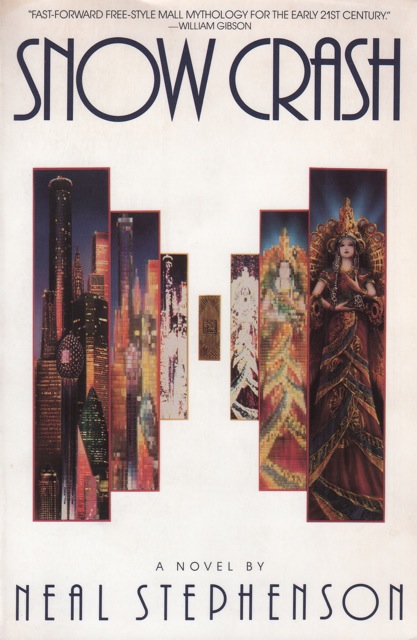
Snow Crash is a 1992 science fiction novel by Neal Stephenson. Like many of Stephenson's novels, its themes include history, linguistics, anthropology, archaeology, religion, computer science, politics, cryptography, memetics, and philosophy.
- Friday
Robert A. Heinleinstandalone novel1982
similar byidentitynear futureadventuroustensescience fiction+1 more
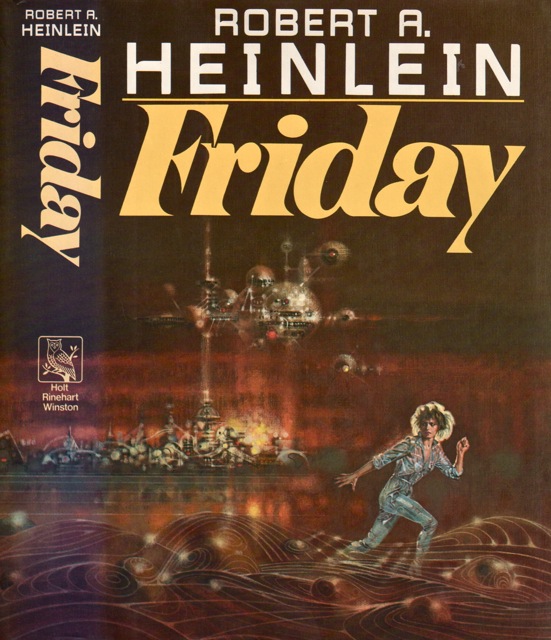
Friday is a 1982 science fiction novel by American writer Robert A. Heinlein. It is the story of a female "artificial person", the eponymous Friday, genetically engineered to be stronger, faster, smarter, and generally better than normal humans. Artificial humans are widely resented, and much of the story deals with Friday's struggle both against prejudice and to conceal her enhanced attributes from other humans. The story is set in a Balkanized 21st century, in which the nations of the North American continent have been split up into a number of smaller states.
- Blade Runner Universe
series6 books1968
similar bynear futureidentityscience fictionbig city+3 more
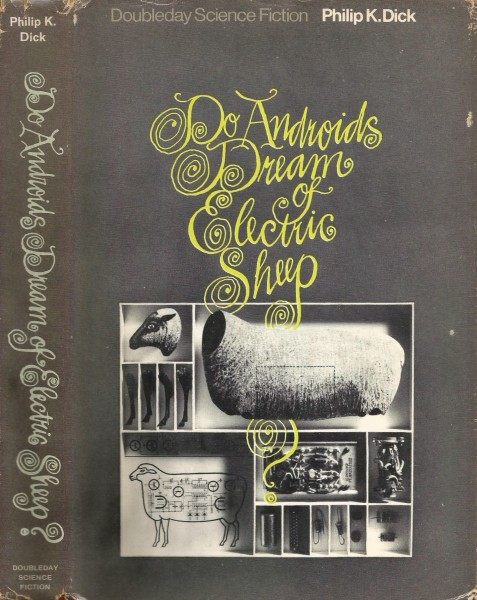
Philip K. Dick's 1968 novel Do Androids Dream of Electric Sheep? follows bounty hunter Rick Deckard as he tracks escaped androids through an irradiated, near-abandoned San Francisco, using the hunt to probe questions of empathy and what separates human from machine. The novel became the basis for Ridley Scott's 1982 film Blade Runner, and Marvel Comics later published an illustrated adaptation of that film. Together the two trace the story's path from prose original to screen and comic-page adaptation.
- The Oracle Year
Charles Soulestandalone novel2018
similar byidentitypolitical intriguenear futuretensescience fictionour worldbig city
Awakening from a dream with more than one hundred predictions about the future in his head, an unassuming Manhattan bassist becomes one of the world's most powerful men and hides his identity behind an online persona that is targeted by greedy corporations and dangerous enemies.
- Divergent
series10 books2011
similar byidentitynear futuretensescience fictionyoung adultbig city
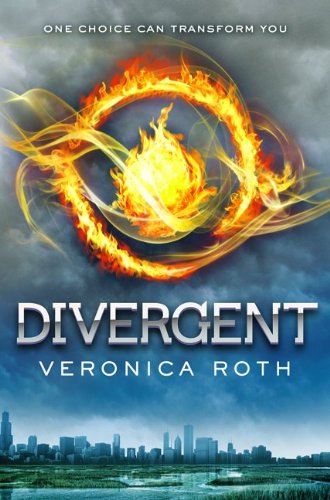
Divergent, also known as The Divergent Series, is a series of young adult dystopian novels by American novelist Veronica Roth set in a post-apocalyptic dystopian Chicago. The trilogy consists of Divergent (2011), Insurgent (2012), and Allegiant (2013). A related book, Four (2014), presents a series of short stories told from the perspective of one of the trilogy's characters, the male love interest Tobias. A later short story, We Can Be Mended (2018), serves as an epilogue five years after the events of the trilogy, again from Tobias/Four's perspective.
- Podkayne of Mars
Robert A. Heinleinstandalone novel1963
similar bypolitical intriguenear futureadventurousscience fictionyoung adult
From the back cover of the Baen 1995 edition: "Meet Podkayne Fries, a thoroughly modern Martian Ms. who thinks that Earth is not really fit for habitation and that humanity evolved in the now-exploded Fifth Planet. Poddy has one goal in life, to be the first female starship captain. She has her strategy all scoped out, and with her determination, looks and I.Q. she'll get there, never you doubt! But all work and no play would make Poddy a Dull Girl, so when a chance comes her way to travel to distant Earth via Venus with her elderly uncle, Poddy jumps at it, even if it does mean having her loathsome little brother along for the trip: Travel, Adventure, the chance to cuddle up (in a nice way) with real spaceship officers and ruthlessly pump their brains - she'll have it all. What Poddy doesn't know is that "Unca Tom" is more than her warmly supportive relative: he is also the Ambassador Plenipotentiary from Mars to the Three Planets Conference (travelling not quite incognito enough) and that certain people will stop at nothing to gain control of his vote - including kidnapping and doing terrible things to sweetly innocent Poddy Fries..."
- Reckoners
series6 books2013
similar bynear futuresuperheroadventuroustensescience fictionyoung adult+2 more
The Reckoners is a series of young adult superhero novels written by American author Brandon Sanderson. The series consists of Steelheart (2013), Firefight (2015), Calamity (2016) and Lux (2021). The series depicts a post-apocalyptic world in which the appearance of an orbiting cosmic phenomenon known as Calamity has given random people superhuman powers in apparent defiance of known physical laws, turning them into "Epics". These Epics prey upon or enslave the rest of humanity, causing the collapse of traditional governments. One young man orphaned by a High Epic joins a group that is killing Epics.
- Double Star
Robert A. Heinleinstandalone novel1956
similar byidentitypolitical intrigueadventurousscience fiction+1 more
Lorenzo Smythe, the excellent yet unemployed actor, meets Dak Broadbent in a bar. Broadbent hires Lorenzo for an unspecified role, and hustles him onto a rocket ship. Broadbent turns out to be an assistant to the famous interplanetary politician and leader of the Expansionist party: John J. Bonforte. Bonforte, however, has been kidnapped by the political opposition on Mars, and due to Lorenzo's physical similarity to Bonforte, his staff wants Lorenzo to impersonate the politician for an important Martian ceremony.
- Imperial Galaxy
series2 books2012
similar byidentitypolitical intrigueadventurousscience fictionyoung adult+1 more
Prince Khemri has spent his life as one of ten thousand princes bred and trained by a sprawling galactic empire, expecting eventual rule -- until he learns just how disposable princes actually are, and how routinely they're assassinated by their own siblings. Garth Nix's A Confusion of Princes follows Khemri through the empire's ruthless military, its secret intelligence service, and a deadly, decades-long competition to determine who might one day take the throne. It's a single, self-contained space opera rather than an ongoing series.
- Shadrach in the Furnace
Robert Silverbergstandalone novel1976
similar byidentitynear futurescience fictionour world+2 more
Shadrach in the Furnace is a science fiction novel by American writer Robert Silverberg, first published as a serial in Analog Science Fiction and Fact magazine in the August, September, and October 1976 issues. It was subsequently published by Bobbs Merrill in 1976. The novel was nominated in 1976 for the Nebula Award, and in 1977 for the Hugo Award.
- Cas Russell / Russell's Attic
series5 books2014
similar byidentitytenseadventurousscience fictionnear futureour world+1 more
- The Children of Men
P. D. Jamesstandalone novel1992
similar bypolitical intriguenear futuretensescience fictionour world
"The human race has become infertile, and under the despotic rule of Xan Lyppiatt, the Warden of England the old are despairing and the young cruel. Theo Faren, a cousin of the Warden, lives a solitary life in this ominous atmosphere. That is, until a chance encounter with a young woman leads him into contact with a group of dissenters. Suddenly his life is changed irrevocably, as he faces agonising choices which could affect the future of mankind." (pdjames.co.uk)
- The Host
Stephenie Meyerstandalone novel2008
similar byidentitynear futuretensescience fictionour world
The earth has been invaded by a species that take over the minds of their human hosts while leaving their bodies intact, and most of humanity has succumbed. But Melanie Stryder refuses to fade away. Wanderer, the invading "soul" who has been given Melanie's body, knew about the challenges of living inside a human: the overwhelming emotions, the too vivid memories. But there was one difficulty Wanderer didn't expect: the former tenant of her body refusing to relinquish possession of her mind. Melanie fills Wanderer's thoughts with visions of the man Melanie loves--Jared, a human who still lives in hiding. Unable to separate herself from her body's desires, Wanderer yearns for a man she's never met. As outside forces make Wanderer and Melanie unwilling allies, they set off to search for the man they both love.--From publisher description.
- Have Space Suit - Will Travel
Robert A. Heinleinstandalone novel1958
similar bynear futureadventuroustensescience fictionyoung adult
From the back cover of the Del Rey 9th printing: "Skyjacked - Everything happened at once. One minute Kip Russell was walking about in his own backyard, testing out an old space suit and dreaming about going to the moon - and the next he was out cold and the captive of an insidious space pirate. The whole thing seemed like a very bad dream until he discovered he wasn't the only prisoner on board. Then the reality of the situation became inescapable. He - along with the daughter of a world-renowned scientist and a beautiful creature from an alien planet - had been skyjacked by a monstrous extraterrestrial and they were on their way to the Moon... a journey toward a fate worse than death!"
- Tripods
series4 books1967
completed
similar bytensenear futurescience fictionour worldyoung adult+1 more
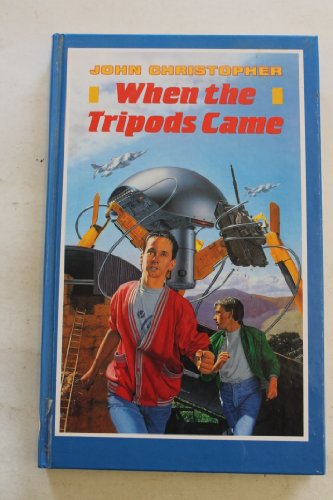
The Tripods is a series of young adult science fiction novels by John Christopher. The series takes place in a post-apocalyptic world where humanity is enslaved by "Tripods"—gigantic three-legged walking machines piloted by an alien race later identified as the "Masters". The first two books were the basis of a science fiction TV series, produced in the United Kingdom in the 1980s.
- Islands in the Net
Bruce Sterlingstandalone novel1988
similar bypolitical intriguenear futuretensescience fictionour world
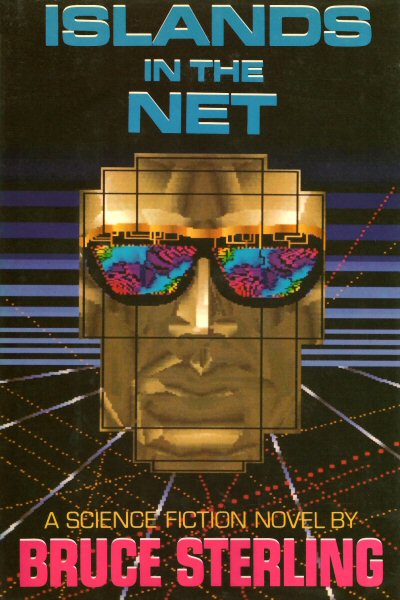
Islands in the Net is a 1988 science fiction novel by American writer Bruce Sterling. It won the John W. Campbell Memorial Award for Best Science Fiction Novel in 1989, and was nominated for both the Hugo and Locus Awards that same year. It offers a view of an early 21st century world, apparently peaceful, with delocalised, networking corporations. The protagonist, swept up in events beyond her control, finds herself in places that are off the net, from a datahaven in Grenada, to a Singapore under terrorist attack, to the poorest and most disaster-struck parts of Africa.
- Flashforward
Robert J. Sawyerstandalone novel1999
similar byidentitynear futuretensescience fictionour world
Flashforward is a science fiction novel by Canadian author Robert J. Sawyer first published in 1999. The novel is set in 2009. At CERN, the Large Hadron Collider accelerator is performing a run to search for the Higgs boson. The experiment has a unique side effect; the entire human race loses their consciousness for about two minutes. During that time, nearly everyone sees themselves roughly twenty-one years and six months in the future. Each individual experiences the future through the senses of their future self. This "flashforward" results in countless deaths and accidents involving vehicles, aircraft, and any other device needing human control at the time of the experiment. The novel was adapted into the 2009 television series FlashForward.
- Termination Shock
Neal Stephensonstandalone novel2021
similar bypolitical intriguenear futuretensescience fictionour world
Termination Shock is a science fiction novel by American writer Neal Stephenson, published in 2021. The book is set in a near-future when climate change has significantly altered human society and follows the attempts of a solar geoengineering scheme. The novel focuses on the geopolitical and social consequences of the rogue fix for climate change, themes common in the growing climate fiction genre.
- Mother of Storms
John Barnesstandalone novel1994
similar bypolitical intriguenear futuretensescience fictionour world
From the flaps of the Tor first edition: "It is 2028. A strike to destroy an illegal Arctic weapons cache has a catastrophic side effect. Massive amounts of energy are liberated from the polar ice, suddenly warming the Earth's climate. In the middle of the Pacific, a gigantic hurricane thousands of miles across is forming, larger than any in human history. A storm with winds of supersonic speed. A storm that changes direction at whim. A storm that refuses to die. A storm so vast it spawns dozens more in its wake... Blinded by intrigue, expedience, and greed, the world's politicians and power brokers have ignored the killer storms threat until it is too late. Already the death toll is in the tens of millions, as it savages the Pacific coast, while its devil's brood of smaller storms are wreaking havoc across the face of the planet. While the survivors scramble for advantage, a handful of courageous men and women undertake a daring, desperate plan to save humanity from total destruction - a plan so visionary it may alter forever the future of the human race."
- Pastworld
Ian Beckstandalone novel2009
similar byidentitynear futuretensescience fictionyoung adultbig city
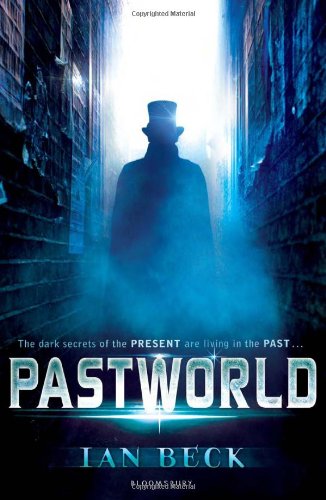
What if all of London were really an amusement park—a whole city returned to Victorian times to entertain visitors from the twenty-first century? That's the wildly original premise of Ian Beck's Pastworld, a high-stakes mystery set in a simulated past. Eve is a lifelong resident of Pastworld who doesn’t know she’s living in a theme park until a mysterious threat forces her to leave home. Caleb is a visiting tourist who finds the lawlessness of the past thrilling—until he suddenly becomes a fugitive from an antiquated justice system. And in the midst of it all, in the thick London fog a dark and deadly figure prowls, claiming victim after victim. He’s the Fantom, a creature both of the past and of the present, in whose dark purpose Caleb and Eve will find their destinies combined. Page-turning, complex, and haunting, Pastworld masterfully exposes the human experience of the past, of violence, of technology, and of entertainment.
- The Blackcoat Rebellion
series3 books2013
similar bypolitical intriguenear futuretensescience fictionyoung adult+1 more
- The Affinities
Robert Charles Wilsonstandalone novel2015
similar byidentitynear futuretensescience fictionour world+1 more
After becoming a part of the Tau, one of twenty-two large global network Affinities in the near future, young Adam Fisk thinks his life has improved for the better until the different Affinities begin to go to war with one another -- in a conflict that will change Adam's world forever.
- The Company Man
Joe Clifford Fauststandalone novel1988
similar bypolitical intriguenear futuretensescience fictionour world+1 more
The main character in The Company Man, Andrew Birch, questions his loyalty to Astradyne--the megacorporation replacing governments on Earth--, which had been unfaltering until he realized he has been used as a company pawn in a twisted plot and decided to strike back.