Loreful
HomeDiscover
Search series, authors…⌘K
Loreful

Reading orders for SF/F series and shared universes — with your place kept in every one.

Explore

UniversesSeriesWorksAuthorsAtlas

Help

FAQAboutSite map

Account & legal

Sign inCreate accountPrivacyTerms

Data

Built on ISFDB, Wikipedia, Wikidata and Open Library. Curated reading orders carry their reasoning on the page; the rest follow publication order. Data sources & licenses

© Loreful · data: ISFDB · CC BY

More like Collateral

anchored on:science fictionour worldshort story cyclesatirefunny

but

Mood

The mood the book leaves you in.

  • The reading experience is propelled by journeys, exploration, and physical risk; excitement and forward momentum dominate over dread or introspection.
  • Joy and loss are deliberately mixed; the resolution grants characters something real while taking something else away, leaving warmth and sorrow together.
  • The book demands work from the reader — dense prose, difficult structure, unfamiliar ideas, or morally uncomfortable material — as part of its intended effect.
  • Grim events, cruelty, or despair dominate the atmosphere, and the book does not soften them with comfort or comic relief.
  • The atmosphere is quietly unsettling — wrongness, unease, and the uncanny pervade the book without necessarily escalating into overt horror.
  • The book is built to move the reader; character feeling is foregrounded and major scenes aim at a strong emotional response.
  • Humor is a primary aim and the prose plays for laughs — comic situations, wit, or dialogue produce sustained comedy, not occasional levity.
  • The book insists that things can improve; effort and decency are shown to matter, and the arc bends toward better outcomes even through hardship.
  • The book teaches as it goes — real facts, history, science, or craft are conveyed in enough depth that learning is part of the reading experience.
  • The book is designed to uplift and motivate, presenting perseverance or achievement in a way that invites the reader to aspire or act.
  • The overall register is cheerful and easygoing; stakes are kept gentle and the book avoids dwelling on pain or dread.
  • Withheld information drives the experience; the book sustains enigmas and secrets the reader wants resolved, whatever its genre.
  • The book is contemplative and inward-looking, giving more weight to thought, memory, and meaning than to external events.
  • The book works as comfort reading — low tension, a soothing pace, and an atmosphere the reader can unwind in.
  • Grief, loss, or melancholy set the dominant register, and the book lets sorrow stand rather than resolving it into comfort.
  • Sustained suspense is the point; the book keeps the reader braced for what happens next through danger, pressure, or impending revelation.
  • Playful invention and charm define the register — fanciful conceits, light absurdity, and a narration that delights in its own oddity.

About

What the story runs on.

  • Stories in which extraterrestrial beings are central — as characters, cultures, or the object of the plot.
  • Stories about venturing into space to explore — survey missions, astronauts, and the frontier of the unknown beyond Earth.
  • Stories structured as a quest — a journey undertaken to find, deliver, or destroy something of great import.
  • Stories in which staying alive against nature, catastrophe, or scarcity is the central problem.
  • Stories of lovers kept apart by law, family, faith, or station, where the obstacle to love is the plot.
  • Stories in which a friendship — its making, testing, or loss — is the emotional center.
  • Stories of growing up — a young protagonist crossing from childhood into adult knowledge and responsibility.
  • Stories about who a character truly is — self-discovery, doubled lives, and the search for a self.
  • Stories in which a buried family truth — hidden parentage, crimes, or shames — surfaces and reorders the present.
  • Stories driven by maneuvering for power — factions, conspiracies, and statecraft conducted in shadow.
  • Stories in which war itself is the subject — combat, occupation, and what warfare does to soldiers and civilians.
  • Stories organized around investigating a killing — the case, the clues, and the pursuit of the killer, in any genre's clothing.

Shelf

Where it sits in the library.

    • Fiction built on magic or other supernatural elements that have no scientific explanation.
    • Secondary-world fantasy at large scale, where the fate of nations or the world turns on the protagonists' struggle.
    • Fantasy set in a recognizably modern city or contemporary world where the supernatural intrudes on everyday life.
    • Fantasy that blends in horror's atmosphere and imagery, keeping a fantastical frame around grim or frightening material.
    • Action-driven fantasy following warriors or rogues with personal stakes against sorcerous threats, rather than world-spanning conflicts.
    • Fantasy set in a real historical period or a close analogue of one, with magic woven into the era.
    • Fantasy in which protagonists cross from the ordinary world into another world through a portal or similar passage.
    • Fiction that retells or reworks a traditional fairy tale in a new form or setting.
    • Fantasy drawing directly on myths, legends, and folklore, retelling them or building on their figures and logic.
    • Fantasy of ghosts, vampires, shapeshifters, psychics, and similar phenomena, usually set in an otherwise ordinary world.
    • Fiction mixing science-fictional trappings with overtly magical or impossible elements in one setting.
    • Low-stakes fantasy emphasizing comfort, community, and everyday pleasures over conflict and peril.
    • Speculative fiction of pervasive moral ambiguity, violence, and cynicism that rejects heroic conventions — fantasy and SF alike.
      • Fiction that extrapolates from science and technology — future societies, space travel, or speculative inventions — within at least nominally natural laws.
      • Science fiction of interstellar scope — starships, galactic polities, and adventure across star systems.
      • Science fiction committed to scientific rigor, where technical plausibility constrains the story.
      • Science fiction centered on armed forces and warfare, told largely from a military point of view.
      • Science fiction of networked, corporate-dominated near futures, pairing high technology with social decay.
      • Science fiction styled on nineteenth-century steam-powered technology, often in a Victorian or pseudo-Victorian setting.
      • Fiction depicting an oppressive or catastrophic society, presented as a warning.
      • Fiction set after civilization's collapse, following survivors in the ruins of the old world.
      • Fiction in which characters move between past and future, and the mechanics or consequences of that travel drive the plot.
      • Fiction exploring a world where a historical event went differently and history diverged from ours.
      • Science fiction about humanity's first encounter and communication with an alien intelligence.
      • Science fiction in which extraterrestrial forces attack or occupy Earth and humanity resists.
      • Fiction whose primary aim is to frighten or unsettle the reader through dread, menace, or the monstrous.
      • Horror of vast, indifferent, incomprehensible entities before which humanity is insignificant, in the Lovecraft tradition.
      • Horror of decaying houses, buried family secrets, and oppressive atmosphere in the Gothic literary tradition.
      • Horror centered on hauntings and the returning dead.
      • Horror located in the mind — paranoia, obsession, and unreliable perception rather than external monsters.
      • Horror built around the reanimated dead and survival amid their outbreaks.
      • Horror defined by explicit, transgressive gore that refuses to cut away from violence.
      • Speculative fiction of the strange and uncanny that resists both natural explanation and standard genre categories.
      • Fiction organized around solving a crime or puzzle, typically following an investigator toward the identification of a culprit.
      • A puzzle-first mystery that lays out clues so the culprit's identity can be deduced before the reveal.
      • Crime fiction of moral ambiguity, fatalism, and hard-edged style, set among the corrupt and the doomed.
      • A mystery following the realistic routines of police work — forensics, interviews, and case-building.
      • A gentle mystery with an amateur sleuth, a small community, and violence kept off the page.
      • A mystery set in a past era, where the investigation works within that period's methods and society.
      • Fast-paced fiction driven by imminent danger, pursuit, or high-stakes conspiracy, built to sustain tension.
      • A thriller of espionage — agents, tradecraft, and intelligence services in conflict.
      • A thriller centered on lawyers and the courtroom, where litigation carries the suspense.
      • A thriller driven by detailed contemporary or near-future technology, often military or scientific.
      • A thriller whose tension comes from mental states and manipulation between characters rather than external action.
      • Fiction whose central plot is a romantic relationship and its development toward an emotionally satisfying resolution.
      • Romance in which one or both partners are supernatural beings, blending fantasy elements into the love story.
      • A fantasy-romance hybrid in which the romantic arc and the fantasy plot carry equal weight.
      • Romance set in a past era, with courtship shaped by the period's society and manners.
      • Romance set in the present day, without supernatural or historical elements.
      • Fiction set in a real past period, where the historical setting materially shapes characters and events.
        • General and literary fiction emphasizing prose style, character interiority, or formal ambition over genre plot conventions.
        • Fiction in a realistic world where magical events occur and are treated as ordinary, in the tradition of Latin American literature.
        • Fiction that ridicules people, institutions, or society in order to criticize them.
        • Fiction of dreamlike, irrational imagery and logic that breaks from realistic representation.
        • Fiction that plays with narrative convention through metafiction, fragmentation, and self-reference.
        • Fiction propelled by journeys, exploration, and physical peril, where action and survival carry the plot.
        • Adventure fiction of ships and seafaring — naval engagements, voyages, and life at sea.
        • Fiction of the American frontier West — gunmen, ranchers, and lawmen, typically in the late nineteenth century.
        • Fiction centered on soldiers, campaigns, and the experience of warfare, historical or imagined.
          • Fiction written primarily to amuse, using comedic situations, wit, or parody as its organizing principle.
            • Multi-generational fiction following a family or dynasty across decades, with inheritance and kinship as the through-line.
              • Fiction whose world runs on explicit game mechanics — levels, stats, and skills that characters can see and exploit.
                • Fiction about costumed or superpowered heroes and their conflicts with comparable villains.

                Practical

                How long a commitment, whether it stands alone, and whether it has finished.

                Tap a chip to ask for it · tap again to rule it out · once more to clear. Numbers show what would be left.

                • Cover of Cat's Cradle
                  Cat's Cradle

                  Kurt Vonnegut & Jr. · standalone novel · 1963

                  similar byfunnyour worldscience fictionsatire

                  Cat's Cradle is a satirical postmodern novel, with science fiction elements, by American writer Kurt Vonnegut. Vonnegut's fourth novel, it was first published on March 18, 1963, exploring and satirizing issues of science, technology, the purpose of religion, and the arms race, often through the use of morbid humor. The novel was nominated for the Hugo Award for Best Novel in 1964.

                • Cover of Service Model
                  Service Model

                  series · 3 books · 2024

                  similar byfunnyour worldscience fictionsatireartificial intelligence

                • Cover of Martians, Go Home
                  Martians, Go Home

                  Fredric Brown · standalone novel · 1955

                  similar byfunnyour worldscience fictionsatire

                  Martians, Go Home is a science fiction comic novel by American writer Fredric Brown, published in the magazine Astounding Science Fiction in September 1954 and later by E. P. Dutton in 1955. The novel concerns a writer who witnesses an alien invasion of Earth by boorish little green men from Mars.

                • Cover of The Rapture of the Nerds
                  The Rapture of the Nerds

                  Cory Doctorow & Charles Stross · standalone novel · 2012

                  similar byfunnyour worldscience fictionartificial intelligence

                  The Rapture of the Nerds is a 2012 novel by Cory Doctorow and Charles Stross. It was released on 4 September 2012 through Tor Books and as an ebook, DRM free, under the CC BY-NC-ND. The book can also be downloaded for free.

                • Cover of Venomous Lumpsucker
                  Venomous Lumpsucker

                  Ned Beauman · standalone novel · 2022

                  similar byfunnyour worldscience fictionsatire

                  She is studying the venomous lumpsucker. It might be intelligent. It might also be threatened by extinction. He has invested in extinction credits. It would cost money if an intelligent species went extinct because of him and his company.

                • Cover of Starter Villain
                  Starter Villain

                  series · 1 book · 2023

                  similar byfunnyour worldscience fictionorganized crime

                • Cover of Up the Line
                  Up the Line

                  Robert Silverberg · standalone novel · 1969

                  similar byfunnyour worldscience fiction

                  Up the Line (1969) is a time travel novel by American science fiction author Robert Silverberg. The plot revolves mainly around the paradoxes brought about by time travel and is considered an example of the more sexually-permissive era of late 1960s American science-fiction, a reflection of the counterculture of its day. It was nominated for a Nebula Award for Best Novel in 1969 and a Hugo Award for Best Novel in 1970 but lost to Ursula K. Le Guin's The Left Hand of Darkness both times.

                • Cover of The Great Time Machine Hoax
                  The Great Time Machine Hoax

                  Keith Laumer · standalone novel · 1963

                  similar byfunnyour worldscience fictionartificial intelligence

                  In the near future, a man inherits from his great grandfather a super computer which has been surreptitiously augmenting itself and accumulating and analysing all available data about the universe for the intervening years, and is capable of creating a realistic virtual reality of any situation, upon request.

                • Cover of The Stainless Steel Rat
                  The Stainless Steel Rat

                  series · 21 books · 1957

                  completed

                  similar byfunnyscience fiction+1 more

                  James Bolivar diGriz, alias "Slippery Jim" and "The Stainless Steel Rat", is a fictional character and a series of comic science fiction novels written by Harry Harrison.

                • Cover of The Asylum World
                  The Asylum World

                  John Jakes · standalone novel · 1969

                  similar byfunnyour worldscience fictionsatire

                  Synopsis - Take a trip to the asylum world, a mind blowing science fiction satire of our times-and times to come! Gears ground and the mechanical voice started describing Newyork. “....such noted tourist attractions as the Mailer Obelisk, the Streisand Catafalque, the ever popular Wax Museum of the Performing Arts...charming ethnic dining spots, prices beginning at 70 credits. Recommended are Nedick’s Flaming Filet, Mother’s Hot Chicken Soup Eatateria...” But the visitors from Mars couldn’t get to Newyork after all-it was closed except to official personnel. Juts then a trainload of lunatics passed the barrier. Official personnel? What on earth was wrong with earth

                • Cover of The Müller-Fokker Effect
                  The Müller-Fokker Effect

                  John Sladek · standalone novel · 1970

                  similar byfunnyour worldscience fictionsatire

                  The Müller-Fokker Effect is a satirical science fiction novel written by John Sladek in 1970. The first UK edition was published by Hutchinson with cover design by Bill Botten. It has long been out of print in the United States, having come out in a Pocket Books edition in 1973. A reprint was done in 1990 by Carroll & Graf. The title is a pun with the insult motherfucker, and the book itself is suffused with wordplay of all stripes.

                • Cover of The Green Gene
                  The Green Gene

                  Peter Dickinson · standalone novel · 1973

                  similar byfunnyour worldscience fictionsatire

                  Green is the color of my true love's skin. The Irish were having green-skinned babies, until they all were "wearing of the green" permanently! The Scots kept right up with them and turned green too! And the Welsh, being fellow Celtics, also became grass-colored! In all the world only one meek little Indian genius had tracked down the wild gene that was doing it. So they called him to the British Isles - and thereby upset the whole delicately balanced green-apple cart! (from the back cover of the DAW Books first printing)

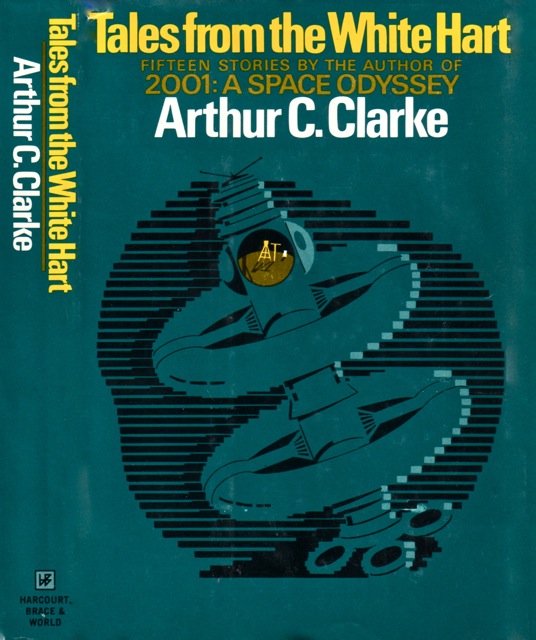
                • Cover of Tales from the White Hart
                  Tales from the White Hart

                  series · 19 books · 1949

                  similar byfunnyscience fictionour world

                • Cover of Crosstalk
                  Crosstalk

                  Connie Willis · standalone novel · 2016

                  similar byfunnyour worldscience fiction

                  Crosstalk is a science fiction novel by Connie Willis, published in 2016. It is a romantic comedy that explores the intersection of telephones and telepathy. In a similar situation to Bellwether and Passage, the main character, Briddey Flannigan, is part of a larger institution who gets caught up in series of escalating events. Additionally, Crosstalk like Bellwether and Passage feature themes of neuroscience, communication and technology.

                • Cover of Search the Sky
                  Search the Sky

                  C. M. Kornbluth & Frederik Pohl · standalone novel · 1954

                  similar byfunnyscience fictionsatire

                  Search the Sky is a satirical science fiction novel by American writers Frederik Pohl and Cyril M. Kornbluth, first published in 1954 by Ballantine Books.

                • Cover of The Technicolor Time Machine
                  The Technicolor Time Machine

                  Harry Harrison · standalone novel · 1967

                  similar byfunnyour worldscience fictionsatire

                  The Technicolor Time Machine is a 1967 science fiction novel by American writer Harry Harrison. It is a time travel story with comedic elements, which satirizes Hollywood. The story first appeared in Analog Science Fiction and Fact magazine, where it was serialized in three parts in the March–May 1967 issues, under the title "The Time-Machined Saga."

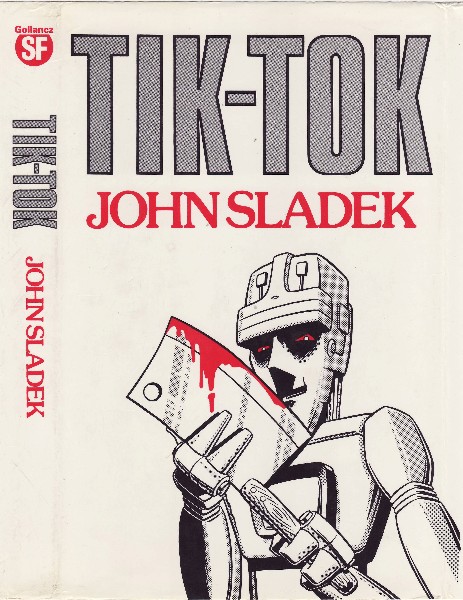
                • Cover of Tik-Tok
                  Tik-Tok

                  John Sladek · standalone novel · 1983

                  similar byfunnyscience fictionsatireartificial intelligence

                  From the back cover DAW paperback: ""A robot shall not injure a human being or through inaction allow a human being to come to harm." - Asimov's First Law of Robotics. Tik-Tok was one of the finest domestic robots ever made, but his asimov circuits were defective. He could injure people as much as he pleased - and he pleased to do it often! But the life of a robot (if that isn't a contradiction) is still all service and unpaid labor. Tik Tok served many masters, all of whom came to a bad end. Happily he went on gathering steam with a trail of catastrophes getting bigger and bigger, destined to culminate with his campaign for the vice-presidency of the United States! Science Fiction Review calls John Sladek "one of the true and original lunatics of science fiction... one of the funniest writers in the field." Now read the hilarious autobiography of Sladek's asimovian scofflaw!"

                • Cover of Extreme Makeover
                  Extreme Makeover

                  Dan Wells · standalone novel · 2016

                  similar byfunnyour worldscience fictionsatire

                  Extreme Makeover is a 2016 satirical medical science fiction thriller novel by Dan Wells. It follows Lyle Fontanelle, a scientist at a cosmetics company, as he deals with the repercussions of creating an anti-wrinkle cream that clones people.

                • Cover of Good News from Outer Space
                  Good News from Outer Space

                  John Kessel · standalone novel · 1989

                  similar byfunnyour worldscience fictionsatire

                  Good News From Outer Space is a science fiction novel by American writer John Kessel. It is predominantly a satire telling the story of a resurrected reporter, George Eberhart, investigating alien involvement on Earth just prior to worldwide hysteria surrounding the countdown to the year 2000. The book was described as "madcap" and containing "gonzo plotting", which lent itself well to the satirical points Kessel was trying to make.

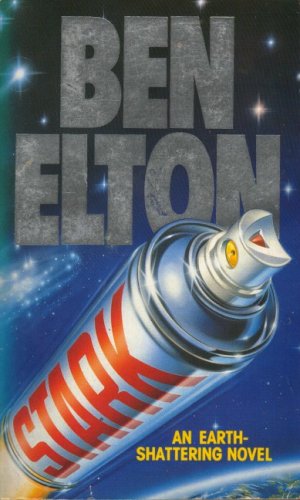
                • Cover of Stark
                  Stark

                  Ben Elton · standalone novel · 1989

                  similar byfunnyour worldscience fictionsatire

                  "Stark has more money than God and the social conscience of a dog on a croquet lawn. What's more they know the Earth is dying." So the rich try and escape in Star Arks.

                • Cover of Roderick
                  Roderick

                  series · 3 books · 1980

                  completed

                  similar byfunnyscience fictionsatire+2 more

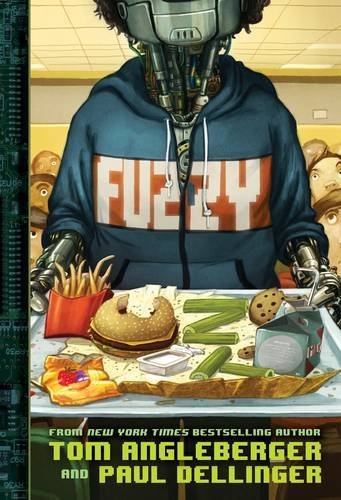
                • Cover of Fuzzy
                  Fuzzy

                  Paul Dellinger & Tom Angleberger · standalone novel · 2016

                  similar byfunnyour worldscience fictionartificial intelligence

                  When Max--Maxine Zealster--befriends her new robot classmate Fuzzy, part of Vanguard One Middle School's new Robot Integration Program, she helps him learn everything he needs to know about surviving middle school--the good, the bad, and the really, really, ugly. Little do they know that surviving sixth grade is going to become a true matter of life and death, because Vanguard has an evil presence at its heart: a digital student evaluation system named BARBARA that might be taking its mission to shape the perfect student to extremes!

                • Cover of As She Climbed Across the Table
                  As She Climbed Across the Table

                  Jonathan Lethem · standalone novel · 1997

                  similar byfunnyscience fictionsatireartificial intelligence

                  As She Climbed Across the Table is a 1997 science fiction novel by the American writer Jonathan Lethem. It is a satirical story set on the fictional campus of Beauchamp University in Northern California. Particle physicist Alice Coombs rooms with narrator Philip Engstrand, an anthropologist researching conflicts between and within disciplines. Their relationship drives the romantic aspect of this story. The novel deals thematically with many of the philosophical issues pertaining to modern quantum physics, as well as human interaction with artificial intelligence.

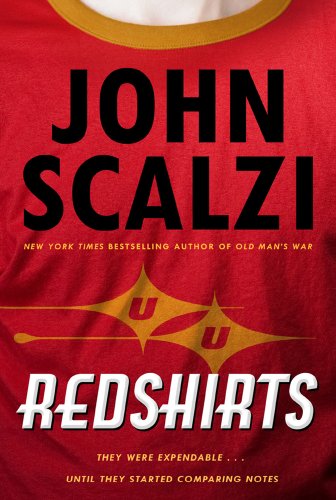
                • Cover of Redshirts
                  Redshirts

                  John Scalzi · standalone novel · 2012

                  similar byfunnyscience fictionsatire

                  Redshirts is a postmodernist science fiction novel by John Scalzi that satirizes the tropes and narrative elements of Star Trek from the perspectives of several characters in a fictional TV show about the adventures of a starship and its crew who gradually become aware of their true nature.