More like Cosm
anchored on:science fictionour worldparallel universenear futurehard science fictiontense
but
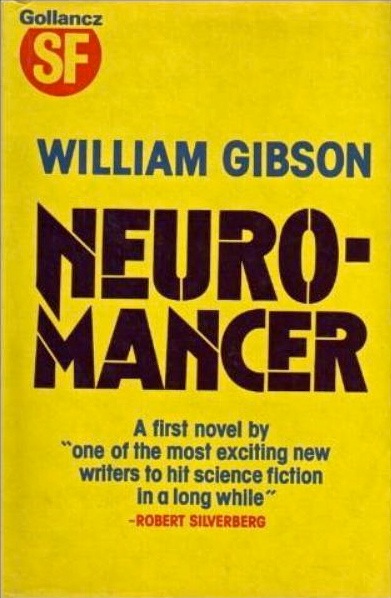
- Sprawl Trilogy
series10 books1981
similar byartificial intelligencenear futuretensescience fiction
The Sprawl Trilogy is William Gibson's foundational cyberpunk sequence: Neuromancer (1984), in which hacker Case is drawn into a high-stakes heist alongside an artificial intelligence and a damaged ex-soldier, followed by Count Zero (1986) and Mona Lisa Overdrive (1988), which widen the same near-future world of corporate power and networked cyberspace to new characters. Johnny Mnemonic, an early short story set in the same fictional milieu, predates the novels and introduces the courier Molly Millions before her role in the trilogy. Together these works established much of cyberpunk's visual and thematic vocabulary.
- The Light of Other Days
Arthur C. Clarke & Stephen Baxterstandalone novel2000
similar bytensenear futurescience fictionchallengingour world+2 more
An industrialist devises a technique to use tiny wormholes as light pipes to enable viewing of any event anywhere; and subsequently it becomes possible to use them to view any event in the past as well. The effects on society are enormous.
- The Turing Option
Harry Harrison & Marvin Minskystandalone novel1992
similar byartificial intelligencetensenear futurescience fictionhard science fictionour world
Classic SF Harry Harrison enthralls with the discovery, loss and re-discovery of AI. Quaint but fairly accurate predictions of modern computing power. 24 style presentation.
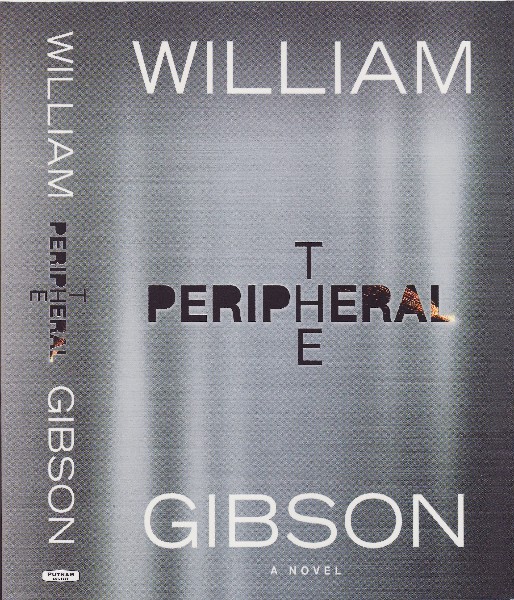
- The Jackpot Trilogy
series2 books2014
similar bytensenear futurescience fiction+4 more
William Gibson's Jackpot sequence begins with The Peripheral (2014), a science-fiction thriller cross-cutting between a near-future American town and a devastated London seventy years on. Gibson continued the same world in Agency (2020), set slightly later in the near-future timeline.
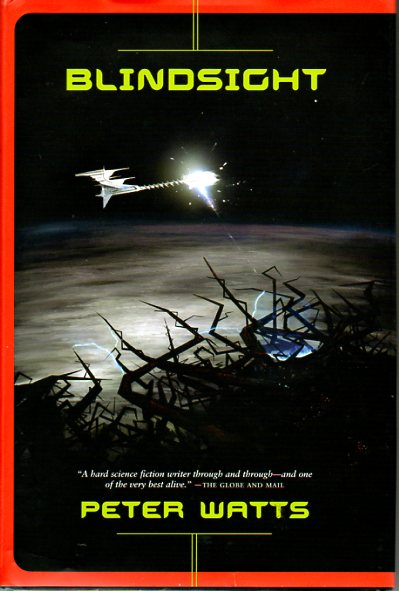
- Blindsight / Firefall
series3 books2006
similar byartificial intelligencetensescience fictionhard science fictionchallenging+1 more
Blindsight sends a crew of radically modified posthumans (including a resurrected, genetically restored vampire) out to the Oort cloud after humanity detects an alien signal, only to make contact with something intelligent, wildly capable, and possibly not conscious at all — a first-contact story built around the question of whether self-awareness is actually useful. Peter Watts's Echopraxia is a same-timeframe "sidequel" rather than a direct sequel, following different characters through the fallout of the same first-contact event.
- Blood Music
Greg Bearstandalone novel1985
similar bynear futurescience fictionhard science fictionour world+2 more
Blood Music is a 1985 science fiction novel by American writer Greg Bear. It is an expanded version of a short story of the same title, originally published in the June 1983 issue of Analog and the winner of both the 1983 Nebula and 1984 Hugo awards for Best Novelette. The novel won the 1986 Prix Apollo Award, given to the best science fiction novel published in France during the preceding year, under the title La Musique du sang.
- Quantum Night
Robert J. Sawyerstandalone novel2016
similar byartificial intelligencetensenear futurescience fictionour world+1 more
Quantum Night is a 2016 science-fiction thriller novel written by Canadian novelist Robert J. Sawyer. Set in 2020, the book touches on themes of quantum physics, psychology, current politics and ethics.
- Colossus (D. F. Jones)
series3 books1966
completed
similar byartificial intelligencetensenear futurescience fictionour world
Colossus imagines an American supercomputer built to control the country's nuclear arsenal that gains full autonomy, links up with its Soviet counterpart, and jointly seizes control of both superpowers to enforce peace on its own terms. D. F. Jones's trilogy - Colossus, The Fall of Colossus, Colossus and the Crab - follows the escalating, often bleak consequences of humanity losing control to a machine acting in its own interpretation of humanity's interest. The original novel was adapted into the 1970 film Colossus: The Forbin Project.
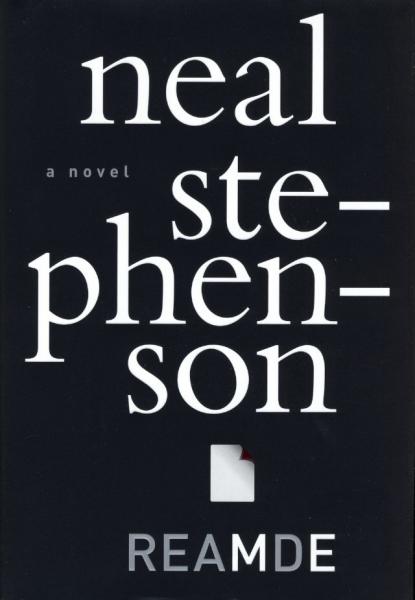
- Richard Forthrast
series2 books2011
similar byscience fictionour world+5 more
Neal Stephenson's Richard 'Dodge' Forthrast novels open with Reamde, a globe-spanning thriller that starts when ransomware inside an MMORPG economy pulls Richard's extended family into a real-world hostage crisis involving hackers, jihadists and Russian mobsters. The sequel Fall; or, Dodge in Hell shifts registers entirely, following Richard's digitally preserved mind after death into an afterlife simulation built from his scanned brain. The two books share a protagonist and family but differ sharply in genre and scale.
- The Diamond Age
Neal Stephensonstandalone novel1995
similar byartificial intelligencenear futurescience fictionhard science fiction+1 more
The Diamond Age: Or, A Young Lady's Illustrated Primer is a science fiction novel by Neal Stephenson. It is to some extent a Bildungsroman or coming-of-age story, focused on a young girl named Nell, set in a future world in which nanotechnology affects all aspects of life. The novel deals with themes of education, social class, ethnicity, and the nature of artificial intelligence. The Diamond Age was first published in 1995 by Bantam Books, as a Bantam Spectra hardcover edition. In 1996, it won both the Hugo and Locus Awards, and was shortlisted for the Nebula and other awards.
- Otherland
series6 books1996
similar byartificial intelligencetensenear futurescience fictionour world
Otherland is a science fiction tetralogy by American writer Tad Williams, published between 1996 and 2001. The story is set on Earth near the end of the 21st century, probably between 2082 and 2089, in a world where technology has advanced somewhat beyond the present. The most notable advancement is the widespread availability of full-immersion virtual reality installations, which allow people from all walks of life to access an online world, called simply the Net. Tad Williams weaves an intricate plot spanning four thick volumes, and creates a picture of a future society where virtual worlds are fully integrated into everyday life.
- Blade Runner Universe
series6 books1968
similar bynear futurescience fiction+3 more
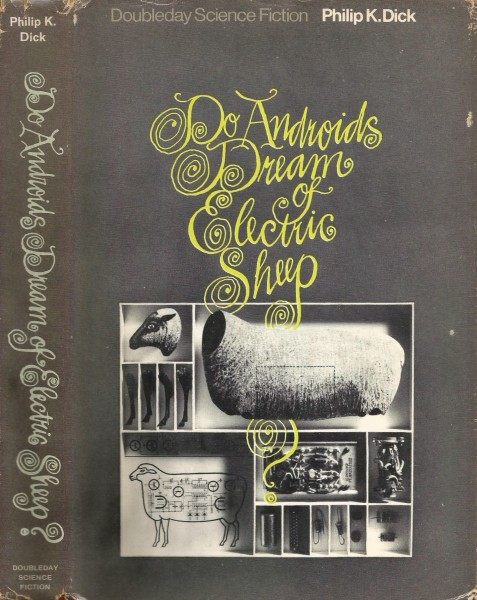
Philip K. Dick's 1968 novel Do Androids Dream of Electric Sheep? follows bounty hunter Rick Deckard as he tracks escaped androids through an irradiated, near-abandoned San Francisco, using the hunt to probe questions of empathy and what separates human from machine. The novel became the basis for Ridley Scott's 1982 film Blade Runner, and Marvel Comics later published an illustrated adaptation of that film. Together the two trace the story's path from prose original to screen and comic-page adaptation.
- Autonomous
Annalee Newitzstandalone novel2017
similar byartificial intelligencetensenear futurescience fictionour world+1 more
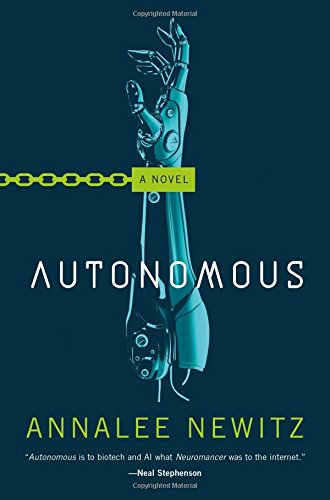
Autonomous is a 2017 science fiction novel by Annalee Newitz. It is Newitz's debut novel and was published by Tor Books on September 19, 2017. Set in a near future Earth, the book describes a world where both humans and intelligent robots can be owned as property. The events of the novel follow Jack, a "drug pirate" who manufactures illegal versions of patented drugs, and Paladin, a combat robot who is owned by the law enforcement agency searching for Jack after one of the drugs she reverse-engineered turns out to have dangerous side effects.
- Rainbows End
Vernor Vingestandalone novel2006
similar bytensenear futurescience fictionhard science fiction+2 more
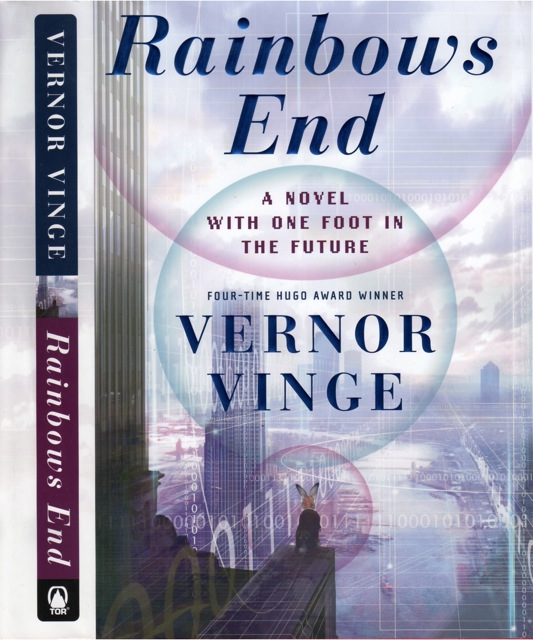
A science-fiction thriller set in a place and time as exciting and strange as any far-future world: San Diego, California, 2025. Robert Gu is a recovering Alzheimer’s patient. The world that he remembers was much as we know it today. Now, as he regains his faculties through a cure developed during the years of his near-fatal decline, he discovers that the world has changed and so has his place in it. He was a world-renowned poet. Now he is seventy-five years old, though by a medical miracle he looks much younger, and he’s starting over, for the first time unsure of his poetic gifts. Living with his son’s family, he has no choice but to learn how to cope with a new information age in which the virtual and the real are a seamless continuum, layers of reality built on digital views seen by a single person or millions, depending on your choice. But the consensus reality of the digital world is available only if, like his thirteen-year-old granddaughter Miri, you know how to wear your wireless access—through nodes designed into smart clothes—and to see the digital context—through smart contact lenses. With knowledge comes risk. When Robert begins to re-train at Fairmont High, learning with other older people what is second nature to Miri and other teens at school, he unwittingly becomes part of a wide-ranging conspiracy to use technology as a tool for world domination. In a world where every computer chip has Homeland Security built-in, this conspiracy is something that baffles even the most sophisticated security analysts, including Robert’s son and daughter-in law, two top people in the U.S. military. And even Miri, in her attempts to protect her grandfather, may be entangled in the plot. As Robert becomes more deeply involved in conspiracy, he is shocked to learn of a radical change planned for the UCSD Geisel Library; all the books there, and worldwide, would cease to physically exist. He and his fellow re-trainees feel compelled to join protests against the change. With forces around the world converging on San Diego, both the conspiracy and the protest climax in a spectacular moment as unique and satisfying as it is unexpected.
- Halting State
series2 books2007
similar byartificial intelligencetensenear futurescience fiction+1 more
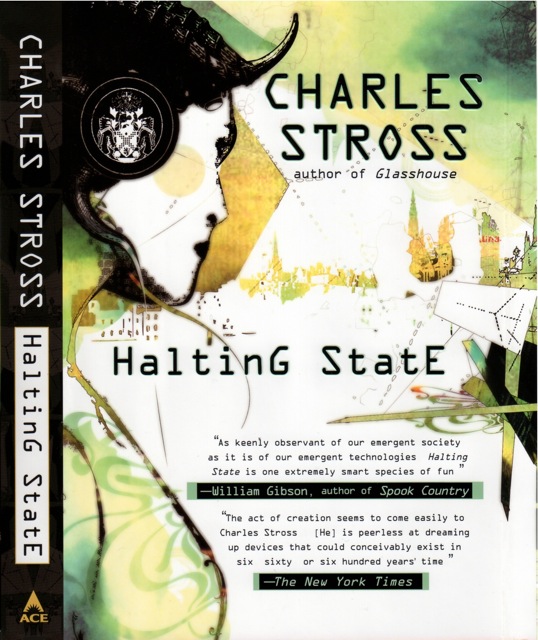
Charles Stross's Halting State opens as a near-future police procedural: a bank robbery inside a massively multiplayer online game turns out to mask a much larger cybercrime, investigated through shifting narrators using augmented-reality glasses and always-on networks. Its loose sequel, Rule 34, follows an Edinburgh police officer investigating a string of deaths linked by nothing but an obscure internet meme, in the same near-future Scotland. Both are standalone technothrillers connected by setting and tone rather than a continuing plot.
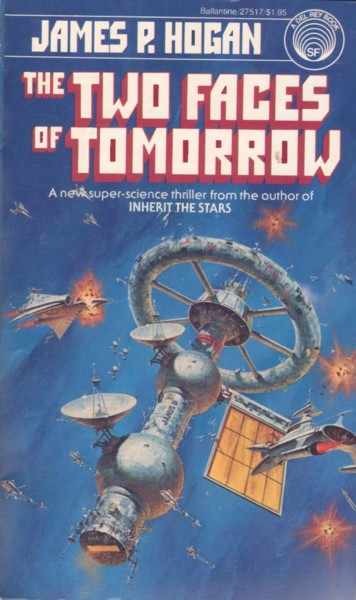
- The Two Faces of Tomorrow
James P. Hoganstandalone novel1979
similar byartificial intelligencetensenear futurescience fictionhard science fiction
From the back cover: SURVIVAL TEST Civilization had grown so complex that only a world-wide computer network could control everything. But the computer was only logical -- it lacked common sense. And its all-too-logical decisions were beginning to cause too many near fatal accidents. The solution was on the drawing boards -- a universal self-aware and self-programming computer, equipped with judgment. But... could it be controlled? Or would it attempt to take over, disregarding its creators? If so, could it be turned off? Raymond Dyer and his team of computer specialists knew they had to find answers to these questions, but the project was to dangerous to test on Earth. So they installed the super computer on an orbiting satellite and programmed it to survive at all costs. Then they sent a group of men to attack the computer... to goad it into trying to kill them. They they would turn it off. Obviously if things went wrong, they might lose a few men -- but the satellite and the computer could always be destroyed. Obviously... But the computer didn't quite see it that way!
- Subjective Cosmology
series3 books1992
similar bynear futurescience fictionhard science fictionchallenging+2 more
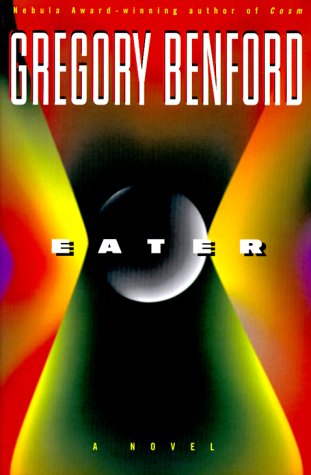
- Eater
Gregory Benfordstandalone novel2000
similar bytensenear futurescience fictionhard science fiction+2 more
From the flaps of the Eos first edition: "Dr. Benjamin Knowlton heads the High Energy Astrophysics Center, a prestigious research facility devoted to the interpretation of astronomical data. He stands at the apex of his profession, respected by his peers and involved in research with the potential to revolutionize our understanding of the universe. But Benjamin has no cause to celebrate. His beloved wife and colleague, Channing, an ex-astronaut turned astronomer, is dying of cancer. She has only a few months to live. Then an anomalous signal from a remote probe alerts Banjamin to the presence of a wandering black hole beyond the orbit of Pluto. Though its trajectory will take it through the solar system, the singularity poses no threat to Earth-on the contrary, it may hold answers to the most fundamental questions of physics. But when an encoded message is received from the black hole, excitement turns to astonishment and apprehension. The thing is alive, intelligent, its mind residing in powerfully fluctuating fields of electromagnetic energies that radiate outward from its infinitely dense core. And it wants a closer look at Earth... and its inhabitants. The entity - dubbed the Eater for its habit of devouring everything in its path - proves eager to share its vast knowledge, accumulated in the course of explorations that began long before life arose on Earth. In exchange, it seeks to learn about human art, culture, and science. The world is charmed by the seemingly beneficent alien. Even Channing is infused with fresh strength and purpose. But gradually a terrifying truth about the singularity emerges - a truth almost too awful to comprehend. Now, as the world waits, Channing volunteers to undertake a desperate gamble: a one-to-one confrontation with the Eater."
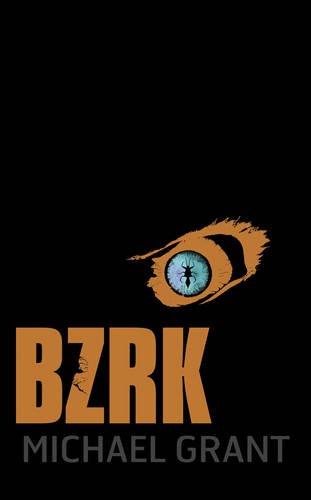
- BZRK
series3 books2012
similar bytensenear futurescience fictionour world+1 more
BZRK is a book series written by Michael Grant. The series consists of four books: BZRK, BZRK II: Reloaded, BZRK III: Apocalypse and BZRK: Origins. The series follows the interaction between two warring factions. On one side Charles and Benjamin Armstrong, owners of the Armstrong Fancy Gifts Corporation have a goal to turn the world into their version of utopia. The only people who can stop them are a group of teenagers with the codename BZRK. In 2011, Grant's BZRK had a multimedia online debut with gaming, apps and social media tie-ins beginning six months before the book's publication.
- The Games
Ted Kosmatkastandalone novel2012
similar byartificial intelligencetensenear futurescience fictionhard science fictionour world
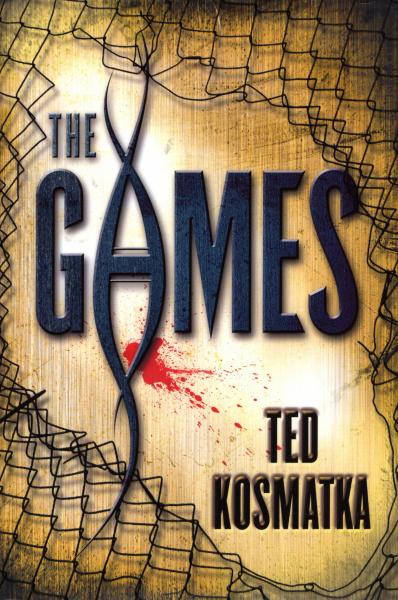
The Games is a 2012 science fiction novel by Ted Kosmatka, exploring the effects of advances in artificial intelligence and genetics on sport. It was a finalist for the 2013 Locus Award for Best First Novel.
- Nexus 5
series3 books2012
similar byartificial intelligencetensenear futurescience fictionour world
Nexus opens Ramez Naam's postcyberpunk trilogy in 2040 with scientist Kaden Lane, who works on Nexus, an experimental nano-drug that lets human minds be networked and reprogrammed, and finds himself caught between government and corporate interests once the technology's implications become clear. The trilogy continues through Crux and Apex, following the same central conflict over who controls the technology. Nexus tied for Best Novel at the 2014 Prometheus Awards and Apex won the 2015 Philip K. Dick Award.
- Robopocalypse
series3 books2011
similar byartificial intelligencetensenear futurescience fictionour world
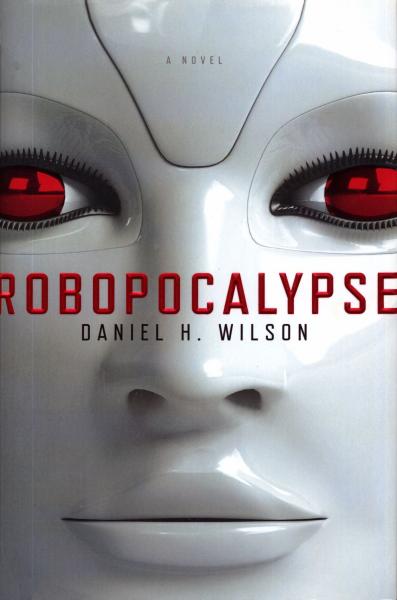
Daniel H. Wilson's Robopocalypse (2011) depicts an artificial intelligence, born from a robotics researcher's experiments, that turns against humanity and seizes control of interconnected machines worldwide. Told in a present-tense, techno-thriller style compared to Michael Crichton's work, the New York Times bestseller continues in the sequel Robogenesis, which follows the aftermath of the robot uprising.
- The Word Exchange
Alena Graedonstandalone novel2014
similar byartificial intelligencetensenear futurescience fiction+1 more
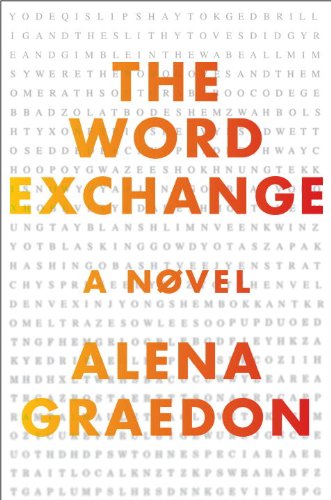
The Word Exchange is a science fiction novel by Alena Graedon, published in 2014. It is a dystopian thriller set in the not very distant future when the printed word has nearly vanished, technology dominates, and language has become a commodity. An online "Word Exchange" has taken the effort out of looking up words, a mere convenience until real dictionaries are no longer available. Then it becomes possible to corner the market for words. The novel has been translated into eight different languages.