More like Creation Node
anchored on:science fictionspace explorationouter planets & moonsnear futurehard science fictionartificial intelligence+2 more
but
- Adventures of Viktor & Julia
series2 books1999
similar bynear futurespace explorationscience fictionhard science fictiontensealiens+2 more
- The Questrison Saga
series1 book2018
similar bymysteriousnear futurespace explorationscience fictionhard science fictiontensespaceouter planets & moons+1 more
- Minervan Experiment / Giants
series5 books1977
completed
similar bymysteriousscience fictionspace explorationhard science fictionaliens+2 more
The Giants series is a quintet of science fiction novels by James P. Hogan, published between 1977 and 2005. The series began with Inherit the Stars, published by Del Rey Books in May 1977.
- All Judgment Fled
James Whitestandalone novel1968
similar bymysteriousnear futurescience fictionspace explorationtensespacealiens
From the front flap of the Rapp first edition: It is the spring of 1978 and a gigantic alien spaceship has entered the solar system and taken up an orbit some sixty million miles from the Sun. The Ship neither signals nor replies in any detectable fashion to signals directed towards it. Silently and, some think, implacably, it orbits like some tremendous battleship cruising off the coast of a tiny, backward island. Inevitably there are natives on the island whose curiosity outweighs their fear and six men in two tiny sophisticated dug-out canoes go out to satisfy their curiosity... All Judgment Fled is not another story about super heroes solving alien communications problems with the aid of super scientific and infallible translation devices. Instead it concerns the reactions of six very ordinary people to what is probably the most extraordinary situation of all - the first meeting with an extraterrestrial race.
- Blindsight / Firefall
series3 books2006
similar byscience fictionartificial intelligencehard science fictiontensespacealiens+3 more
Blindsight sends a crew of radically modified posthumans (including a resurrected, genetically restored vampire) out to the Oort cloud after humanity detects an alien signal, only to make contact with something intelligent, wildly capable, and possibly not conscious at all — a first-contact story built around the question of whether self-awareness is actually useful. Peter Watts's Echopraxia is a same-timeframe "sidequel" rather than a direct sequel, following different characters through the fallout of the same first-contact event.
- Heart of the Comet
David Brin & Gregory Benfordstandalone novel1986
similar bynear futurespace explorationscience fictionhard science fictionspace+1 more
Heart of the Comet is a novel by David Brin and Gregory Benford about human space travel to Halley's Comet published in 1986. Its publication coincided with the comet's 1986 approach to the Earth.
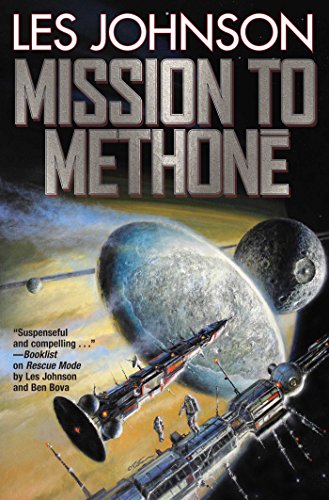
- Mission to Methone
Les Johnsonstandalone novel2018
similar bymysteriousnear futurescience fictionartificial intelligencespace explorationtensespacealiens
"The year is 2065 and an accidental encounter in space leads to the discovery that we are not alone and that our continued existence may be in jeopardy. Chris Holt, working at the Space Resources Corp., discovers that one of the asteroids he surveying for mining is actually a derelict spaceship. What Earth doesn't know is that across the galaxy, a war has been underway for millennia. A war between alien civilizations that have very different ideas about what should be done about emerging spacefaring civilizations like our own. The artificial intelligence resident in the derelict has been in our solar system since before the dawn of human civilization, watching, waiting and keeping quiet lest the war return and wipe out humanity"--
- Starplex
Robert J. Sawyerstandalone novel1996
similar bymysteriousnear futurescience fictionspace explorationtensespacealiens
The only novel of its year to be nominated for both the Hugo and Nebula Awards. Starplex won Canada's Aurora Award for best novel of the year. For nearly twenty years Earth's space exploration had exploded outward, thanks to a series of mysterious, artificial wormholes. No one knows who created these interstellar passages, yet they have brought the far reaches of space immediately close. For Starplex Director Keith Lansing, too close. Discovery is superseding understanding. And when an unknown vessel — with no windows, no seams, and no visible means of propulsion — arrives through a new wormhole, an already battle-scarred Starplex could be the starting point of a new interstellar war . . . ROBERT J. SAWYER has won the Hugo, Nebula, John W. Campbell Memorial, Seiun, and Aurora Awards, all for best science fiction novel of the year. His novels include Hominids, Rollback, Wake, and FlashForward (basis for the TV series).
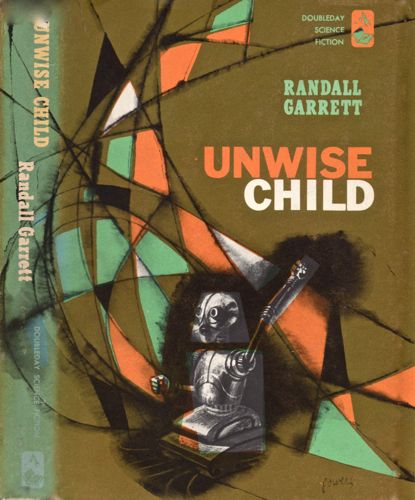
- Unwise Child
Randall Garrettstandalone novel1962
similar bymysteriousnear futurescience fictionartificial intelligencetense+1 more
"When a super-robot named Snookums discovers how to build his own superbombs, it becomes obvious that Earth is by no means the safest place for him to be. And so Dr. Fitzhugh, his designer, and Leda Crannon, a child psychologist acting as Snookums' nursemaid, agree to set up Operation Brainchild, a plan to transport the robot to a far distant planet. "... once into space, the Branchell becomes the scene of some frightening events—the medical officer is murdered, and Snookums appears to be the culprit. Mike the Angel indulges himself in a bit of sleuthing, and the facts he turns up lead to a most unusual climax." (From Project Gutenberg's version of the 1962 Doubleday edition, published 2007.)
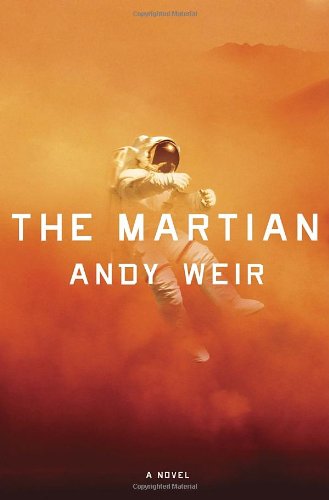
- The Martian
series2 books2012
similar bynear futurescience fictionspace explorationhard science fictiontense
Andy Weir's novel The Martian, first self-published in 2011 before a commercial re-release, follows astronaut Mark Watney after he is stranded alone on Mars when his crew presumes him dead and departs. Using scientific improvisation and dark humor, Watney works to keep himself alive long enough for a rescue to reach him. It is a single, self-contained survival story.
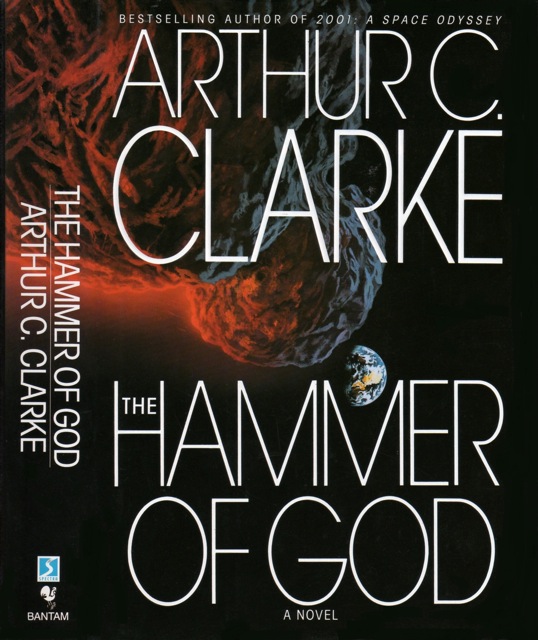
- The Hammer of God
Arthur C. Clarkestandalone novel1993
similar bynear futurescience fictionspace explorationhard science fictiontensespace+1 more
The Hammer of God is a science fiction novel by Arthur C. Clarke originally published in 1993. Set in the year 2109, it deals with the discovery of an asteroid to be on course to collide with Earth and depicts the mission for deflecting the asteroid by using fusion thermal rockets.
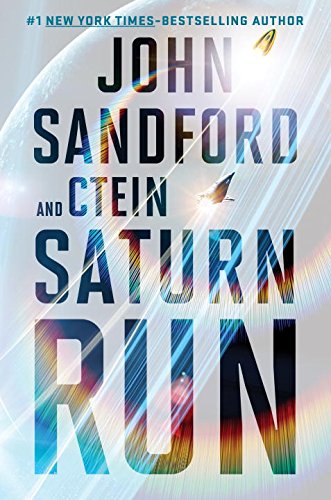
- Saturn Run
Ctein & John Sandfordstandalone novel2015
similar bynear futurespace explorationscience fictionhard science fictiontensespaceouter planets & moonsaliens
"The year is 2066. A Caltech intern inadvertently notices an anomaly from a space telescope--something is approaching Saturn, and decelerating. Space objects don't decelerate. Spaceships do. A flurry of top-level government meetings produces the inescapable conclusion: Whatever built that ship is at least one hundred years ahead in hard and soft technology, and whoever can get their hands on it exclusively and bring it back will have an advantage so large, no other nation can compete. A conclusion the Chinese definitely agree with when they find out. The race is on, and a remarkable adventure begins..."--
- Have Space Suit - Will Travel
Robert A. Heinleinstandalone novel1958
similar bynear futurescience fictionspace explorationtensespacealiens
From the back cover of the Del Rey 9th printing: "Skyjacked - Everything happened at once. One minute Kip Russell was walking about in his own backyard, testing out an old space suit and dreaming about going to the moon - and the next he was out cold and the captive of an insidious space pirate. The whole thing seemed like a very bad dream until he discovered he wasn't the only prisoner on board. Then the reality of the situation became inescapable. He - along with the daughter of a world-renowned scientist and a beautiful creature from an alien planet - had been skyjacked by a monstrous extraterrestrial and they were on their way to the Moon... a journey toward a fate worse than death!"
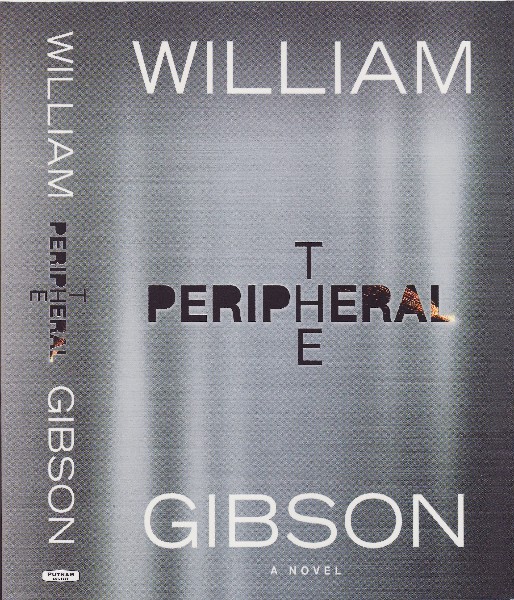
- The Jackpot Trilogy
series2 books2014
similar bymysteriousnear futurescience fictiontense+2 more
William Gibson's Jackpot sequence begins with The Peripheral (2014), a science-fiction thriller cross-cutting between a near-future American town and a devastated London seventy years on. Gibson continued the same world in Agency (2020), set slightly later in the near-future timeline.
- The Final Six
series2 books2018
similar bynear futurespace explorationscience fictiontensespace+3 more
- NASA Trilogy
series4 books1996
similar byspace explorationscience fictionhard science fictiontense+4 more
The NASA Trilogy consists of three hard science fiction novels written by British science fiction author Stephen Baxter. They were published from 1996 to 1998. These books explore the possibilities of the American space program if the circumstances had been different. They have generally darker tones than his other books and are critical of NASA. They consist of:
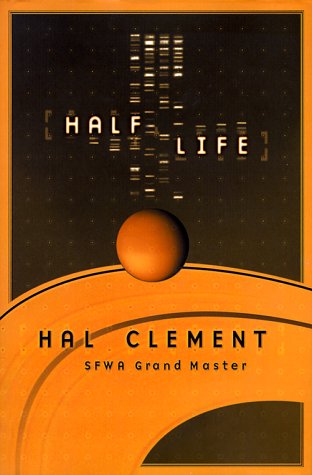
- Half Life
Hal Clementstandalone novel1999
similar bynear futurespace explorationscience fictionhard science fictionouter planets & moonstensespace
As the human race faces extinction because of incurable diseases, a crew of young men and women is sent to the moons of Saturn. They are to study pre-life conditions in the hope of discovering a way of saving Earth. But they are all dying.
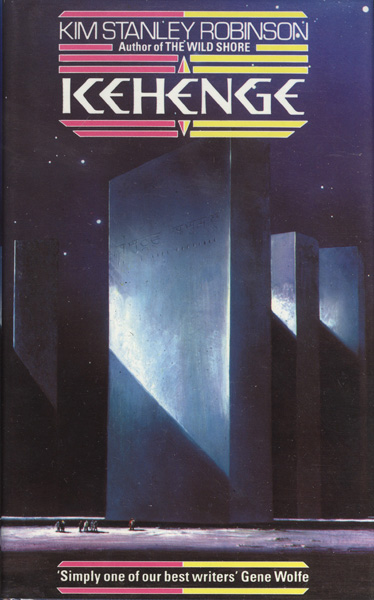
- Icehenge
Kim Stanley Robinsonstandalone novel1984
similar bymysteriousscience fictionspace explorationhard science fictionouter planets & moons+1 more
Icehenge unfolds in three parts, narrated years or centuries apart by different investigators piecing together the same facts. The first is the diary of Emma Weil, an engineer swept into a Martian revolution in 2248, conscripted onto a rebel starship fitted for a voyage beyond the solar system, and forced to decide how far her sympathy for the uprising extends. Generations later, other narrators pick up the thread of what became of her and the ship, drawn toward a stone monument on a moon of Pluto that should not exist. An early standalone novel by Kim Stanley Robinson, revisiting the Martian-revolution material he later expanded into the Mars trilogy.
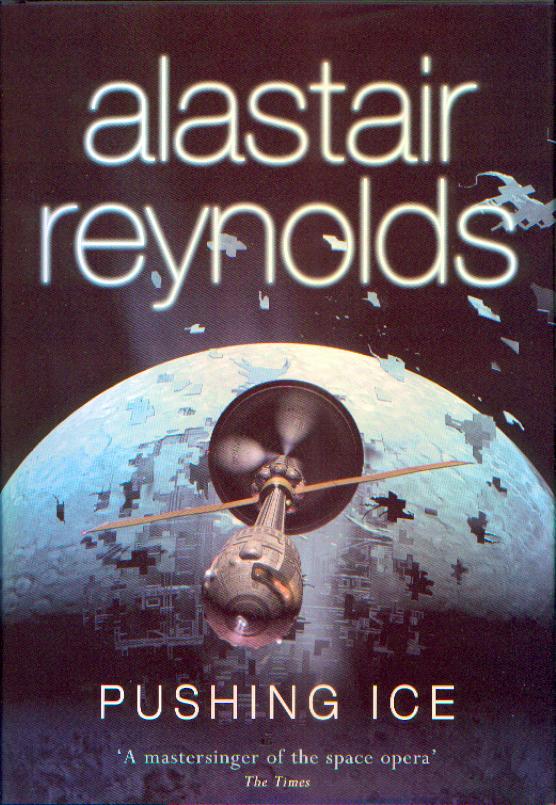
- Pushing Ice
Alastair Reynoldsstandalone novel2005
similar byspace explorationscience fictionhard science fictiontensespacealiens
When Saturn's moon Janus suddenly takes off into interstellar space, an ice mining spaceship sent to investigate finds itself swept along into distant space until it ends up trapped in a gigantic alien structure, wherein the crew must prepare to reside for the foreseeable future.
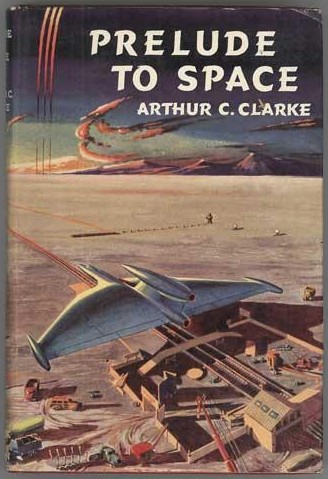
- Prelude to Space
Arthur C. Clarkestandalone novel1951
similar bynear futurespace explorationscience fictionhard science fiction+1 more
Prelude to Space is a science fiction novel written by British author Arthur C. Clarke in 1947. It appeared for the first time in 1951 as a paperback from World Editions Inc, as number three in its series of Galaxy novels. Sidgwick & Jackson published it in the UK in 1953, followed the next year by a United States hardcover edition from Gnome Press and a paperback from Ballantine Books.
- The Omega Project
Steve Altenstandalone novel2013
similar bynear futurescience fictionartificial intelligencespace explorationhard science fictiontenseouter planets & moons+1 more
Joining a scientific team originally scheduled to travel to one of Jupiter's moons, tech genius Robert Eisenbraun is put into hibernation against his will and awakens on a hostile Earth where he must defeat a technological adversary of his own making.
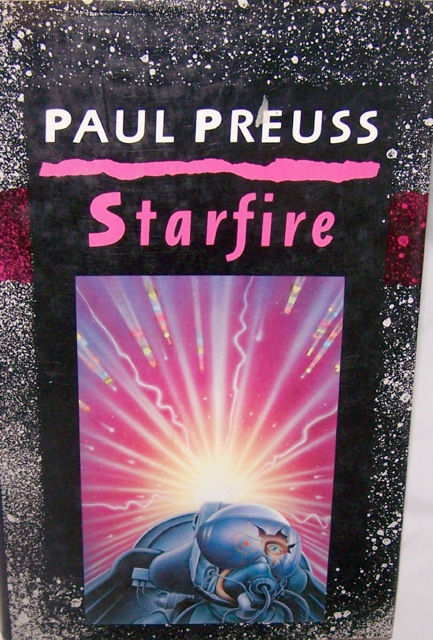
- Starfire
Paul Preussstandalone novel1988
similar bynear futurespace explorationscience fictionhard science fictiontensespace
Starfire is a science fiction novel by author Paul Preuss. First published in February 1988, it is about a group of NASA astronauts on a mission to an asteroid which is falling into the Sun.
- A Fall of Moondust
Arthur C. Clarkestandalone novel1961
similar bynear futurescience fictionhard science fictiontense+1 more
From the back cover of the Harbrace paperback: "The action of A Fall of Moondust takes place almost a century from now when tours on the moon are a common occurrence. One of the high points of each tour is a cruise around the Sea of Thirst, a body of volcanic dust, in a specially designed vessel called the Selene On a perfectly routine voyage one day the Selene suddenly disappears. How do you locate a small tourist "cruiser" buried beneath fifty feet of dust? If you find it, how do you rescue the passengers and crew? If you are on board, how do you feel and what do you do while brave men and expert technicians join forces in a race against time? Sustained excitement, lively humor, and an engaging cast of characters make this one of Arthur C. Clarke's most intriguing novels."