More like Cuttlefish
anchored on:steampunkalternate historylate 20th centurypolitical intrigueadventuroustense
but
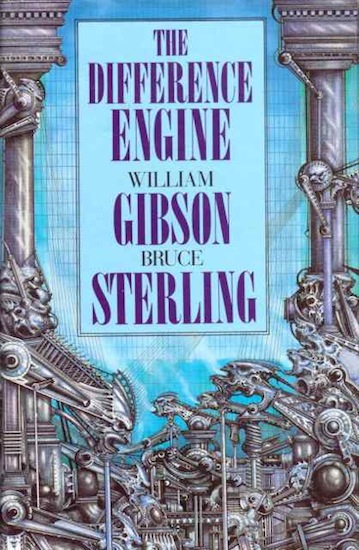
- The Difference Engine
William Gibson & Bruce Sterlingstandalone novel1990
similar bypolitical intriguesteampunkalternate historyscience fiction+1 more
The computer age arrives a century early with Babbage's perfection of his 'analytical engine'. The industrial revolution is accelerated by the development of steam-driven cybernetic 'Engines'. An advanced Great Britain prepares to better the world's lot. An example of the 'steampunk' sub-genre of the cyberpunk movement.
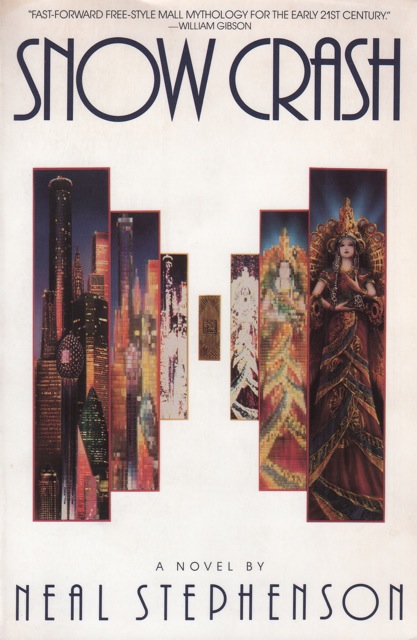
- Snow Crash
Neal Stephensonstandalone novel1992
similar bypolitical intrigueadventuroustensescience fiction
Snow Crash is a 1992 science fiction novel by Neal Stephenson. Like many of Stephenson's novels, its themes include history, linguistics, anthropology, archaeology, religion, computer science, politics, cryptography, memetics, and philosophy.
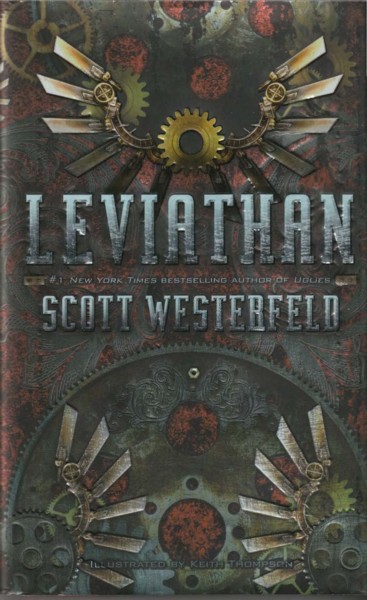
- The Leviathan Trilogy
series3 books2009
similar byadventuroussteampunkalternate historyyoung adultscience fiction+2 more
Set in an alternate First World War, Leviathan splits the belligerents into Clankers, who fight with mechanical walkers, and Darwinists, who fight with fabricated living creatures built from spliced DNA. Scott Westerfeld follows a British girl disguised as a boy to serve on a living airship and the exiled heir to the Austro-Hungarian throne as their paths collide, continuing across Behemoth and Goliath. Keith Thompson's illustrations are integral to all three books, alternating text chapters with illustrated sequences.
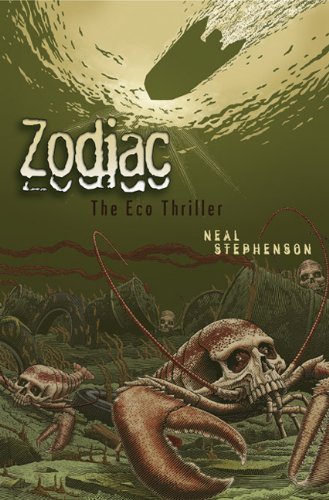
- Zodiac: The Eco-Thriller
Neal Stephensonstandalone novel1988
similar bypolitical intriguelate 20th centuryadventuroustense+1 more
Sangamon Taylor's a New Age Sam Spade who sports a wet suit instead of a trench coat and prefers Jolt from the can to Scotch on the rocks. He knows about chemical sludge the way he knows about evil -- all too intimately. And the toxic trail he follows leads to some high and foul places. Before long Taylor's house is bombed, his every move followed, he's adopted by reservation Indians, moves onto the FBI's most wanted list, makes up with his girlfriend, and plays a starring role in the near-assassination of a presidential candidate. Closing the case with the aid of his burnout roomate, his tofu-eating comrades, three major networks, and a range of unconventional weaponry, Sangamon Taylor pulls off the most startling caper in Boston Harbor since the Tea Party. As he navigates this ecological thriller with hardboiled wit and the biggest outboard motor he can get his hands on, Taylor reveals himself as one of the last of the white-hatted good guys in a very toxic world.
- The Moon Is a Harsh Mistress
Robert A. Heinleinstandalone novel1966
similar bypolitical intrigueadventurousscience fiction+1 more
A technician discovers that the massive computer that operates everything on Luna (a prison colony) has become self-aware. He befriends it, but when he accompanied a beautiful girl to a dissident meeting, he encounters people who want to throw off the yoke of their Earth rulers.
- Podkayne of Mars
Robert A. Heinleinstandalone novel1963
similar bypolitical intrigueadventurousyoung adultscience fiction
From the back cover of the Baen 1995 edition: "Meet Podkayne Fries, a thoroughly modern Martian Ms. who thinks that Earth is not really fit for habitation and that humanity evolved in the now-exploded Fifth Planet. Poddy has one goal in life, to be the first female starship captain. She has her strategy all scoped out, and with her determination, looks and I.Q. she'll get there, never you doubt! But all work and no play would make Poddy a Dull Girl, so when a chance comes her way to travel to distant Earth via Venus with her elderly uncle, Poddy jumps at it, even if it does mean having her loathsome little brother along for the trip: Travel, Adventure, the chance to cuddle up (in a nice way) with real spaceship officers and ruthlessly pump their brains - she'll have it all. What Poddy doesn't know is that "Unca Tom" is more than her warmly supportive relative: he is also the Ambassador Plenipotentiary from Mars to the Three Planets Conference (travelling not quite incognito enough) and that certain people will stop at nothing to gain control of his vote - including kidnapping and doing terrible things to sweetly innocent Poddy Fries..."
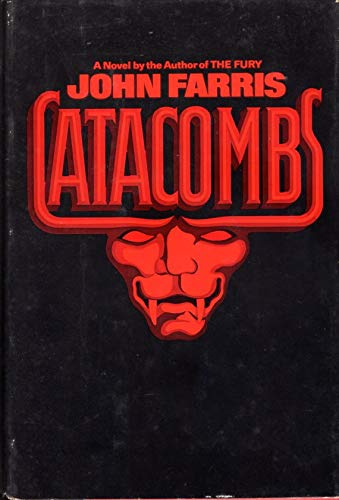
- Catacombs
John Farrisstandalone novel1981
similar bypolitical intriguelate 20th centuryadventuroustense
Americans agents, Soviets agents and an archeaological team investigate the catacombs of an ancient advanced civilization in Africa.
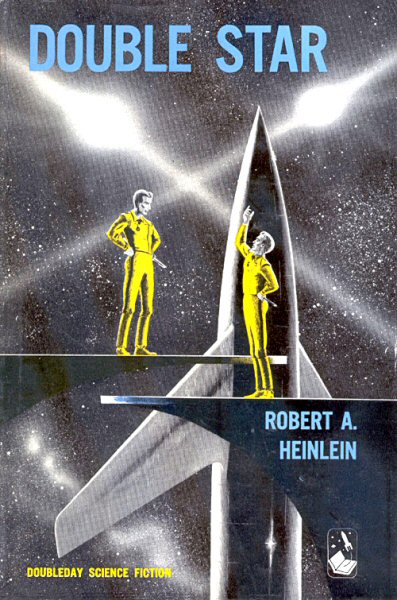
- Double Star
Robert A. Heinleinstandalone novel1956
similar bypolitical intrigueadventurousscience fiction+1 more
Lorenzo Smythe, the excellent yet unemployed actor, meets Dak Broadbent in a bar. Broadbent hires Lorenzo for an unspecified role, and hustles him onto a rocket ship. Broadbent turns out to be an assistant to the famous interplanetary politician and leader of the Expansionist party: John J. Bonforte. Bonforte, however, has been kidnapped by the political opposition on Mars, and due to Lorenzo's physical similarity to Bonforte, his staff wants Lorenzo to impersonate the politician for an important Martian ceremony.
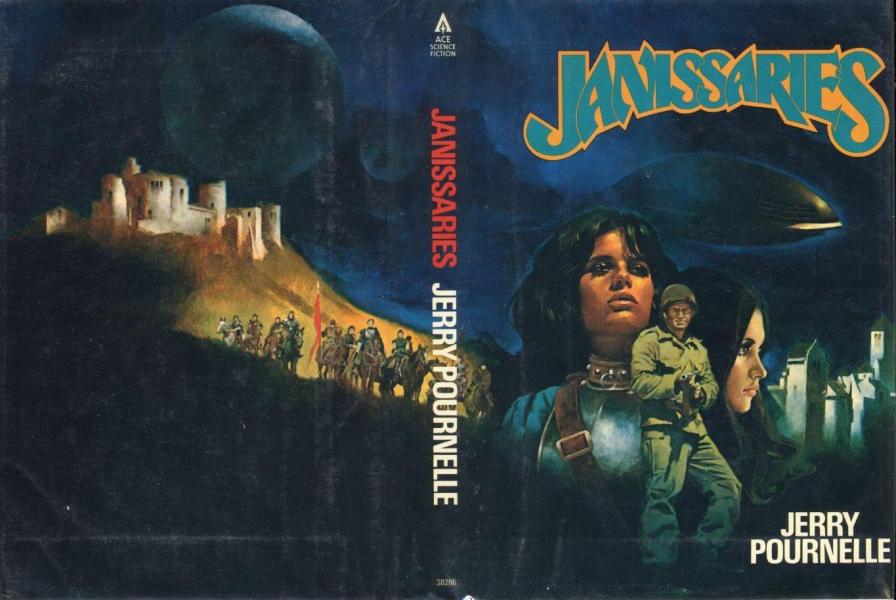
- Janissaries
series4 books1979
similar bypolitical intrigueadventuroustensescience fiction
Janissaries are an American series of military and political-based science fiction novels are set in an interstellar confederation of races, in which humans are a slave race entrusted with military affairs and law enforcement. They were written by Jerry Pournelle, with Roland J. Green co-authoring the second two books.
- Chanur
series7 books1982
part of Alliance-Union Universe
similar bypolitical intrigueadventuroustensescience fiction
The Chanur novels are a series of five science fiction novels, forming three separate stories, written by American author C. J. Cherryh and published by DAW Books between 1982 and 1992. The first novel in the series is The Pride of Chanur (1982), which was nominated for both the Hugo and Locus Awards in 1983. The Pride of Chanur, originally a stand-alone story, was followed by the Chanur's Venture trilogy, Chanur's Venture (1984), which was shortlisted for a Locus Award in 1985; The Kif Strike Back (1985) and Chanur's Homecoming (1986). These were followed by a later sequel, Chanur's Legacy (1992). The five novels were also published in two omnibus editions: the first three in The Chanur Saga in 2000 and the next two in Chanur's Endgame in 2007.
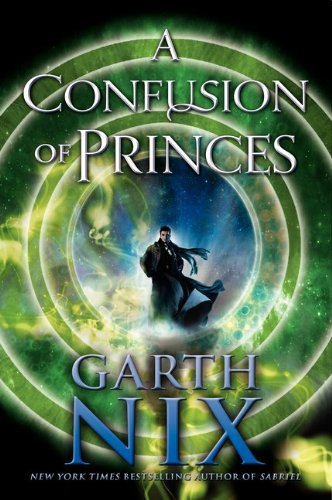
- Imperial Galaxy
series2 books2012
similar bypolitical intrigueadventurousyoung adultscience fiction+1 more
Prince Khemri has spent his life as one of ten thousand princes bred and trained by a sprawling galactic empire, expecting eventual rule -- until he learns just how disposable princes actually are, and how routinely they're assassinated by their own siblings. Garth Nix's A Confusion of Princes follows Khemri through the empire's ruthless military, its secret intelligence service, and a deadly, decades-long competition to determine who might one day take the throne. It's a single, self-contained space opera rather than an ongoing series.
- The Masks of Time
Robert Silverbergstandalone novel1968
similar bypolitical intriguelate 20th centurytensescience fiction
From the back cover of the Ballantine first edition: "The year is 1999. The century is about to turn. The civilized world is prosperous but tense with fear about the still existing possibility of a major war. While in the large area that used called "underdeveloped" there is a hysterical conviction that the world will cone to an end with the arrival of the new century Into this explosive situation floats a creature calling himself Vornam-19 - and claiming to be a visitor from 1000 years in the future... The world is ready, indeed ripe, for a sign, an omen, a new cult. But no one realizes exactly what Vornaa-19 is in his own right."
- Bartimaeus
series4 books2003
similar bypolitical intrigueadventurousyoung adultalternate history
The Bartimaeus Sequence is a series of young adult novels of alternate history, fantasy and magic. It was written by British writer Jonathan Stroud and consists of a trilogy published from 2003 to 2005 and a prequel novel published in 2010. The story follows the career of a teenage magician Nathaniel and a five-thousand-year-old djinni Bartimaeus, whom he has summoned and nominally controls, through the alternate history of the peak of London's domination as a magical oligarchy.
- Inventors World
series1 book2013
similar bypolitical intrigueadventuroustensesteampunkyoung adultscience fiction
- SS-GB
Len Deightonstandalone novel1978
similar bypolitical intriguetensealternate historyscience fiction
It's November 1941 in a Britain that lost the war: Operation Sea Lion succeeded, Churchill was executed, and the King is a prisoner in his own Tower of London. Detective Superintendent Douglas Archer, still working homicide for the Metropolitan Police under German occupation, catches what looks like a routine case, a well-dressed man murdered above an antiques shop, until the body's oddities point toward something far more dangerous than burglary gone wrong. Archer's investigation collides with occupation politics, the British resistance, and rival factions of the SS and the German Army, each wanting the case to go a different way. Len Deighton's alternate-history spy thriller.
- The Last President
Michael Kurland & S. W. Bartonstandalone novel1980
similar bypolitical intriguelate 20th centurytensealternate history
WorldCat: Set in an alternative reality where "All the President's men" do not get caught at Watergate, this "shockingly believable" novel presents the frightening scenario of what could happen if a powerful but paranoid American chief executive goes out of control.
- The Apollo Murders
Chris Hadfieldstandalone novel2021
similar bypolitical intrigueadventuroustensealternate history
The Apollo Murders is a 2021 alternate history, thriller novel by Canadian retired astronaut and writer Chris Hadfield. It was first published in October 2021 in the United States by Little, Brown and Company, and in the United Kingdom by Quercus. The book is Hadfield's debut novel, and is the first in his Apollo Murders series, followed later by The Defector in 2023 and Final Orbit in 2025. Hadfield had previously published three non-fiction books, his first being his autobiography, An Astronaut's Guide to Life on Earth (2013).
- Dune
series20 books1963
part of Dune Universe
similar bypolitical intriguescience fiction+1 more
Frank Herbert's Dune Chronicles opens with 1965's Dune, set on the desert planet Arrakis where House Atreides takes control of the only source of the vital spice melange and young Paul Atreides is pulled into a struggle over its politics and religion. Herbert carried the story forward across five further novels — Dune Messiah, Children of Dune, God Emperor of Dune, Heretics of Dune, and Chapterhouse: Dune — following Paul's line over the following millennia, before Brian Herbert and Kevin J. Anderson later extended the saga. Many other editions of these six novels are omnibus and box-set repackagings rather than separate stories.
- Sword of the Rightful King
Jane Yolenstandalone novel2003
similar bypolitical intrigueadventuroustenseyoung adult
"The newly crowned King Arthur has yet to win the support of the people. Merlin must do something before the king is betrayed, or murdered, or--worst of all--gets married..."
- The Merchant Princes
series14 books2004
similar bypolitical intriguetensealternate historyscience fiction
The Merchant Princes is a science fantasy and alternate history series of nine novels by British writer Charles Stross. In the series, there exist a number of parallel worlds, all of which are on the same geographical Earth but with different societies at different points of development. Members of a certain bloodline can travel between these worlds along with their immediate possessions. The series largely follows Miriam Beckstein, a technology journalist raised in a familiar "normal" Earth, who discovers she was born in a parallel world and is a member of this bloodline. She quickly becomes entangled in political maneuvering and assassination plots with her estranged family. Miriam uses modern technology and investigative journalism to attempt to stay a step ahead.
- Wolfling
Gordon R. Dicksonstandalone novel1969
similar bypolitical intrigueadventuroustensescience fiction
From the flaps of the Baen/SFBC edition: "Is Earth merely the lost colony of a superior race? - She was well over six feet tall, and beautiful in a sculpted, abstract way. She had skin the color of white onyx, and her eyes... her eyes were large and feline - a startling lemon yellow in color. She was the Princess Afuan, one of the High-born, and she had chosen the Earthman Kim Keil to return to the Throne World with her - for she had decided that his performance in the bull-ring might amuse the Emperor. She didn't know that Jim was a bull-fighter only by virtue of six months' intensive training, nor that the bull was programmed - his behavior following and impressively fierce but unswerving pattern. Jim was just another wolfling to Afuan - a lesser being from a backward colony world. Jim, however, was keenly aware that he was playing a role, one which might prove to be extremely dangerous. Up until 10 years earlier, when their first ship had reached Alpha Centauri, the people of Earth hadn't even known that the vast Empire of human-occupied worlds existed. The discovery had been a profound shock. Had we evolved independently? Or were we merely descendants of the Empire's first space pioneers - a lost colony found at last, perhaps with devastating consequences? That's what Jim Keil had to find out. Chosen from among numerous highly qualified candidates - an anthropologist trained, mentally and physically, beyond the limits of his profession - it was his mission to observe the Throne World and the High-born... to determine whether or not they posed a threat to Earth. One thing was apparent from the start. The High-born were superior beings - physically taller and stronger than other humans, endowed with faster reflexes, superior mental capacity... and extraordinary technological resources. Their contempt for the new wolfling in their midst was open, their intrigues complex. An enormous gulf separated the people of the Throne World from Earthlings. But that gulf was not so wide that Jim couldn't recognize an enemy when he met one. Clearly, if he remained merely a passive observer of the High-born, he'd never survive among them."
- 1920: America's Great War
Robert Conroystandalone novel2013
similar bypolitical intrigueadventuroustensealternate historyscience fiction
1920: America's Great War is an alternate history novel by the Michigan economics professor Robert Conroy. It was first published as an ebook by Baen Books in November 2013. A hardcover edition followed in December of the same year and then a paperback edition in March 2015. The novel depicts a fictional world in which Imperial Germany had emerged victorious early in World War I and launches a surprise invasion of the United States in 1920 from Mexico. The book's premise is based on an actual plan that Germany had proposed to Mexico during the war.
- Vatta's War
series6 books2003
part of Vatta
similar bypolitical intrigueadventuroustensescience fiction
Vatta's War is a science fiction series by American writer Elizabeth Moon, comprising five books: Trading in Danger (2003), Marque and Reprisal, Engaging the Enemy (2006), Command Decision (2007), and Victory Conditions (2008). They have been characterized as military science fiction similar in style to the works of Lois McMaster Bujold, David Weber and Walter Jon Williams.