More like Doomflower
anchored on:science fictionfar futureother star systems
but
- Dune Universe
universe78 books1963
Start hereDune · Start here
similar byscience fictionfar futureother star systems+1 more
Arrakis. Dune. The desert planet, where empire runs on a single substance: the spice melange, which folds space, prolongs life, and unlocks prescience, and which exists nowhere else in the known universe. Frank Herbert's saga is a meditation dressed as an adventure — feudal houses and a secret sisterhood, engineered messiahs and the patient ecology of a world without water, all turning on the terrible gravity of who commands the spice. It reads like scripture and schemes like a war room, ten thousand years hence, among people who have outlawed the thinking machine and made instruments of themselves instead. At its heart stand Herbert's original six — Dune, Dune Messiah, Children of Dune, God Emperor of Dune, Heretics of Dune, Chapterhouse: Dune — a single deepening arc across millennia, arguing the whole way between prophecy and free will. Around that spine his son Brian Herbert and Kevin J. Anderson have raised a vast prequel architecture: Prelude to Dune, tracing the great houses a generation before Paul; Legends of Dune, reaching back to the crusade that broke the machines; the Schools of Dune cycle on the founding of Bene Gesserit, Mentat, and Navigator; the Caladan Trilogy and Heroes of Dune filling years the originals left in shadow. Many hands, dozens of volumes, one desert. What sets Dune apart is its refusal of the simple: religion is manufactured, heroes are hazards, and the sand itself — worm, water, ecology — acts as a political power. Begin where the universe did, with Frank Herbert's Dune (1965), and read the original six in order; you need nothing else to feel the full weight. The prequels are a country to explore afterward, taken by era. Beginnings are delicate times.
- Dune
series20 books1963
part of Dune Universe
similar byscience fictionfar futureother star systems+1 more
Frank Herbert's Dune Chronicles opens with 1965's Dune, set on the desert planet Arrakis where House Atreides takes control of the only source of the vital spice melange and young Paul Atreides is pulled into a struggle over its politics and religion. Herbert carried the story forward across five further novels — Dune Messiah, Children of Dune, God Emperor of Dune, Heretics of Dune, and Chapterhouse: Dune — following Paul's line over the following millennia, before Brian Herbert and Kevin J. Anderson later extended the saga. Many other editions of these six novels are omnibus and box-set repackagings rather than separate stories.
- Ender Wiggin
series14 books1977
part of Ender's Game Universe
similar byscience fictionother star systemsfar future
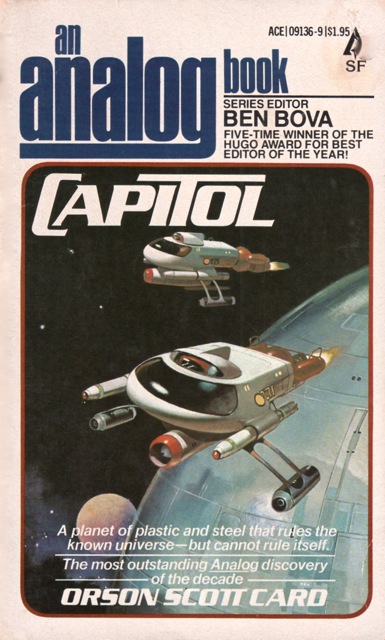
Orson Scott Card's Ender's Game (1985, expanded from his 1977 novella) follows child prodigy Andrew "Ender" Wiggin as he is recruited into a military training program built to prepare Earth's defenses for an anticipated third war against an insectoid alien species known as the Formics. The saga continues years later through Speaker for the Dead and Xenocide, following an older Ender as he confronts the moral weight of his role in that earlier conflict, and concludes the core arc in Children of the Mind, with Ender in Exile filling in the years between the first two books. Set within the wider Ender's Game universe, the series shifts from military coming-of-age story to slower, more philosophical science fiction as it progresses.
- The Stars My Destination
Alfred Besterstandalone novel1956
similar byscience fictiondarkfar futureother star systems
When a passing spaceship refuses to rescue the lone survivor from the drifting wreck of another ship, he dedicates his life to discovering who made that decision and exacting his revenge, in the process altering human history and his own character.
- Pandora
series4 books1966
similar byscience fictionfar futureother star systems+1 more
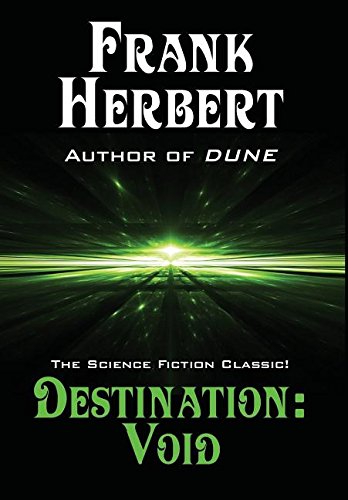
The Pandora Sequence opens with Frank Herbert's solo novel Destination: Void, in which a starship crew must jury-rig a working artificial consciousness after their vessel's control systems fail. Bill Ransom co-writes the three novels that follow, carrying the survivors to the world Pandora, where they must contend with both a manipulative machine intelligence and the planet's own hostile ecology. Across its four books the series moves from a claustrophobic ship-bound crisis to a generations-long struggle over faith, control, and survival on a dangerous new world.
- The Dosadi Experiment
Frank Herbertstandalone novel1977
similar byscience fictionfar futureother star systems+1 more
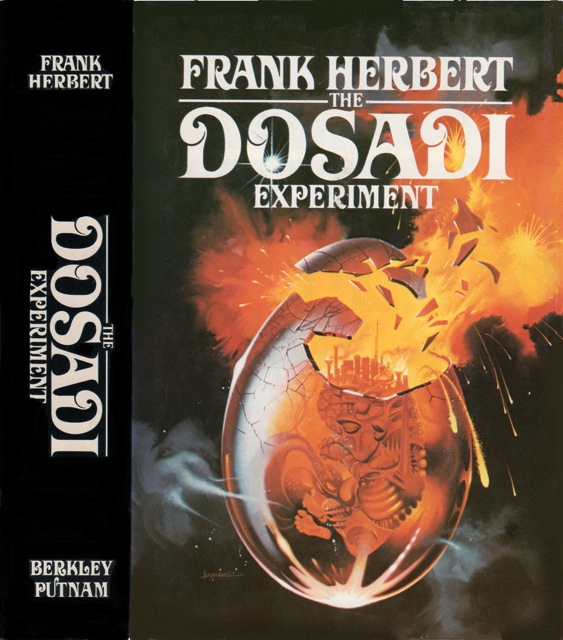
From the flaps of the Berkley Putnam first edition: "In his first new work of science fiction since the best-selling Children of Dune, Frank Herbert returns to his world of Whipping Star, and involves Jorj X. McKie, Saboteur Extraordinary, in a new intrigue. In Whipping Star, McKie discovered that some of the stars in the universe are actually intelligent, super-powerful beings, and was able to befriend one of them, the star Alcyone - affectionately known as Fannie Mae. As The Dosadi Experiment opens, McKie is assigned to investigate the planet Dosadi, which is isolated from the rest of the galaxy by a "god-wall," a barrier set up by one of the intelligent stars. Dosadi is rumored to be an experimental planet, and the experimenters are the froglike Gowachin, whose culture is founded upon a strange legal system in which McKie is the only human ever trained. He learns that humans and Gowachin have been placed on Dosadi, without their consent, for an experiment that could last centuries: an experiment in extreme overcrowding. But this monstrous plot is apparently out of control, and it seems the Gowachin may be prepared to destroy Dosadi rather than expose its secret, thus breaking the peace among the races, and starting the first interstellar war. But this is just the beginning. When McKie finally reaches Dosadi he discovers that the Dosadis have taken control of their own evolution and produced a competitive, highly evolved elite, of both humans and Gowachin, who have been able to extrapolate the existence of a universe beyond the god-wall and hate whoever has imprisoned them like this. They plan to break out and avenge themselves on the galaxy."
- Forever War
series10 books1972
similar byscience fictionfar future+2 more
Joe Haldeman's The Forever War (1974) follows a soldier conscripted into a centuries-long interstellar war against the alien Taurans, using relativistic space travel so that months spent in transit correspond to years or decades passing back on Earth. Haldeman later returned to the same conflict in Forever Peace (1997), a thematically connected but separate story, and Forever Free (1999), a direct sequel set years after the original war's end. The first novel won the Hugo, Nebula, and Locus awards and is considered a foundational work of military science fiction.
- Heorot
series4 books1987
similar byscience fictionfar futureother star systems
Larry Niven, Jerry Pournelle and Steven Barnes's The Legacy of Heorot strands human colonists on an idyllic-seeming alien world where they discover apex predators -- grendels -- hidden beneath the surface, forcing them to fight for survival. Beowulf's Children continues the colony a generation later as the children born on the planet clash with their parents over how to live alongside the grendels, and a fourth book, Starborn and Godsons, returns to the settlement decades further on. It's hard-SF creature-horror crossed with generational colony drama.
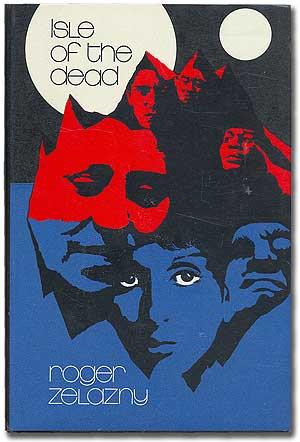
- Creatures of Light and Darkness
Roger Zelaznystandalone novel1969
similar byscience fictiondarkfar futureother star systems
Creatures of Light and Darkness is a 1969 science fiction novel by American writer Roger Zelazny. Long out of print, it was reissued in April 2010. The novel is set in the far future, with humans on many worlds. Some humans have god-like powers or perhaps are actually gods—the names and aspects of various Egyptian gods are used. Elements of horror and technology are mixed, and the novel shares elements with cyberpunk.
- Armor
John Steakleystandalone novel1984
similar byscience fictiondarkfar futureother star systems
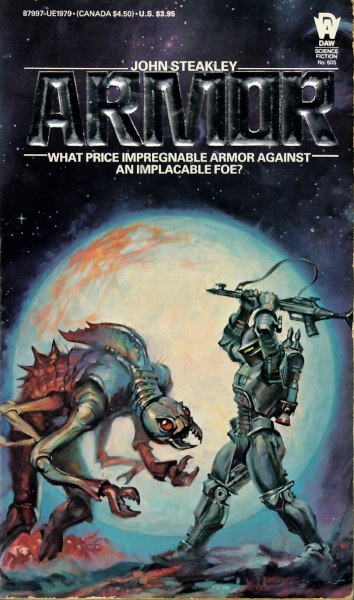
Armor is a military science fiction novel by John Steakley. It features the military use of exoskeletons and insect-like alien enemies but concentrates on the psychological effects of violence on human beings.
- Hainish
series33 books1964
completed
similar byscience fictionfar futureother star systems
The Hainish Cycle consists of a number of science fiction novels and stories by Ursula K. Le Guin. The cycle is set in a future history that features civilizations of human beings on planets orbiting a number of nearby stars, including Terra ("Earth"); these humans are contacting each other for the first time and establishing diplomatic relations, as well as setting up a confederacy under the guidance of the oldest of the human worlds, the peaceful planet Hain. In this history, human beings did not evolve on Earth, but they were instead the result of interstellar colonies planted by Hain in the distant past, after which interstellar travel ceased for an extended period. Some of the human races have new genetic traits, a result of ancient Hainish experiments in genetic engineering; this includes people who can dream while awake, and a world of hermaphroditic people who only enter active sexuality once per month, not knowing which sex will manifest in them. In keeping with Le Guin's narrative approach, she uses varied social and environmental settings to explore the anthropological and sociological outcomes of human evolution in those environments. The author often discounted the characterization of a so-called "Hainish Cycle".
- Thorns
Robert Silverbergstandalone novel1967
similar byscience fictiondarkfar futureother star systems
From the back cover of the Ballantine first edition: "Lona Kelvin - naive orphan. And at seventeen, mother of one hundred children. Minner Burris - starman. Whose butchered body had been put together by aliens, with artificial and alien replacements. Horror stalked just beneath the surface of these two lonely creatures. Duncan Chalk - a vulture, carrion eater of other people's emotions, feeding on pain, fear, anger, hatred, jealousy, terror; typifying in the appetites of his vast body the sick delight that millions took in the tragedies he skillfully arranged. Lona Kelvin - Minner Burris - Duncan Chalk - Surely the strangest triangle the worlds had ever seen."
- Wolfbane
C. M. Kornbluth & Frederik Pohlstandalone novel1959
similar byscience fictionfar futureother star systems+1 more
Wolfbane is a science fiction novel by American writers Frederik Pohl and C. M. Kornbluth, published in 1959. It was serialized in Galaxy in 1957, with illustrations by Wally Wood. In his review column for F&SF, Damon Knight selected the novel as one of the 10 best genre books of 1959.
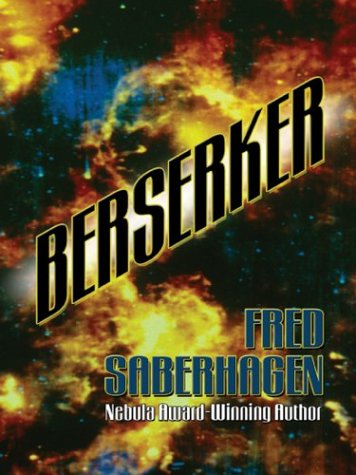
- Berserker (Fred Saberhagen)
series59 books1963
similar byscience fictionfar futureother star systems+1 more
The Berserker series is a series of space opera science fiction short stories and novels by Fred Saberhagen, in which robotic self-replicating machines strive to destroy all life.
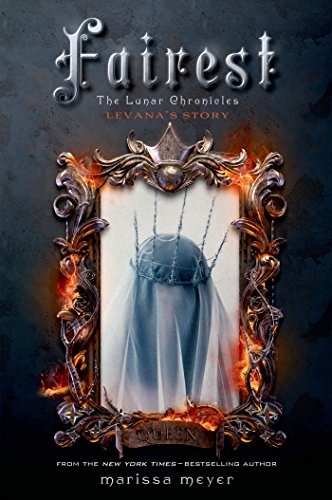
- Lunar Chronicles
series15 books2011
similar byscience fictionfar futureother star systems
The Lunar Chronicles is a series of four young adult science fiction novels, a novella, and a short story collection written by American author Marissa Meyer and published by Feiwel & Friends. Each book entails a science fictional twist on a classic fairy tale, including "Cinderella", "Little Red Riding Hood", "Rapunzel", and "Snow White". Set in a futuristic world inhabited by various species and creatures, tensions are rising between Earth and its former colony Luna, while both attempt to manage an ongoing pandemic.
- Clans of the Alphane Moon
Philip K. Dickstandalone novel1964
similar byscience fictionfar futureother star systems+1 more
Clans of the Alphane Moon is a 1964 science fiction novel by American writer Philip K. Dick. It is based on his 1954 short story "Shell Game", first published in Galaxy Science Fiction magazine.
- The Status Civilization
Robert Sheckleystandalone novel1960
similar byscience fictiondarkfar futureother star systems
"Will Barrent had no memory of his crime ... but he found himself shipped across space to a brutal prison-planet. On Omega, his only chance to advance himself -- and stay alive -- is to commit an endless series of violent crimes. The average inmate's life expectancy from time of arrival is three years. Can Barrett survive, escape, and return to Earth to clear his name?" - From the cover of the 2007 Wildside paperback edition.
- Thousand Worlds
series24 books1971
similar byscience fictionfar futureother star systems+1 more
George R.R. Martin's Thousand Worlds is a loose future-history setting he used for several of his 1970s-80s stories and novels, encompassing human interstellar colonization and encounters with older, stranger civilizations. Dying of the Light, A Song for Lya and the novella Nightflyers are among its best-known entries, sharing background rather than continuing characters or plot.
- The Worthing Chronicle
series17 books1978
similar byscience fictionfar futureother star systems
The Worthing series is a series of science fiction works by American writer Orson Scott Card. It consists of two anthologies and two novels. The first three books in this series are currently out of print.
- Takeshi Kovacs
series3 books2002
similar byscience fictiondarkfar futureother star systems
Takeshi Kovacs is a former elite soldier turned freelance troubleshooter in a future where human consciousness can be digitized and transferred between bodies, or sleeves, making death an inconvenience for those who can afford new ones. Richard Morgan's trilogy - Altered Carbon, Broken Angels, Woken Furies - moves Kovacs through noir-inflected mysteries on different worlds, using the resleeving premise to interrogate class, violence, and what, if anything, survives a person's original body. It became the basis for a Netflix series.
- Kefahuchi Tract Trilogy
series3 books2002
similar byscience fictionfar futureother star systems+1 more
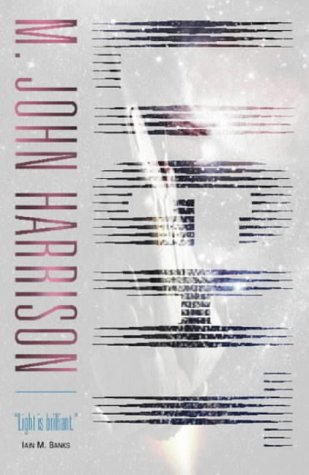
M. John Harrison's Kefahuchi Tract trilogy circles a strange, physics-breaking anomaly in deep space that draws scientists, smugglers, and drifters into its pull across different eras. Light moves between a near-future timeline and a far-future one drawn to the Tract itself; its sequel Nova Swing stays within one future period, where a fragment of the anomaly's altered space bleeds into the run-down port city of Saudade, giving the book a noir, Roadside-Picnic-like atmosphere; Empty Space concludes the sequence. The three novels share a setting and mood more than a continuous plot or cast.
- Childe Cycle
series19 books1957
similar byscience fictionother star systemsfar future
The Childe Cycle is an unfinished series of science fiction novels by American writer Gordon R. Dickson. The name Childe Cycle is an allusion to "Childe Roland to the Dark Tower Came", a poem by Robert Browning, which provided inspiration for elements in the work. The series is sometimes referred to as the Dorsai series, after the Dorsai people who are central to it. The related short stories and novellas all center on the Dorsai, primarily members of the Graeme and Morgan families.
- Nightfall
Isaac Asimov & Robert Silverbergstandalone novel1990
similar byscience fictionfar futureother star systems+1 more
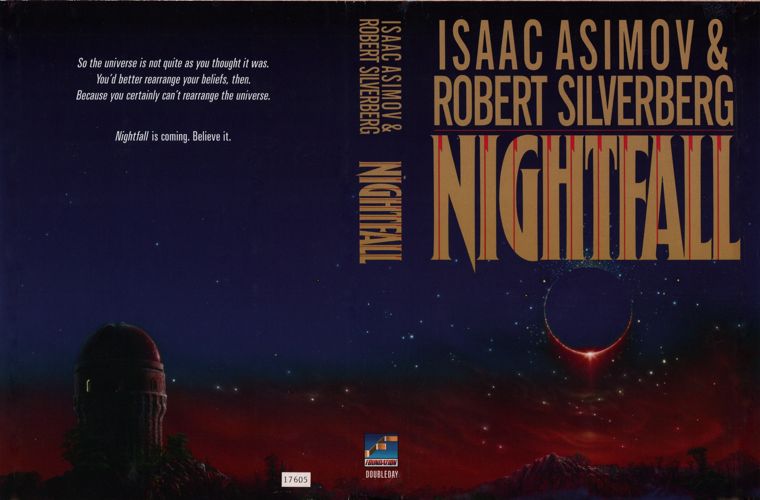
These two renowned writers have invented a world not unlike our own--a world on the edge of chaos, torn between the madness of religious fanaticism and the stubborn denial of scientists. Only a handful of people on the planet Lagash are prepared to face the truth--that their six suns are setting all at once for the first time in 2,000 years, signaling the end of civilization!