More like Down Styphon!
anchored on:science fictionalternate historytransported to another worldpolitical intriguewaradventurous
but
- Restoree
Anne McCaffreystandalone novel1967
similar byadventurousscience fictiontransported to another worldtense
Torn from Earth by a bizarre and nameless black force, Sara has no idea where she is or why she inhabits a beautiful new body. Controlled by brutal guards and tamed by terror, she can not comprehend her role as a nurse for a man who appears to be an idiot. She discovers that the planet she had been brought to was Lothar and that the man she was caring for was its Regent, Sara knows the restorees had to escape. When they do, they become fugitives on a world of multiple evils. (adapted from the back cover of the Baen edition)
- Paratime Police
series33 books1948
similar byadventurousscience fictionalternate history+3 more
The Paratime series written by H. Beam Piper and subsequently by John F. Carr consists of several short stories, one novella, and one novel, all but one of which were originally published in Astounding Science Fiction under the editorship of John W. Campbell. The series deals with an advanced civilization that is able to travel between parallel universes with alternate histories, and uses that ability to trade for goods and services that its own, exhausted Earth cannot provide. The protagonists of the stories are the Paratime Police, the organization that protects the secret of paratime travel.
- The Lost Regiment
series9 books1990
similar byadventurousscience fictionwartensealternate history+1 more
William R. Forstchen's Lost Regiment series begins with Rally Cry, in which a Civil War Union regiment is swept onto a distant world where humans transplanted from many eras and cultures are farmed as food by an alien race. Arriving with nineteenth-century gunpowder weapons and organized tactics, the regiment's survivors fight to build a defensible nation and turn the war back on their captors, a conflict that escalates across nine novels of technology, politics, and generations.
- The Codex Alera
series6 books2004
similar byadventurouspolitical intriguewartense
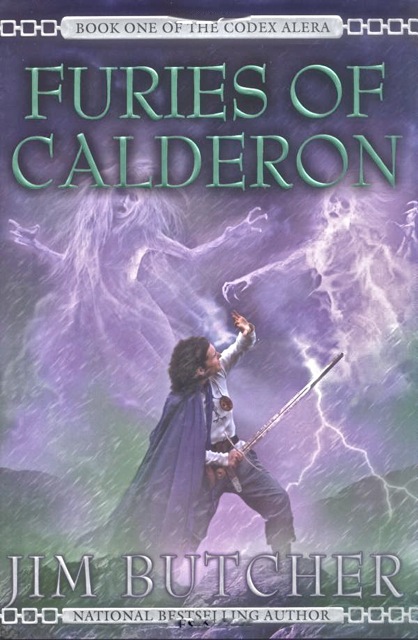
Furies of Calderon opens The Codex Alera in a Rome-flavored fantasy world where nearly everyone commands elemental spirits called furies, except Tavi, a teenager with none, whose resourcefulness becomes the series' recurring answer to raw magical power. Jim Butcher's six-book series, continuing through Academ's Fury, Cursor's Fury, Captain's Fury, Princeps' Fury, and First Lord's Fury, builds from small-scale political maneuvering into full-scale war.
- Transit
Edmund Cooperstandalone novel1964
similar byadventurousscience fictiontransported to another worldtense
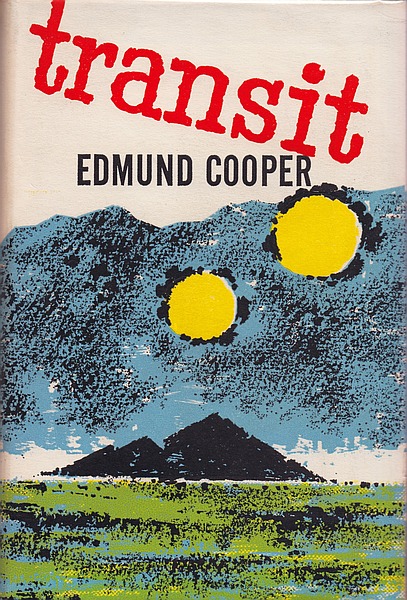
Transit... to another world. As a human being - an Earthman - Richard Avery was not particularly successful. He was mediocre as a teacher, and a failure as an artist. The rewards of Earth had passed him by. Still... Earth was home. It was where he belonged, where he could at least go his way unnoticed. Until that afternoon in Kensington Gardens, and that gleaming, hypnotic crystal that transported him - instantaneously - to a new and alien world. He was not alone, at least. There were three other Earth people marooned with him, all without a hint of the location or reason. And four more oddly assorted individuals would have been hard to imagine... Together, they faced sudden, savage onslaughts from an unknown foe. Together, they faced a fantastic implacable environment. And alone, they faced themselves - for to win, or even to survive, they had to re-discover what it meant to be human... (from the back cover of the Lancer first American edition)
- Janissaries
series4 books1979
similar byadventurousscience fictionpolitical intriguewartense
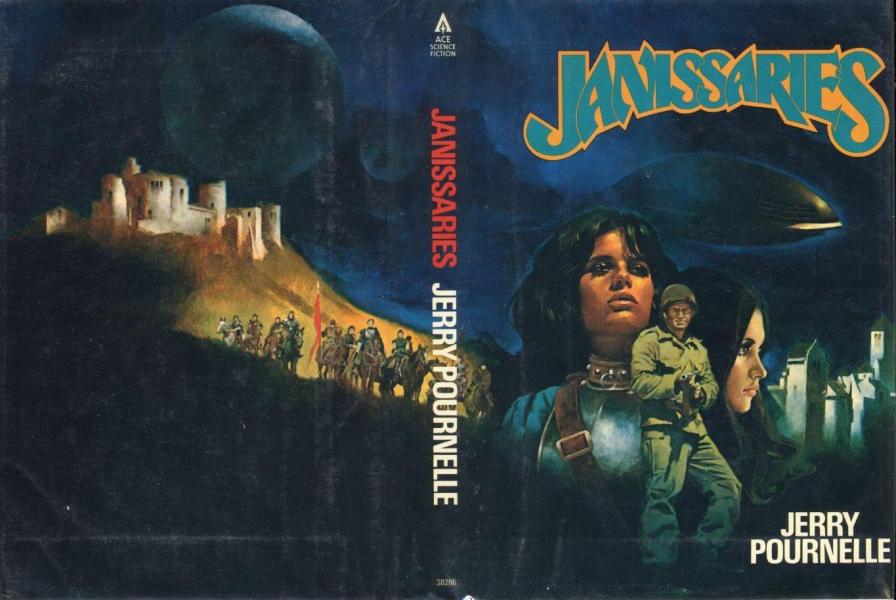
Janissaries are an American series of military and political-based science fiction novels are set in an interstellar confederation of races, in which humans are a slave race entrusted with military affairs and law enforcement. They were written by Jerry Pournelle, with Roland J. Green co-authoring the second two books.
- The Leviathan Trilogy
series3 books2009
similar byadventurouswaralternate historyscience fiction+2 more
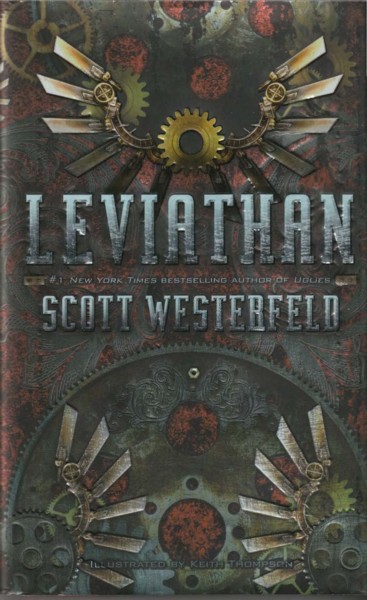
Set in an alternate First World War, Leviathan splits the belligerents into Clankers, who fight with mechanical walkers, and Darwinists, who fight with fabricated living creatures built from spliced DNA. Scott Westerfeld follows a British girl disguised as a boy to serve on a living airship and the exiled heir to the Austro-Hungarian throne as their paths collide, continuing across Behemoth and Goliath. Keith Thompson's illustrations are integral to all three books, alternating text chapters with illustrated sequences.
- Vatta's War
series6 books2003
part of Vatta
similar byadventurousscience fictionwarpolitical intriguetense
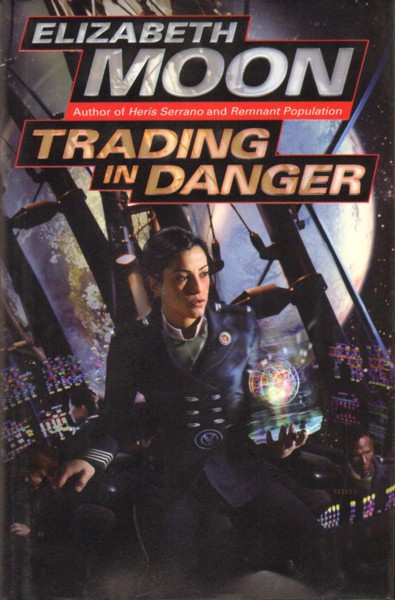
Vatta's War is a science fiction series by American writer Elizabeth Moon, comprising five books: Trading in Danger (2003), Marque and Reprisal, Engaging the Enemy (2006), Command Decision (2007), and Victory Conditions (2008). They have been characterized as military science fiction similar in style to the works of Lois McMaster Bujold, David Weber and Walter Jon Williams.
- Sten
series11 books1982
completed
similar byadventurousscience fictionpolitical intriguewar+1 more
The Sten Chronicles, also called The Sten Adventures, are a series of eight military science fiction and space opera novels by Chris Bunch and Allan Cole published from 1982 to 1993. The series was originally published by Del Rey and then re-released by Orbit.
- 1920: America's Great War
Robert Conroystandalone novel2013
similar byadventurousscience fictionalternate historypolitical intriguewartense
1920: America's Great War is an alternate history novel by the Michigan economics professor Robert Conroy. It was first published as an ebook by Baen Books in November 2013. A hardcover edition followed in December of the same year and then a paperback edition in March 2015. The novel depicts a fictional world in which Imperial Germany had emerged victorious early in World War I and launches a surprise invasion of the United States in 1920 from Mexico. The book's premise is based on an actual plan that Germany had proposed to Mexico during the war.
- The Moon Is a Harsh Mistress
Robert A. Heinleinstandalone novel1966
similar byadventurousscience fictionpolitical intrigue+1 more
A technician discovers that the massive computer that operates everything on Luna (a prison colony) has become self-aware. He befriends it, but when he accompanied a beautiful girl to a dissident meeting, he encounters people who want to throw off the yoke of their Earth rulers.
- Old Man's War
series16 books2005
similar byadventurousscience fictionwar+2 more
The Old Man's War series is a series of science fiction novels by John Scalzi. The first book in the series, Old Man's War, was first published in 2005 by Tor Books, and was nominated for the Hugo Award for Best Novel in 2006. In 2026 it was a finalist for the Hugo Award for Best Series.
- Double Star
Robert A. Heinleinstandalone novel1956
similar byadventurousscience fictionpolitical intrigue+1 more
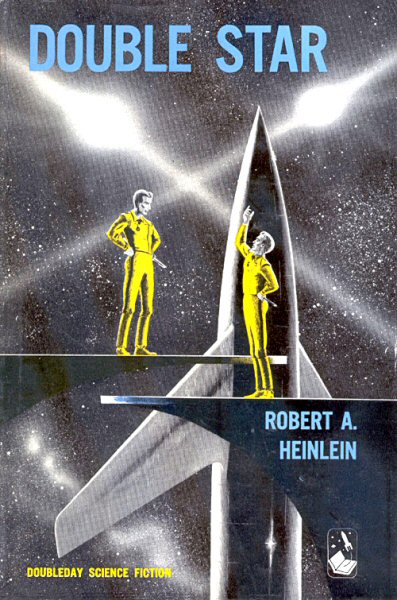
Lorenzo Smythe, the excellent yet unemployed actor, meets Dak Broadbent in a bar. Broadbent hires Lorenzo for an unspecified role, and hustles him onto a rocket ship. Broadbent turns out to be an assistant to the famous interplanetary politician and leader of the Expansionist party: John J. Bonforte. Bonforte, however, has been kidnapped by the political opposition on Mars, and due to Lorenzo's physical similarity to Bonforte, his staff wants Lorenzo to impersonate the politician for an important Martian ceremony.
- Honor Harrington
series14 books1993
part of Honorverse
similar byscience fictionwarpolitical intriguetense+1 more
David Weber's Honor Harrington novels follow the title character's rise through the Manticoran navy in the 'Honorverse,' a space-opera setting built around Age-of-Sail-style naval combat, interstellar politics and a decades-long war between rival star nations. Beginning with On Basilisk Station, the core series runs to fourteen books, alongside spin-off subseries, prequels and shared-world anthologies also set in the Honorverse. It's one of the longest-running modern military science fiction series, published by Baen.
- Conquerors
series3 books1994
similar byadventurousscience fictionwarpolitical intriguetense
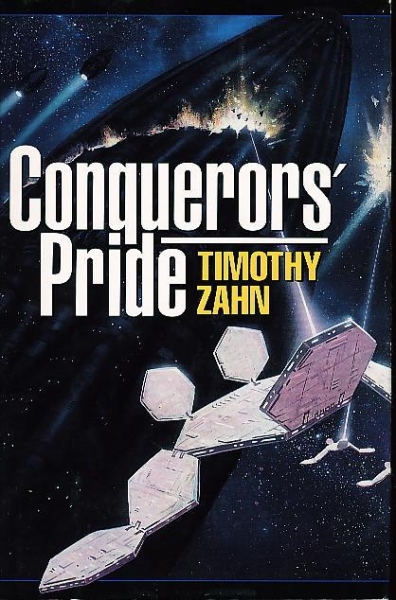
Conquerors is Timothy Zahn's military science-fiction trilogy following human fighter pilots and their commanders through an interstellar war that neither side fully understands, told across Conquerors' Pride, Conquerors' Heritage, and Conquerors' Legacy. Zahn alternates perspective between the human and alien chains of command, using the shifting viewpoints to slowly unpick why the conflict started in the first place. It's contact-and-conflict SF built around miscommunication rather than straightforward invasion.
- A Brother's Price
Wen Spencerstandalone novel2005
similar byadventurousscience fictionalternate history+1 more
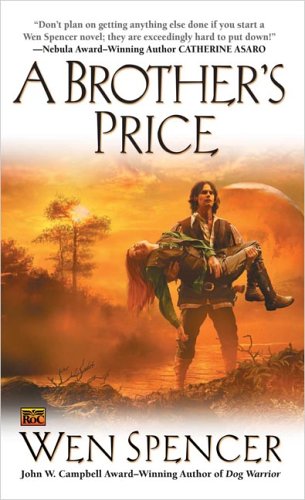
On an alternate Earth, where the population is ninety percent female and a man is sold by his sisters to marry all the women in a family, Jerin Whistler is coming of age. His mothers are respected landed gentry, his grandfather a kidnapped prince, and his grandmothers common line soldiers blackballed for treason, trained by thieves, re-enlisted as spies, and knighted for acts of valor. Jerin wants to marry well, and his sisters want a husband bought by his brother’s price.
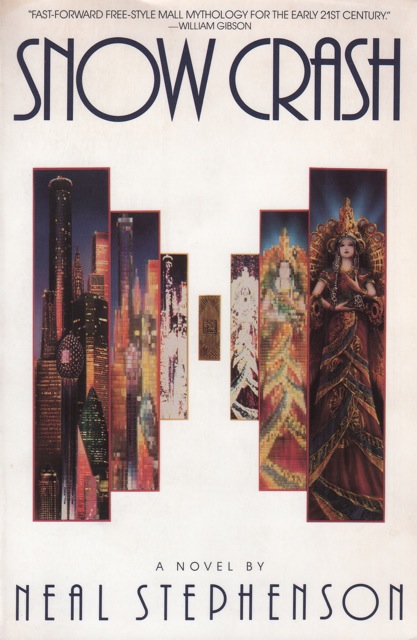
- Snow Crash
Neal Stephensonstandalone novel1992
similar byadventurousscience fictionpolitical intriguetense
Snow Crash is a 1992 science fiction novel by Neal Stephenson. Like many of Stephenson's novels, its themes include history, linguistics, anthropology, archaeology, religion, computer science, politics, cryptography, memetics, and philosophy.
- A Song of Ice and Fire
series14 books1996
part of World of Ice and Fire
similar bypolitical intriguewar+1 more
A Song of Ice and Fire is a series of high fantasy novels by the American author George R. R. Martin. Martin began writing the first volume, A Game of Thrones, in 1991, and published it in 1996. Martin, who originally envisioned the series as a trilogy, has released five out of seven planned volumes. The most recent entry in the series, A Dance with Dragons, was published in 2011. Since then, Martin has been working on the sixth novel, titled The Winds of Winter. A seventh novel, A Dream of Spring, is planned to follow.
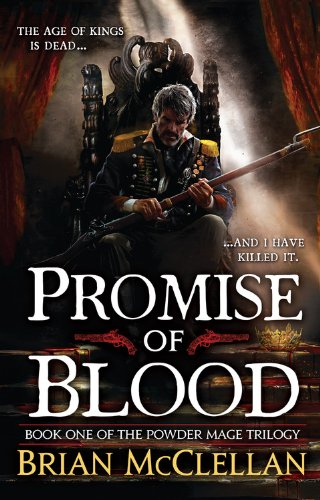
- The Powder Mage
universe19 books2013
Start hereThe Powder Mage Trilogy · Start here
similar bywarpolitical intriguetense+1 more
Load your powder, and pray your sorcery outruns their cannon. Here the age of kings is ending at musket-point: a world where black powder is not merely fired but eaten, and the men and women called powder mages snort a pinch of it to burn a trance across the battlefield — igniting an enemy's cartridges from a mile off, bending a bullet mid-flight, reading a room by the taste of the air. Against them stand the Privileged, glove-fingered sorcerers of the old order who summon fire and frost, and above both, gods who have not finished walking the earth. Brian McClellan builds this flintlock world across two linked trilogies. The Powder Mage Trilogy — Promise of Blood, The Crimson Campaign, The Autumn Republic — opens with a field marshal's coup against a rotten monarchy and the invasion, revolution, and divine reckoning that follow. Gods of Blood and Powder — Sins of Empire, Wrath of Empire, Blood of Empire — crosses the ocean a decade on to the colonial frontier of Fatrasta, where old soldiers, spies, and a heretic goddess collide. A run of novellas and short stories fills the corners between. Expect grapeshot and gunsmoke, siege lines and back-alley intrigue, generals and con men given equal weight. Begin at Promise of Blood and read in publication order — the trilogies run in sequence, and the short work is seasoning, not prerequisite.
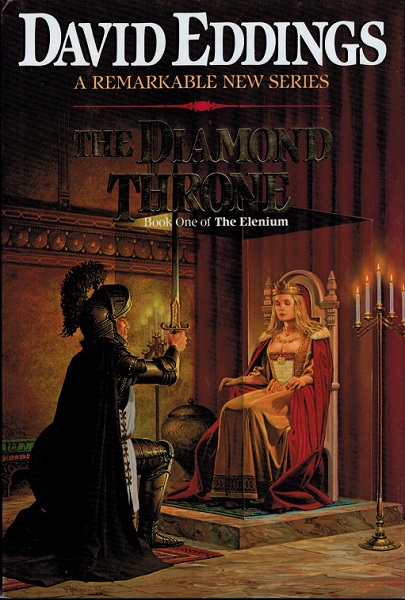
- Sparhawk
universe6 books1989
Start hereElenium · Start here
similar byadventurous+3 more
Sir Sparhawk is not a young man, and he has little patience for the pageantry his order pretends to. A Pandion Knight of the militant Elene Church, he rides home from a long exile to find his kingdom rotten with intrigue and his young queen, Ehlana, poisoned — kept alive only inside a shell of living crystal. To wake her he must find Bhelliom, a jewel with the power to remake the world or unmake it. So begins a long ride across the continent of Eosia. This is warm, character-first epic fantasy from David Eddings, told across two trilogies. The Elenium — The Diamond Throne, The Ruby Knight, The Sapphire Rose — pits Sparhawk against a corrupt church and a hungry elder god. The Tamuli — Domes of Fire, The Shining Ones, The Hidden City — carries him east into the vast Tamul Empire, where older enemies stir. Around him gathers a quarrelsome company: the Styric sorceress Sephrenia, the thief-boy Talen, the plain-spoken squire Kurik, and a small, imperious goddess who plays a set of pipes and always, somehow, gets her way. The pleasure here is the talk — grizzled knights trading dry insults between miracles and murders, a hero who solves as many problems with patience as with a sword. It never reaches for grimness or grand obscurity; it wants your good company for a long journey. Newcomers begin with The Diamond Throne and read the six in order: the Elenium stands whole on its own before the Tamuli widens the map.
- Eden (Harry Harrison)
series5 books1984
completed
similar byscience fictionalternate historywar+2 more
Harry Harrison's Eden trilogy imagines an Earth where the dinosaurs never died out, evolving instead into the Yilane, a technologically advanced reptilian civilization that shares the planet uneasily with early humans. West of Eden (1984) introduces the clash between the two species; Winter in Eden and Return to Eden carry it forward as a shifting climate forces both sides to adapt or die. It's an alternate-evolution saga more than a conventional dinosaur adventure.
- Warrior of the Altaii
Robert Jordanstandalone novel2019
similar byadventuroustransported to another worldwar+1 more
From the front flap of the Tor first edition: "Epic fantasy legend Robert Jordan's never before published first novel, for fans of the #1 New York Times bestselling the Wheel of Time Draw near and listen, or else time is at an end. The waterholes of the Plain are drying up, the fearsome fanghorn grow more numerous, and bad omens abound. Wulfgar, a leader of the Altaii people must contend with twin queens, warlords, prophets, and magic in the hopes of protecting his people and securing their future. Elspeth, a visitor from another world, holds the answers, but first Wulfgar must learn to as the right questions. But what if the knowledge that saves the Altaii will also destroy them?"
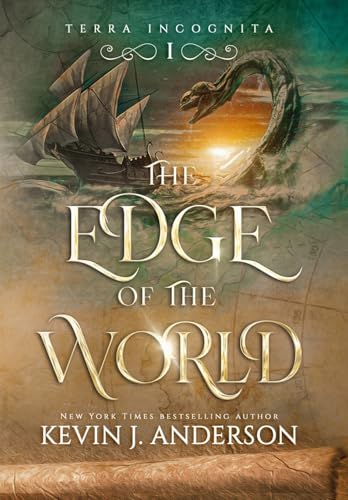
- Terra Incognita (Kevin J. Anderson)
series4 books2009
similar byadventurouswar+2 more
Kevin J. Anderson's Terra Incognita trilogy is set in a fantasy world modeled on the Age of Exploration, following rival seafaring nations sending expeditions in opposite directions around their world's coastline, driven by religious conflict and the search for a fabled promised land. The Edge of the World opens the story, continuing through The Map of All Things and The Key to Creation.
- The Powder Mage Trilogy
series15 books2013
part of The Powder Mage
similar bywarpolitical intriguetense+1 more
The Powder Mage trilogy is a series of epic fantasy novels written by American author Brian McClellan. It consists of the novels Promise of Blood (2013), The Crimson Campaign (2014) and The Autumn Republic (2015). In 2014, Promise of Blood received the Morningstar Award for Best Fantasy Newcomer. Several short stories and novellas set in the world of The Powder Mage trilogy have been published, as well as an additional trilogy called Gods of Blood and Powder.