More like Echea
anchored on:science fiction
but
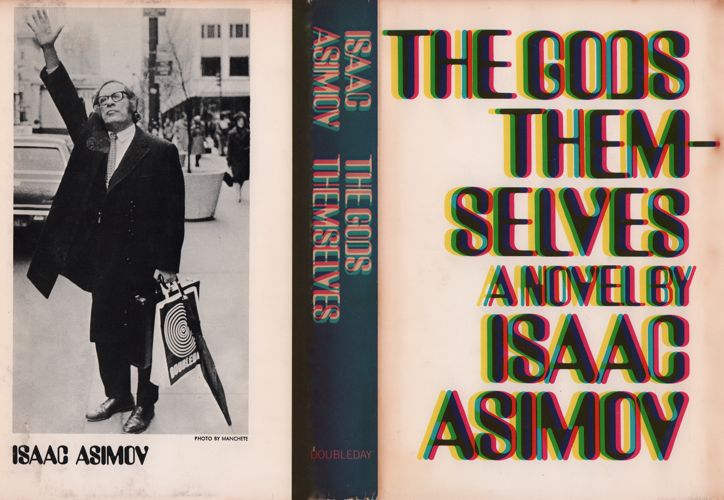
- The Gods Themselves
Isaac Asimovstandalone novel1972
similar byscience fictionthe moon+1 more
The Gods Themselves is a 1972 science fiction novel written by Isaac Asimov, and his first original novel in fifteen years. It won the Nebula Award for Best Novel in 1972, and the Hugo Award for Best Novel in 1973.
- Time Out of Joint
Philip K. Dickstandalone novel1959
similar byscience fiction+2 more
Time Out of Joint is a science fiction novel by American writer Philip K. Dick, first published in novel form in the United States in 1959. An abridged version was also serialised in the British science fiction magazine New Worlds Science Fiction in several installments from December 1959 to February 1960.
- The Moon Sequence
series6 books1923
similar byscience fictionthe moon+1 more
Edgar Rice Burroughs' Moon Maid trilogy (The Moon Maid, The Moon Men, The Red Hawk, 1923-1926) opens with an interplanetary voyage to the Moon that goes wrong, then jumps forward through generations of an Earth occupied by the invading Kalkars, before ending in a war of liberation centuries later. Christopher Paul Carey and Peter David's Swords Against the Moon Men (2017-2018) is an authorized continuation set later in that same timeline.
- Fifth Imperium
series3 books1991
similar byscience fictionwar+1 more
David Weber's Fifth Imperium series opens with the discovery that Earth's Moon is in fact a disguised alien starship, the Dahak, that has orbited undetected for tens of thousands of years - a relic of the fallen Fourth Imperium, a multi-star civilization destroyed while defending against the genocidal Achuultani. Mutineers' Moon follows humanity's first contact with Dahak and the mutineers still aboard it; The Armageddon Inheritance and Heirs of Empire escalate from that discovery into interstellar war and dynastic politics as humanity inherits the old empire's legacy and its enemies. The three novels were later collected as the omnibus Empire from the Ashes.
- H. G. Wells' War of the Worlds
universe65 books1898
Start hereThe War of the Worlds · Start here
similar byscience fiction
No one would have believed, in the closing years of the nineteenth century, that human affairs were being watched keenly and closely from the timeless worlds of space. And then the cylinders fell. H. G. Wells' War of the Worlds opens in the quiet of the Surrey commons, where a falling star proves to be the first Martian craft — and from the pit rise the towering tripods, the Heat-Ray, the choking Black Smoke and the creeping red weed, wielded by minds that regard mankind much as we regard the creatures we boil for supper. This is invasion rendered as natural disaster: cold, methodical, and vast beyond argument. Wells' 1898 novel is the seed; everything else grows from that Martian soil. The catalogue gathers direct sequels and continuations alongside a wide field of other hands. In War of the Worlds: Global Dispatches the invasion is retold across the whole planet through the eyes of Twain, Verne, Tolstoy, Lowell and Kipling; in the Manly Wade and Wade Wellman crossover, Sherlock Holmes, Watson and Professor Challenger take the field against the machines; and Scott Washburn's Great Martian War stretches the fighting into a decades-long alternate history of steam, artillery and grinding attrition. It is a loose shared world — no single decreed sequence, many voices answering one calamity. What sets this world apart is its refusal of heroics: the invaders fall not to generals but to the smallest things of Earth, humbling and indifferent. Begin, always, with Wells' original novel — it is short, and it is the ground every later book stands upon. From there follow your appetite: Global Dispatches for the panorama, the Holmes campaign for adventure, Washburn for the long war.
- Cavor
series2 books1901
similar byscience fictionthe moon
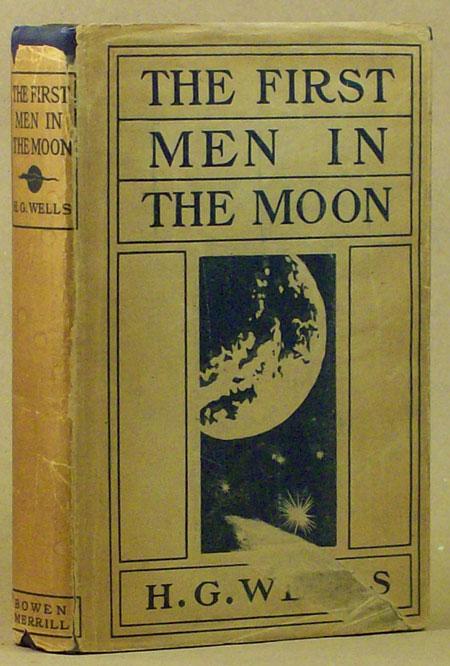
H. G. Wells's 1901 novel The First Men in the Moon is narrated by the businessman Bedford, who joins the reclusive scientist Cavor after Cavor invents cavorite, a gravity-blocking substance that carries the two men to the Moon. There they discover a vast underground civilization of insect-like Selenites, and the expedition that began as a hunt for lunar minerals turns into an encounter with an alien society. It is a standalone novel; later editions crediting Stephen Baxter add an introduction or afterword rather than a continuing story.
- Tongues of the Moon
Philip José Farmerstandalone novel1964
similar byscience fictionwarthe moon
Tongues of the Moon is a science fiction novel by American writer Philip José Farmer. Originally released in 1964, the book is an action story, focusing on fighting and combat scenes rather than a complex plot. It was initially printed as a novella in Amazing Stories.
- Starship Troopers
Robert A. Heinleinstandalone novel1959
similar byscience fictionwar
Starship Troopers is a military science fiction novel by American writer Robert A. Heinlein. Written in a few weeks in reaction to the US suspending nuclear tests, the story was first published as a two-part serial in The Magazine of Fantasy & Science Fiction as Starship Soldier, and published as a book by G. P. Putnam's Sons on November 5, 1959.
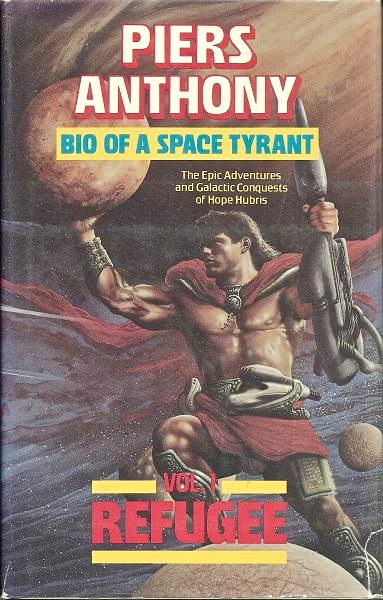
- Bio of a Space Tyrant
series6 books1983
similar byscience fiction+1 more
Bio of a Space Tyrant series is a six-book science-fiction series by Piers Anthony based within the Solar System. The series revolves around the character Hope Hubris and his family, and charts Hope's ascent from poor Hispanic refugee to Tyrant of Jupiter, a single person heading the Executive, Judicial and Legislative branches of the government. It is considerably more adult-themed than many of Anthony's earlier works.
- To the Stars (Leinster)
series3 books1953
completed
similar byscience fictionthe moon
Murray Leinster's Joe Kenmore trilogy follows a master machinist's son through the Cold War-era race to build and defend America's first space station, then a rescue tug, and finally a lunar outpost, in three techno-thriller adventures blending realistic 1950s spaceflight speculation with sabotage plots. Space Platform (1953) introduces Kenmore amid attempts to sabotage the orbital station project; Space Tug and City on the Moon carry the same hardware-focused approach into orbit and onto the Moon.
- Forever War
series10 books1972
similar byscience fiction+1 more
Joe Haldeman's The Forever War (1974) follows a soldier conscripted into a centuries-long interstellar war against the alien Taurans, using relativistic space travel so that months spent in transit correspond to years or decades passing back on Earth. Haldeman later returned to the same conflict in Forever Peace (1997), a thematically connected but separate story, and Forever Free (1999), a direct sequel set years after the original war's end. The first novel won the Hugo, Nebula, and Locus awards and is considered a foundational work of military science fiction.
- Fugue for a Darkening Island
Christopher Prieststandalone novel1972
similar byscience fictionwarimmigration and exile
Fugue for a Darkening Island is a dystopian novel by Christopher Priest. First published in 1972, it describes a man's struggle to protect his family and himself in a near-future England ravaged by civil war. The violence is brought about by a new far-right political party entering government, voted in to combat a massive influx of African refugees. Those refugees are aligned with the principal opposition faction, known as the Secessionists, leading to a multi-sided conflict.
- The Moon Is a Harsh Mistress
Robert A. Heinleinstandalone novel1966
similar byscience fictionthe moon
A technician discovers that the massive computer that operates everything on Luna (a prison colony) has become self-aware. He befriends it, but when he accompanied a beautiful girl to a dissident meeting, he encounters people who want to throw off the yoke of their Earth rulers.
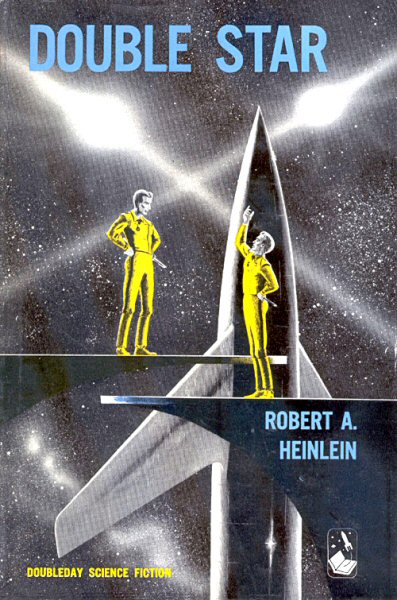
- Double Star
Robert A. Heinleinstandalone novel1956
similar byscience fiction+1 more
Lorenzo Smythe, the excellent yet unemployed actor, meets Dak Broadbent in a bar. Broadbent hires Lorenzo for an unspecified role, and hustles him onto a rocket ship. Broadbent turns out to be an assistant to the famous interplanetary politician and leader of the Expansionist party: John J. Bonforte. Bonforte, however, has been kidnapped by the political opposition on Mars, and due to Lorenzo's physical similarity to Bonforte, his staff wants Lorenzo to impersonate the politician for an important Martian ceremony.
- Earthlight
Arthur C. Clarkestandalone novel1955
similar byscience fictionthe moon
Earthlight is a science fiction novel by British writer Arthur C. Clarke, published in 1955. It is an expansion to novel length of a novella of the same name that he had published four years earlier.
- Dune Universe
universe78 books1963
Start hereDune · Start here
similar byscience fiction
Arrakis. Dune. The desert planet, where empire runs on a single substance: the spice melange, which folds space, prolongs life, and unlocks prescience, and which exists nowhere else in the known universe. Frank Herbert's saga is a meditation dressed as an adventure — feudal houses and a secret sisterhood, engineered messiahs and the patient ecology of a world without water, all turning on the terrible gravity of who commands the spice. It reads like scripture and schemes like a war room, ten thousand years hence, among people who have outlawed the thinking machine and made instruments of themselves instead. At its heart stand Herbert's original six — Dune, Dune Messiah, Children of Dune, God Emperor of Dune, Heretics of Dune, Chapterhouse: Dune — a single deepening arc across millennia, arguing the whole way between prophecy and free will. Around that spine his son Brian Herbert and Kevin J. Anderson have raised a vast prequel architecture: Prelude to Dune, tracing the great houses a generation before Paul; Legends of Dune, reaching back to the crusade that broke the machines; the Schools of Dune cycle on the founding of Bene Gesserit, Mentat, and Navigator; the Caladan Trilogy and Heroes of Dune filling years the originals left in shadow. Many hands, dozens of volumes, one desert. What sets Dune apart is its refusal of the simple: religion is manufactured, heroes are hazards, and the sand itself — worm, water, ecology — acts as a political power. Begin where the universe did, with Frank Herbert's Dune (1965), and read the original six in order; you need nothing else to feel the full weight. The prequels are a country to explore afterward, taken by era. Beginnings are delicate times.
- Cat's Cradle
Kurt Vonnegut & Jr.standalone novel1963
similar byscience fiction+1 more
Cat's Cradle is a satirical postmodern novel, with science fiction elements, by American writer Kurt Vonnegut. Vonnegut's fourth novel, it was first published on March 18, 1963, exploring and satirizing issues of science, technology, the purpose of religion, and the arms race, often through the use of morbid humor. The novel was nominated for the Hugo Award for Best Novel in 1964.
- A Fall of Moondust
Arthur C. Clarkestandalone novel1961
similar byscience fictionthe moon
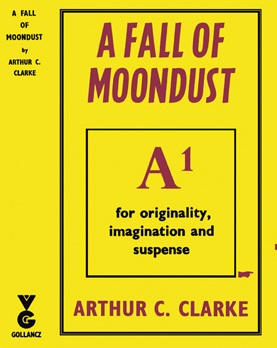
From the back cover of the Harbrace paperback: "The action of A Fall of Moondust takes place almost a century from now when tours on the moon are a common occurrence. One of the high points of each tour is a cruise around the Sea of Thirst, a body of volcanic dust, in a specially designed vessel called the Selene On a perfectly routine voyage one day the Selene suddenly disappears. How do you locate a small tourist "cruiser" buried beneath fifty feet of dust? If you find it, how do you rescue the passengers and crew? If you are on board, how do you feel and what do you do while brave men and expert technicians join forces in a race against time? Sustained excitement, lively humor, and an engaging cast of characters make this one of Arthur C. Clarke's most intriguing novels."
- Red Rising
series13 books2014
similar byscience fiction+1 more
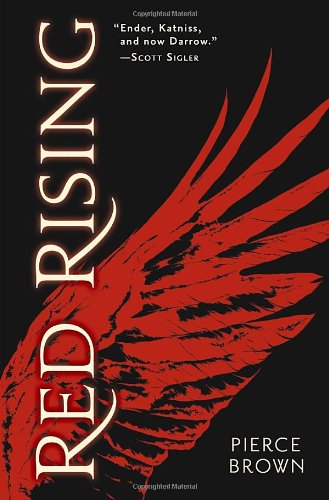
Pierce Brown's Red Rising follows Darrow, a lowborn 'Red' miner on a colonized Mars who discovers his caste's suffering is a lie sustained by the ruling Gold elite, and infiltrates their ranks to destroy the system from within. The series expands from a single-protagonist revenge story into a sprawling multi-book war across the solar system, eventually following an ensemble cast beyond Darrow alone, and combines Roman-inspired factional politics with brutal, competition-driven action set pieces.
- The Hunger Games
series3 books2008
part of The Hunger Games Universe
similar byscience fiction+1 more
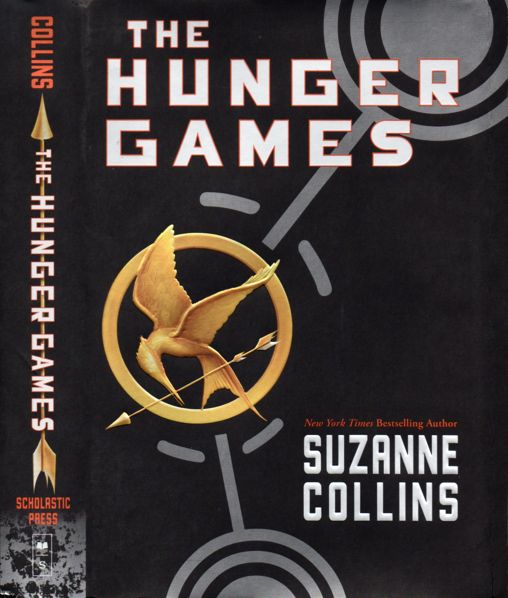
The Hunger Games is a series of young adult dystopian novels written by American author Suzanne Collins. The series consists of a trilogy that follows teenage protagonist Katniss Everdeen, as well as two prequels. The Hunger Games universe is a dystopia set in Panem, a post-apocalyptic North American country consisting of the wealthy Capitol and 12 districts in varying states of poverty. As punishment for rebellion, the Capitol hosts an annual battle royale competition called The Hunger Games. Each of the 12 districts must send two children between the ages of 12 and 18 to participate, and the last surviving child is dubbed the victor.
- Islands in the Sky
Arthur C. Clarkestandalone novel1952
similar byscience fiction+1 more
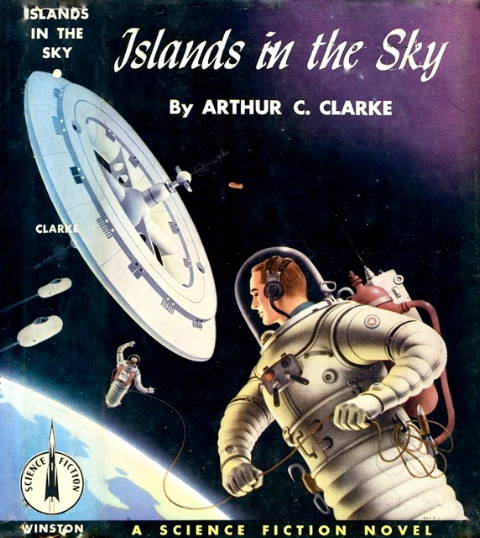
Islands in the Sky is a 1952 science fiction novel by British writer Arthur C. Clarke. It is one of his earliest works. Clarke wrote the story as a travelogue of human settlement of cislunar space in the last half of the twenty-first century.
- Dune
series20 books1963
part of Dune Universe
similar byscience fiction
Frank Herbert's Dune Chronicles opens with 1965's Dune, set on the desert planet Arrakis where House Atreides takes control of the only source of the vital spice melange and young Paul Atreides is pulled into a struggle over its politics and religion. Herbert carried the story forward across five further novels — Dune Messiah, Children of Dune, God Emperor of Dune, Heretics of Dune, and Chapterhouse: Dune — following Paul's line over the following millennia, before Brian Herbert and Kevin J. Anderson later extended the saga. Many other editions of these six novels are omnibus and box-set repackagings rather than separate stories.
- The Kraken Wakes
John Wyndhamstandalone novel1953
similar byscience fictionwar
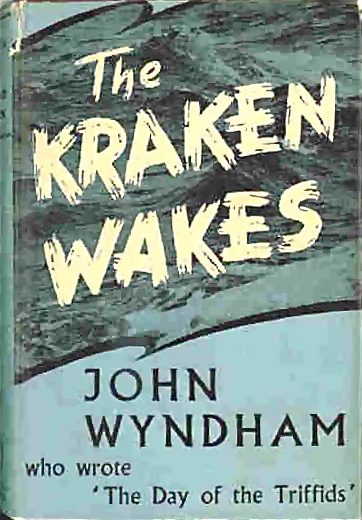
" Behind a spectacular meteor shower actually hides the beginning of an invasion by a mysterious and powerful alien race. Earth's life is disrupted by the attacks of extraterrestrials whose war machines, emerging from the depths of the oceans, seem indestructible. The coalitioned forces of the whole world are worthless, powerless in the face of the indecipherable and deadly plans of a superior intelligence, capable of bringing the entire planet to the brink of catastrophe" Goodreads May 20, 2022