More like Eutopia
anchored on:science fictionalternate historyalternate earthmid 20th centurypolitical intriguetense
but
- Small Change
series4 books2006
similar bypolitical intriguetensealternate historymid 20th centurydarkscience fictionalternate earth
The Small Change trilogy is a series of alternate history thriller novels by the author Jo Walton that were published from 2006 to 2008. The series are set in a Europe in which the United Kingdom exits World War II in 1941. As the series begins, Britain itself slides toward fascism. The series has three books:Farthing Tor Books August 8, 2006, ISBN 0-7653-1421-5, ISBN 978-0-7653-1421-5 Ha'penny, Tor Books; Reprint edition July 1, 2008, ISBN 0-7653-5808-5, ISBN 978-0-7653-5808-0 Half a Crown, Tor Books; September 30, 2008, ISBN 0-7653-1621-8, ISBN 978-0-7653-1621-9
- Destiny Times Three
Fritz Leiberstandalone novel1945
similar bypolitical intriguetensemid 20th centuryscience fictionalternate historyalternate earth+1 more
Destiny Times Three is an alternate timeline 1945 science fiction novel by American writer Fritz Leiber. It first appeared in Astounding Science Fiction in March and April 1945. In 1952 it featured in Five Science Fiction Novels published by Gnome Press. Its first appearance as a standalone novel came in 1957 when published by Galaxy Science Fiction Novels.
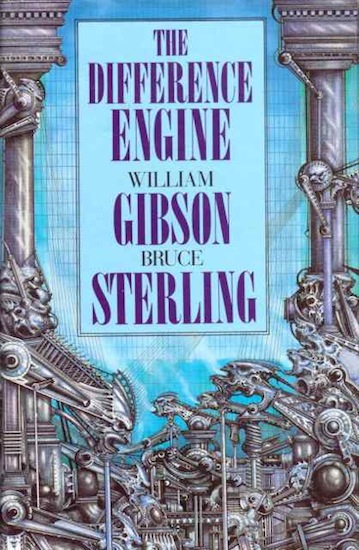
- The Difference Engine
William Gibson & Bruce Sterlingstandalone novel1990
similar bypolitical intriguescience fictionalternate historyalternate earth+1 more
The computer age arrives a century early with Babbage's perfection of his 'analytical engine'. The industrial revolution is accelerated by the development of steam-driven cybernetic 'Engines'. An advanced Great Britain prepares to better the world's lot. An example of the 'steampunk' sub-genre of the cyberpunk movement.
- Fatherland
Robert Harrisstandalone novel1992
similar bypolitical intriguetensemid 20th centuryalternate historydark
Twenty years after Nazi Germany won the Second World War, Berlin is preparing to celebrate Adolf Hitler's seventy-fifth birthday when detective Xavier March is called to investigate a body pulled from a lake, ostensibly an accident, but one that leads him to a string of suspiciously staged deaths among senior Nazi officials. Ordered off the case by the Gestapo but quietly told to keep going by his own superior, March teams up with an American journalist, Charlie Maguire, and starts following a trail toward Swiss bank accounts and a secret the regime has spent two decades burying. Robert Harris's alternate-history debut novel.
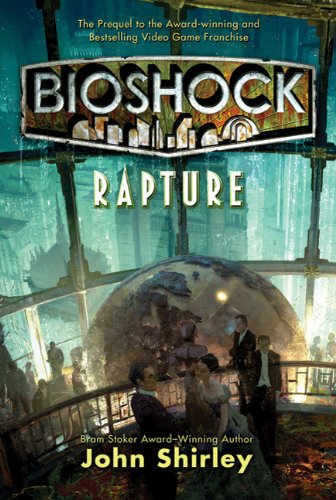
- Bioshock: Rapture
John Shirleystandalone novel2011
similar bypolitical intriguetensemid 20th centuryscience fictiondark
BioShock: Rapture is a 2011 science fiction novel written by John Shirley, published by Tor Books in the United States and by Titan Books in the United Kingdom. Rapture forms part of the BioShock retrofuturistic media franchise created by Ken Levine and published by 2K Games and developed by several studios, including Irrational Games and 2K Marin. A prequel to the first BioShock game the novel tells the story of how Andrew Ryan founded the underwater city of Rapture. The book follows multiple BioShock characters. The cover art was designed by Craig Mullins, who also produced the cover art for BioShock 2. It was released July 19, 2011.
- Dune
series20 books1963
part of Dune Universe
similar bypolitical intriguescience fiction+2 more
Frank Herbert's Dune Chronicles opens with 1965's Dune, set on the desert planet Arrakis where House Atreides takes control of the only source of the vital spice melange and young Paul Atreides is pulled into a struggle over its politics and religion. Herbert carried the story forward across five further novels — Dune Messiah, Children of Dune, God Emperor of Dune, Heretics of Dune, and Chapterhouse: Dune — following Paul's line over the following millennia, before Brian Herbert and Kevin J. Anderson later extended the saga. Many other editions of these six novels are omnibus and box-set repackagings rather than separate stories.
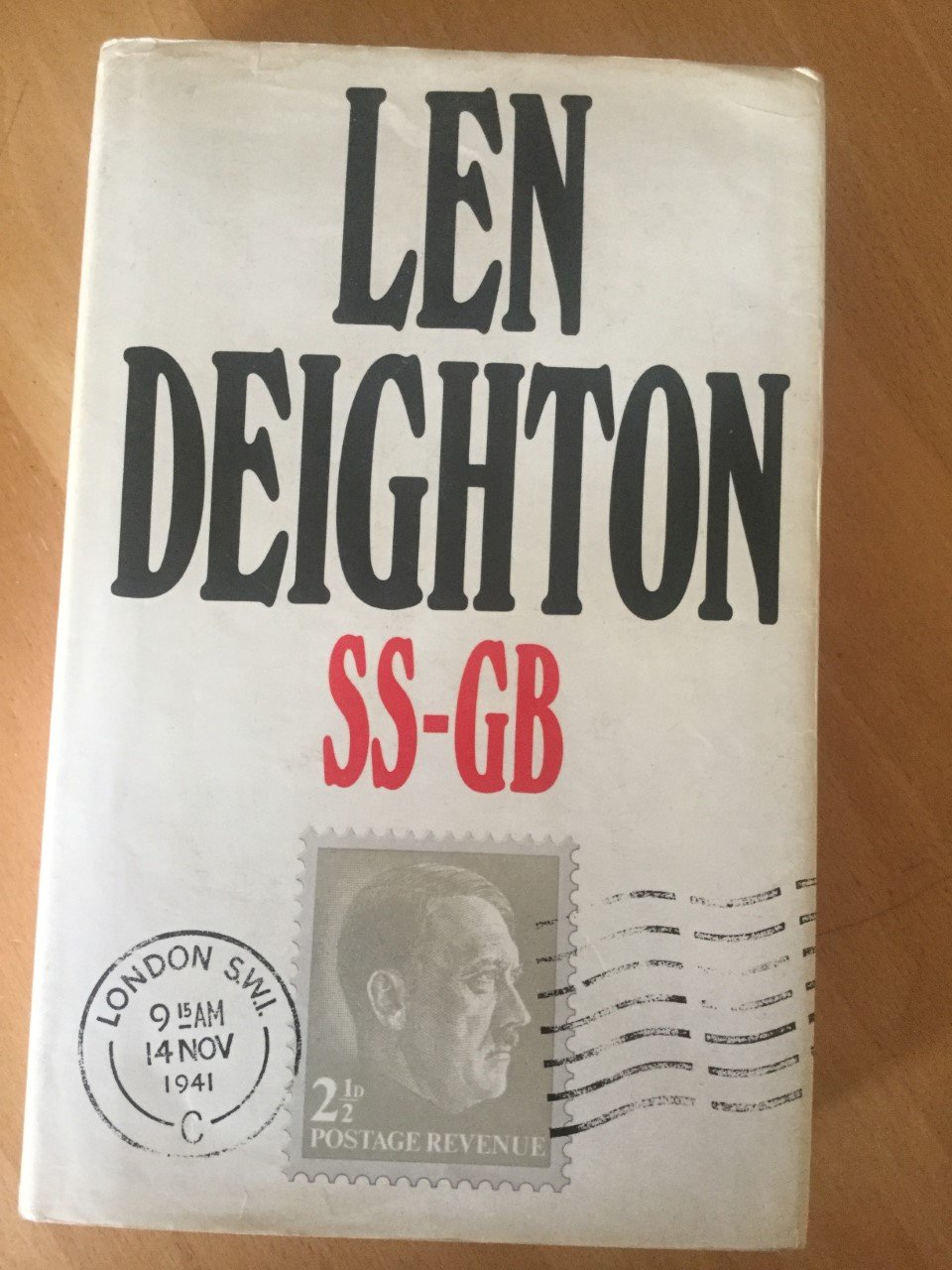
- SS-GB
Len Deightonstandalone novel1978
similar bypolitical intriguetensealternate historydarkscience fiction
It's November 1941 in a Britain that lost the war: Operation Sea Lion succeeded, Churchill was executed, and the King is a prisoner in his own Tower of London. Detective Superintendent Douglas Archer, still working homicide for the Metropolitan Police under German occupation, catches what looks like a routine case, a well-dressed man murdered above an antiques shop, until the body's oddities point toward something far more dangerous than burglary gone wrong. Archer's investigation collides with occupation politics, the British resistance, and rival factions of the SS and the German Army, each wanting the case to go a different way. Len Deighton's alternate-history spy thriller.
- Dune Universe
universe78 books1963
Start hereDune · Start here
similar bypolitical intriguescience fiction+2 more
Arrakis. Dune. The desert planet, where empire runs on a single substance: the spice melange, which folds space, prolongs life, and unlocks prescience, and which exists nowhere else in the known universe. Frank Herbert's saga is a meditation dressed as an adventure — feudal houses and a secret sisterhood, engineered messiahs and the patient ecology of a world without water, all turning on the terrible gravity of who commands the spice. It reads like scripture and schemes like a war room, ten thousand years hence, among people who have outlawed the thinking machine and made instruments of themselves instead. At its heart stand Herbert's original six — Dune, Dune Messiah, Children of Dune, God Emperor of Dune, Heretics of Dune, Chapterhouse: Dune — a single deepening arc across millennia, arguing the whole way between prophecy and free will. Around that spine his son Brian Herbert and Kevin J. Anderson have raised a vast prequel architecture: Prelude to Dune, tracing the great houses a generation before Paul; Legends of Dune, reaching back to the crusade that broke the machines; the Schools of Dune cycle on the founding of Bene Gesserit, Mentat, and Navigator; the Caladan Trilogy and Heroes of Dune filling years the originals left in shadow. Many hands, dozens of volumes, one desert. What sets Dune apart is its refusal of the simple: religion is manufactured, heroes are hazards, and the sand itself — worm, water, ecology — acts as a political power. Begin where the universe did, with Frank Herbert's Dune (1965), and read the original six in order; you need nothing else to feel the full weight. The prequels are a country to explore afterward, taken by era. Beginnings are delicate times.
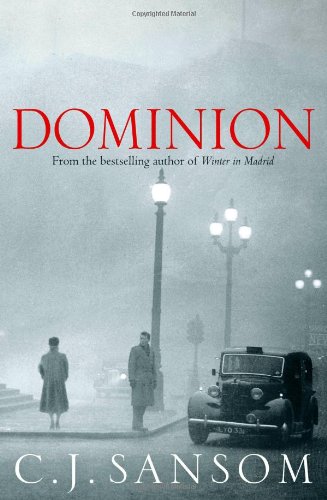
- Dominion
C. J. Sansomstandalone novel2012
similar bypolitical intriguetensemid 20th centuryalternate historydark
Dominion is a 2012 alternative history novel by British author C. J. Sansom. It is a political thriller set in the early 1950s against the backdrop of a Britain that has become a satellite state of Nazi Germany. The point of divergence from actual history is that Lord Halifax, rather than Winston Churchill, succeeded Neville Chamberlain as Prime Minister in May 1940 leading to an armistice with Germany.
- The Plot Against America
Philip Rothstandalone novel2004
similar bypolitical intriguetensealternate historydarkscience fiction
Roosevelt is defeated in 1940 by Charles Lindbergh, who guides the US towards fascism and anti-Semitism.
- The Dosadi Experiment
Frank Herbertstandalone novel1977
similar bypolitical intriguetensescience fiction+1 more
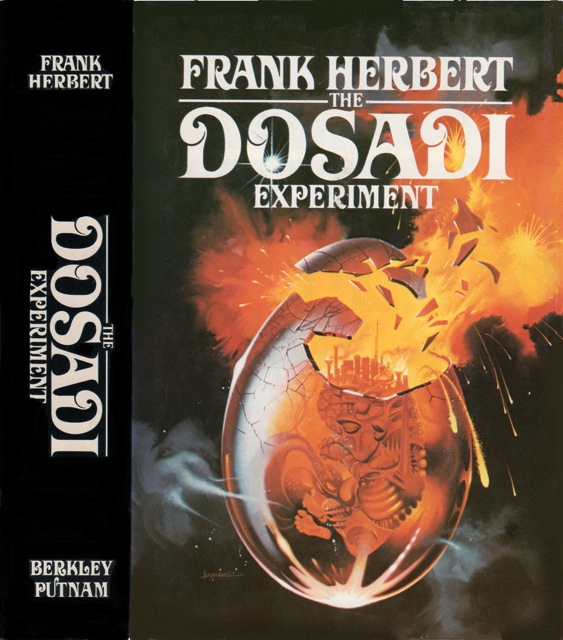
From the flaps of the Berkley Putnam first edition: "In his first new work of science fiction since the best-selling Children of Dune, Frank Herbert returns to his world of Whipping Star, and involves Jorj X. McKie, Saboteur Extraordinary, in a new intrigue. In Whipping Star, McKie discovered that some of the stars in the universe are actually intelligent, super-powerful beings, and was able to befriend one of them, the star Alcyone - affectionately known as Fannie Mae. As The Dosadi Experiment opens, McKie is assigned to investigate the planet Dosadi, which is isolated from the rest of the galaxy by a "god-wall," a barrier set up by one of the intelligent stars. Dosadi is rumored to be an experimental planet, and the experimenters are the froglike Gowachin, whose culture is founded upon a strange legal system in which McKie is the only human ever trained. He learns that humans and Gowachin have been placed on Dosadi, without their consent, for an experiment that could last centuries: an experiment in extreme overcrowding. But this monstrous plot is apparently out of control, and it seems the Gowachin may be prepared to destroy Dosadi rather than expose its secret, thus breaking the peace among the races, and starting the first interstellar war. But this is just the beginning. When McKie finally reaches Dosadi he discovers that the Dosadis have taken control of their own evolution and produced a competitive, highly evolved elite, of both humans and Gowachin, who have been able to extrapolate the existence of a universe beyond the god-wall and hate whoever has imprisoned them like this. They plan to break out and avenge themselves on the galaxy."
- When the Sleeper Wakes
H. G. Wellsstandalone novel1899
similar bypolitical intriguetensescience fictiondark
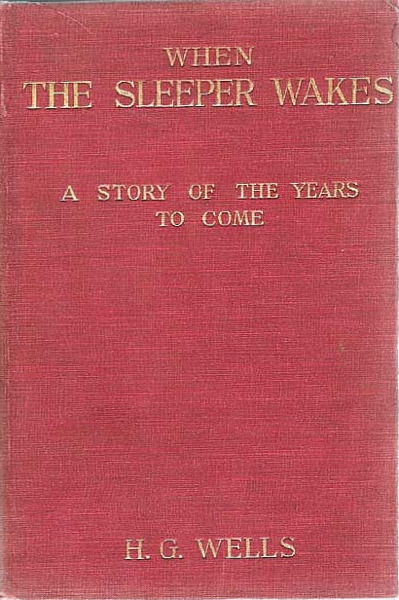
Graham, an insomniac Englishman in 1890s London, takes a course of sleep-inducing drugs and falls into a coma that lasts two centuries. He wakes in the year 2100 to find his investments have compounded, through a ruling body called the White Council, into effective ownership of most of the world's wealth and power, making him, on paper, humanity's master, and in practice, its prisoner, held under guard while the Council governs in his name. A rebel faction led by a man named Ostrog frees him, hoping to use his symbolic authority to spark an uprising against the Council. An early H. G. Wells dystopia about inherited power and manufactured consent.
- Johan Eschbach
series3 books1994
similar bypolitical intriguetensealternate historyalternate earthscience fiction
- The Man with the Iron Heart
Harry Turtledovestandalone novel2008
similar bypolitical intriguetensemid 20th centuryalternate historydark
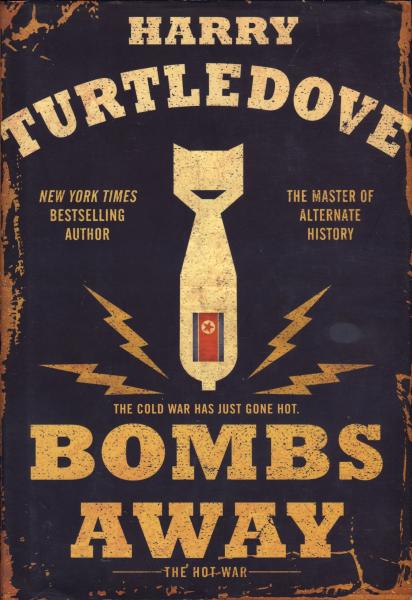
The Man with the Iron Heart is an alternate history novel by Harry Turtledove. Published in 2008, it takes as its premise the survival by Reinhard Heydrich of his 1942 assassination in Czechoslovakia and his subsequent leadership of the postwar Werwolf insurgency in occupied Germany, which Turtledove depicts as growing into a far more formidable force than was the case historically.
- Golden State
Ben H. Wintersstandalone novel2019
similar bypolitical intriguetensescience fictionalternate earth+1 more
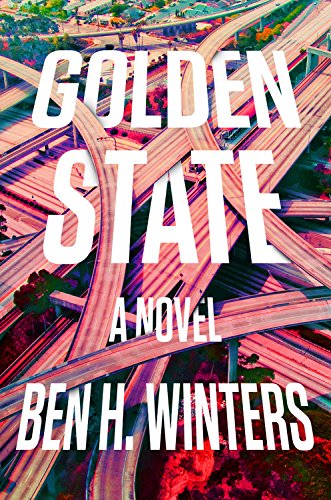
A veteran of the Speculative Service in an alternate-world California where the law and truth are valued above all else uses his rare authority to question the facts when truth enforcement is manipulated for corrupt purposes. "In a strange alternate society that values law and truth above all else, Laszlo Ratesic is a nineteen-year veteran of the Speculative Service. He lives in the Golden State, a nation standing where California once did, a place where like-minded Americans retreated after the erosion of truth and the spread of lies made public life and governance impossible. In the Golden State, knowingly contradicting the truth is the greatest crime--and stopping those crimes is Laz's job. In its service, he is one of the few individuals permitted to harbor untruths, to 'speculate' on what might have happened. But the Golden State is less a paradise than its name might suggest. To monitor, verify, and enforce the truth requires a veritable panopticon of surveillance and recording. And when those in control of the facts twist them for nefarious means, the Speculators are the only ones with the power to fight back." -- Amazon.
- The Hot War
series3 books2015
similar bypolitical intriguetensemid 20th centuryalternate historydark+1 more
- Shift
Dale Peck & Tim Kringstandalone novel2010
similar bypolitical intriguetensemid 20th centuryalternate historydark
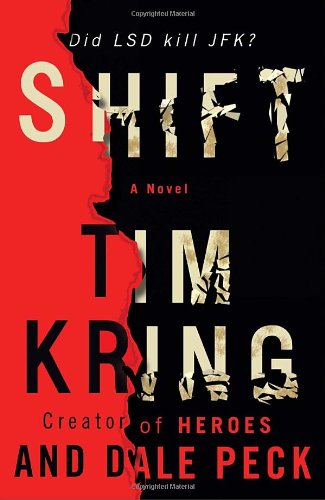
Shift is a 2010 alternative history book by Tim Kring and Dale Peck and is the first book in the Gates of Orpheus trilogy, originally titled as the Flag of Orpheus trilogy. The book was released on August 10, 2010 in the United States by Crown Publishing and centers around a series of secretive government experiments with LSD and its repercussions. Kring has stated that he first began work on the novel after the 2007–2008 Writers Guild of America strike and intended to make use of multiple forms of media to promote the novel and further its storyline.
- Solar Lottery
Philip K. Dickstandalone novel1955
similar bypolitical intriguetensescience fiction+1 more
Solar Lottery is a 1955 science fiction novel by American writer Philip K. Dick. It was his first published novel and contains many of the themes present in his later work. It was also published in altered form in the UK as World of Chance. The main story is about a man named Ted Benteley who lives in a strange world, dominated by percentages and the lottery. Lotteries are used to choose the next leader as well as a new assassin, whose job is to try to kill the leader or "Quizmaster". Everybody in society has the opportunity to be selected as a leader or an assassin. Benteley unexpectedly gets chosen to be a member of the committee trying to assassinate the new Quizmaster and he must decide what he is going to do.
- The Puppet Masters
Robert A. Heinleinstandalone novel1951
similar bytensemid 20th centuryscience fiction+1 more
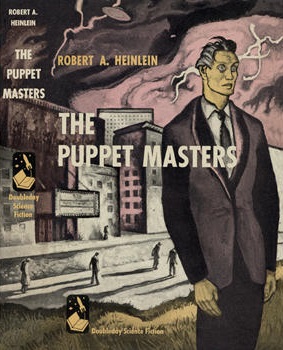
Parasitical aliens attach themselves to human hosts and take over their bodies. Two spies are sent to find out what's happening, but the extent is much farther than they knew. With access to the humans' memories, the aliens quietly invade the government and start taking over.
- Bug Jack Barron
Norman Spinradstandalone novel1969
similar bypolitical intriguetensescience fiction+1 more
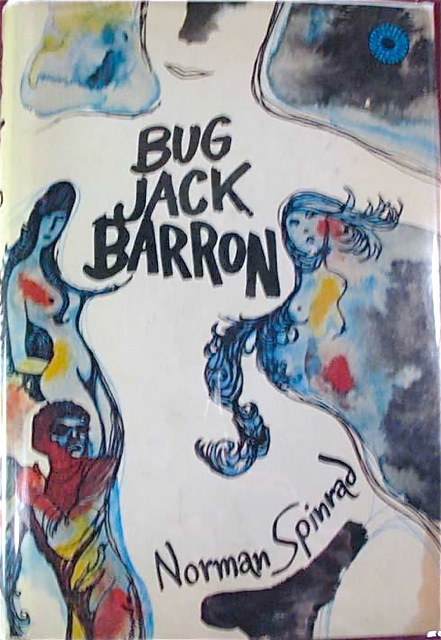
Bug Jack Barron is a 1969 science fiction novel by American writer Norman Spinrad, first serialized in the New Worlds magazine under the editorship of Michael Moorcock. It was nominated for the 1970 Hugo Award. The novel is notable for its lyrical style and unique use of cut-up phrases. In this regard, Spinrad has cited the influence of Beat writers William S. Burroughs, Allen Ginsberg, and Jack Kerouac.
- Lord of the Flies
William Goldingstandalone novel1954
similar bytensemid 20th centurydark+2 more
Lord of the Flies is the 1954 debut novel of British author William Golding. The plot concerns a group of prepubescent British boys who are stranded on an uninhabited island and their disastrous attempts to govern themselves that lead to a descent into savagery. The novel's themes include morality, leadership, and the tension between civility and chaos.
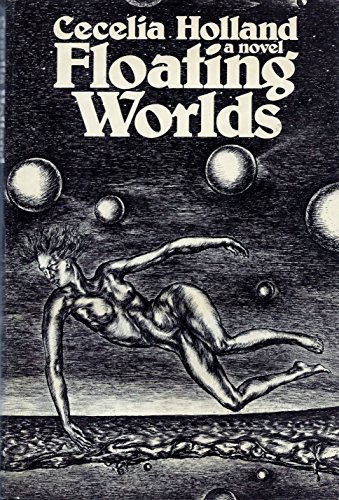
- Floating Worlds
Cecelia Hollandstandalone novel1976
similar bypolitical intriguetensescience fiction+1 more
2000 years in the future, runaway pollution has made the Earth uninhabitable except in giant biodomes. The society is an anarchy, with disputes mediated through the Machiavellian Committee for the Revolution. Mars, Venus and the Moon support flourishing colonies of various political stripes. On the fringes of the solar system, in the Gas Planets, a strange, new, violent kind of human has evolved.In this unstable system the anarchist Paula Mendoza, an agent of the Committee, works to make peace, and ultimately protect her people, in a catastrophic clash of worlds that destroys the order she knows.
- The War in the Air
H. G. Wellsstandalone novel1908
similar bypolitical intriguetensescience fiction+1 more
The War in the Air: And Particularly How Mr. Bert Smallways Fared While It Lasted is a military science fiction novel written by H. G. Wells and published in 1908.
- Under the Dome
Stephen Kingstandalone novel2009
similar bypolitical intriguetensescience fictiondark
A small town in Maine finds itself suddenly cut off from the outside world by an impenetrable barrier, and the clash of personalities of the trapped people takes its inexorable devastating course.