More like Exiled
anchored on:paranormal romancescience fiction
but
- Ender Wiggin
series14 books1977
part of Ender's Game Universe
similar byaliensfar futurescience fictionother star systems+2 more
Orson Scott Card's Ender's Game (1985, expanded from his 1977 novella) follows child prodigy Andrew "Ender" Wiggin as he is recruited into a military training program built to prepare Earth's defenses for an anticipated third war against an insectoid alien species known as the Formics. The saga continues years later through Speaker for the Dead and Xenocide, following an older Ender as he confronts the moral weight of his role in that earlier conflict, and concludes the core arc in Children of the Mind, with Ender in Exile filling in the years between the first two books. Set within the wider Ender's Game universe, the series shifts from military coming-of-age story to slower, more philosophical science fiction as it progresses.
- Anna Nestor-Sigrid / The Aighors
series4 books1975
completed
similar byaliensfar futurescience fictionspaceother star systems+2 more
Beyond Heaven's River follows Yoshio Kawashita, a soldier abducted mid-battle during World War II and stranded by unknown aliens on a distant world he can never leave, whose only tie back to meaning is Anna Nestor, a ruthless interstellar power broker who first treats him as a curiosity before the two are forced to confront who took him and why. Greg Bear wrote it as a standalone 1980 novel rather than the start of a series.
- Hainish
series33 books1964
completed
similar byfar futurescience fictionother star systems+1 more
The Hainish Cycle consists of a number of science fiction novels and stories by Ursula K. Le Guin. The cycle is set in a future history that features civilizations of human beings on planets orbiting a number of nearby stars, including Terra ("Earth"); these humans are contacting each other for the first time and establishing diplomatic relations, as well as setting up a confederacy under the guidance of the oldest of the human worlds, the peaceful planet Hain. In this history, human beings did not evolve on Earth, but they were instead the result of interstellar colonies planted by Hain in the distant past, after which interstellar travel ceased for an extended period. Some of the human races have new genetic traits, a result of ancient Hainish experiments in genetic engineering; this includes people who can dream while awake, and a world of hermaphroditic people who only enter active sexuality once per month, not knowing which sex will manifest in them. In keeping with Le Guin's narrative approach, she uses varied social and environmental settings to explore the anthropological and sociological outcomes of human evolution in those environments. The author often discounted the characterization of a so-called "Hainish Cycle".
- The Best of All Possible Worlds Universe
series3 books2013
similar byaliensfar futurescience fictionother star systems+2 more
The Best of All Possible Worlds, the opener of this loose sequence by Karen Lord, follows survivors of a destroyed alien civilization as they search other worlds for compatible communities to join, told with more interest in culture and relationships than action. The Galaxy Game and The Blue, Beautiful World continue Lord's character-driven exploration of the same universe's societies, power politics, and cross-cultural understanding, without following a single continuous plot.
- Tower and the Hive
series7 books1959
completed
part of The Talents
similar byfar futurescience fictionspaceother star systems+1 more
The Tower and the Hive series opens with The Rowan (1990), following an isolated but powerful telepath who is drawn out of her loneliness by a psychic call for help from a distant Talent facing an alien threat. Anne McCaffrey continued the story across four more novels, Damia, Damia's Children, Lyon's Pride, and the concluding The Tower and the Hive (1999), following later generations of a telepathic family staffing the Prime Towers that give a starfaring human civilization instant communication. The series is set later in the same Talents universe as McCaffrey's earlier Pegasus books.
- Skolian Empire Universe
series36 books1994
similar byfar futurescience fictionother star systems+2 more
- Lunar Chronicles
series15 books2011
similar byfar futurescience fictionother star systems+2 more
The Lunar Chronicles is a series of four young adult science fiction novels, a novella, and a short story collection written by American author Marissa Meyer and published by Feiwel & Friends. Each book entails a science fictional twist on a classic fairy tale, including "Cinderella", "Little Red Riding Hood", "Rapunzel", and "Snow White". Set in a futuristic world inhabited by various species and creatures, tensions are rising between Earth and its former colony Luna, while both attempt to manage an ongoing pandemic.
- Interstellar Brides Universe
series30 books2016
similar byfar futurescience fictionother star systemsromance+1 more
- Agent of Change
series10 books1988
part of Liaden
similar byfar futurescience fictionspaceother star systems
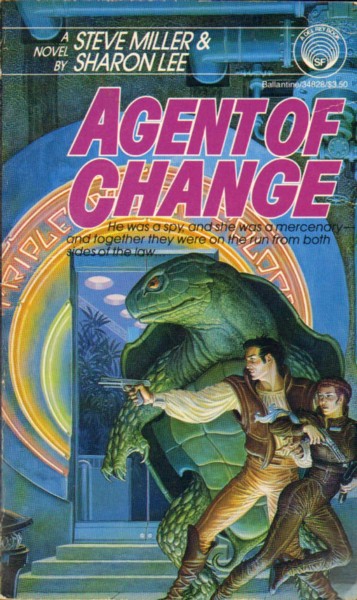
Agent of Change opens Sharon Lee and Steve Miller's long-running Liaden Universe sequence with Val Con yos'Phelium, a covert agent of the Liaden clans, and Miri Robertson, a mercenary soldier, forced into an uneasy alliance while fleeing assassins across space. It's the foundational quartet of a much larger set of novels blending space opera, clan intrigue, and a slow-burn partnership between its two leads. The series belongs to the wider Liaden universe, a shared future history of trade clans, mercenary companies, and human/alien contact spanning dozens of books.
- LySanTer (Future Fantasy Romance)
series3 books1990
completed
similar byfar futureother star systemsromance+6 more
- Firebird Universe (Kathy Tyers)
series8 books1987
similar byfar futurescience fictionother star systems+2 more
- Xeno Relations
series5 books2014
similar byaliensfar futurescience fictionspaceother star systems+3 more
- The Xenith Trilogy
series3 books2017
similar byaliensfar futurescience fictionspaceother star systemsromance+2 more
- The League
series15 books1994
similar byfar futurescience fictionspaceother star systems+1 more
Sherrilyn Kenyon's The League opens with Born of Night, a science-fiction romance centered on an assassin protagonist, continuing across more than a dozen further 'Born of...' novels.
- Stardance
series5 books1977
similar byscience fictionspace+2 more
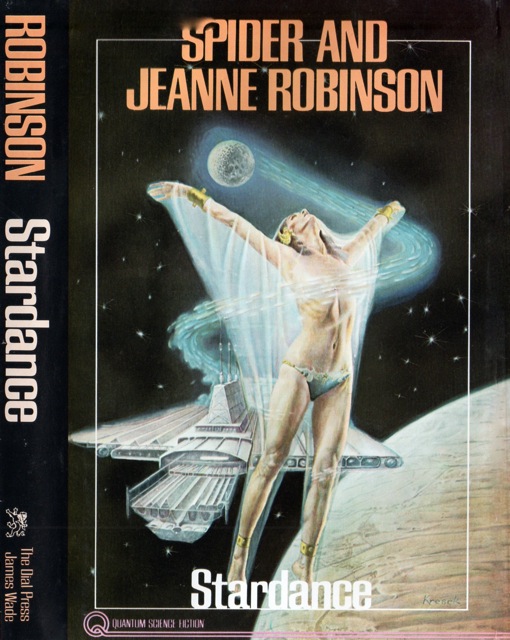
Stardance began as Spider Robinson and Jeanne Robinson's Hugo- and Nebula-winning novella before growing into a trilogy about the birth of dance choreographed for zero gravity, and the human and, later, alien audiences it reaches. Jeanne Robinson was herself a professional dancer, and the books carry that grounding into their depiction of movement as art once freed from gravity. The sequels, Starseed and Starmind, push the premise outward from one dancer's breakthrough into first-contact territory.