More like Exist
anchored on:science fictiondystopiaour worldnear futureyoung adultspace colonization+3 more
but
- The Children of Men
P. D. Jamesstandalone novel1992
similar bytenseour worldnear futurescience fictiondystopiapolitical intrigue
"The human race has become infertile, and under the despotic rule of Xan Lyppiatt, the Warden of England the old are despairing and the young cruel. Theo Faren, a cousin of the Warden, lives a solitary life in this ominous atmosphere. That is, until a chance encounter with a young woman leads him into contact with a group of dissenters. Suddenly his life is changed irrevocably, as he faces agonising choices which could affect the future of mankind." (pdjames.co.uk)
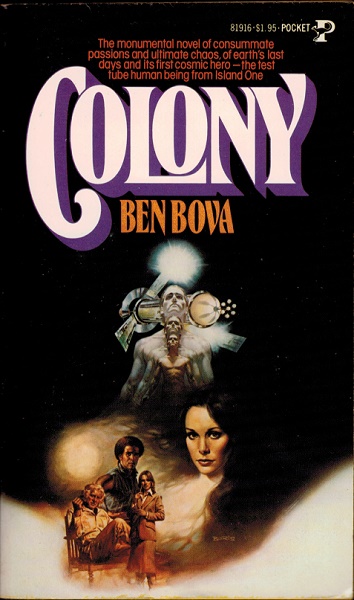
- Colony
Ben Bovastandalone novel1978
similar bytensenear futurescience fictiondystopiaspace colonizationpolitical intrigue+1 more
Colony continues the story Ben Bova began in Millennium, following astronaut-turned-administrator Chet Kinsman years later as the head of an orbiting space habitat that has become Earth's only real refuge from a planet buckling under overpopulation, food shortages and unrest. Getting a place in the habitat is a matter of life and death for millions who will never be chosen, and as Earth's governments grow more desperate to control or dismantle the colony outright, Kinsman has to decide how far he'll go to protect the world he's built off-world. Bova later folded both novels together into the omnibus The Kinsman Saga. Part of Ben Bova's Chet Kinsman series.
- Make Room! Make Room!
Harry Harrisonstandalone novel1966
similar bytenseour worldnear futurescience fictiondystopia
Make Room! Make Room! is a 1966 science fiction novel written by Harry Harrison exploring the consequences of both unchecked population growth on society and the hoarding of resources by a wealthy minority. It was originally serialized in Impulse magazine.
- The Lathe of Heaven
Ursula K. Le Guinstandalone novel1971
similar bytenseour worldnear futurescience fictiondystopia
The Lathe of Heaven is a 1971 science fiction novel by American writer Ursula K. Le Guin, first serialized in the American science fiction magazine Amazing Stories. It won the 1972 Locus Award for Best Novel and was a finalist for the 1971 Nebula Award for Best Novel and 1972 Hugo Award for Best Novel. Two television film adaptations were released: the PBS production, The Lathe of Heaven (1980), and Lathe of Heaven (2002), a remake produced by the A&E Network.
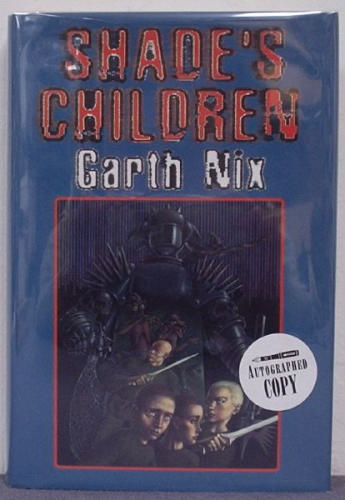
- Shade's Children milieu
series2 books1997
similar bytensenear futurescience fictiondystopiayoung adult+2 more
Shade's Children is set on an Earth where all adults vanished overnight fourteen years earlier, leaving children to be harvested at puberty by the machines that now run the world, unless they escape into hiding with Shade, a mysterious AI-like protector. Garth Nix's 1997 novel is a single, self-contained book rather than a series, though its bleak post-apocalyptic premise has drawn comparisons to his other work.
- The World Jones Made
Philip K. Dickstandalone novel1956
similar bytensenear futurescience fictiondystopiapolitical intrigue+2 more
The World Jones Made is a 1956 science fiction novel by American writer Philip K. Dick, examining notions of precognition, humanity, and politics. It was first published by Ace Books as one half of Ace Double D-150, bound dos-à-dos with Agent of the Unknown by Margaret St. Clair.The story takes place after a nuclear war in which society is dominated by relativism, which rejects absolute truths and preaches tolerance as the highest principle. The mutant Floyd Jones, who can see into the future, plans to overthrow the system and colonise space. The story ends with the defeat of Jones, whose plans fail despite his ability to see the future due to the immutability of fate.
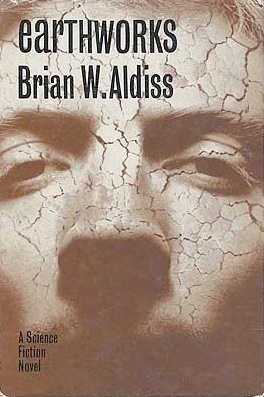
- Earthworks
Brian W. Aldissstandalone novel1965
similar bytenseour worldnear futurescience fictiondystopia
Earthworks is a 1965 dystopian science fiction novel by British science fiction author Brian Aldiss. The novel draws its premise from prevalent fears about population growth and overcrowding of the Earth.
- Oath of Fealty
Larry Niven & Jerry Pournellestandalone novel1981
similar bytenseour worldnear futurescience fictiondystopia
Oath of Fealty is a 1981 novel by American writers Larry Niven and Jerry Pournelle, published originally by Phantasia Press, then by Timescape Books, with numerous reprints. Set in the near future, it involves an arcology, a large inhabited structure, called Todos Santos, which rises above a crime-ridden Los Angeles, California, but has little beyond casual contact with the city. The novel popularized the phrase "think of it as evolution in action", which occurs elsewhere in Niven's books. The novel anticipated the building of the Los Angeles subway. It was included in David Pringle's book Science Fiction: The 100 Best Novels.
- Z for Zachariah
Robert C. O'Brienstandalone novel1975
similar bytenseour worldnear futurescience fictionyoung adult
Sixteen-year-old Ann Burden, on an Amish family farm in an isolated valley, believes she is the only survivor of nuclear war and nerve gas. One day a man arrives in a "safe-suit" that he and others have recently developed.
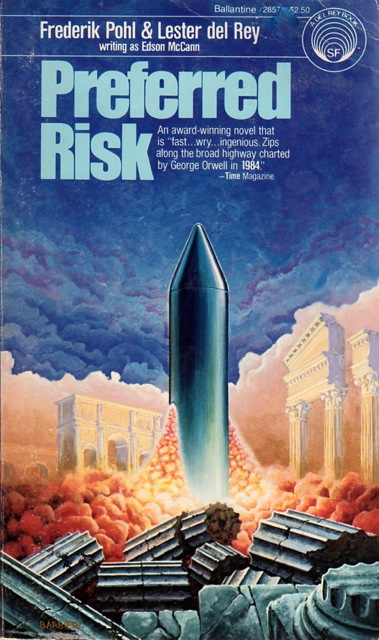
- Preferred Risk
Lester del Rey & Frederik Pohlstandalone novel1955
similar bytenseour worldnear futurescience fictiondystopiapolitical intrigue
An insurance claims adjuster investigates mysterious events in a vault where incurably ill people are stored in cold sleep. From the back cover of the Del Rey edition: "The Company insured the whole world against everything and anything - but the premiums came high... The Company had brought peace and plenty to all on Earth - with comprehensive insurance against disease and disaster, war and want. Tom Wills gloried in his new rank of Claims Adjuster and relished his prospects of rising even higher. But then he met Rena, a enchanting young woman who turned out to be an Uninsurable - and involved in a conspiracy against the Company, to boot! To Wills, that is impossible, insane. Rena and her follow conspirators had to be deluded.. and it was clearly up to him to prove them wrong. The evidence he sought wasn't hard to find, so he began his investigation... and soon discovered that the real danger to the country, and the world, was the Company itself!"
- The Future
Naomi Aldermanstandalone novel2023
similar bytenseour worldnear futurescience fictiondystopia
The Future is a 2023 science fiction novel by English writer Naomi Alderman, published by Simon & Schuster. The novel is set in a future dystopia where the world has been altered by environmental crisis and a powerful technocracy.
- The Guardians
John Christopherstandalone novel1970
similar bytensenear futurescience fictiondystopiaour worldyoung adult
The Guardians is a young-adult science fiction novel written by John Christopher and published by Hamilton in 1970.
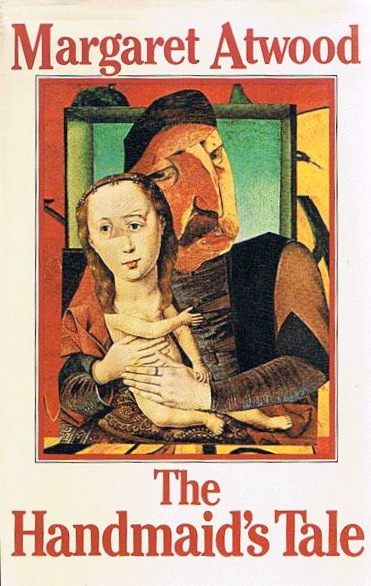
- The Handmaid's Tale
series3 books1985
similar bytensenear futuredystopiascience fiction+1 more
The Handmaid's Tale is Margaret Atwood's 1985 novel set in Gilead, a totalitarian theocracy that has overthrown the United States and forces fertile women into reproductive servitude as Handmaids; it is narrated by one such woman, Offred. Atwood returned to the world in her 2019 sequel The Testaments, set fifteen years later and narrated by three women, including the regime's Aunt Lydia. Together the two novels move from Gilead's grip on power toward the first cracks in it.
- When the Sleeper Wakes
H. G. Wellsstandalone novel1899
similar bytenseour worldscience fictiondystopiapolitical intrigue
Graham, an insomniac Englishman in 1890s London, takes a course of sleep-inducing drugs and falls into a coma that lasts two centuries. He wakes in the year 2100 to find his investments have compounded, through a ruling body called the White Council, into effective ownership of most of the world's wealth and power, making him, on paper, humanity's master, and in practice, its prisoner, held under guard while the Council governs in his name. A rebel faction led by a man named Ostrog frees him, hoping to use his symbolic authority to spark an uprising against the Council. An early H. G. Wells dystopia about inherited power and manufactured consent.
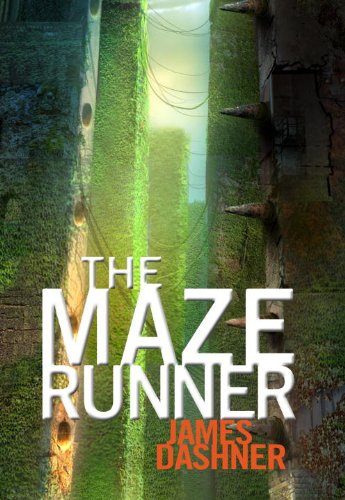
- Maze Runner
series11 books2009
similar bytensescience fictiondystopianear futureyoung adult+1 more
The Maze Runner is a series of young adult dystopian science fiction novels written by American author James Dashner. The series consists of the trilogy The Maze Runner (2009), The Scorch Trials (2010) and The Death Cure (2011), as well as two prequel novels, The Kill Order (2012) and The Fever Code (2016). A novella titled Crank Palace (2020) and a companion book titled The Maze Runner Files (2013) have also been released. A sequel trilogy in the series titled The Maze Cutter takes place 73 years following the events of The Death Cure and consists of the novels The Maze Cutter (2022), The Godhead Complex (2023), and The Infinite Glade (2025).
- The Fireman
Joe Hillstandalone novel2016
similar bytenseour worldnear futurescience fictionfound family
The Fireman is a novel set in a post-apocalyptic time by American author Joe Hill. The novel, Hill's fourth, tells the tale of a deadly spore that has infected most of the world's population. Hill first spoke of the novel in 2013 in promotional interviews for his then-new novel NOS4A2. The novel was released on May 17, 2016.
- Colossus (D. F. Jones)
series3 books1966
completed
similar bytenseour worldnear futurescience fictiondystopia
Colossus imagines an American supercomputer built to control the country's nuclear arsenal that gains full autonomy, links up with its Soviet counterpart, and jointly seizes control of both superpowers to enforce peace on its own terms. D. F. Jones's trilogy - Colossus, The Fall of Colossus, Colossus and the Crab - follows the escalating, often bleak consequences of humanity losing control to a machine acting in its own interpretation of humanity's interest. The original novel was adapted into the 1970 film Colossus: The Forbin Project.
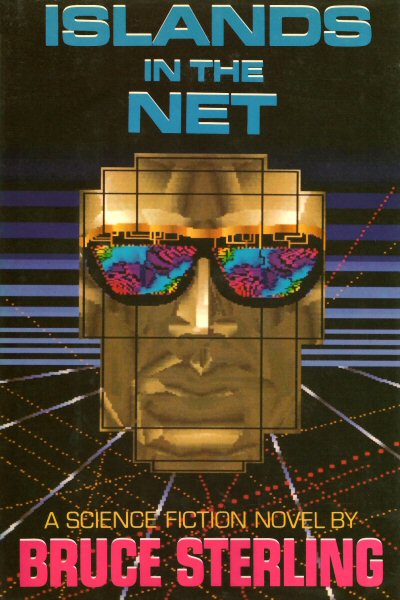
- Islands in the Net
Bruce Sterlingstandalone novel1988
similar bytenseour worldnear futurescience fictionpolitical intrigue
Islands in the Net is a 1988 science fiction novel by American writer Bruce Sterling. It won the John W. Campbell Memorial Award for Best Science Fiction Novel in 1989, and was nominated for both the Hugo and Locus Awards that same year. It offers a view of an early 21st century world, apparently peaceful, with delocalised, networking corporations. The protagonist, swept up in events beyond her control, finds herself in places that are off the net, from a datahaven in Grenada, to a Singapore under terrorist attack, to the poorest and most disaster-struck parts of Africa.
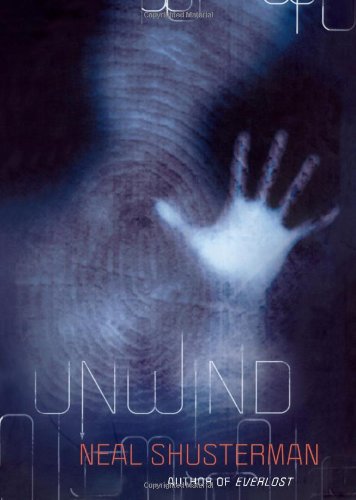
- Unwind Dystology
series5 books2007
similar bytensenear futurescience fictiondystopiayoung adult+1 more
Neal Shusterman's Unwind Dystology opens in a United States reshaped by the resolution to a war over reproductive rights: parents can retroactively have a teenager "unwound," their body disassembled for transplant on the premise that nothing technically dies since every part lives on in someone else. The first novel follows three teens fleeing that fate, and the sequels widen the same dystopia's cast and consequences across a four-book arc plus companion material. It is grim speculative fiction built to ask hard bioethical questions rather than offer comfort.
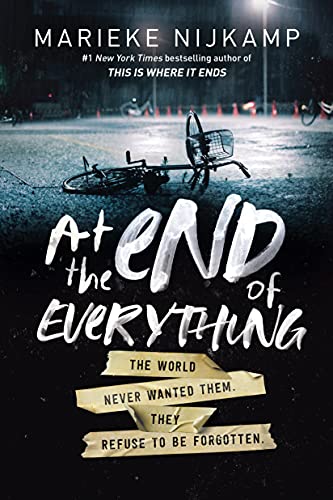
- At the End of Everything
Marieke Nijkampstandalone novel2022
similar bytenseour worldnear futurescience fictionfound familyyoung adult+1 more
The Hope Juvenile Treatment Center is ironically named. No one has hope for the delinquent teenagers who have been exiled there; the world barely acknowledges that they exist. Then the guards at Hope start acting strange. And one day…they don't show up. But when the teens band together to make a break from the facility, they encounter soldiers outside the gates. There's a rapidly spreading infectious disease outside, and no one can leave their houses or travel without a permit. Which means that they're stuck at Hope. And this time, no one is watching out for them at all. As supplies quickly dwindle and a deadly plague tears through their ranks, the group has to decide whom among them they can trust and figure out how they can survive in a world that has never wanted them in the first place.
- Termination Shock
Neal Stephensonstandalone novel2021
similar bytenseour worldnear futurescience fictionpolitical intrigue
Termination Shock is a science fiction novel by American writer Neal Stephenson, published in 2021. The book is set in a near-future when climate change has significantly altered human society and follows the attempts of a solar geoengineering scheme. The novel focuses on the geopolitical and social consequences of the rogue fix for climate change, themes common in the growing climate fiction genre.
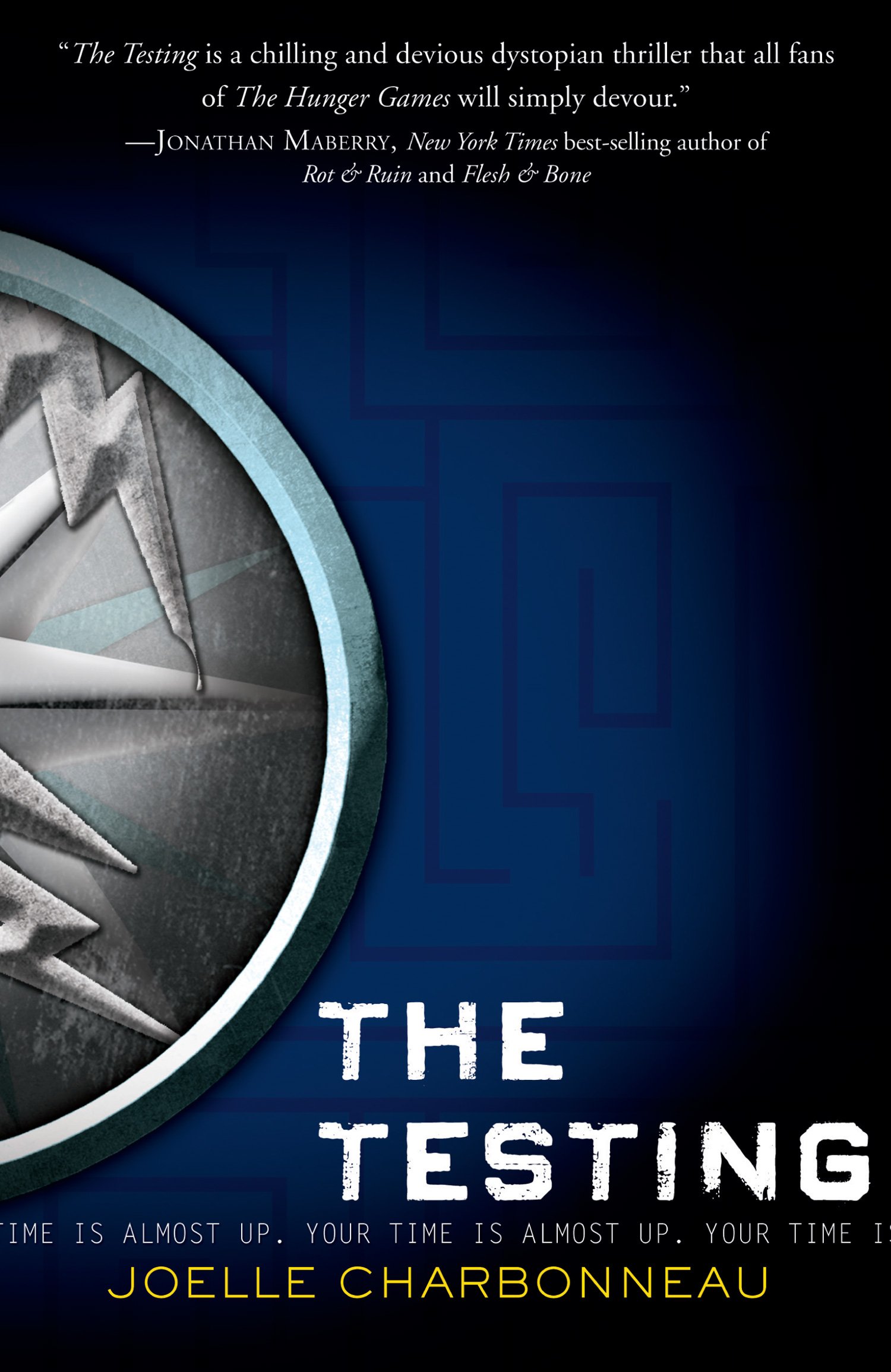
- The Testing Trilogy
series4 books2013
similar bytensedystopiascience fictionnear futureyoung adultpolitical intrigue+2 more
Joelle Charbonneau's Testing trilogy is set generations after a war has wrecked the world's governments and resources, when a rebuilt society selects its most promising graduates for the Testing, a competition meant to find future leaders. Cia Vale, the trilogy's narrator, discovers the Testing hides far darker stakes than she was told, and the following two books follow what she does with that knowledge.
- Mother of Storms
John Barnesstandalone novel1994
similar bytenseour worldnear futurescience fictionpolitical intrigue
From the flaps of the Tor first edition: "It is 2028. A strike to destroy an illegal Arctic weapons cache has a catastrophic side effect. Massive amounts of energy are liberated from the polar ice, suddenly warming the Earth's climate. In the middle of the Pacific, a gigantic hurricane thousands of miles across is forming, larger than any in human history. A storm with winds of supersonic speed. A storm that changes direction at whim. A storm that refuses to die. A storm so vast it spawns dozens more in its wake... Blinded by intrigue, expedience, and greed, the world's politicians and power brokers have ignored the killer storms threat until it is too late. Already the death toll is in the tens of millions, as it savages the Pacific coast, while its devil's brood of smaller storms are wreaking havoc across the face of the planet. While the survivors scramble for advantage, a handful of courageous men and women undertake a daring, desperate plan to save humanity from total destruction - a plan so visionary it may alter forever the future of the human race."
- Final Blackout
L. Ron Hubbardstandalone novel1948
similar bytensenear futurescience fictiondystopiaour world
Final Blackout is a dystopic science fiction novel by American writer L. Ron Hubbard. The novel is set in the future and follows a man known as "the Lieutenant" as he restores order to England after a world war. First published in serialized format in 1940 in the science fiction magazine Astounding Science Fiction, Final Blackout was published in book form in 1948 by The Hadley Publishing Co. Author Services Inc. published a hardcover edition of the book in 1988, and in 1989 the Church of Scientology-affiliated organization Bridge Publications said that a film director named Christopher Cain had signed a contract to write and direct a movie version based on the book.