More like Glacial
anchored on:science fictionhard science fictionmadnessother star systemsfar futureeerie+2 more
but
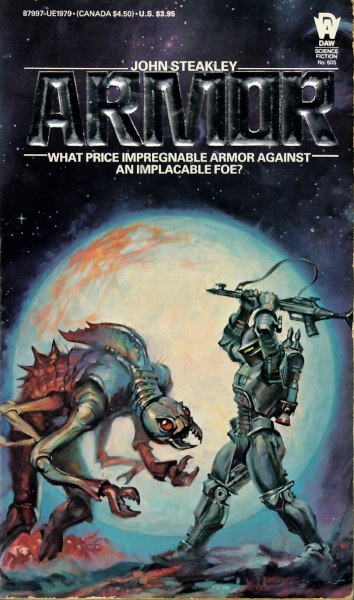
- Armor
John Steakleystandalone novel1984
similar byother star systemsfar futuremadnessscience fictiondark
Armor is a military science fiction novel by John Steakley. It features the military use of exoskeletons and insect-like alien enemies but concentrates on the psychological effects of violence on human beings.
- The Stars My Destination
Alfred Besterstandalone novel1956
similar byfar futuresurvivalscience fictionother star systemsdark
When a passing spaceship refuses to rescue the lone survivor from the drifting wreck of another ship, he dedicates his life to discovering who made that decision and exacting his revenge, in the process altering human history and his own character.
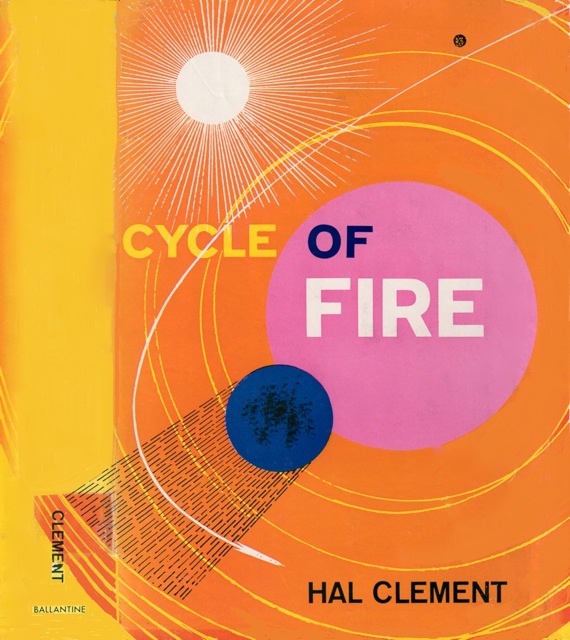
- Cycle of Fire
Hal Clementstandalone novel1957
similar byother star systemsfar futuresurvivalscience fictionhard science fiction
After his ship crashed on the inhospitable planet Abyorman, Nils Kruger had spent weeks wandering across the face of the planet.suffering from blistering heat, the searing cold of an alien climate. Now he had found a fellow wanderer, Dar, an alien castaway. They may both die. The human opts to do something about it. Dar, who knows the time of his death in advance, opts to do nothing. Which of them is right? Perhaps both
- The Status Civilization
Robert Sheckleystandalone novel1960
similar byother star systemsfar futuresurvivalscience fictiondark
"Will Barrent had no memory of his crime ... but he found himself shipped across space to a brutal prison-planet. On Omega, his only chance to advance himself -- and stay alive -- is to commit an endless series of violent crimes. The average inmate's life expectancy from time of arrival is three years. Can Barrett survive, escape, and return to Earth to clear his name?" - From the cover of the 2007 Wildside paperback edition.
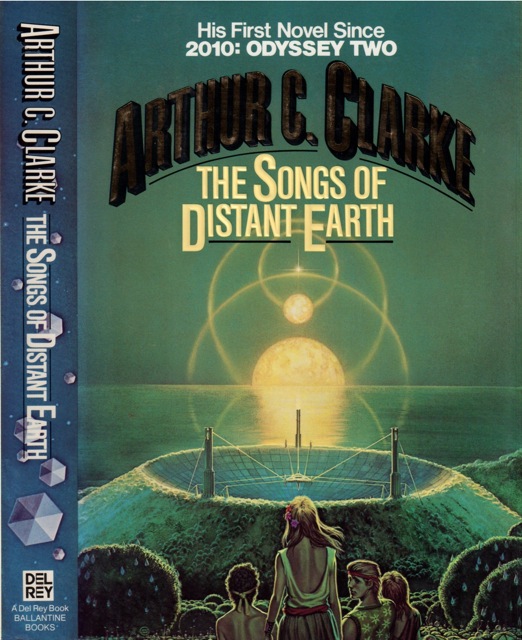
- The Songs of Distant Earth
Arthur C. Clarkestandalone novel1986
similar byother star systemsfar futuresurvivalscience fictionhard science fiction
The Songs of Distant Earth is a 1986 science fiction novel by British writer Arthur C. Clarke, based upon his 1958 short story of the same title. Of all of his novels, Clarke stated that this was his favourite. Prior to the publishing of the novel, Clarke also wrote a short step outline with the same title, published in Omni magazine and anthologised in The Sentinel in 1983.
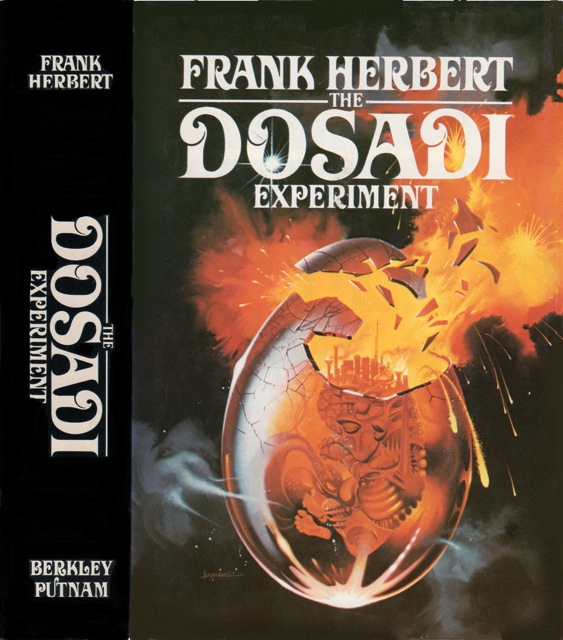
- The Dosadi Experiment
Frank Herbertstandalone novel1977
similar byother star systemsfar futuresurvivalscience fiction+1 more
From the flaps of the Berkley Putnam first edition: "In his first new work of science fiction since the best-selling Children of Dune, Frank Herbert returns to his world of Whipping Star, and involves Jorj X. McKie, Saboteur Extraordinary, in a new intrigue. In Whipping Star, McKie discovered that some of the stars in the universe are actually intelligent, super-powerful beings, and was able to befriend one of them, the star Alcyone - affectionately known as Fannie Mae. As The Dosadi Experiment opens, McKie is assigned to investigate the planet Dosadi, which is isolated from the rest of the galaxy by a "god-wall," a barrier set up by one of the intelligent stars. Dosadi is rumored to be an experimental planet, and the experimenters are the froglike Gowachin, whose culture is founded upon a strange legal system in which McKie is the only human ever trained. He learns that humans and Gowachin have been placed on Dosadi, without their consent, for an experiment that could last centuries: an experiment in extreme overcrowding. But this monstrous plot is apparently out of control, and it seems the Gowachin may be prepared to destroy Dosadi rather than expose its secret, thus breaking the peace among the races, and starting the first interstellar war. But this is just the beginning. When McKie finally reaches Dosadi he discovers that the Dosadis have taken control of their own evolution and produced a competitive, highly evolved elite, of both humans and Gowachin, who have been able to extrapolate the existence of a universe beyond the god-wall and hate whoever has imprisoned them like this. They plan to break out and avenge themselves on the galaxy."
- Pandora
series4 books1966
similar byfar futurescience fictionother star systemssurvival+1 more
The Pandora Sequence opens with Frank Herbert's solo novel Destination: Void, in which a starship crew must jury-rig a working artificial consciousness after their vessel's control systems fail. Bill Ransom co-writes the three novels that follow, carrying the survivors to the world Pandora, where they must contend with both a manipulative machine intelligence and the planet's own hostile ecology. Across its four books the series moves from a claustrophobic ship-bound crisis to a generations-long struggle over faith, control, and survival on a dangerous new world.
- Shroud (Adrian Tchaikovsky)
series2 books2024
similar byother star systemsfar futuresurvivalscience fictionhard science fiction+1 more
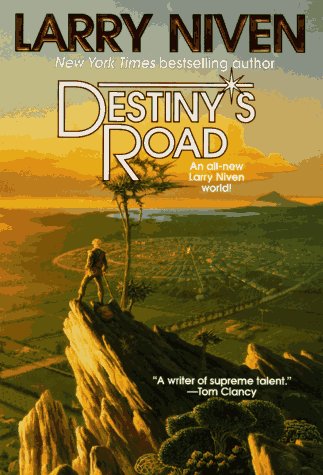
- Destiny's Road
Larry Nivenstandalone novel1997
similar byother star systemsfar futuresurvivalscience fictionhard science fiction
Destiny's Road is a science fiction novel by American writer Larry Niven, first published in 1998. It follows Jemmy Bloocher's exploration of Destiny's Road, a long scar of once-melted rock seared onto the planet's surface by a spaceship's fusion drive. Jemmy is descended from the original Destiny colonists, who were stranded when their landing craft deserted them.
- Pushing Ice
Alastair Reynoldsstandalone novel2005
similar byfar futuresurvivalscience fictionother star systemshard science fiction
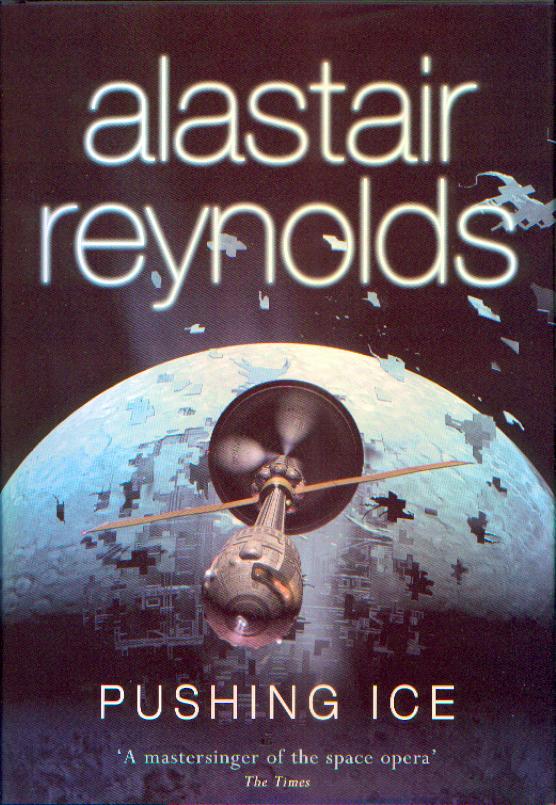
When Saturn's moon Janus suddenly takes off into interstellar space, an ice mining spaceship sent to investigate finds itself swept along into distant space until it ends up trapped in a gigantic alien structure, wherein the crew must prepare to reside for the foreseeable future.
- Dune
series20 books1963
part of Dune Universe
similar byfar futureother star systemsscience fiction+1 more
Frank Herbert's Dune Chronicles opens with 1965's Dune, set on the desert planet Arrakis where House Atreides takes control of the only source of the vital spice melange and young Paul Atreides is pulled into a struggle over its politics and religion. Herbert carried the story forward across five further novels — Dune Messiah, Children of Dune, God Emperor of Dune, Heretics of Dune, and Chapterhouse: Dune — following Paul's line over the following millennia, before Brian Herbert and Kevin J. Anderson later extended the saga. Many other editions of these six novels are omnibus and box-set repackagings rather than separate stories.
- Aurora
Kim Stanley Robinsonstandalone novel2015
similar byfar futuresurvivalscience fictionhard science fictionother star systems
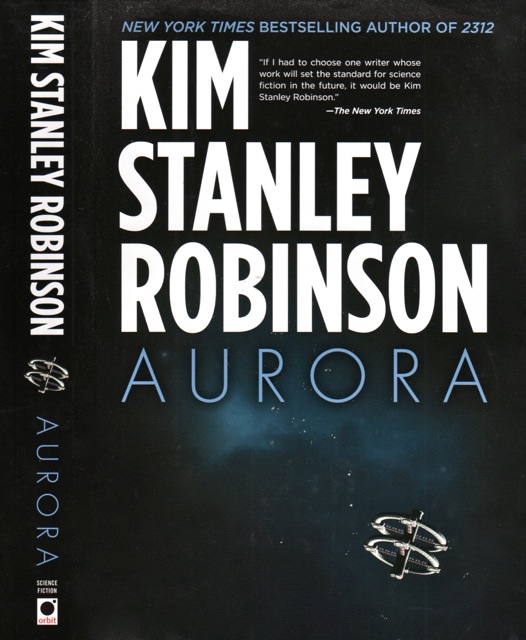
Aurora is a 2015 novel by American science fiction author Kim Stanley Robinson. The novel concerns a generation ship built in the style of a Stanford torus, traveling to Tau Ceti to start a human colony. The novel's primary narrative voice is that of the starship's artificial intelligence. Aurora was well received by critics.
- Mesklin
series6 books1954
completed
similar byother star systemsfar futurescience fictionhard science fiction+1 more
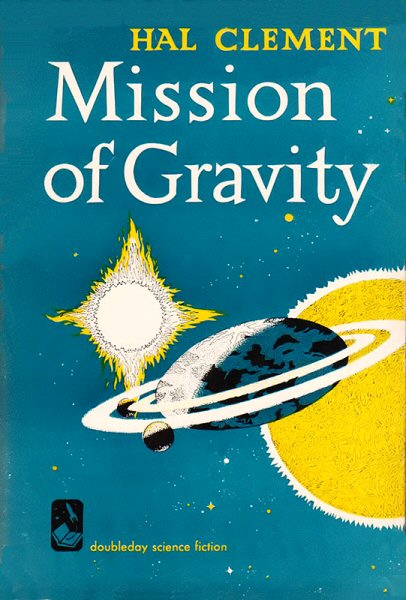
Mesklin is a fictional planet created by Hal Clement and used in a number of his hard science fiction stories, starting with Mission of Gravity (1954). Alongside the novel's original 1953 serialization in Astounding Science Fiction, Clement published an essay titled "Whirligig World" on how he designed the planet to have the properties he wanted. The idea came from an object that was at the time believed to exist in the 61 Cygni system, and which might represent an extrasolar planet.
- Clans of the Alphane Moon
Philip K. Dickstandalone novel1964
similar byother star systemsfar futuremadnessscience fiction+1 more
Clans of the Alphane Moon is a 1964 science fiction novel by American writer Philip K. Dick. It is based on his 1954 short story "Shell Game", first published in Galaxy Science Fiction magazine.
- Creatures of Light and Darkness
Roger Zelaznystandalone novel1969
similar byfar futurescience fictionother star systemsdarkeerie
Creatures of Light and Darkness is a 1969 science fiction novel by American writer Roger Zelazny. Long out of print, it was reissued in April 2010. The novel is set in the far future, with humans on many worlds. Some humans have god-like powers or perhaps are actually gods—the names and aspects of various Egyptian gods are used. Elements of horror and technology are mixed, and the novel shares elements with cyberpunk.
- The City in the Middle of the Night
Charlie Jane Andersstandalone novel2019
similar byother star systemsfar futuresurvivalscience fictiondark
The City In the Middle of the Night is a 2019 climate-fiction novel by Charlie Jane Anders. It is set on a tidally locked planet, where human life, surrounded by hostile alien life, is mostly divided between two archetypically different urban sites. The main story focuses on two characters whose actions take them outside of the cities.
- Solaris
Stanisław Lemstandalone novel1961
similar byother star systemsfar futuremadnessscience fictioneeriehard science fiction
Solaris is a 1961 science fiction novel by Polish writer Stanisław Lem. It follows a crew of scientists on a hovering near-surface research facility as they attempt to understand an extraterrestrial intelligence, which takes the form of a vast ocean on the titular alien planet. The novel is one of Lem's best-known works.
- Helm
Steven Gouldstandalone novel1998
similar byother star systemsfar futuresurvivalmadnessscience fiction+1 more
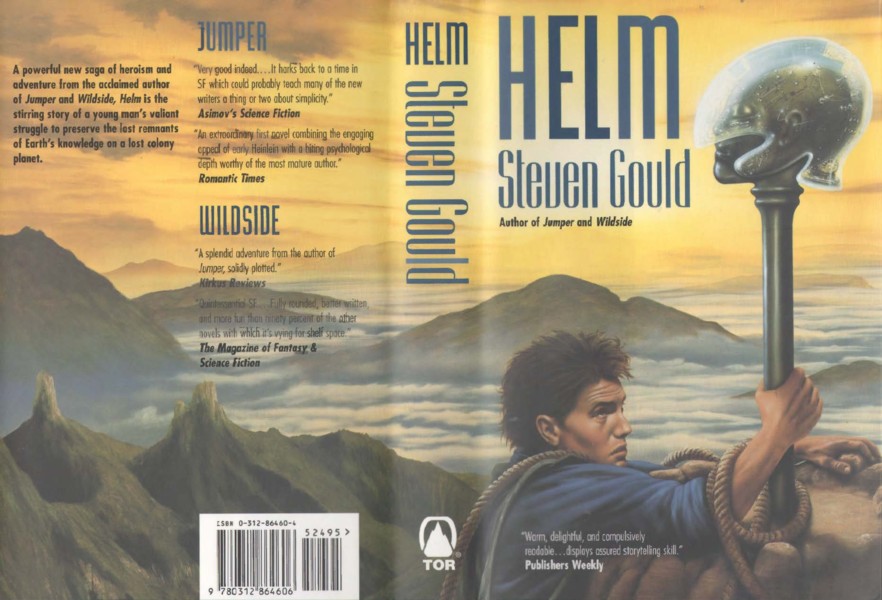
After global devastation, the last remnants of Earth sent a handful of colonists of a distant terraformed world to give humanity one last, desperate chance. Unable to provide the technology required for an advanced civilization, the founders instilled in the colonists a strict code of conduct and gave them a few precious imprinting devices: glass helmets that contain all of Earth's scientific knowledge. Once in a generation, the heir to the province of Laal begins the arduous training required to survive the imprinting of the Glass Helm and acquire the knowledge of the lost Earth. But Leland de Laal, the youngest son of one of Agatsu's greatest leaders, has climbed the forbidden rock spire where the Helm is kept and donned it, unaware that its knowledge has a terrible price. To an unprepared mind, it brings madness, agony, and even death.
- Heorot
series4 books1987
similar byother star systemsfar futurescience fiction+2 more
Larry Niven, Jerry Pournelle and Steven Barnes's The Legacy of Heorot strands human colonists on an idyllic-seeming alien world where they discover apex predators -- grendels -- hidden beneath the surface, forcing them to fight for survival. Beowulf's Children continues the colony a generation later as the children born on the planet clash with their parents over how to live alongside the grendels, and a fourth book, Starborn and Godsons, returns to the settlement decades further on. It's hard-SF creature-horror crossed with generational colony drama.
- Tunnel in the Sky
Robert A. Heinleinstandalone novel1955
similar byother star systemsfar futuresurvivalscience fiction
As the final test of a survivalist/explorer class, teenagers are dumped on an alien planet to use their skills while awaiting pickup. But something has gone wrong, and they find they are on their own.
- Dichronauts
Greg Eganstandalone novel2017
similar byother star systemsfar futuresurvivalscience fictionhard science fiction
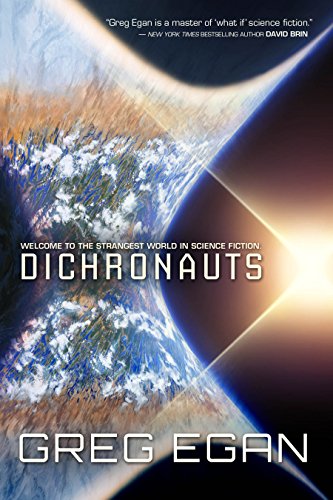
Dichronauts is a hard science-fiction novel by Australian author Greg Egan. The novel was published by Night Shade Books on 11 July 2017. It describes a universe with two time dimensions, one of which corresponds to the time perception of the characters while the other influences their spatial perception, which precludes rotations in the latter chronological direction. Hence a symbiosis of two life forms is necessary, so that they can even see in all directions. Furthermore, many fundamental laws of physics are altered crucially: Objects can roll uphill or not fall over any more when oriented suitably. There is negative kinetic energy and a fourth state of matter. Planets are no longer spherical, but hyperbolic and therefore have three separate surfaces. Egan describes these details on his website.
- We Who Are About to ...
Joanna Russstandalone novel1977
similar byother star systemsfar futuresurvivalscience fictiondark
We Who Are About To... is a feminist science fiction novella by Joanna Russ. It first appeared in magazine form in the January 1976 and February 1976 issues of Galaxy Science Fiction and was first published in book form by Dell Publishing in July 1977.
- Dark Secret
Edward M. Lernerstandalone novel2016
similar byother star systemsfar futuresurvivalscience fictiondarkhard science fiction
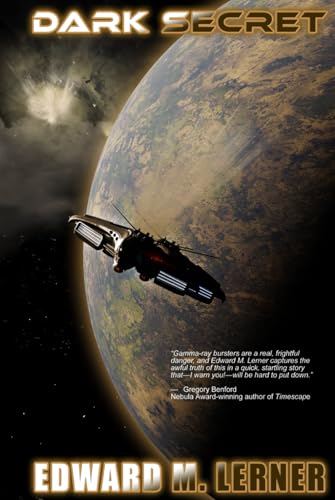
Cosmologically speaking, Earth's luck ran out in an eye blink. In another million years or so, humanity could have had the technology to shield its cradle from an imminent gamma-ray burst. Or humans might already have spread out among the stars -- safe, as a species, from any less-than-galactic-scale disaster. Too bad we didn't get that million years. And too bad, with humanity teetering on the brink of extinction, the few desperate survivors on Dark couldn't leave behind their conflicts ...
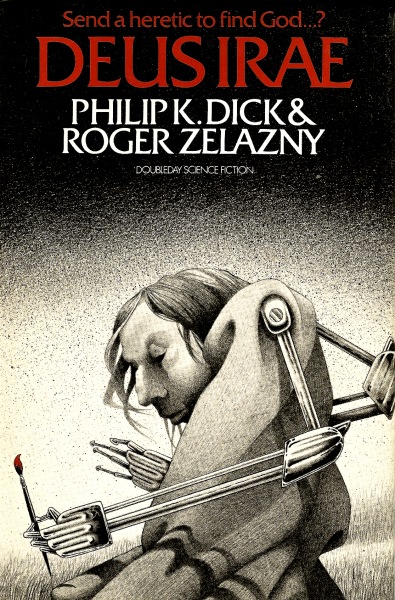
- Deus Irae
Philip K. Dick & Roger Zelaznystandalone novel1976
similar byfar futuresurvivalscience fictiondark+1 more
Deus Irae is a post-apocalyptic science fiction novel written by two American authors; it was started by Philip K. Dick and finished with the help of Roger Zelazny. It was published in 1976. The novel's title, Deus irae, means 'God of Wrath' in Latin; the title is a play on words on the phrase Dies Irae, meaning 'Day of Wrath' or 'Judgment Day'. The novel was based on Dick's short stories "The Great C" and "Planet for Transients".