More like Interface
anchored on:thriller & suspensepolitical intriguenorth americanear futuretensescience fiction+3 more
but
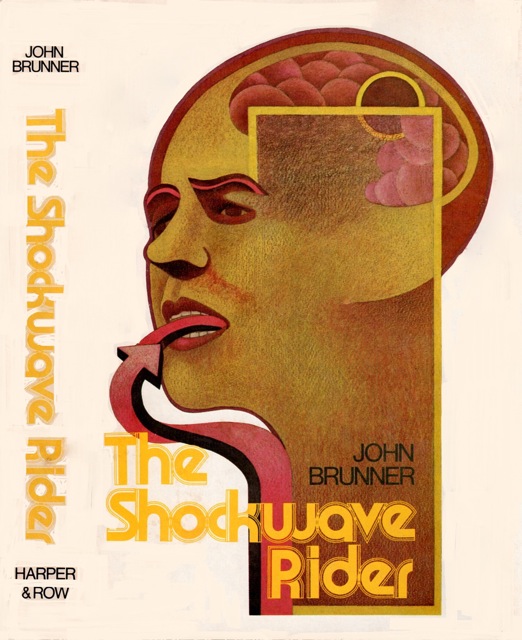
- The Shockwave Rider
John Brunnerstandalone novel1975
similar bynear futuretensenorth americascience fictiondarksurveillancebig city
The Shockwave Rider is a science fiction novel by John Brunner, originally published in 1975. It is notable for its hero's use of computer hacking skills to escape pursuit in a dystopian future, and for the coining of the word "worm" to describe a program that propagates itself through a computer network. It also introduces the concept of a Delphi pool, perhaps derived from the RAND Corporation's Delphi method – a prediction market on world events which bears close resemblance to DARPA's controversial and cancelled Policy Analysis Market.
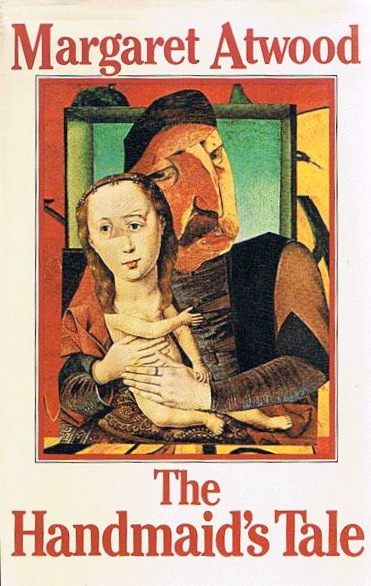
- The Handmaid's Tale
series3 books1985
similar bynear futurenorth americascience fictiondarktense+2 more
The Handmaid's Tale is Margaret Atwood's 1985 novel set in Gilead, a totalitarian theocracy that has overthrown the United States and forces fertile women into reproductive servitude as Handmaids; it is narrated by one such woman, Offred. Atwood returned to the world in her 2019 sequel The Testaments, set fifteen years later and narrated by three women, including the regime's Aunt Lydia. Together the two novels move from Gilead's grip on power toward the first cracks in it.
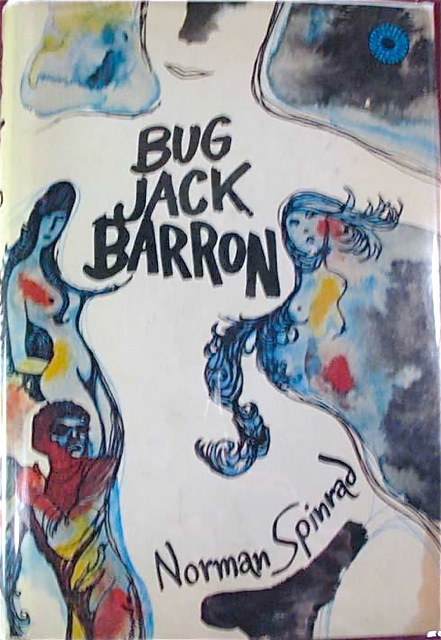
- Bug Jack Barron
Norman Spinradstandalone novel1969
similar bynear futurepolitical intriguenorth americascience fictiontensesurveillance+1 more
Bug Jack Barron is a 1969 science fiction novel by American writer Norman Spinrad, first serialized in the New Worlds magazine under the editorship of Michael Moorcock. It was nominated for the 1970 Hugo Award. The novel is notable for its lyrical style and unique use of cut-up phrases. In this regard, Spinrad has cited the influence of Beat writers William S. Burroughs, Allen Ginsberg, and Jack Kerouac.
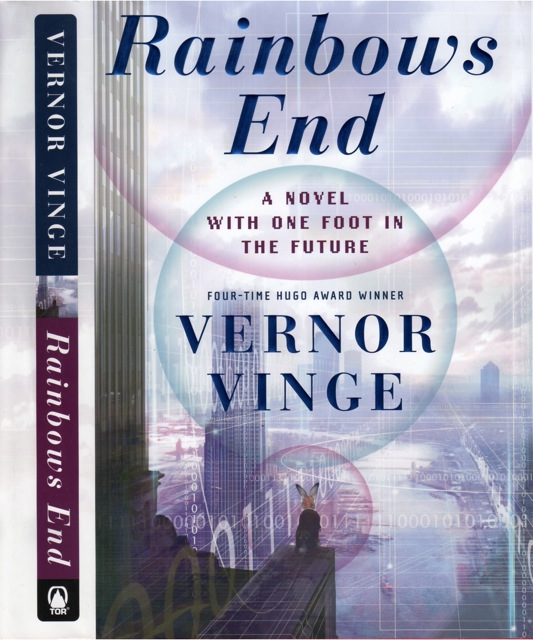
- Rainbows End
Vernor Vingestandalone novel2006
similar bynear futurenorth americascience fictionthriller & suspensetensesurveillancebig city+2 more
A science-fiction thriller set in a place and time as exciting and strange as any far-future world: San Diego, California, 2025. Robert Gu is a recovering Alzheimer’s patient. The world that he remembers was much as we know it today. Now, as he regains his faculties through a cure developed during the years of his near-fatal decline, he discovers that the world has changed and so has his place in it. He was a world-renowned poet. Now he is seventy-five years old, though by a medical miracle he looks much younger, and he’s starting over, for the first time unsure of his poetic gifts. Living with his son’s family, he has no choice but to learn how to cope with a new information age in which the virtual and the real are a seamless continuum, layers of reality built on digital views seen by a single person or millions, depending on your choice. But the consensus reality of the digital world is available only if, like his thirteen-year-old granddaughter Miri, you know how to wear your wireless access—through nodes designed into smart clothes—and to see the digital context—through smart contact lenses. With knowledge comes risk. When Robert begins to re-train at Fairmont High, learning with other older people what is second nature to Miri and other teens at school, he unwittingly becomes part of a wide-ranging conspiracy to use technology as a tool for world domination. In a world where every computer chip has Homeland Security built-in, this conspiracy is something that baffles even the most sophisticated security analysts, including Robert’s son and daughter-in law, two top people in the U.S. military. And even Miri, in her attempts to protect her grandfather, may be entangled in the plot. As Robert becomes more deeply involved in conspiracy, he is shocked to learn of a radical change planned for the UCSD Geisel Library; all the books there, and worldwide, would cease to physically exist. He and his fellow re-trainees feel compelled to join protests against the change. With forces around the world converging on San Diego, both the conspiracy and the protest climax in a spectacular moment as unique and satisfying as it is unexpected.
- No Harm Can Come to a Good Man
James Smythestandalone novel2014
similar bynear futuretensenorth americascience fictionthriller & suspensedarkartificial intelligence+2 more
How far would you go to save your family from an invisible threat? A terrifyingly original thriller from the author of The Machine. ClearVista is used by everyone and can predict everything. It's a daily lifesaver, predicting weather to traffic to who you should befriend. Laurence Walker wants to be the next President of the United States. ClearVista will predict his chances. It will predict whether he's the right man for the job. It will predict that his son can only survive for 102 seconds underwater. It will predict that Laurence's life is about to collapse in the most unimaginable way.
- The Terminal Man
Michael Crichtonstandalone novel1972
similar bytensenorth americascience fictionthriller & suspensedarkartificial intelligencebig city
The Terminal Man is a novel by American writer Michael Crichton. It is his second novel under his own name, his 12th overall, and is about the dangers of mind control. It was published in April 1972 and also serialized in Playboy in March, April, and May 1972. In 1974, it was made into a film of the same name.
- Sprawl Trilogy
series10 books1981
similar bynear futurescience fictiontensedarkartificial intelligencebig city
The Sprawl Trilogy is William Gibson's foundational cyberpunk sequence: Neuromancer (1984), in which hacker Case is drawn into a high-stakes heist alongside an artificial intelligence and a damaged ex-soldier, followed by Count Zero (1986) and Mona Lisa Overdrive (1988), which widen the same near-future world of corporate power and networked cyberspace to new characters. Johnny Mnemonic, an early short story set in the same fictional milieu, predates the novels and introduces the courier Molly Millions before her role in the trilogy. Together these works established much of cyberpunk's visual and thematic vocabulary.
- The Circle (Eggers)
series2 books2013
similar bynear futurescience fictiondarktensenorth americasurveillancebig city+1 more
Mae Holland lands a coveted job at the Circle, a Silicon Valley tech company whose relentless, cheerful push toward total transparency -- 'secrets are lies, sharing is caring, privacy is theft' -- gradually reveals itself as something closer to soft totalitarianism. Dave Eggers's The Circle follows Mae's rise inside the company as she buys further and further into its ideology, at increasing cost to her own privacy and the people around her. The 2021 follow-up, The Every, picks up with Mae now running the merged tech giant and a new employee questioning it from the inside.
- A State of Disobedience
Tom Kratmanstandalone novel2003
similar bynear futuretensepolitical intriguenorth americascience fictionthriller & suspensedark
During the war against terrorism, the US government had taken on extraordinary powers. Now that the war was won, elements of the government had no intention of giving those powers up, and the country was on the verge of civil war.
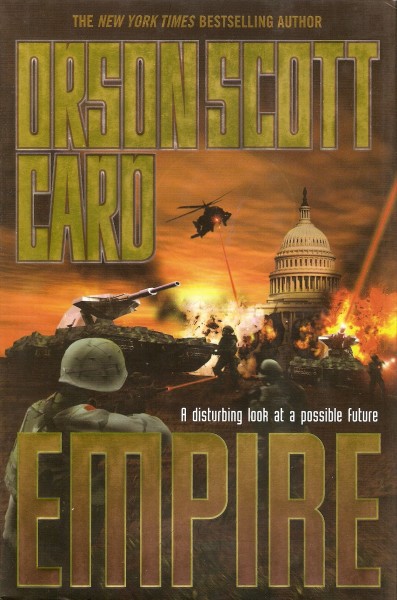
- Empire (Orson Scott Card)
series2 books2006
similar bynear futuretensenorth americapolitical intriguescience fictionthriller & suspense+1 more
The Empire Duet is a two-book series written by Orson Scott Card under license from Chair Entertainment, beginning with Empire in 2006. The sequel Hidden Empire was released December 22, 2009.
- The Running Man
Stephen Kingstandalone novel1982
similar bynear futuretensenorth americascience fictionthriller & suspensedark
The Running Man is a dystopian thriller novel by American writer Stephen King, first published under the pseudonym Richard Bachman in 1982 as a paperback original. It was collected in 1985 in the omnibus The Bachman Books. The novel is set in a dystopian United States during the year 2025, in which the nation's economy is in ruins and world violence is rising. The story follows protagonist Ben Richards as he participates in the reality show The Running Man, in which contestants win money by evading a team of hitmen sent to kill them.
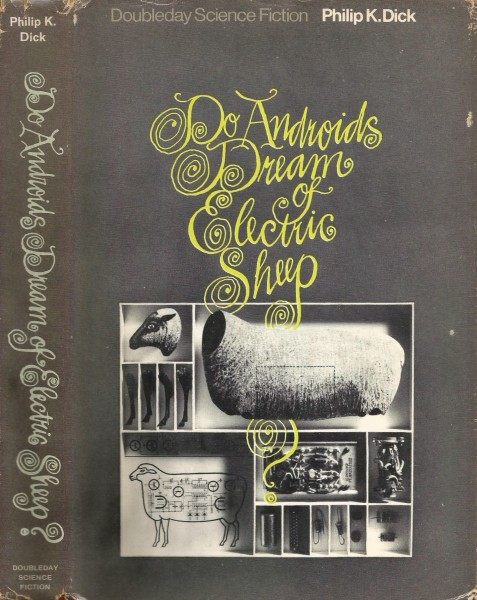
- Blade Runner Universe
series6 books1968
similar bynear futurescience fictiondarkbig city+3 more
Philip K. Dick's 1968 novel Do Androids Dream of Electric Sheep? follows bounty hunter Rick Deckard as he tracks escaped androids through an irradiated, near-abandoned San Francisco, using the hunt to probe questions of empathy and what separates human from machine. The novel became the basis for Ridley Scott's 1982 film Blade Runner, and Marvel Comics later published an illustrated adaptation of that film. Together the two trace the story's path from prose original to screen and comic-page adaptation.
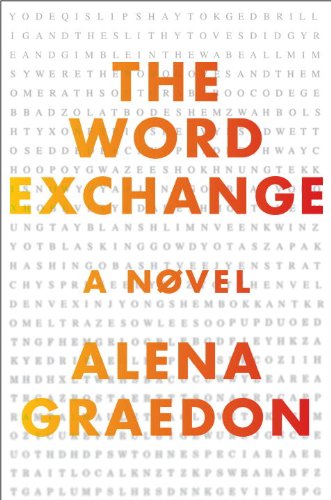
- The Word Exchange
Alena Graedonstandalone novel2014
similar bynear futurenorth americascience fictionthriller & suspensetenseartificial intelligencebig city+1 more
The Word Exchange is a science fiction novel by Alena Graedon, published in 2014. It is a dystopian thriller set in the not very distant future when the printed word has nearly vanished, technology dominates, and language has become a commodity. An online "Word Exchange" has taken the effort out of looking up words, a mere convenience until real dictionaries are no longer available. Then it becomes possible to corner the market for words. The novel has been translated into eight different languages.
- The Execution Channel
Ken MacLeodstandalone novel2007
similar bynear futurepolitical intriguescience fictiondarktensesurveillancenorth america
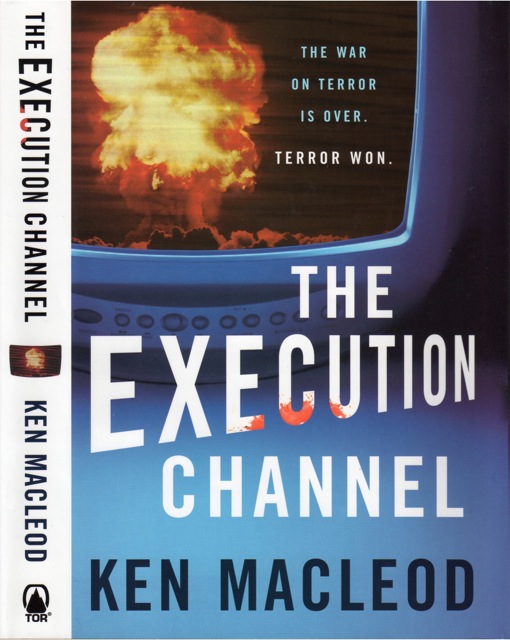
Al Gore is elected American president and the War on Terror takes on new dimensions.
- Nexus 5
series3 books2012
similar bynear futuretensescience fictiondarkartificial intelligence+4 more
Nexus opens Ramez Naam's postcyberpunk trilogy in 2040 with scientist Kaden Lane, who works on Nexus, an experimental nano-drug that lets human minds be networked and reprogrammed, and finds himself caught between government and corporate interests once the technology's implications become clear. The trilogy continues through Crux and Apex, following the same central conflict over who controls the technology. Nexus tied for Best Novel at the 2014 Prometheus Awards and Apex won the 2015 Philip K. Dick Award.
- Quantum Night
Robert J. Sawyerstandalone novel2016
similar bynear futuretensescience fictionthriller & suspenseartificial intelligencenorth america+1 more
Quantum Night is a 2016 science-fiction thriller novel written by Canadian novelist Robert J. Sawyer. Set in 2020, the book touches on themes of quantum physics, psychology, current politics and ethics.
- Lesser Evils
series5 books2017
similar bynear futuretensepolitical intriguenorth americascience fictionthriller & suspensedark
- Drought
Graham Mastertonstandalone novel2014
similar bynear futurethriller & suspensetensescience fictiondarkpolitical intriguenorth america
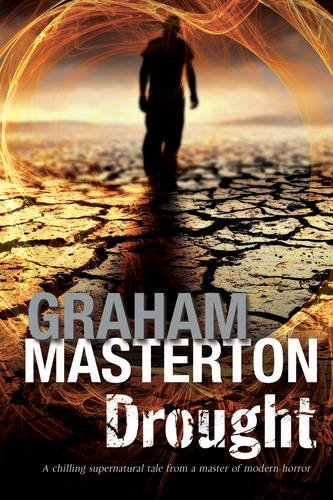
A nationwide drought causes the taps to run dry and ex-marine and social worker Martin Makepeace must take drastic action to protect his family, while corrupt politicians try to use the drought to their advantage.
- Assassin (Robert Ferrigno)
series3 books2006
similar bynear futuretensethriller & suspensenorth americascience fictiondarkpolitical intrigue
- City of Cain
Kate Wilhelmstandalone novel1974
similar bytensenorth americascience fictionthriller & suspensedarkpolitical intriguesurveillance
Publisher: "Peter Roos cannot help knowing the thoughts of those around him. A rare physical condition has given him that power. Now he has ''heard'' about the government's secret plan to give up control of America to the military - to build an underground city for themselves in the event of a nuclear attack. Unfortunately for Roos, the government knows he knows. And the project's sponsors - including his senator brother - have no choice."
- The Oracle Year
Charles Soulestandalone novel2018
similar bynear futurescience fictionthriller & suspensetensepolitical intriguenorth americabig city+1 more
Awakening from a dream with more than one hundred predictions about the future in his head, an unassuming Manhattan bassist becomes one of the world's most powerful men and hides his identity behind an online persona that is targeted by greedy corporations and dangerous enemies.
- Halting State
series2 books2007
similar bynear futurescience fictiontenseartificial intelligencesurveillance+2 more
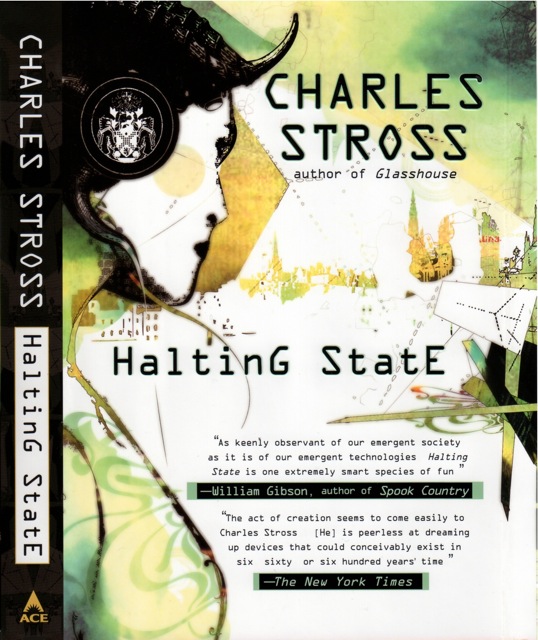
Charles Stross's Halting State opens as a near-future police procedural: a bank robbery inside a massively multiplayer online game turns out to mask a much larger cybercrime, investigated through shifting narrators using augmented-reality glasses and always-on networks. Its loose sequel, Rule 34, follows an Edinburgh police officer investigating a string of deaths linked by nothing but an obscure internet meme, in the same near-future Scotland. Both are standalone technothrillers connected by setting and tone rather than a continuing plot.
- The World Jones Made
Philip K. Dickstandalone novel1956
similar bynear futurescience fictiondarktensepolitical intriguenorth america
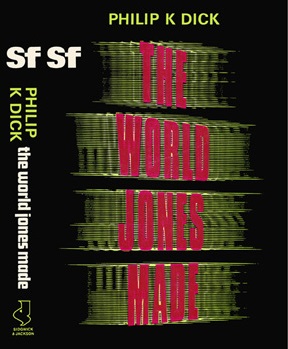
The World Jones Made is a 1956 science fiction novel by American writer Philip K. Dick, examining notions of precognition, humanity, and politics. It was first published by Ace Books as one half of Ace Double D-150, bound dos-à-dos with Agent of the Unknown by Margaret St. Clair.The story takes place after a nuclear war in which society is dominated by relativism, which rejects absolute truths and preaches tolerance as the highest principle. The mutant Floyd Jones, who can see into the future, plans to overthrow the system and colonise space. The story ends with the defeat of Jones, whose plans fail despite his ability to see the future due to the immutability of fate.
- Daemon (Daniel Suarez)
series2 books2006
similar bytensescience fictionartificial intelligencesurveillancenorth america+3 more