More like Microcosms
anchored on:science fictionfar futureshort story cyclehard science fictionspace explorationspace+1 more
but
- Diaspora
Greg Eganstandalone novel1997
similar bychallengingspacefar futurescience fictionspace explorationhard science fictionartificial intelligence+1 more
Diaspora is a hard science fiction novel by the Australian writer Greg Egan which first appeared in print in 1997. It originated as the short story "Wang's Carpets" which originally appeared in the Greg Bear-edited anthology New Legends. The story appears as a chapter of the novel.
- A Meeting with Medusa
series2 books1971
similar byspacescience fictionchallengingfar futurespace explorationhard science fictionreflectivealiens+1 more
Arthur C. Clarke's A Meeting with Medusa follows an astronaut, badly injured in an earlier disaster, on a solo balloon expedition into Jupiter's atmosphere, where he encounters vast floating lifeforms unlike anything previously catalogued. Decades later, Stephen Baxter and Alastair Reynolds continued the story in The Medusa Chronicles, following the same protagonist across a much longer span of future history. The original novella won the 1972 Nebula Award.
- Thistledown
series5 books1978
completed
similar byspacefar futurescience fictionspace explorationhard science fiction+2 more
- Imperial Earth
Arthur C. Clarkestandalone novel1975
similar byspacefar futurescience fictionspace explorationhard science fictionreflective
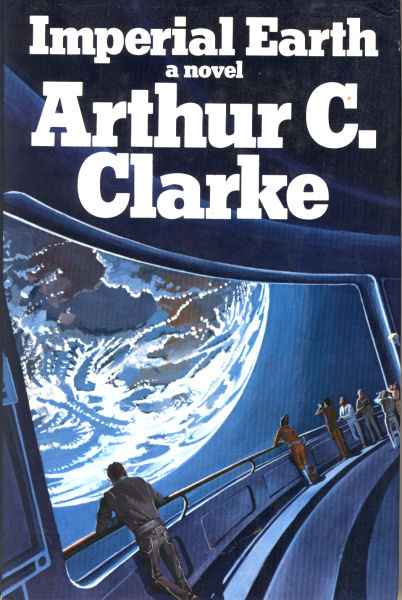
Imperial Earth is a science fiction novel by British writer Sir Arthur C. Clarke, published in 1975 by Gollancz Books. The plot follows the protagonist, Duncan Makenzie, on a trip to Earth from his home on Titan, in large part as a diplomatic visit to the U.S. for its quincentennial in 2276, but also to have a clone of himself produced. The book was published in time for the U.S. bicentennial in 1976.
- Xeelee
series89 books1987
similar byfar futurescience fictionspacehard science fictionaliens+2 more
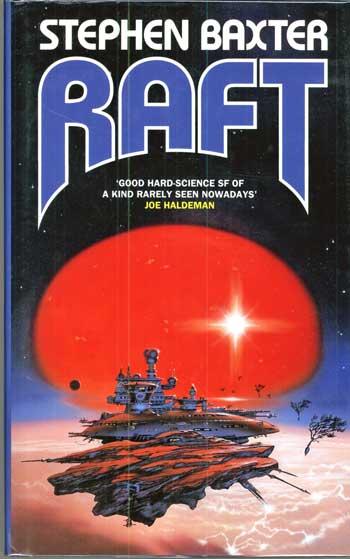
The Xeelee Sequence is a series of hard science fiction novels, novellas, and short stories written by British author Stephen Baxter. The series spans billions of years of fictional history, exploring humanity's future expansion into the universe, its intergalactic war with the Xeelee, a supremely advanced Kardashev Type V alien civilization, and the Xeelee's own conflict with dark matter entities known as Photino Birds. The Xeelee are described as symbiotic entities composed of spacetime defects, Bose–Einstein condensates, and baryonic matter.
- Schild's Ladder
Greg Eganstandalone novel2002
similar bychallengingspacefar futurescience fictionspace explorationhard science fiction
Schild's Ladder is a 2002 science fiction novel by Australian author Greg Egan. The book derives its name from Schild's ladder, a construction in differential geometry, devised by the mathematician and physicist Alfred Schild.
- Jean le Flambeur
series3 books2010
similar bychallengingspacefar futurescience fictionhard science fictionartificial intelligencevirtual reality
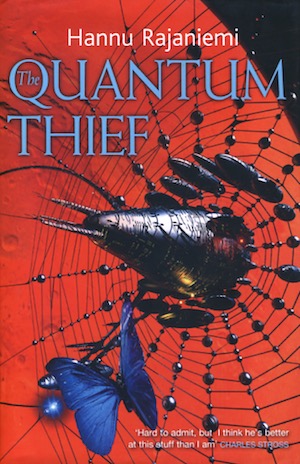
Jean le Flambeur is a master thief broken out of a virtual prison to pull off one more impossible heist, in a solar system reshaped by uploaded minds, post-human factions, and economies built on memory and privacy themselves. Hannu Rajaniemi's trilogy - The Quantum Thief, The Fractal Prince, The Causal Angel - is dense, idea-heavy hard SF that trusts readers to piece its future together from context rather than exposition.
- Blindsight / Firefall
series3 books2006
similar byspacescience fictionchallenginghard science fictionfar futureartificial intelligencealiens+1 more
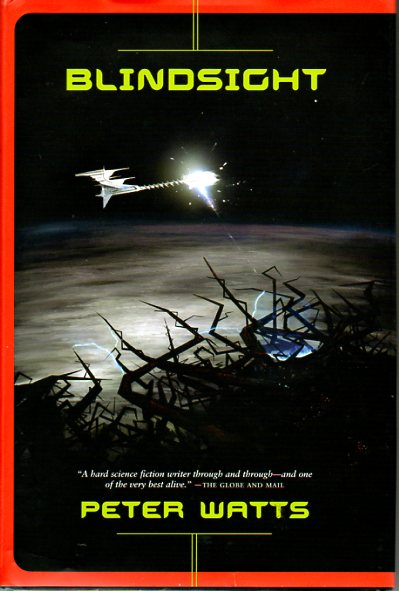
Blindsight sends a crew of radically modified posthumans (including a resurrected, genetically restored vampire) out to the Oort cloud after humanity detects an alien signal, only to make contact with something intelligent, wildly capable, and possibly not conscious at all — a first-contact story built around the question of whether self-awareness is actually useful. Peter Watts's Echopraxia is a same-timeframe "sidequel" rather than a direct sequel, following different characters through the fallout of the same first-contact event.
- Hegira
Greg Bearstandalone novel1979
similar bychallengingspacefar futurescience fictionhard science fictionartificial intelligence+1 more
Hegira is a 1979 science fiction novel by American writer Greg Bear. It deals with themes including cyclic time, artificial intelligence, artificial life, and artificial structures of planetary scale.
- The Gods Themselves
Isaac Asimovstandalone novel1972
similar bychallengingfar futurescience fictionhard science fictionaliens+1 more
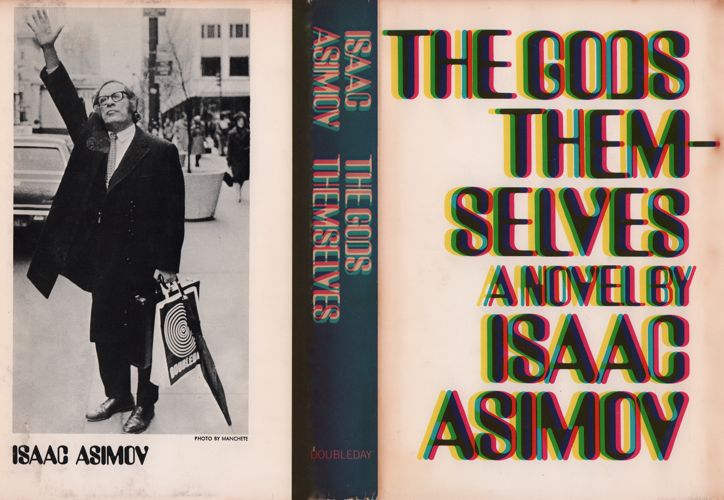
The Gods Themselves is a 1972 science fiction novel written by Isaac Asimov, and his first original novel in fifteen years. It won the Nebula Award for Best Novel in 1972, and the Hugo Award for Best Novel in 1973.
- Ringworld
series5 books1970
part of Known Space
similar byspacefar futurescience fictionspace explorationaliens
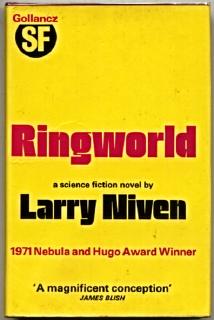
The Ringworld series is a series of science fiction novels written by American author Larry Niven. It is part of his Known Space series of stories. Its backdrop is the Ringworld, a giant artifact 3 million times the surface area of Earth circling a star. The series is composed of four standalone science fiction novels, the original award-winning book and its three sequels:1970: Ringworld 1979: The Ringworld Engineers 1996: The Ringworld Throne 2004: Ringworld's Children
- Aurora
Kim Stanley Robinsonstandalone novel2015
similar bychallengingfar futurescience fictionhard science fictionreflectiveartificial intelligence+1 more
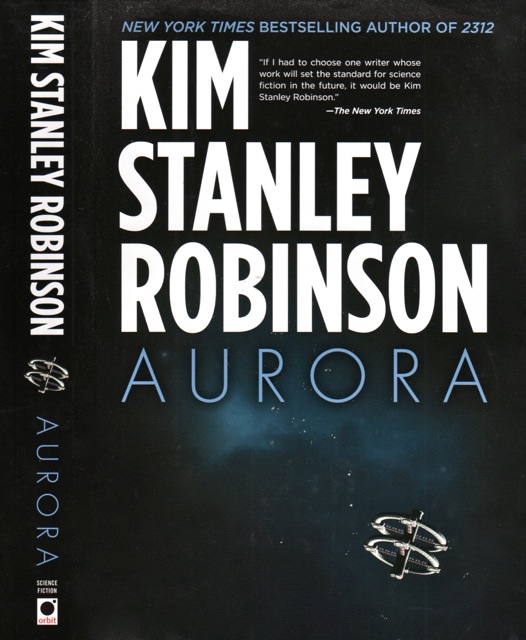
Aurora is a 2015 novel by American science fiction author Kim Stanley Robinson. The novel concerns a generation ship built in the style of a Stanford torus, traveling to Tau Ceti to start a human colony. The novel's primary narrative voice is that of the starship's artificial intelligence. Aurora was well received by critics.
- Pushing Ice
Alastair Reynoldsstandalone novel2005
similar byspacefar futurescience fictionspace explorationhard science fictionaliens
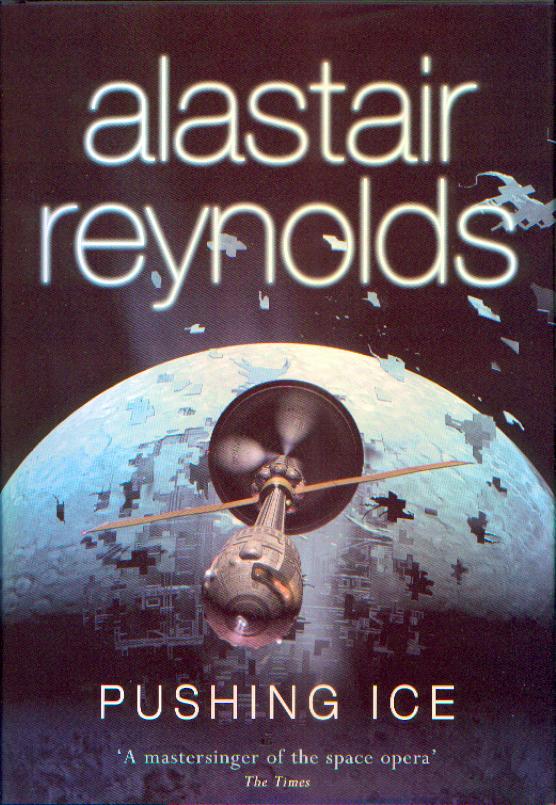
When Saturn's moon Janus suddenly takes off into interstellar space, an ice mining spaceship sent to investigate finds itself swept along into distant space until it ends up trapped in a gigantic alien structure, wherein the crew must prepare to reside for the foreseeable future.
- Manifold
series8 books1997
similar byscience fictionchallengingspacehard science fictionspace exploration+3 more
Manifold: Time, Manifold: Space, and Manifold: Origin follow overlapping characters through three mutually exclusive answers to the Fermi Paradox - why we appear to be alone in the universe - each book taking one answer seriously enough to build an entire future history around it. Stephen Baxter designed the trilogy to be read in any order, since it plays out across a multiverse rather than a single continuous timeline.
- Learning the World
Ken MacLeodstandalone novel2005
similar byspacefar futurescience fictionspace explorationhard science fictionreflectivealiens
From the front flap of the Tor first printing: "Humanity has spread to every star within 500 light-years of its half-forgotten origin, coloring the sky with a haze of habitats. Societies rise and fall. Incautious experiments burn fast and fade. On the fringes, less modified humans get on with the job of settling a universe that has, so far, been empty of intelligent life. The ancient starship But the Sky, My Lady! The Sky! is entering orbit around a promising new system after a four hundred year journey. For its long-lived inhabitants, the centuries have been busy. Now a younger generation is eager to settle the system. The ship is a seed-pod ready to burst. Then they detect curious electromagnetic emissions from the system's Earth-like world. As the nature of the signals becomes clear, the choices facing the humans become stark. On Ground, second world from the sun, a young astronomer searches for his system's outermost planet. A moving point of light thrills, then disappoints him. It's only a comet. His physicist colleague Orro takes time off from trying to invent a flying-machine to calculate the comet's trajectory. Something is very odd about that comet's path. They are not the only ones for whom the world has changed. "We are not living in the universe we thought we lived in yesterday. We have to start learning the world all over again.""
- The Fountains of Paradise
Arthur C. Clarkestandalone novel1979
similar byspacefar futurescience fictionspace explorationhard science fiction
The Fountains of Paradise is a 1979 science fiction novel by British writer Arthur C. Clarke. Set in the 22nd century, it describes the construction of a space elevator. This "orbital tower" is a giant structure rising from the ground and linking with a satellite in geostationary orbit at the height of approximately 36,000 kilometres. Such a structure would be used to raise payloads to orbit without the expense of using rockets. The novel won both the Hugo and Nebula Awards for Best Novel.
- Implied Spaces
Walter Jon Williamsstandalone novel2008
similar bychallengingspacefar futurescience fictionreflectiveartificial intelligencevirtual reality
Implied Spaces is a 2008 space opera novel by American author Walter Jon Williams. It explores themes of transhumanism, artificial intelligence and ontology.
- Singularity Sky
series2 books2003
similar bychallengingspacefar futurescience fictionartificial intelligence+1 more
Singularity Sky and its sequel Iron Sunrise are collectively known as the Eschaton novels, after the godlike posthuman intelligence that seeded human colonies across space on the condition they never attempt time travel or threaten causality - rules tested when a low-tech colony world is destabilized by a group calling itself the Festival. Charles Stross uses the setup for a mix of space opera, economics, and diplomatic intrigue.
- Heechee
series19 books1972
completed
similar byspacefar futurescience fictionspace explorationaliens
The Heechee Saga, also known as the Gateway series, is a series of science fiction novels and short stories by Frederik Pohl. The Heechee are an advanced alien race that visited the Solar System hundreds of millennia ago and then mysteriously disappeared. They left behind bases containing artifacts, including working starships, which are discovered and exploited by humanity.
- Children of Time
series6 books2015
similar byfar futurespacescience fiction+5 more
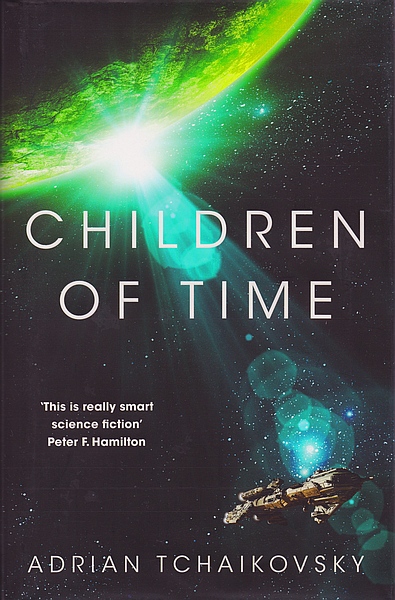
Adrian Tchaikovsky's Children of Time follows two threads: a terraformed planet where an experimental nanovirus meant to accelerate primate evolution instead uplifts a species of spiders into a technological civilization guided by the recorded personality of a human scientist, and the last survivors of Earth aboard a generation ark ship searching for a new home. The two threads collide across mismatched timescales as the ark ship's crew, cycling in and out of cryosleep, finally reach the spiders' world. It's the first of a loosely connected series that applies the same premise to different alien biologies in each subsequent book.
- 2312
Kim Stanley Robinsonstandalone novel2012
similar byspacefar futurescience fictionhard science fictionreflective+1 more
In the eponymous year, when Earth's ecology is degraded and humanity has settled throughout the solar system by terraforming and genetic engineering, mysterious disasters strike some human communities and an assortment of human types from throughout the system seek to find and eliminate the cause.
- The Collected Stories of Arthur C. Clarke
series10 books2000
completed
similar byspacescience fictionfar futurespace exploration+4 more
The Collected Stories of Arthur C. Clarke, first published in 2001, is a collection of almost all science fiction short stories written by Arthur C. Clarke. It includes 114 stories, arranged in order of publication, from "Travel by Wire!" in 1937 through to "Improving the Neighbourhood" in 1999. The story "Improving The Neighbourhood" has the distinction of being the first fiction published in the journal Nature. The titles "Venture to the Moon" and "The Other Side of the Sky" are not stories, but the titles of groups of six interconnected stories, each story with its own title. This collection is only missing a very few stories, for example "When the Twerms Came", which appears in his other collections More Than One Universe and The View from Serendip. This edition contains a foreword by Clarke written in 2000, where he speculates on the science fiction genre in relation to the concept of short stories. Furthermore, many of the stories have a short introduction about their publication history or literary nature.
- Kefahuchi Tract Trilogy
series3 books2002
similar bychallengingspacefar futurescience fiction+2 more
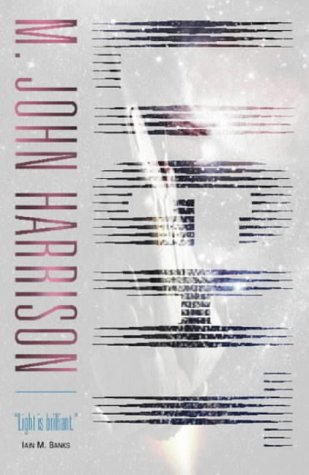
M. John Harrison's Kefahuchi Tract trilogy circles a strange, physics-breaking anomaly in deep space that draws scientists, smugglers, and drifters into its pull across different eras. Light moves between a near-future timeline and a far-future one drawn to the Tract itself; its sequel Nova Swing stays within one future period, where a fragment of the anomaly's altered space bleeds into the run-down port city of Saudade, giving the book a noir, Roadside-Picnic-like atmosphere; Empty Space concludes the sequence. The three novels share a setting and mood more than a continuous plot or cast.