More like Mind Tricks
anchored on:science fiction
but
- Dune Universe
universe78 books1963
Start hereDune · Start here
similar byscience fiction
Arrakis. Dune. The desert planet, where empire runs on a single substance: the spice melange, which folds space, prolongs life, and unlocks prescience, and which exists nowhere else in the known universe. Frank Herbert's saga is a meditation dressed as an adventure — feudal houses and a secret sisterhood, engineered messiahs and the patient ecology of a world without water, all turning on the terrible gravity of who commands the spice. It reads like scripture and schemes like a war room, ten thousand years hence, among people who have outlawed the thinking machine and made instruments of themselves instead. At its heart stand Herbert's original six — Dune, Dune Messiah, Children of Dune, God Emperor of Dune, Heretics of Dune, Chapterhouse: Dune — a single deepening arc across millennia, arguing the whole way between prophecy and free will. Around that spine his son Brian Herbert and Kevin J. Anderson have raised a vast prequel architecture: Prelude to Dune, tracing the great houses a generation before Paul; Legends of Dune, reaching back to the crusade that broke the machines; the Schools of Dune cycle on the founding of Bene Gesserit, Mentat, and Navigator; the Caladan Trilogy and Heroes of Dune filling years the originals left in shadow. Many hands, dozens of volumes, one desert. What sets Dune apart is its refusal of the simple: religion is manufactured, heroes are hazards, and the sand itself — worm, water, ecology — acts as a political power. Begin where the universe did, with Frank Herbert's Dune (1965), and read the original six in order; you need nothing else to feel the full weight. The prequels are a country to explore afterward, taken by era. Beginnings are delicate times.
- Dune
series20 books1963
part of Dune Universe
similar byscience fiction+1 more
Frank Herbert's Dune Chronicles opens with 1965's Dune, set on the desert planet Arrakis where House Atreides takes control of the only source of the vital spice melange and young Paul Atreides is pulled into a struggle over its politics and religion. Herbert carried the story forward across five further novels — Dune Messiah, Children of Dune, God Emperor of Dune, Heretics of Dune, and Chapterhouse: Dune — following Paul's line over the following millennia, before Brian Herbert and Kevin J. Anderson later extended the saga. Many other editions of these six novels are omnibus and box-set repackagings rather than separate stories.
- Stranger in a Strange Land
Robert A. Heinleinstandalone novel1961
similar bypsychic powersscience fiction
Stranger in a Strange Land is a 1961 science fiction novel by the American author Robert A. Heinlein. It tells the story of Valentine Michael Smith, a human who comes to Earth in early adulthood after being born on the planet Mars and raised by Martians, and explores his interaction with and eventual transformation of Terran culture.
- Childhood's End
Arthur C. Clarkestandalone novel1953
similar byscience fiction+1 more
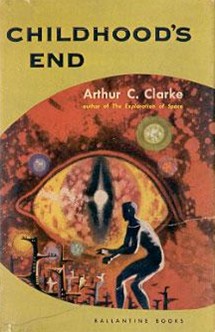
Childhood's End is a 1953 science fiction novel by the British author Arthur C. Clarke. The story follows a peaceful alien invasion of Earth by mysterious Overlords, whose arrival begins decades of apparent utopia under indirect alien rule, at the cost of human identity and culture.
- The Midwich Cuckoos
John Wyndhamstandalone novel1957
similar byscience fiction+1 more
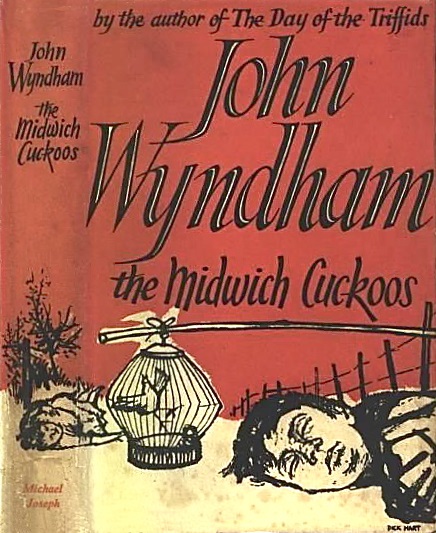
The Midwich Cuckoos is a 1957 science fiction novel written by the English author John Wyndham. It tells the tale of an English village in which the women become pregnant by brood parasitic aliens. The book has been praised by many critics, including the dramatist Dan Rebellato, who called it "a searching novel of moral ambiguities", and the novelist Margaret Atwood, who called the book Wyndham's "chef d'œuvre". The book has been adapted for film, radio, and television.
- Maps in a Mirror: The Short Fiction of Orson Scott Card
series9 books1979
similar byscience fiction
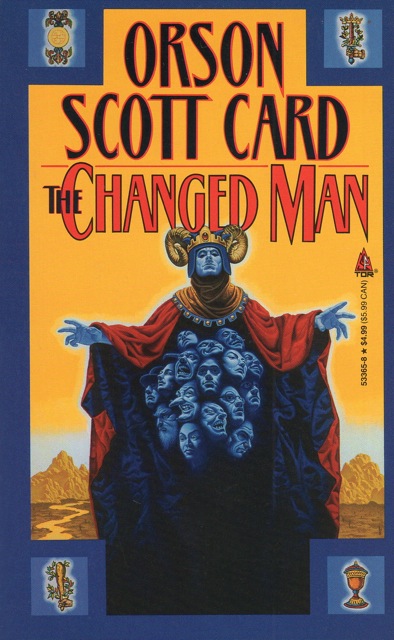
Maps in a Mirror (1990) is a collection of short stories by American writer Orson Scott Card. Like Card's novels, most of the stories have a science fiction or fantasy theme. Some of the stories, such as "Ender's Game", "Lost Boys", and "Mikal's Songbird" were later expanded into novels. Each of the smaller volumes that make up the larger collection as a whole are centered on a theme or genre. For instance, Volume 1, The Changed Man, reprints several of Card's horror stories. The collection won the Locus Award for Best Collection in 1991.
- More Than Human
Theodore Sturgeonstandalone novel1953
similar bypsychic powersscience fiction
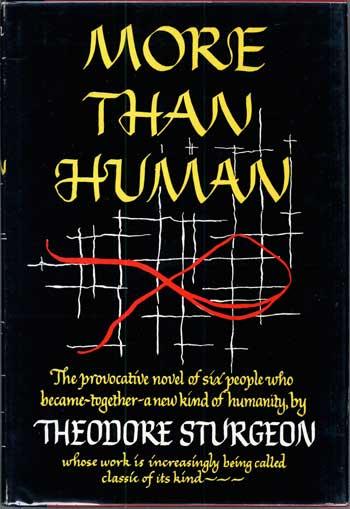
More Than Human is a 1953 science fiction fix-up novel by American writer Theodore Sturgeon. It is a revision and expansion of his 1952 novella Baby Is Three, which is bracketed by two additional parts written for the novel, "The Fabulous Idiot" and "Morality". It won the 1954 International Fantasy Award, which was also given to works in science fiction. It was additionally nominated in 2004 for a "Retro Hugo" award for the year 1954. Science fiction critic and editor David Pringle included it in his book Science Fiction: The 100 Best Novels.
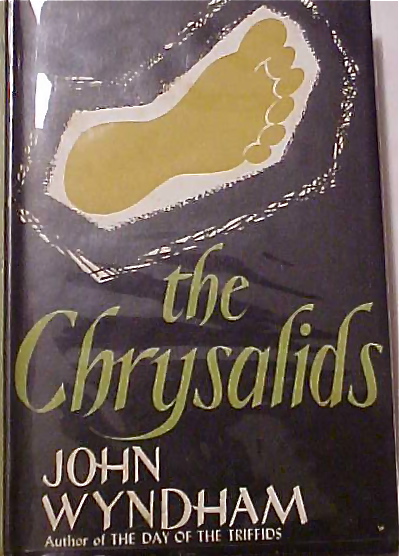
- The Chrysalids
John Wyndhamstandalone novel1955
similar bypsychic powersscience fiction
The Chrysalids is a science fiction novel by British writer John Wyndham, first published in 1955 by Michael Joseph. It is the least typical of Wyndham's major novels, but regarded by some as his best. An early manuscript version was entitled Time for a Change.
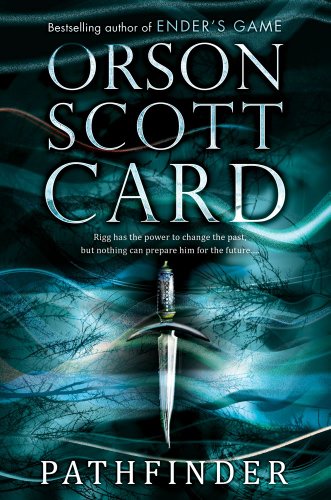
- Pathfinder Trilogy
series3 books2010
similar byscience fiction+1 more
The Pathfinder series is a completed series of novels by Orson Scott Card that is notable for its unusual fusion of the themes of science fiction and fantasy, with some elements of historical fiction. One significant aspect of the Pathfinder series is its uniquely complex but well documented set of time travel rules.
- The Demolished Man
Alfred Besterstandalone novel1953
similar bypsychic powersscience fiction
In the year 2301, guns are only museum pieces and benign telepaths sweep the minds of the populace to detect crimes before they happen. In 2301 murder is virtually impossible, but one man is about to change that..
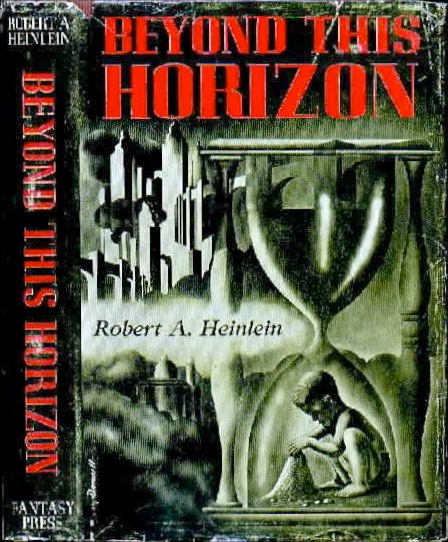
- Beyond This Horizon
Robert A. Heinleinstandalone novel1948
similar byscience fiction+1 more
From the front flap of a 2001 Baen reprint: "Utopia has been achieved. For centuries, disease, hunger, poverty, and war have been things found only in the history tapes. And applied genetics has given men and women the bodies of athletes and a lifespan of over a century. They should all have been very happy... But Hamilton Felix is bored. And he is the culmination of a star line, each of his last thirty ancestors chosen for superior genes. Hamilton is, as far as genetics can produce one, the ultimate man. And this ultimate man can see no reason why the human race should survive, and has no intention of continuing the pointless comedy. However, Hamilton's life is about to become less boring. A secret cabal of revolutionaries who find utopia not just boring, but desperately in need of leaders who know just What Needs to be Done, are planning to revolt and put themselves in charge. Knowing of Hamilton's disenchantment with the modern world, they have recruited him to join their Glorious Revolution. Big mistake! The revolutionaries are about to find out that recruiting a superman was definitely not a good idea..."
- Slan
series2 books1946
similar byscience fiction+1 more
Slan (1946) is A. E. van Vogt's science fiction novel about slans, a persecuted race of telepathic superbeings living hidden among ordinary humans, first serialized in Astounding Science Fiction before its Arkham House hardcover edition. More than sixty years later, Kevin J. Anderson completed Slan Hunter (2007), an authorized sequel built from van Vogt's notes to continue the story left unfinished at the original author's death. The two novels together bracket a single continuing narrative rather than an ongoing series.
- Time for the Stars
Robert A. Heinleinstandalone novel1956
similar bypsychic powersscience fiction
Explorer spaceships need a way to communicate back to earth in a timely manner when they are light years away. When telepathy is found to have no delay, pairs of twins are hired. One twin stays on Earth to receive reports, and the other twin goes into space.
- The Lathe of Heaven
Ursula K. Le Guinstandalone novel1971
similar bypsychic powersscience fiction
The Lathe of Heaven is a 1971 science fiction novel by American writer Ursula K. Le Guin, first serialized in the American science fiction magazine Amazing Stories. It won the 1972 Locus Award for Best Novel and was a finalist for the 1971 Nebula Award for Best Novel and 1972 Hugo Award for Best Novel. Two television film adaptations were released: the PBS production, The Lathe of Heaven (1980), and Lathe of Heaven (2002), a remake produced by the A&E Network.
- Chocky
series2 books1968
similar byscience fiction+1 more
Chocky (1968) is John Wyndham's science fiction novel about an eleven-year-old boy, Matthew, whose parents grow alarmed by his conversations with an unseen presence that feeds him unsettling insights into mathematics and human progress, building toward the reveal of what, or who, Chocky really is. Mark Daniel's Chocky's Challenge (1986), published after Wyndham's death, is an authorized continuation that carries the story forward.
- The Stars My Destination
Alfred Besterstandalone novel1956
similar byscience fiction+1 more
When a passing spaceship refuses to rescue the lone survivor from the drifting wreck of another ship, he dedicates his life to discovering who made that decision and exacting his revenge, in the process altering human history and his own character.
- Solar Queen
series7 books1955
similar byscience fiction
Andre Norton's Solar Queen novels follow the crew of a free-trader starship under Captain Jellico as they scrape by hauling cargo and making first contact on the fringes of settled space. The first three books appeared in the 1950s; Norton returned to the series decades later and, from the 1990s on, completed it in collaboration with P. M. Griffin and Sherwood Smith. Across its seven novels the series keeps its ensemble trading-crew premise rather than following one continuous plot.
- Pip & Flinx
series18 books1972
part of Humanx Commonwealth
similar byscience fiction+1 more
The Pip & Flinx novels follow Flinx, a young man with an unusual, mysterious origin, and his ever-present animal companion Pip, across Alan Dean Foster's Humanx Commonwealth setting. Beginning with The Tar-Aiym Krang (1972) — chronologically the second entry, since Foster later filled in Flinx's earlier life — the series grew to fifteen novels published between 1972 and 2017, mixing planetary adventure with a slowly unfolding personal mystery.
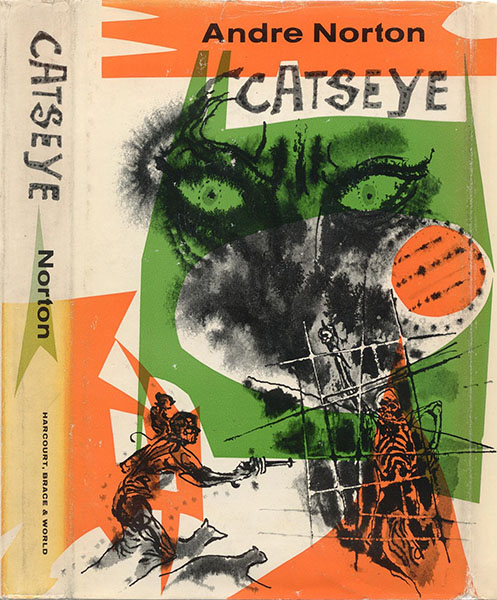
- Dipple
series2 books1961
completed
similar byscience fiction
Andre Norton's Dipple books are linked by a shared setting rather than a continuing plot: the Dipple, a squalid refugee slum for displaced aliens and humans on a distant colony world, first introduced in Catseye (1961). Night of Masks (1964), grouped here alongside it, follows a different, disfigured young protagonist drawn into his own separate adventure that also touches the Dipple, rather than continuing Catseye's story. Each book stands alone, connected mainly by Norton's recurring interest in outcasts finding purpose off-world.
- Tower and the Hive
series7 books1959
completed
part of The Talents
similar bypsychic powersscience fiction
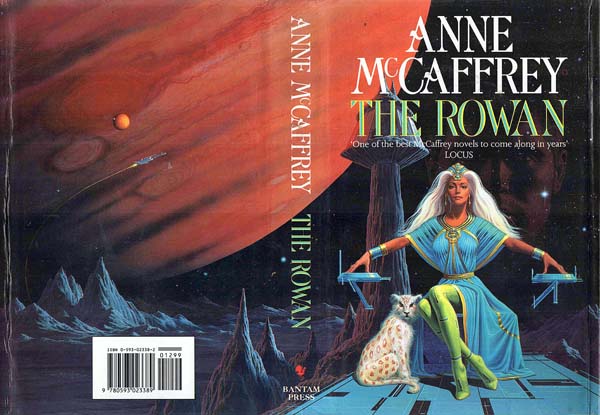
The Tower and the Hive series opens with The Rowan (1990), following an isolated but powerful telepath who is drawn out of her loneliness by a psychic call for help from a distant Talent facing an alien threat. Anne McCaffrey continued the story across four more novels, Damia, Damia's Children, Lyon's Pride, and the concluding The Tower and the Hive (1999), following later generations of a telepathic family staffing the Prime Towers that give a starfaring human civilization instant communication. The series is set later in the same Talents universe as McCaffrey's earlier Pegasus books.
- Fantastic Voyage
series2 books1966
completed
similar byscience fiction
Fantastic Voyage (1966) is Isaac Asimov's novelization of the film about a submarine crew shrunk to microscopic size and injected into an injured scientist's body to repair damage from the inside. Asimov returned to the same premise of medical miniaturization in the unrelated 1987 novel Fantastic Voyage II: Destination Brain, which follows a different cast and plot rather than continuing the first book's story.
- Talents (Anne McCaffrey)
series9 books1969
completed
part of The Talents
similar byscience fiction+1 more
The Talent series opens with To Ride Pegasus (1973), a linked collection of stories introducing people born with parapsychic gifts such as telepathy, telekinesis, and precognition, as society first learns to organize and rely on them. Pegasus in Flight (1990) and Pegasus in Space (2000) complete the trilogy, following the training and growing use of these Talents through near-Earth crises. Anne McCaffrey set the series earlier in the same Talents universe that her later Tower and Hive novels continue.