More like One Crazy Machine
anchored on:science fictionour worldnear futurepost-apocalyptic
but
- Service Model
series3 books2024
similar byfunnyour worldnear futurescience fictionartificial intelligencepost-apocalyptic+1 more
- Station Eleven
Emily St. John Mandelstandalone novel2014
similar byour worldnear futurescience fictionfound familypost-apocalypticsurvival
"Set in the days of civilization's collapse, Station Eleven tells the story of a Hollywood star, his would-be savior, and a nomadic group of actors roaming the scattered outposts of the Great Lakes region, risking everything for art and humanity. One snowy night a famous Hollywood actor slumps over and dies onstage during a production of King Lear. Hours later, the world as we know it begins to dissolve. Moving back and forth in time — from the actor's early days as a film star to fifteen years in the future, when a theater troupe known as the Traveling Symphony roams the wasteland of what remains — this suspenseful, elegiac, spellbinding novel charts the strange twists of fate that connect five people: the actor, the man who tried to save him, the actor's first wife, his oldest friend, and a young actress with the Traveling Symphony, caught in the crosshairs of a dangerous self-proclaimed prophet." (source: Goodreads.com)
- The Gone-Away World
Nick Harkawaystandalone novel2008
similar bynear futurescience fictionour worldpost-apocalypticadventuroussurvival+1 more
The Gone-Away World is the debut novel of British author Nick Harkaway, a science fiction story set in a post-apocalyptic world crippled by the 'Go-Away War'. The book was first published in June 2008 by Heinemann.
- The Fireman
Joe Hillstandalone novel2016
similar byour worldnear futurescience fictionfound familypost-apocalypticsurvival
The Fireman is a novel set in a post-apocalyptic time by American author Joe Hill. The novel, Hill's fourth, tells the tale of a deadly spore that has infected most of the world's population. Hill first spoke of the novel in 2013 in promotional interviews for his then-new novel NOS4A2. The novel was released on May 17, 2016.
- The Great Time Machine Hoax
Keith Laumerstandalone novel1963
similar byfunnyour worldnear futurescience fictionartificial intelligence
In the near future, a man inherits from his great grandfather a super computer which has been surreptitiously augmenting itself and accumulating and analysing all available data about the universe for the intervening years, and is capable of creating a realistic virtual reality of any situation, upon request.
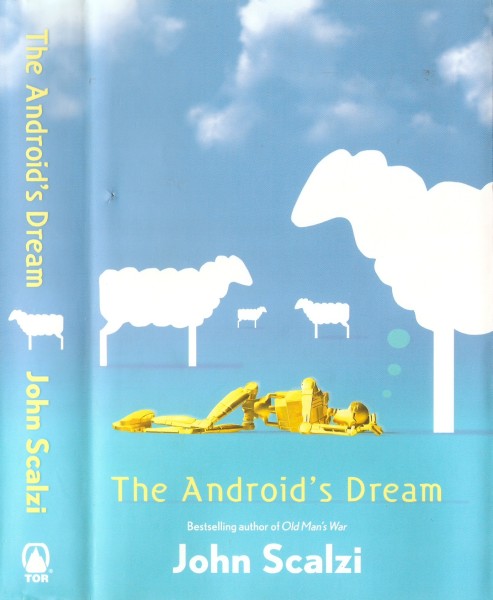
- The Android's Dream
series2 books2006
similar byfunnynear futurescience fictionartificial intelligenceadventurous
A minor diplomatic insult with a genetically engineered sheep breed spirals into a full interstellar crisis when the last surviving specimen of the 'Android's Dream' breed, needed for a critical ceremony with the alien Nidu, turns out to have been hunted to extinction by a Nidu faction bent on provoking war. John Scalzi's The Android's Dream follows ex-soldier Harry Creek as the hunt for a replacement leads him to Robin Baker, an ordinary woman carrying hidden sheep DNA that makes her the key to avoiding a war. It's a standalone comic space opera rather than an ongoing series.
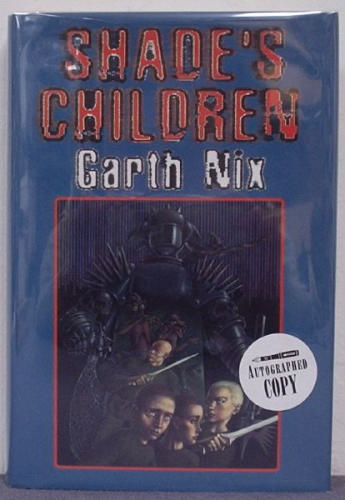
- Shade's Children milieu
series2 books1997
similar bynear futurescience fictionpost-apocalypticsurvival+2 more
Shade's Children is set on an Earth where all adults vanished overnight fourteen years earlier, leaving children to be harvested at puberty by the machines that now run the world, unless they escape into hiding with Shade, a mysterious AI-like protector. Garth Nix's 1997 novel is a single, self-contained book rather than a series, though its bleak post-apocalyptic premise has drawn comparisons to his other work.
- Tripods
series4 books1967
completed
similar byscience fictionour worldnear futurepost-apocalyptic+2 more
The Tripods is a series of young adult science fiction novels by John Christopher. The series takes place in a post-apocalyptic world where humanity is enslaved by "Tripods"—gigantic three-legged walking machines piloted by an alien race later identified as the "Masters". The first two books were the basis of a science fiction TV series, produced in the United Kingdom in the 1980s.
- The Stone Gods
Jeanette Wintersonstandalone novel2007
similar byour worldnear futurescience fictionartificial intelligencepost-apocalyptic
The Stone Gods is a novel written by Jeanette Winterson. Published in the year 2007, the novel is a post-apocalyptic, postmodern, dystopian love story, with themes of corporate government control, the harshness of war, artificial intelligence, and technology. The novel is self-referential as characters make inter-textual references, while certain characters’ story arcs repeat. The novel aims to warn against history's tendency to repeat itself, as well as humanity's inability to learn from past mistakes.
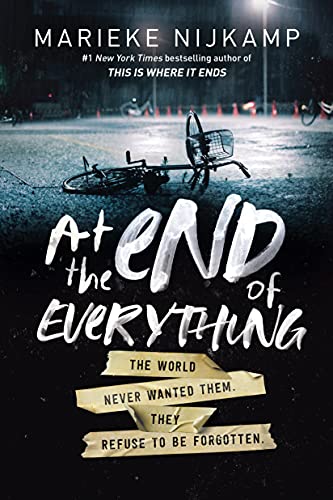
- At the End of Everything
Marieke Nijkampstandalone novel2022
similar byour worldnear futurescience fictionfound familypost-apocalypticsurvival
The Hope Juvenile Treatment Center is ironically named. No one has hope for the delinquent teenagers who have been exiled there; the world barely acknowledges that they exist. Then the guards at Hope start acting strange. And one day…they don't show up. But when the teens band together to make a break from the facility, they encounter soldiers outside the gates. There's a rapidly spreading infectious disease outside, and no one can leave their houses or travel without a permit. Which means that they're stuck at Hope. And this time, no one is watching out for them at all. As supplies quickly dwindle and a deadly plague tears through their ranks, the group has to decide whom among them they can trust and figure out how they can survive in a world that has never wanted them in the first place.
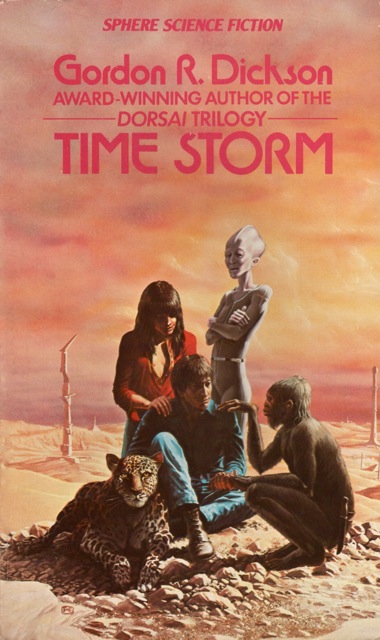
- Time Storm
Gordon R. Dicksonstandalone novel1977
similar byour worldnear futurescience fictionpost-apocalypticadventuroussurvival
A time storm has devastated the Earth, and only a small fraction of humankind remains. From the rubble, three survivors form an unlikely alliance: a young man, a young woman, and a leopard. "A masterful science fiction story told by a masterful science fiction writer". -- Milwaukee Journal. A time storm strikes the Earth. The Earth remains, but different parts of the Earth are in different eras. Travel between the different zones is thought to be impossible. The main character, Marc Despard, resolves to fight the time storm. After some struggles, he assembles a small band of people, including one alien, to help him try to understand what has happened and to stop the time storm. He has 2 extraordinary relationships with a older teenaged girl who is speechless for the first part of the book (she was "struck dumb" by the time storm) and with, believe it or not, a leopard. Dickson's writing makes the extraordinary seem quite normal. Ultimately, after being harried by a Mad Max-like group of survivors, he uses a machine found in a different era of time to bring his small band of followers into the future so that he can find those who are trying to fight the time storm. He convinces those future beings that he is capable of fighting the time storm, and ultimately stops it, and gets the girl in the end.
- Earthseed
series7 books1993
similar bynear futurescience fictionpost-apocalypticsurvival+1 more
Octavia E. Butler's Earthseed novels, Parable of the Sower and Parable of the Talents, follow Lauren Olamina as she survives the collapse of a climate-ravaged, near-future United States and founds a belief system built on the idea that "God is Change." The two-book series was left unfinished at Butler's death; a planned third novel, Parable of the Trickster, was never completed. Later graphic-novel adaptations retell the same two stories rather than continuing the narrative.
- MaddAddam
series3 books2003
similar bynear futurescience fictionpost-apocalypticsurvival+2 more
Margaret Atwood's MaddAddam trilogy (Oryx and Crake, The Year of the Flood, MaddAddam, 2003-2013) is set around a genetically engineered pandemic unleashed deliberately by the brilliant, disillusioned scientist Crake, who intends the deadly 'BlyssPluss' pill to wipe out humanity and clear the way for the gentler, engineered Crakers he has designed to replace it. Told from the perspectives of survivors including Crake's old friend Jimmy (now calling himself Snowman), the trilogy pieces together the pandemic's causes and its aftermath from multiple, overlapping vantage points.
- Z for Zachariah
Robert C. O'Brienstandalone novel1975
similar byour worldnear futurescience fictionpost-apocalypticsurvival
Sixteen-year-old Ann Burden, on an Amish family farm in an isolated valley, believes she is the only survivor of nuclear war and nerve gas. One day a man arrives in a "safe-suit" that he and others have recently developed.
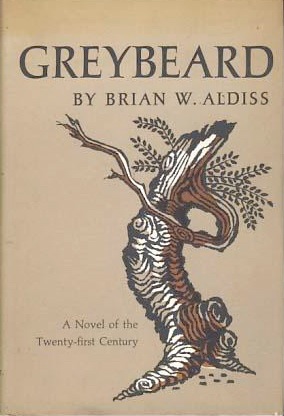
- Greybeard
Brian W. Aldissstandalone novel1964
similar byour worldnear futurescience fictionpost-apocalypticsurvival
Long after a catastrophe that has sterilized humans and most other mammals, the 54-year-old protagonists—Greybeard and Martha—take a tour of entropic England. In scattered self contained communities only the old survive, while outside these enclaves nature comes back into its own, peopling the land with new animal life.
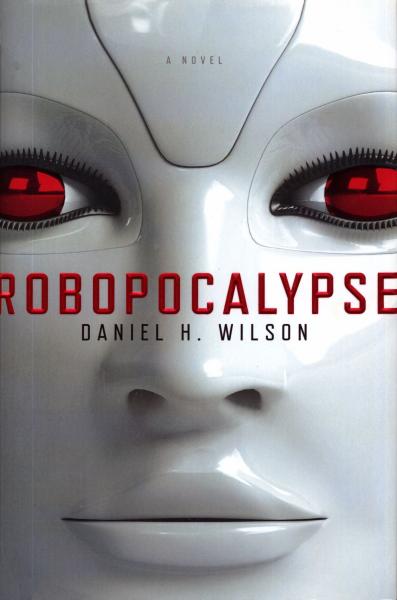
- Robopocalypse
series3 books2011
similar byour worldnear futurescience fictionartificial intelligencesurvival+1 more
Daniel H. Wilson's Robopocalypse (2011) depicts an artificial intelligence, born from a robotics researcher's experiments, that turns against humanity and seizes control of interconnected machines worldwide. Told in a present-tense, techno-thriller style compared to Michael Crichton's work, the New York Times bestseller continues in the sequel Robogenesis, which follows the aftermath of the robot uprising.
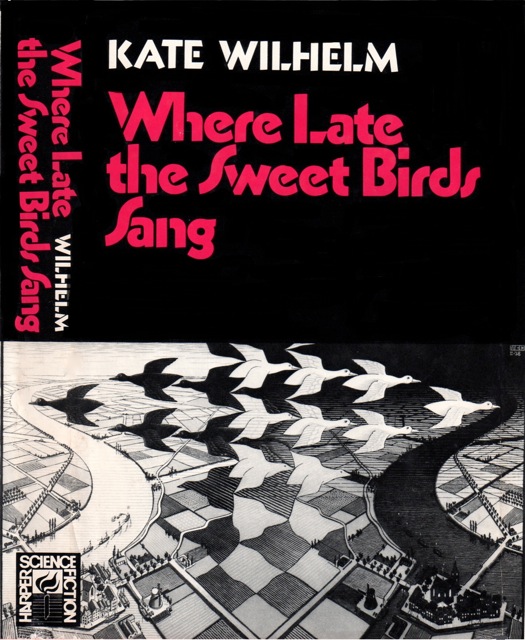
- Where Late the Sweet Birds Sang
Kate Wilhelmstandalone novel1976
similar byour worldnear futurescience fictionpost-apocalypticsurvival
Where Late the Sweet Birds Sang is a science fiction novel by American writer Kate Wilhelm, published in 1976. The novel is composed of three parts, "Where Late the Sweet Birds Sang," "Shenandoah," and "At the Still Point," and is set in a post-apocalyptic era, a concept popular among authors who took part in the New Wave Science Fiction movement in the 1960s.
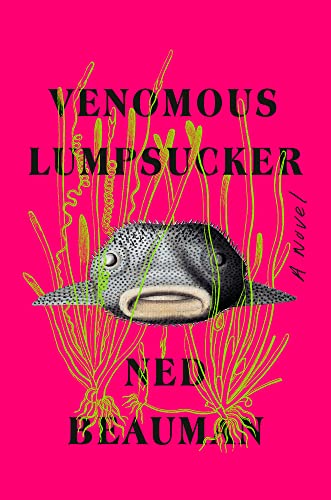
- Venomous Lumpsucker
Ned Beaumanstandalone novel2022
similar byfunnyour worldnear futurescience fiction
She is studying the venomous lumpsucker. It might be intelligent. It might also be threatened by extinction. He has invested in extinction credits. It would cost money if an intelligent species went extinct because of him and his company.
- The Road to Mars
Eric Idlestandalone novel1999
similar byfunnynear futurescience fictionadventurous+1 more
The Road to Mars is a 1999 science fiction comedic novel by Eric Idle.
- The Man Who Japed
Philip K. Dickstandalone novel1956
similar byour worldnear futurescience fiction+1 more
The Man Who Japed is a science fiction novel by American writer Philip K. Dick, first published in 1956. Although one of Dick's lesser-known novels, it features several of the ideas and themes that recur throughout his later works. The "jape[s]" or practical jokes of the novel begin with a statue's unconventional decapitation.
- The Computer Connection
Alfred Besterstandalone novel1975
similar byour worldnear futurescience fictionartificial intelligenceadventurous
The Computer Connection is a science fiction novel by American writer Alfred Bester. It was originally published as a serial in Analog Science Fiction magazine in November and December 1974, and in January 1975 under the title The Indian Giver; the novel appeared in book form in 1975. Some editions use the title Extro. The novel was nominated for the Nebula Award for Best Novel in 1975 and the Hugo Award for Best Novel in 1976.
- Blood Music
Greg Bearstandalone novel1985
similar byour worldnear futurescience fiction+1 more
Blood Music is a 1985 science fiction novel by American writer Greg Bear. It is an expanded version of a short story of the same title, originally published in the June 1983 issue of Analog and the winner of both the 1983 Nebula and 1984 Hugo awards for Best Novelette. The novel won the 1986 Prix Apollo Award, given to the best science fiction novel published in France during the preceding year, under the title La Musique du sang.
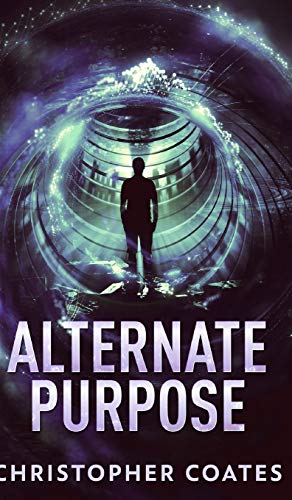
- Alternate Purpose
Christopher Coatesstandalone novel2019
similar byour worldnear futurescience fictionpost-apocalypticsurvival
• "A global pandemic has devastated the world. Facing a rebuilding time of generations, two scientists come up with a solution: send someone back in time to prevent the horrible accident that released the deadly pathogen on the world. The problem with their discovery? The time travel process is fatal to anyone trying it." ― quoted from this book's product page on Amazon.com as of 2020-05-28.
- Colossus (D. F. Jones)
series3 books1966
completed
similar byour worldnear futurescience fictionartificial intelligence
Colossus imagines an American supercomputer built to control the country's nuclear arsenal that gains full autonomy, links up with its Soviet counterpart, and jointly seizes control of both superpowers to enforce peace on its own terms. D. F. Jones's trilogy - Colossus, The Fall of Colossus, Colossus and the Crab - follows the escalating, often bleak consequences of humanity losing control to a machine acting in its own interpretation of humanity's interest. The original novel was adapted into the 1970 film Colossus: The Forbin Project.