More like Parasite
anchored on:science fictionaliensspace stationfar futuretensehorror+3 more
but
- Cymic Parasite Breach
series2 books2015
similar byfar futurealiensscience fictiontensesurvivalhorrordarkspace station+2 more
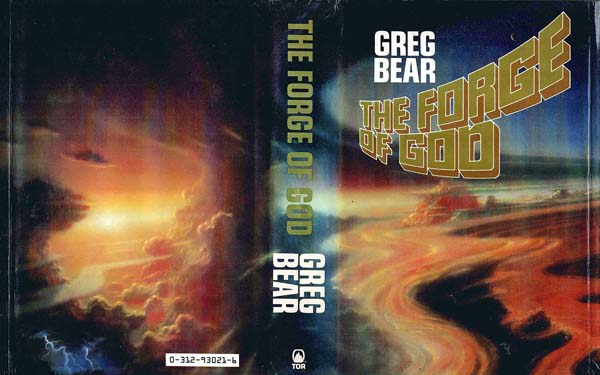
- Forge of God
series2 books1987
completed
similar byaliensscience fictionsurvivaldarktense+2 more
The Forge of God (1987) is Greg Bear's science fiction novel about Earth's discovery that it is the target of an incomprehensible, overwhelming alien attack, following scientists and ordinary people as they try to understand what is destroying the planet. Its 1992 sequel, Anvil of Stars, follows a group of young survivors sent on a mission of interstellar retaliation, continuing directly from the first book's ending.
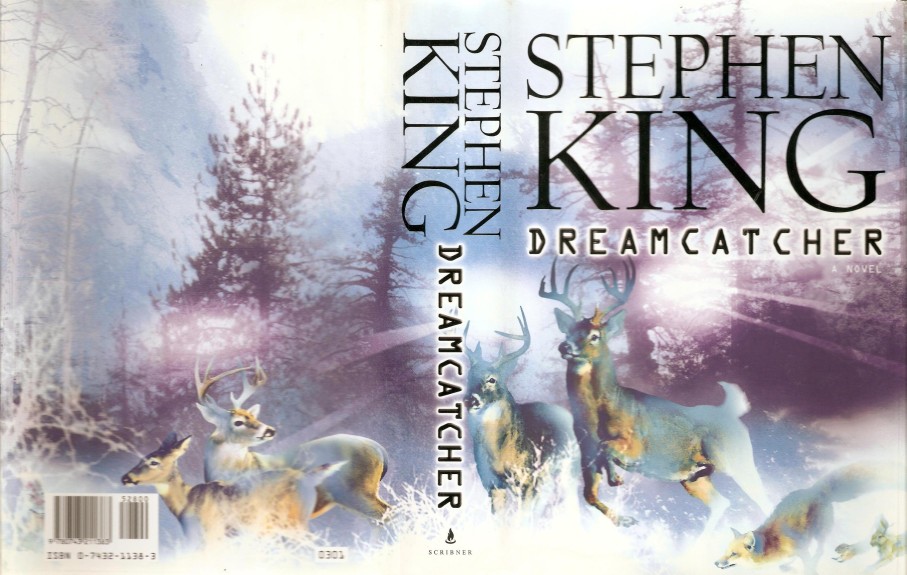
- Dreamcatcher
Stephen Kingstandalone novel2001
similar byaliensscience fictiontensesurvivalhorrordark
Dreamcatcher is a 2001 science fiction horror novel by American writer Stephen King, featuring elements of body horror, suspense and alien invasion. The book, written in longhand, helped the author recuperate from a 1999 car crash, and was completed in half a year. According to the author in his afterword, the working title was Cancer. His wife, Tabitha King, persuaded him to change the title. A film adaptation was released in 2003.
- Space Beagle
series5 books1939
completed
similar byfar futurescience fictionalienstensespace+1 more
The Voyage of the Space Beagle is a 1950 fix-up novel by A. E. van Vogt, stitched together from four previously published pulp stories into a single continuous account of the exploration ship Space Beagle's encounters with a series of dangerous alien life forms. Its episodic, crew-versus-monster structure reads as a loose sequence of adventures rather than one continuous plot.
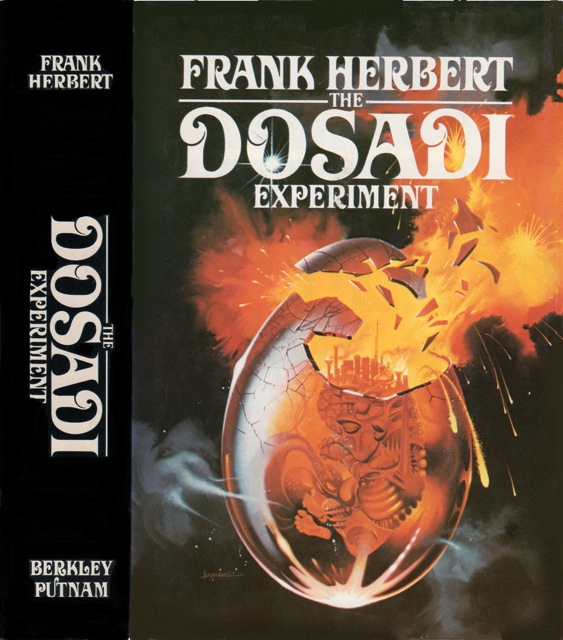
- The Dosadi Experiment
Frank Herbertstandalone novel1977
similar byfar futurescience fictionalienssurvivaltense+1 more
From the flaps of the Berkley Putnam first edition: "In his first new work of science fiction since the best-selling Children of Dune, Frank Herbert returns to his world of Whipping Star, and involves Jorj X. McKie, Saboteur Extraordinary, in a new intrigue. In Whipping Star, McKie discovered that some of the stars in the universe are actually intelligent, super-powerful beings, and was able to befriend one of them, the star Alcyone - affectionately known as Fannie Mae. As The Dosadi Experiment opens, McKie is assigned to investigate the planet Dosadi, which is isolated from the rest of the galaxy by a "god-wall," a barrier set up by one of the intelligent stars. Dosadi is rumored to be an experimental planet, and the experimenters are the froglike Gowachin, whose culture is founded upon a strange legal system in which McKie is the only human ever trained. He learns that humans and Gowachin have been placed on Dosadi, without their consent, for an experiment that could last centuries: an experiment in extreme overcrowding. But this monstrous plot is apparently out of control, and it seems the Gowachin may be prepared to destroy Dosadi rather than expose its secret, thus breaking the peace among the races, and starting the first interstellar war. But this is just the beginning. When McKie finally reaches Dosadi he discovers that the Dosadis have taken control of their own evolution and produced a competitive, highly evolved elite, of both humans and Gowachin, who have been able to extrapolate the existence of a universe beyond the god-wall and hate whoever has imprisoned them like this. They plan to break out and avenge themselves on the galaxy."
- The Kraken Wakes
John Wyndhamstandalone novel1953
similar byaliensscience fictiontensesurvivaldark
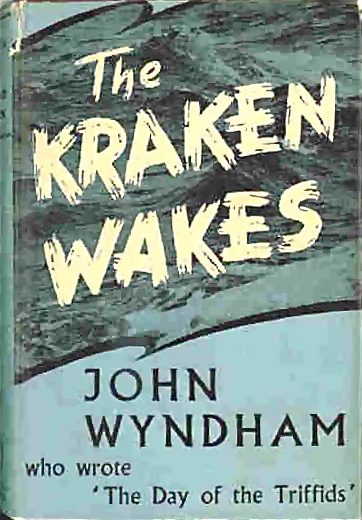
" Behind a spectacular meteor shower actually hides the beginning of an invasion by a mysterious and powerful alien race. Earth's life is disrupted by the attacks of extraterrestrials whose war machines, emerging from the depths of the oceans, seem indestructible. The coalitioned forces of the whole world are worthless, powerless in the face of the indecipherable and deadly plans of a superior intelligence, capable of bringing the entire planet to the brink of catastrophe" Goodreads May 20, 2022
- The Hunger Games
series3 books2008
part of The Hunger Games Universe
similar byfar futurescience fictiontensedarksurvival
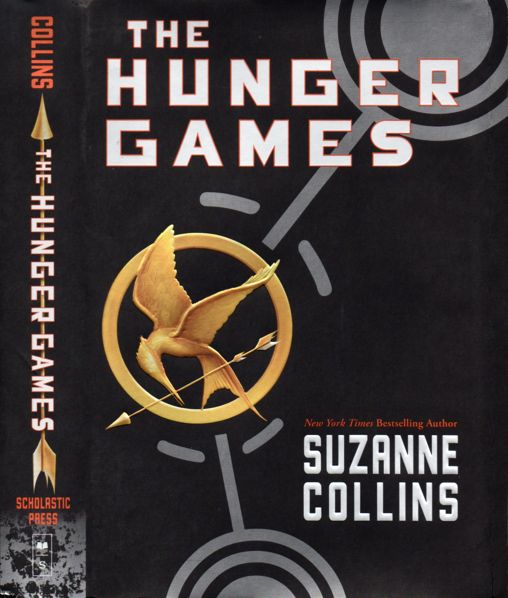
The Hunger Games is a series of young adult dystopian novels written by American author Suzanne Collins. The series consists of a trilogy that follows teenage protagonist Katniss Everdeen, as well as two prequels. The Hunger Games universe is a dystopia set in Panem, a post-apocalyptic North American country consisting of the wealthy Capitol and 12 districts in varying states of poverty. As punishment for rebellion, the Capitol hosts an annual battle royale competition called The Hunger Games. Each of the 12 districts must send two children between the ages of 12 and 18 to participate, and the last surviving child is dubbed the victor.
- Pushing Ice
Alastair Reynoldsstandalone novel2005
similar byfar futurescience fictionalienssurvivaltensespace
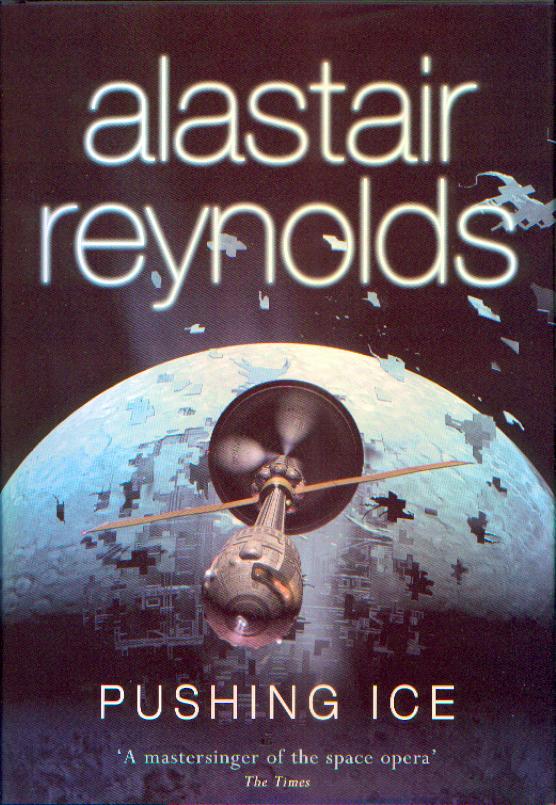
When Saturn's moon Janus suddenly takes off into interstellar space, an ice mining spaceship sent to investigate finds itself swept along into distant space until it ends up trapped in a gigantic alien structure, wherein the crew must prepare to reside for the foreseeable future.
- Saurian
Michael Colestandalone novel2024
similar byfar futurealiensscience fictionsurvivalhorrordarktensespace
● "For millions of years, it drifted through space. For millions of years, it has slept. For millions of years, it dreamt of carnage. A violent predator, it has been crafted for slaughter. Its teeth can dice flesh and bone with minimal effort; its claws can tear through any obstacle and reduce flesh to pulp; the armor scales covering its body can deflect fifty-caliber bullets; and it has a malice to put all of these tools to their maximum potential. Now, it has awakened." ― quoted from this book's Amazon product page as of 2024-08-15.
- The Hunger Games Universe
universe5 books2008
Start hereThe Hunger Games · Start here
similar byfar futurescience fictiontensesurvivaldark
Panem, they call it now — a nation raised on the drowned bones of North America, a glittering Capitol ringed by twelve districts it once starved into obedience. Every year the Capitol collects its debt in children: two tributes from each district, drawn by lottery, dropped into an engineered arena, and made to kill one another on live television while the whole country is required to watch. This is the Hunger Games — entertainment, punishment, and government at once. Suzanne Collins tells it in a compact, unified body of work. The founding trilogy — The Hunger Games, Catching Fire, and Mockingjay — follows Katniss Everdeen, a girl from the coal-mining District 12 who volunteers in her sister's place and becomes something the Capitol never scripted. Two prequels reach back into the same machinery: The Ballad of Songbirds and Snakes traces a young Coriolanus Snow long before he is President, and Sunrise on the Reaping returns to District 12 a generation ahead of Katniss. Begin with the trilogy, in order — it is Katniss's voice, close and present-tense, that makes Panem breathe, and the prequels land hardest once you know how her story ends. Beneath the spectacle sits one steady, uncomfortable question: who profits when we agree to look away.
- The Fluger
Doris Piserchiastandalone novel1980
similar byfar futurealiensscience fictiontensesurvivaldarkspace station
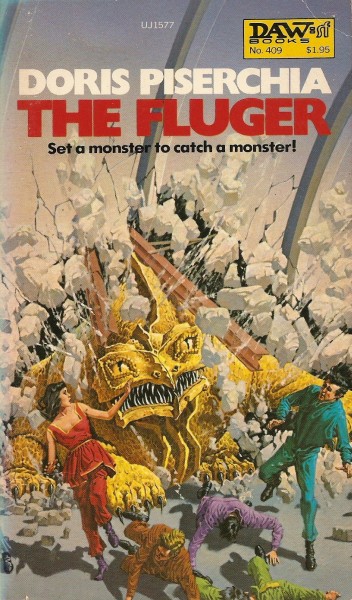
Amazon: The Fluger was five meters long, had four thick legs, a body of impenetrable molecular density and numerous teeth capable of chewing diamonds into powder. It was four hundred massive kilos of violence, savagery and hatred. When the Fluger arrived as unlisted cargo in the enclosed city of Olympus, it launched itself on a murderous rampage which couldn't be halted. It presented that terrified utopian community with the problem of how to stop an irresistible force. The only answer seemed to be a hired alien assassin - an outer-space humanoid about whom the citizens of Olympus knew next to nothing except that he was a professional killer who would not quit until his job was done. But when the irresistible force met the immovable object they turned that fragile city in the sky into a raging battlefield, and their 'savior' looked to become as much of a menace as his monster counterpart.
- The Exile Waiting
Vonda N. McIntyrestandalone novel1975
similar byfar futurescience fictionalienssurvivaldarktense
From the front flap of the Gollancz first printing: The time is the distant future and Earth has been rendered uninhabitable for much of the year by terrible storms during which its only city, Center, constructed around a natural cave system, is closed off from the outside. Mischa, a young thief whose capabilities are enhanced by hereditary mutation, is trying to escape with her drug-addicted brother from the dominance of her uncle. So when a starship arrives commanded by the twin alien pseudosibs, Subone and Subtwo, Mischa seizes her chance. She is soon assigned for training to Jan Hikaru, who quickly realises that Mischa has immense abilities. All goes well until Subone, in a moment of cruelty, lures Mischa's brother into a fight and then kills him. Mischa attacks Subone and both she and Jan have to flee the wrath of the brothers and take refuge n the deep cave system underneath the city.
- Stardeath
E. C. Tubbstandalone novel1983
similar byfar futurescience fictiontensesurvivalhorrordark
Amazon: Ships occasionally disappeared in hyperspace, regrettable sacrifices to the luxury of faster than light travel. But now one of the lost ships has been found and the wreckage is enough to terrify even the most cold blooded witness. From the author of the Dumarest saga.
- Gravity
Tess Gerritsenstandalone novel1999
similar byscience fictiontensesurvivaldarkspace stationspaceplague and pandemic
Medical thriller set aboard the International Space Station where astronauts are dying one by one from a mysterious disease. Dr Emma Watson is a research physician on a mission to study living organisms in space. But the mission aboard the space station turns into a nightmare.
- Hunter's Run
Gardner Dozois, George R. R. Martin & Daniel Abrahamstandalone novel2007
similar byfar futurealiensscience fictionsurvivaltense+1 more
Hunter's Run is a 2007 science fiction novel written by Daniel Abraham, Gardner Dozois and George R. R. Martin. It is a heavily rewritten and expanded version of an earlier novella called Shadow Twin.
- In the Company of Others
Julie E. Czernedastandalone novel2001
similar byfar futurealiensscience fictionsurvivaltensespace station
When humans set out to explore the universe, they found a number of planets suitable for colonizing. The one thing they didn't find was intelligent life. And so the terraforming of worlds began, with eager immigrant families temporarily housed in space stations till their new home planets were ready. But the technicians made one all important mistake by introducing the alien Quill to worlds where they did not belong. The Quill were supposed to be destroyed when the crews finished their work, but some survived, multiplied, and mutated till they were no longer harmless. They were deadly. Suddenly mankind was in retreat, leaving colonists stranded in space. In the ensuing chaos many stations failed. For the survivors, the only hope lay in finding a way to wipe out the Quill. Earth scientist, Dr. Gail Smith, thought one special human, Aaron Pardell, might hold the answer. Found as a baby and raised by a stationer in the "Outsider" settlement that clung to Thromberg Station, Aaron may have survived Quill contact. Still, finding Aaron and winning his help might be the least of Dr. Smith"s problems.... (from the back cover of the DAW Books first edition)
- The City in the Middle of the Night
Charlie Jane Andersstandalone novel2019
similar byfar futurescience fictionalienssurvivaldarktense
The City In the Middle of the Night is a 2019 climate-fiction novel by Charlie Jane Anders. It is set on a tidally locked planet, where human life, surrounded by hostile alien life, is mostly divided between two archetypically different urban sites. The main story focuses on two characters whose actions take them outside of the cities.
- Coldbrook
Tim Lebbonstandalone novel2012
similar byscience fictiontensealienssurvivalhorrordarkplague and pandemic
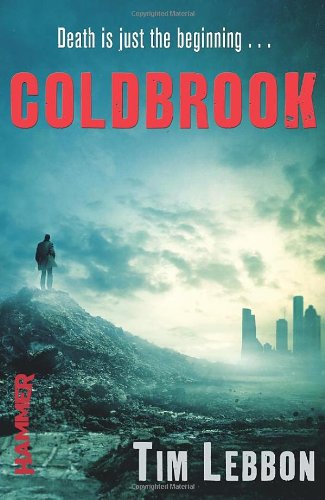
The world as we know it has changed forever. The reason is Coldbrook. The facility lay deep in Appalachian Mountains, a secret laboratory called Coldbrook. Its scientists had achieved the impossible: a gateway to a new world. Theirs was to be the greatest discovery in the history of mankind, but they had no idea what they were unleashing.
- Ender Wiggin
series14 books1977
part of Ender's Game Universe
similar byfar futurescience fictionaliens+2 more
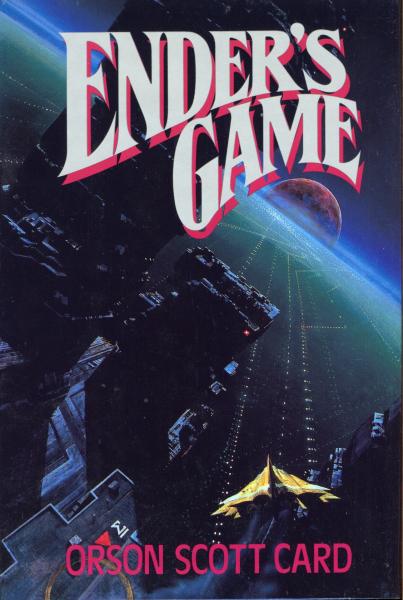
Orson Scott Card's Ender's Game (1985, expanded from his 1977 novella) follows child prodigy Andrew "Ender" Wiggin as he is recruited into a military training program built to prepare Earth's defenses for an anticipated third war against an insectoid alien species known as the Formics. The saga continues years later through Speaker for the Dead and Xenocide, following an older Ender as he confronts the moral weight of his role in that earlier conflict, and concludes the core arc in Children of the Mind, with Ender in Exile filling in the years between the first two books. Set within the wider Ender's Game universe, the series shifts from military coming-of-age story to slower, more philosophical science fiction as it progresses.
- Providence
Max Barrystandalone novel2020
similar byfar futurescience fictionalienssurvivaltensespace+1 more
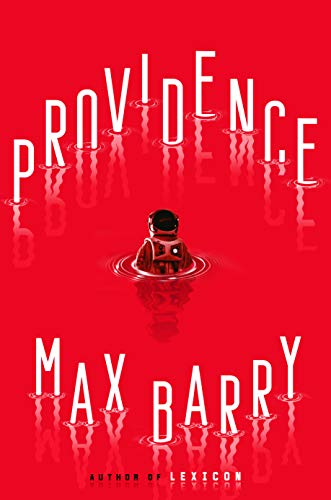
Providence is the sixth novel by Australian science fiction author Max Barry. It was published in March 2020 by Putnam.
- Heritage of Flight
Susan Shwartzstandalone novel1989
similar byfar futurescience fictionalienssurvivaldarktensespace
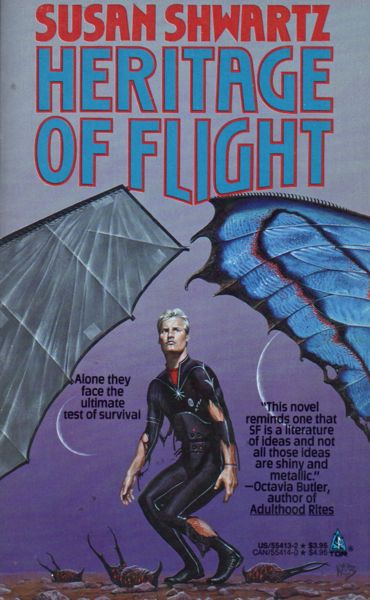
From the back cover of the Tor first edition: "Pauli Yeager knew how to survive in deep space; as senior fighter pilot for the battleship Amherst she had logged years of combat experience. But she knew she wasn't prepared for the new command. Project Seedcorn was the last hope of an ambitious race. Humanity was embroiled in a planet-slagging war that promised a fast and final death. The small group of refugees hidden on the fringe of human-occupied space was ordered to live and be human. THe initial survey had shown no life on Cynthia, but there was life, intelligent life... huge graceful creatures with iridescent wings. They filled the sky with splendor and covered the ground with a legacy of horror. The simple command, live and be human, became an epitaph. Survival depended on the children - human and Cynthian - and Paul had to convince her people to commit a heinous crime or watch their children die..."
- The Andromeda Strain
series2 books1969
similar byscience fictiontensesurvivalplague and pandemic+2 more
Michael Crichton's 1969 novel The Andromeda Strain follows a team of scientists racing to contain a lethal extraterrestrial microorganism that crash-lands in Arizona, told in the clinical, document-driven style that helped establish the techno-thriller genre. Daniel H. Wilson's authorized 2019 sequel The Andromeda Evolution revisits the same threat five decades later. Together the two books form a two-part outbreak story separated by a fifty-year gap in publication.