More like Quantum Night
anchored on:science fictionour worldnear futuretensethriller & suspenseartificial intelligence+1 more
but
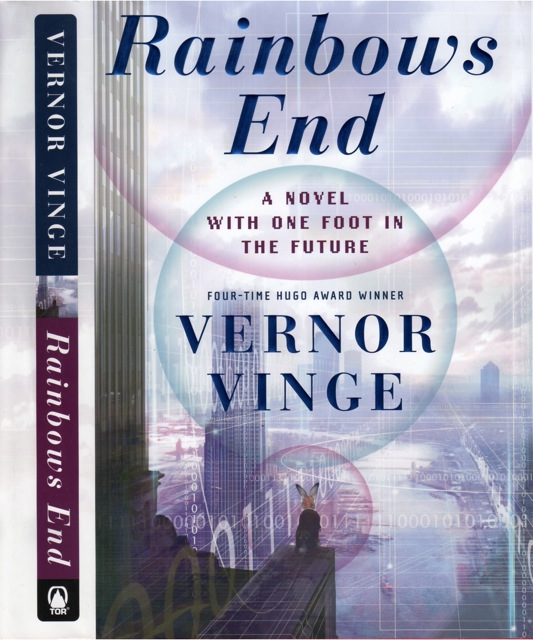
- Rainbows End
Vernor Vingestandalone novel2006
similar bynear futurescience fictiontensethriller & suspensenorth america+3 more
A science-fiction thriller set in a place and time as exciting and strange as any far-future world: San Diego, California, 2025. Robert Gu is a recovering Alzheimer’s patient. The world that he remembers was much as we know it today. Now, as he regains his faculties through a cure developed during the years of his near-fatal decline, he discovers that the world has changed and so has his place in it. He was a world-renowned poet. Now he is seventy-five years old, though by a medical miracle he looks much younger, and he’s starting over, for the first time unsure of his poetic gifts. Living with his son’s family, he has no choice but to learn how to cope with a new information age in which the virtual and the real are a seamless continuum, layers of reality built on digital views seen by a single person or millions, depending on your choice. But the consensus reality of the digital world is available only if, like his thirteen-year-old granddaughter Miri, you know how to wear your wireless access—through nodes designed into smart clothes—and to see the digital context—through smart contact lenses. With knowledge comes risk. When Robert begins to re-train at Fairmont High, learning with other older people what is second nature to Miri and other teens at school, he unwittingly becomes part of a wide-ranging conspiracy to use technology as a tool for world domination. In a world where every computer chip has Homeland Security built-in, this conspiracy is something that baffles even the most sophisticated security analysts, including Robert’s son and daughter-in law, two top people in the U.S. military. And even Miri, in her attempts to protect her grandfather, may be entangled in the plot. As Robert becomes more deeply involved in conspiracy, he is shocked to learn of a radical change planned for the UCSD Geisel Library; all the books there, and worldwide, would cease to physically exist. He and his fellow re-trainees feel compelled to join protests against the change. With forces around the world converging on San Diego, both the conspiracy and the protest climax in a spectacular moment as unique and satisfying as it is unexpected.
- Nexus 5
series3 books2012
similar bytensenear futurescience fictionartificial intelligenceour world+3 more
Nexus opens Ramez Naam's postcyberpunk trilogy in 2040 with scientist Kaden Lane, who works on Nexus, an experimental nano-drug that lets human minds be networked and reprogrammed, and finds himself caught between government and corporate interests once the technology's implications become clear. The trilogy continues through Crux and Apex, following the same central conflict over who controls the technology. Nexus tied for Best Novel at the 2014 Prometheus Awards and Apex won the 2015 Philip K. Dick Award.
- Blade Runner Universe
series6 books1968
similar bynear futurescience fictionidentity+4 more
Philip K. Dick's 1968 novel Do Androids Dream of Electric Sheep? follows bounty hunter Rick Deckard as he tracks escaped androids through an irradiated, near-abandoned San Francisco, using the hunt to probe questions of empathy and what separates human from machine. The novel became the basis for Ridley Scott's 1982 film Blade Runner, and Marvel Comics later published an illustrated adaptation of that film. Together the two trace the story's path from prose original to screen and comic-page adaptation.
- The Light of Other Days
Arthur C. Clarke & Stephen Baxterstandalone novel2000
similar bynear futurescience fictiontenseour worldchallenging+2 more
An industrialist devises a technique to use tiny wormholes as light pipes to enable viewing of any event anywhere; and subsequently it becomes possible to use them to view any event in the past as well. The effects on society are enormous.
- The Oracle Year
Charles Soulestandalone novel2018
similar bynear futurescience fictiontensethriller & suspenseour worldidentitypolitical intriguenorth america
Awakening from a dream with more than one hundred predictions about the future in his head, an unassuming Manhattan bassist becomes one of the world's most powerful men and hides his identity behind an online persona that is targeted by greedy corporations and dangerous enemies.
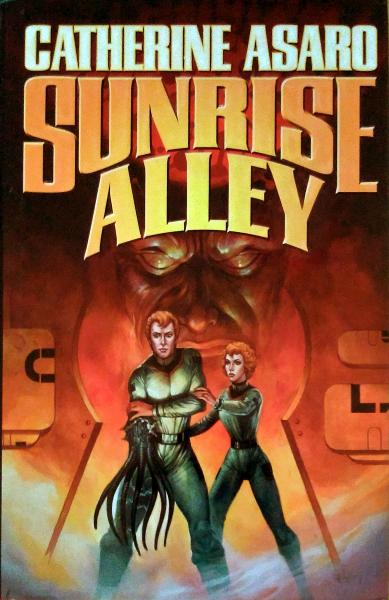
- Sunrise Alley
series2 books2004
similar bynear futuretenseartificial intelligencescience fiction+4 more
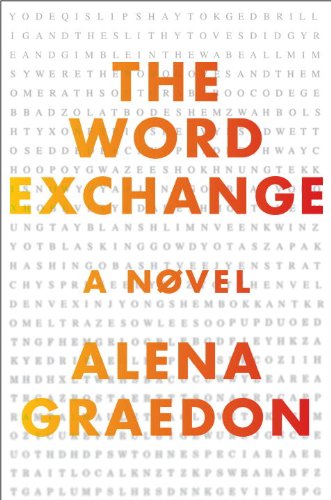
- The Word Exchange
Alena Graedonstandalone novel2014
similar bynear futureartificial intelligencescience fictiontensethriller & suspensenorth america+1 more
The Word Exchange is a science fiction novel by Alena Graedon, published in 2014. It is a dystopian thriller set in the not very distant future when the printed word has nearly vanished, technology dominates, and language has become a commodity. An online "Word Exchange" has taken the effort out of looking up words, a mere convenience until real dictionaries are no longer available. Then it becomes possible to corner the market for words. The novel has been translated into eight different languages.
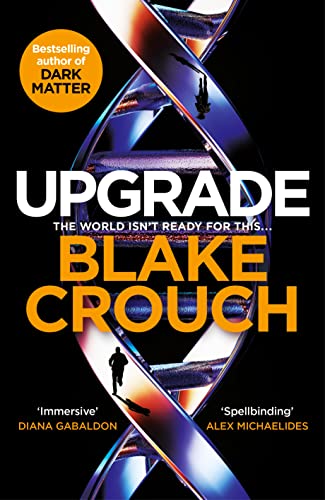
- Upgrade
Blake Crouchstandalone novel2022
similar bytensenear futurescience fictionthriller & suspenseidentitynorth america+1 more
Upgrade is a 2022 novel by Blake Crouch. It is his tenth stand-alone novel, published three years after Summer Frost (2019). The novel explores the ethical and existential ramifications of genetic engineering, set in a near-future world where humanity grapples with the consequences of advanced human genetic enhancement.
- Laurent Michaelmas
series3 books1975
completed
similar byartificial intelligencescience fictionnear futuretensethriller & suspenseour world+1 more
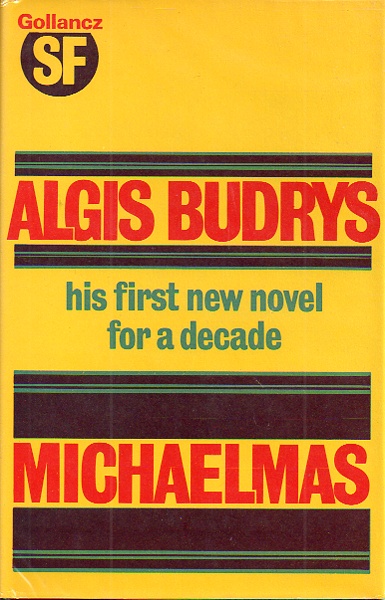
Algis Budrys' Michaelmas is a science-fiction novel about Laurent Michaelmas, a globally trusted television newsman who secretly steers world events from behind the scenes with the help of Domino, an artificial intelligence only he controls. Budrys frames Michaelmas as a hidden protector keeping a fragile near-future world from chaos, blurring the line between reporting the news and making it. It stands as a single novel, not part of a longer series.
- Sprawl Trilogy
series10 books1981
similar bynear futurescience fictionartificial intelligencetense
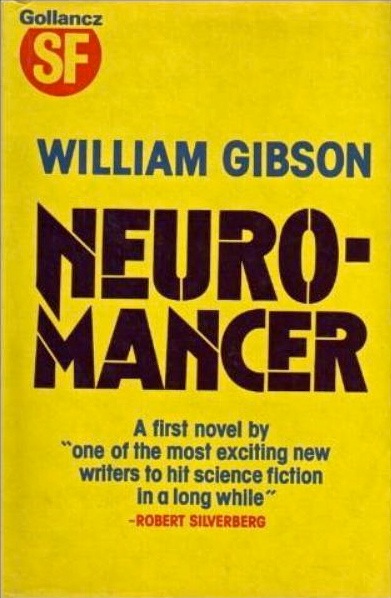
The Sprawl Trilogy is William Gibson's foundational cyberpunk sequence: Neuromancer (1984), in which hacker Case is drawn into a high-stakes heist alongside an artificial intelligence and a damaged ex-soldier, followed by Count Zero (1986) and Mona Lisa Overdrive (1988), which widen the same near-future world of corporate power and networked cyberspace to new characters. Johnny Mnemonic, an early short story set in the same fictional milieu, predates the novels and introduces the courier Molly Millions before her role in the trilogy. Together these works established much of cyberpunk's visual and thematic vocabulary.
- Richard Forthrast
series2 books2011
similar byscience fictionour worldnorth america+5 more
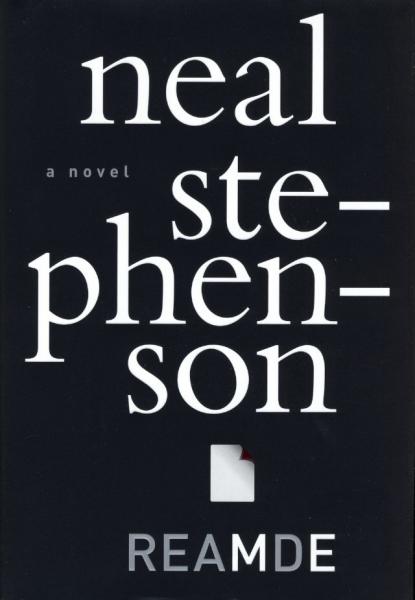
Neal Stephenson's Richard 'Dodge' Forthrast novels open with Reamde, a globe-spanning thriller that starts when ransomware inside an MMORPG economy pulls Richard's extended family into a real-world hostage crisis involving hackers, jihadists and Russian mobsters. The sequel Fall; or, Dodge in Hell shifts registers entirely, following Richard's digitally preserved mind after death into an afterlife simulation built from his scanned brain. The two books share a protagonist and family but differ sharply in genre and scale.
- No Harm Can Come to a Good Man
James Smythestandalone novel2014
similar bytensenear futureartificial intelligencescience fictionthriller & suspensenorth america+1 more
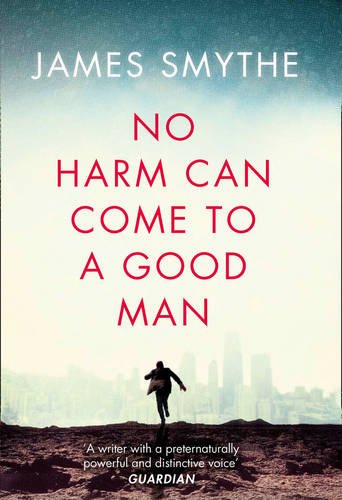
How far would you go to save your family from an invisible threat? A terrifyingly original thriller from the author of The Machine. ClearVista is used by everyone and can predict everything. It's a daily lifesaver, predicting weather to traffic to who you should befriend. Laurence Walker wants to be the next President of the United States. ClearVista will predict his chances. It will predict whether he's the right man for the job. It will predict that his son can only survive for 102 seconds underwater. It will predict that Laurence's life is about to collapse in the most unimaginable way.
- Friday
Robert A. Heinleinstandalone novel1982
similar bynear futurescience fictiontenseidentitynorth america+1 more
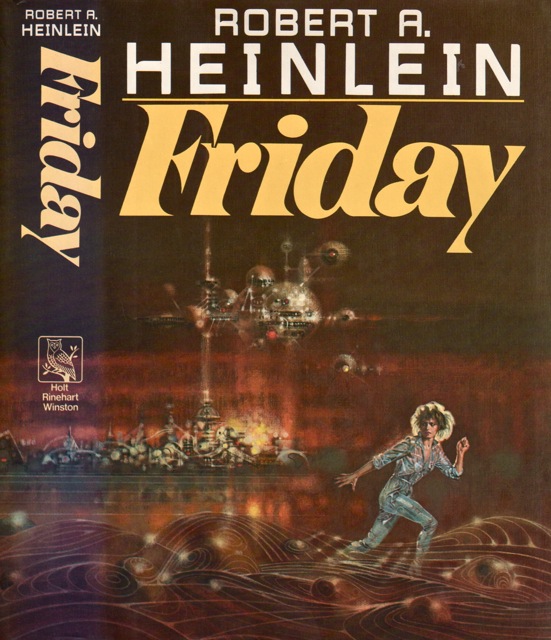
Friday is a 1982 science fiction novel by American writer Robert A. Heinlein. It is the story of a female "artificial person", the eponymous Friday, genetically engineered to be stronger, faster, smarter, and generally better than normal humans. Artificial humans are widely resented, and much of the story deals with Friday's struggle both against prejudice and to conceal her enhanced attributes from other humans. The story is set in a Balkanized 21st century, in which the nations of the North American continent have been split up into a number of smaller states.
- The Zap Gun
Philip K. Dickstandalone novel1967
similar bynear futurescience fictionour worldnorth america+3 more
The Zap Gun is a 1967 science fiction novel by American writer Philip K. Dick. It was first published as the two-part serial Project Plowshare in Worlds of Tomorrow in 1965 and 1966, before Pyramid Books issued it in paperback under its present title. The novel originated in a title-first commission devised by Pyramid editor Don Bensen and was written in 1964 during a period of rapid production in Dick's career.
- Interface
Neal Stephenson & J. Frederick Georgestandalone novel1994
similar bytensenear futureartificial intelligencescience fictionthriller & suspensepolitical intriguenorth america
Interface is a 1994 novel by Neal Stephenson and J. Frederick George and originally published under the joint pseudonym Stephen Bury. Reprints of the novel have credited the work to Stephenson and George. It is a thriller, set in the then-future year of 1996 when a shadowy coalition bent on controlling the world economy attempts to manipulate a candidate for president of the United States through the use of a computer biochip brain implant. It was described by writer Cory Doctorow in 2007 as an "underappreciated masterpiece".
- Daemon (Daniel Suarez)
series2 books2006
similar bytenseartificial intelligencescience fictionour worldnorth america+2 more
- Colossus (D. F. Jones)
series3 books1966
completed
similar bynear futureartificial intelligencescience fictiontenseour world+1 more
Colossus imagines an American supercomputer built to control the country's nuclear arsenal that gains full autonomy, links up with its Soviet counterpart, and jointly seizes control of both superpowers to enforce peace on its own terms. D. F. Jones's trilogy - Colossus, The Fall of Colossus, Colossus and the Crab - follows the escalating, often bleak consequences of humanity losing control to a machine acting in its own interpretation of humanity's interest. The original novel was adapted into the 1970 film Colossus: The Forbin Project.
- Dangerous Reality
Malorie Blackmanstandalone novel1999
similar bytensenear futureartificial intelligencescience fictionthriller & suspenseour world
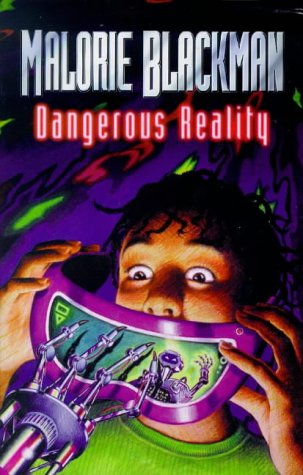
Dominic is really proud of his Mum, she invented VIMS. She's also about to marry Jack which will give Dominic the best stepdad he could wish for. VIMS can do anything, disarm a landmine, hold a baby. But when VIMS attacks violently without warning, Dominic realizes it is no longer a fantastic game. Suggested level: intermediate, junior secondary.
- Machinehood
S. B. Divyastandalone novel2021
similar bytensenear futureartificial intelligencescience fictionthriller & suspenseour world
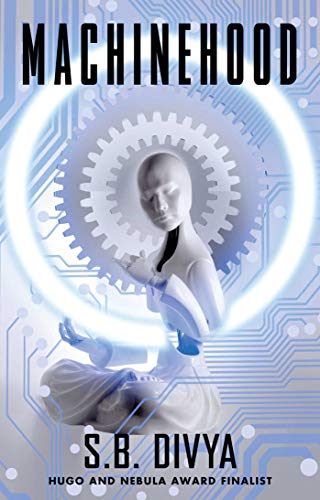
Machinehood, a near-future science fiction thriller published in 2021, is the debut novel of S.B. Divya. It was a nominee for the Nebula Award for Best Novel in 2022.
- Oath of Fealty
Larry Niven & Jerry Pournellestandalone novel1981
similar bynear futurescience fictiontenseour worldnorth america+1 more
Oath of Fealty is a 1981 novel by American writers Larry Niven and Jerry Pournelle, published originally by Phantasia Press, then by Timescape Books, with numerous reprints. Set in the near future, it involves an arcology, a large inhabited structure, called Todos Santos, which rises above a crime-ridden Los Angeles, California, but has little beyond casual contact with the city. The novel popularized the phrase "think of it as evolution in action", which occurs elsewhere in Niven's books. The novel anticipated the building of the Los Angeles subway. It was included in David Pringle's book Science Fiction: The 100 Best Novels.
- The Turing Option
Harry Harrison & Marvin Minskystandalone novel1992
similar bynear futureartificial intelligencescience fictiontenseour world+1 more
Classic SF Harry Harrison enthralls with the discovery, loss and re-discovery of AI. Quaint but fairly accurate predictions of modern computing power. 24 style presentation.
- Stranger in a Strange Land
Robert A. Heinleinstandalone novel1961
similar byscience fictionnear futureidentitychallengingnorth americaour world
Stranger in a Strange Land is a 1961 science fiction novel by the American author Robert A. Heinlein. It tells the story of Valentine Michael Smith, a human who comes to Earth in early adulthood after being born on the planet Mars and raised by Martians, and explores his interaction with and eventual transformation of Terran culture.
- Hopscotch
Kevin J. Andersonstandalone novel2002
similar bytensenear futurescience fictionthriller & suspenseour worldidentity
From the flaps of the Bantam first edition: "Suppose you could switch bodies with another person? What exciting new experiences would you choose to explore? What forbidden desires would you indulge? Suppose someone stole your life–how far would you go to get it back? From ... author Kevin J. Anderson comes a pure adrenaline thriller of hijacked identities, elusive motives, and deeply buried secrets–a disturbing, thought-provoking excursion into a sleek, hedonistic society where nothing is your own...not even your soul. Hopscotch - For a fee, Eduard Swan will swap bodies with people in distress–those facing surgeries, emotional crises, moments of unpleasantness or discomfort they can't or would rather not deal with. Eduard will experience the suffering for them. It's a lucrative business, and in a world in which no one is required to feel any pain, there is no end of clients. But someone doesn't want to play by the rules. Someone doesn't want to return his body. And, unfortunately for Eduard, that someone is one of the world's most powerful men. Now Eduard has no choice but to steal back his life. He has the perfect alibi–or so he thinks. For even in a world where you can hopscotch from body to body, you always leave a trail. And following that trail is a relentless dispenser of "justice" named Daragon, a childhood friend, now a zealous and ambitious agent of state security, who won't let old friendships stand in the way of doing his duty. When Eduard goes on the run, hounded at every turn by Daragon, his only hope is two other childhood friends: Garth, a tormented artist who gains success beyond his wildest dreams, only to discover the terrible price of fame; and Teresa, a spiritual seeker who risks losing her own body to a fanatical religious cult as she embarks on a harrowing quest to find her true identity. Moving from underground hopscotch pleasure bars to the highest enclaves of power to a seamy underworld of illegal Phantoms, ancient minds who steal younger bodies in a quest for eternal life, Eduard and his friends seek the meaning of identity in a society in which appearances mean everything–and nothing–and where everything is relative...even murder."