More like Shell Games
anchored on:science fictionsuperheronorth americamid 20th centuryalternate historygenetic engineering+1 more
but
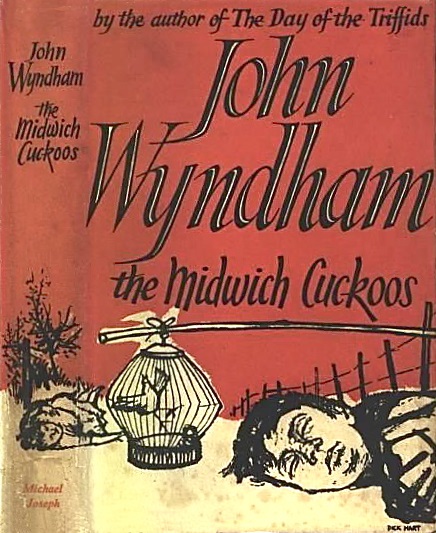
- The Midwich Cuckoos
John Wyndhamstandalone novel1957
similar bydarkmid 20th centuryaliensscience fictiontense
The Midwich Cuckoos is a 1957 science fiction novel written by the English author John Wyndham. It tells the tale of an English village in which the women become pregnant by brood parasitic aliens. The book has been praised by many critics, including the dramatist Dan Rebellato, who called it "a searching novel of moral ambiguities", and the novelist Margaret Atwood, who called the book Wyndham's "chef d'œuvre". The book has been adapted for film, radio, and television.
- The Child Buyer
John Herseystandalone novel1960
similar bygenetic engineeringdarknorth americamid 20th centuryscience fiction
The Child Buyer is John Hersey's 1960 novel about a project to engineer super-intelligent persons for a project whose aim is never definitely stated. Told entirely in the form of minutes from a State Senate Standing Committee, it relates the story of the appearance and efforts of a mysterious stranger in the small town of Pequot, and the repercussions of his attempt to buy a boy, Barry Rudd.
- A Report from Group 17
Robert C. O'Brienstandalone novel1972
similar bygenetic engineeringdarknorth americamid 20th centuryscience fictiontense
A Report from Group 17, published in 1972, is a science-fiction thriller written by Robert Leslie Conly under his pen name Robert C. O'Brien. Set in Washington, D.C., during the Cold War, the story deals particularly with the danger of developing bioweapons. The potential cause of conflict is a resurgence of Nazism in Europe. A 12-year-old girl who lives near a Soviet estate in Maryland becomes a victim of intrigue when she is kidnapped for use as an experimental subject. Themes include the threat of modern war to human survival, the moral responsibility of scientists, and the importance of both individual freedom and sympathetic instincts. Following two novels for children, A Report from Group 17 was the first of two dystopian novels that O'Brien wrote for adults. His last novel, Z for Zachariah (1974), depicts a conflict between two survivors of a nuclear war and deals with similar themes.
- The Grays
Whitley Strieberstandalone novel2006
similar bygenetic engineeringdarknorth americaaliensscience fictiontense
Millions of people are confronting aliens that authorities say do not exist. Whitley Strieber -- author of the legendary, #1 bestseller Communion, which detailed his own close encounters -- now returns to the riddle of aliens with The Grays. Drawing on a lifetime of research, Strieber offers up a fictional account of the conspiracy behind alien presence on Earth while also giving us a startling look inside the alien mind that will astound, frighten, and enthrall readers. Meet the Three Thieves, a group of Grays assigned to duty in a small Kentucky town. For decades, they have abducted its residents and manipulated bloodlines trying to create an ultra-intelligent human being. Nine year-old Conner Callahan will face the ultimate terror as he struggles to understand who he has been bred to be, and what he must do to save humanity. Meet Colonel Michael Wilkes, the head of a select group of government and military officials who have been monitoring the Grays for years. Wilkes has done everything in his power to keep the secret of the Grays from the public. But when the Grays begin to reveal themselves, Wilkess fear of occupation forces him to set in motion his own sinister plan to ensure the survival of humanity, but at what cost? The fate of the human race lies with one woman, Lauren Glass, whose unique ability to communicate with the last remaining captive Gray, known as A for Adam, may be the only way humans can truly unravel the Grays ultimate plan. The Grays is a mind-bending journey behind the curtain of secrecy that surrounds the subject of aliens, written by the fields great master. This book will make you think deeply, not only about the mystery of who the Grays are, but who exactly we are.
- Patternist
series6 books1976
completed
similar bygenetic engineeringdarkscience fiction+3 more
The Patternist series is a group of science fiction novels by Octavia E. Butler that detail a secret history continuing from the Ancient Egyptian period to the far future that involves telepathic mind control and an extraterrestrial plague. A profile of Butler in Black Women in America notes that the themes of the series include "racial and gender-based animosity, the ethical implications of biological engineering, the question of what it means to be human, ethical and unethical uses of power, and how the assumption of power changes people."
- The Kraken Wakes
John Wyndhamstandalone novel1953
similar bydarkmid 20th centuryaliensscience fictiontense
" Behind a spectacular meteor shower actually hides the beginning of an invasion by a mysterious and powerful alien race. Earth's life is disrupted by the attacks of extraterrestrials whose war machines, emerging from the depths of the oceans, seem indestructible. The coalitioned forces of the whole world are worthless, powerless in the face of the indecipherable and deadly plans of a superior intelligence, capable of bringing the entire planet to the brink of catastrophe" Goodreads May 20, 2022
- Camp Concentration
Thomas M. Dischstandalone novel1968
similar bygenetic engineeringdarkmid 20th centuryscience fiction+1 more
Camp Concentration is a science fiction novel by American writer Thomas M. Disch. It was first serialized in four parts in New Worlds from July to October 1967 and was published in book form in the United Kingdom in 1968, followed by a first U.S. edition in 1969.
- I Am Legend
Richard Mathesonstandalone novel1954
similar bydarkmid 20th centurynorth americatensescience fiction
The last human survivor of the vampire epidemic has to maintain his defences against their onslaught, while attempting to research the cause and possibly solution to the plague. Robert Neville is the last living man on Earth... but he is not alone. Every other man, woman and child on the planet has become a vampire, and they are hungry for Neville's blood. By day he is the hunter, stalking the undead through the ruins of civilization. By night, he barricades himself in his home and prays for the dawn. How long can a man survive like this?
- Midnight
Dean R. Koontzstandalone novel1989
similar bygenetic engineeringdarknorth americascience fictiontense
A wealthy tech entrepreneur, intending to create superhumans by infecting them with nanotech to assist their physical and mental abilities, picks a California town as his secret pilot project, but things go terribly wrong.
- When She Woke
Hillary Jordanstandalone novel2011
similar bygenetic engineeringdarknorth americascience fictiontense
When She Woke is a science fiction novel by American author Hillary Jordan, published in October 2011. It has been translated into French, Spanish, Turkish, German, Portuguese and Chinese. The novel is a dystopian reimagining of Nathaniel Hawthorne's The Scarlet Letter, set in a future theocratic America where rather than being imprisoned and rehabilitated, criminals are punished by being "chromed" – having their skin color genetically altered to fit their crime – and released into the general population to survive as best they can.
- Invasion
Robin Cookstandalone novel1997
similar bygenetic engineeringnorth americaaliensscience fictiontense+1 more
Earth is bombarded from space by small disks which, in addition to having powerful physical armaments, when handled activate latent viral DNA which causes humans to mutate into alien beings; a small group recognize the danger and attempt to develop a biological counterweapon.
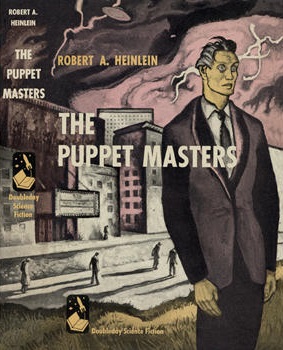
- The Puppet Masters
Robert A. Heinleinstandalone novel1951
similar bymid 20th centurynorth americaaliensscience fictiontense
Parasitical aliens attach themselves to human hosts and take over their bodies. Two spies are sent to find out what's happening, but the extent is much farther than they knew. With access to the humans' memories, the aliens quietly invade the government and start taking over.
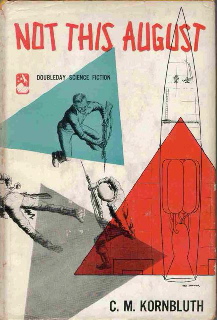
- Not This August
C. M. Kornbluthstandalone novel1955
similar bydarknorth americamid 20th centuryscience fictionalternate history+1 more
Not This August, also known as Christmas Eve, is a Hugo Award shortlisted science fiction novel by Cyril M. Kornbluth. It was originally published in 1955 by Doubleday. It was serialized in Maclean's magazine (Canada) in May and June 1955. A revised edition with a new foreword and afterword by Frederik Pohl was published in 1981 by Tor Books, ISBN 0-523-48518-2. The title comes from author Ernest Hemingway's "Notes on the Next War".
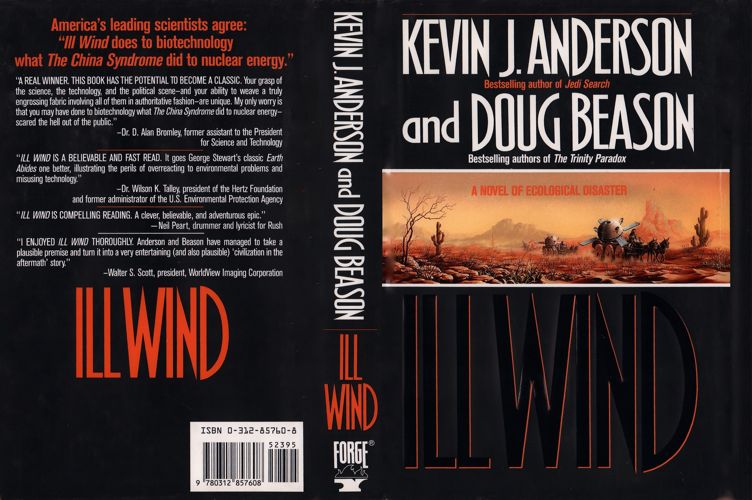
- Ill Wind
Kevin J. Anderson & Doug Beasonstandalone novel1995
similar bygenetic engineeringdarknorth americascience fictiontense
From the flaps of the Forge first printing: "A supertanker has crashed off the shores of San Francisco, producing the largest oil spill in history. Desperate to avert an ecological - and public relations - disaster, a multinational oil company releases an untested virus designed to break up the spill. A virus that spreads like wildfire on the wind, destroying anything made of petroleum - destroying gasoline in automobile tanks, plastics, nylon, the very fabric of modern civilization itself. Dr. Spencer Lockwood, one of the few scientists to recognize the danger, tries to alert government and industry to the impending danger. But his warnings go unheeded and the devastation mounts. As America descends into savagery, Lockwood forges a courageous band of scientists to carry out a daring plan to restore order. But humanity's last hope my be snuffed out by a ruthless general driven by an insatiable desire for power. A riveting and inspiring saga of ecological catastrophe and human survival, Ill Wind is all the more frightening because it could actually happen. Kevin Anderson, a technical consultant for the Air Force, and Doug Beason, a former science advisor o the Reagan administration, have drawn upon the latest breakthroughs in biotechnology to create a disaster scenario that is terrifying in its plausibility."
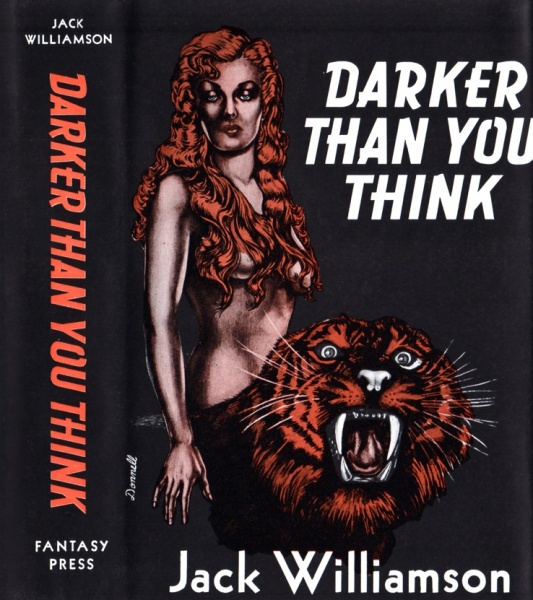
- Darker Than You Think
Jack Williamsonstandalone novel1948
similar bydarknorth americamid 20th century+2 more
Darker Than You Think is a science fantasy and horror novel by American writer Jack Williamson. Originally a novelette, it was expanded into novel length and published by Fantasy Press in 1948. The short version was published in Unknown in 1940.
- MaddAddam
series3 books2003
similar bygenetic engineeringdarknorth americascience fiction
Margaret Atwood's MaddAddam trilogy (Oryx and Crake, The Year of the Flood, MaddAddam, 2003-2013) is set around a genetically engineered pandemic unleashed deliberately by the brilliant, disillusioned scientist Crake, who intends the deadly 'BlyssPluss' pill to wipe out humanity and clear the way for the gentler, engineered Crakers he has designed to replace it. Told from the perspectives of survivors including Crake's old friend Jimmy (now calling himself Snowman), the trilogy pieces together the pandemic's causes and its aftermath from multiple, overlapping vantage points.
- Unwind Dystology
series5 books2007
similar bygenetic engineeringnorth americadarkscience fictiontense
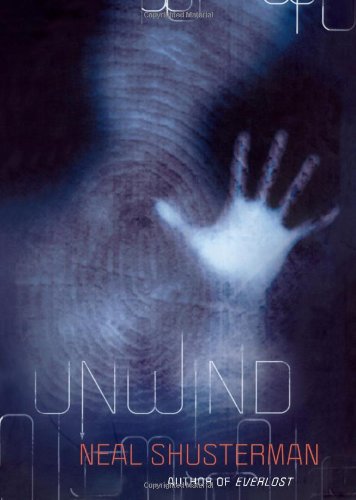
Neal Shusterman's Unwind Dystology opens in a United States reshaped by the resolution to a war over reproductive rights: parents can retroactively have a teenager "unwound," their body disassembled for transplant on the premise that nothing technically dies since every part lives on in someone else. The first novel follows three teens fleeing that fate, and the sequels widen the same dystopia's cast and consequences across a four-book arc plus companion material. It is grim speculative fiction built to ask hard bioethical questions rather than offer comfort.
- Blood Music
Greg Bearstandalone novel1985
similar bygenetic engineeringdarknorth americascience fiction
Blood Music is a 1985 science fiction novel by American writer Greg Bear. It is an expanded version of a short story of the same title, originally published in the June 1983 issue of Analog and the winner of both the 1983 Nebula and 1984 Hugo awards for Best Novelette. The novel won the 1986 Prix Apollo Award, given to the best science fiction novel published in France during the preceding year, under the title La Musique du sang.
- The Hunger Games
series3 books2008
part of The Hunger Games Universe
similar bydarknorth americascience fictiontense
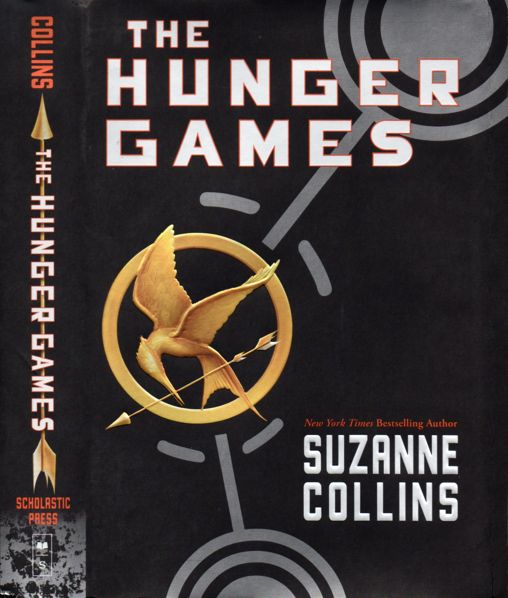
The Hunger Games is a series of young adult dystopian novels written by American author Suzanne Collins. The series consists of a trilogy that follows teenage protagonist Katniss Everdeen, as well as two prequels. The Hunger Games universe is a dystopia set in Panem, a post-apocalyptic North American country consisting of the wealthy Capitol and 12 districts in varying states of poverty. As punishment for rebellion, the Capitol hosts an annual battle royale competition called The Hunger Games. Each of the 12 districts must send two children between the ages of 12 and 18 to participate, and the last surviving child is dubbed the victor.
- The World Jones Made
Philip K. Dickstandalone novel1956
similar bydarknorth americascience fictiontense+2 more
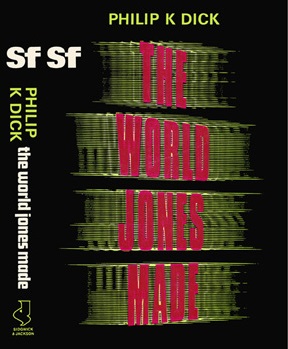
The World Jones Made is a 1956 science fiction novel by American writer Philip K. Dick, examining notions of precognition, humanity, and politics. It was first published by Ace Books as one half of Ace Double D-150, bound dos-à-dos with Agent of the Unknown by Margaret St. Clair.The story takes place after a nuclear war in which society is dominated by relativism, which rejects absolute truths and preaches tolerance as the highest principle. The mutant Floyd Jones, who can see into the future, plans to overthrow the system and colonise space. The story ends with the defeat of Jones, whose plans fail despite his ability to see the future due to the immutability of fate.
- The 5th Wave
series4 books2013
similar bynorth americadarkaliensscience fictiontense
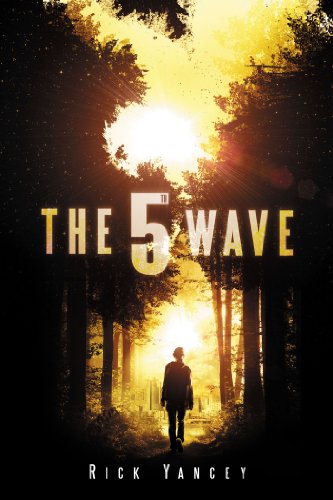
Rick Yancey's The 5th Wave opens after a series of escalating alien attacks has already devastated Earth's population and infrastructure, following sixteen-year-old survivor Cassie Sullivan as she searches for her younger brother while trying to work out who, among the remaining humans, can still be trusted. The trilogy is young-adult science fiction that treats its alien-invasion premise as a survival and paranoia story more than a war story.
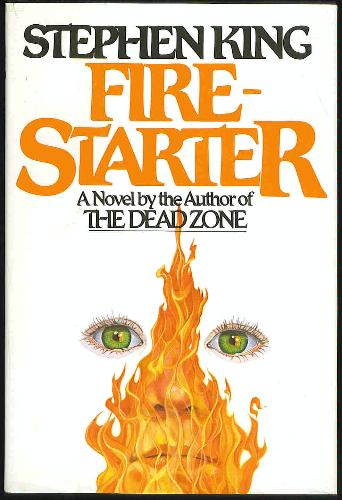
- Firestarter
Stephen Kingstandalone novel1980
similar bydarknorth americatensescience fiction+1 more
WorldCat: Innocence and beauty ignite with evil and terror... First, a man and a woman are subjects of a top-secret government experiment designed to produce extraordinary psychic powers. Then, they are married and have a child. A daughter. Early on the daughter shows signs of a wild and horrifying force growing within her. Desperately, her parents try to train her to keep that force in check, to 'act normal'. Now the government wants its brainchild back for its own insane ends.
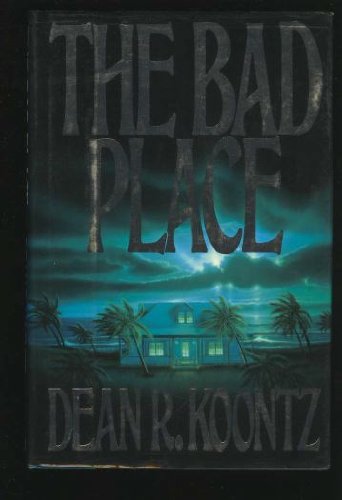
- The Bad Place
Dean R. Koontzstandalone novel1990
similar bygenetic engineeringdarknorth americatense
The Bad Place is a horror novel by American writer Dean Koontz, released in 1990. It includes elements of horror, suspense, and mystery, and is presented partially as a twist on the private eye drama. The story follows Frank Pollard, a man who wakes up each night with no memory of where he has been or what he has done, only to find himself covered in injuries or in possession of strange items. As his condition worsens, private investigators Bobby and Julie Dakota are hired to track him and uncover the truth behind his blackouts. Their investigation leads them into a disturbing web of genetic experimentation, family secrets, and a hidden force manipulating human lives from the shadows. As the plot unfolds, the novel reveals that Frank and others are being pursued by powerful, almost inhuman figures connected to a twisted experiment involving selective breeding and enhanced abilities. The Dakotas become entangled in a struggle not only to save Frank but also to survive against forces that seem to operate beyond normal human limits. Themes in the novel include identity, memory loss, the abuse of science, and the nature of evil. Koontz blends psychological horror with fast-paced action, creating a narrative that shifts between detective fiction and supernatural thriller. The book received generally positive reception from readers who enjoyed Koontz’s signature suspense style, though some critics noted its complex and sometimes chaotic plot structure. Over time, it has remained one of his more memorable early-1990s works due to its unusual blend of genres and its dark, unsettling tone.
- Alas, Babylon
Pat Frankstandalone novel1959
similar bynorth americamid 20th centuryscience fictiontense+1 more
Classic novel of nuclear war and aftermath in rural Florida. From the back cover of a Bantam Pathfinder edition: "The day that the bomb dropped the thousands of years of "progress" that had covered the treacheries and weaknesses of ordinary man with a thin veneer of civilization were dissolved and melted like snow on the desert's dusty face. Then - the law of the jungle reigned but in the wreckage a few courageous survivors, men and women with the guts to have hope, were determined to build a new and better world on the ruins of the old. This is their story."