More like Soirée
but
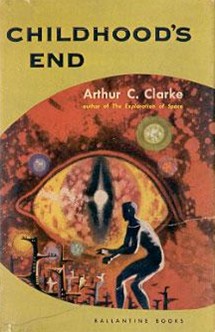
- Childhood's End
Arthur C. Clarkestandalone novel1953
similar bytechnological singularity
Childhood's End is a 1953 science fiction novel by the British author Arthur C. Clarke. The story follows a peaceful alien invasion of Earth by mysterious Overlords, whose arrival begins decades of apparent utopia under indirect alien rule, at the cost of human identity and culture.
- Blood Music
Greg Bearstandalone novel1985
similar bytechnological singularity
Blood Music is a 1985 science fiction novel by American writer Greg Bear. It is an expanded version of a short story of the same title, originally published in the June 1983 issue of Analog and the winner of both the 1983 Nebula and 1984 Hugo awards for Best Novelette. The novel won the 1986 Prix Apollo Award, given to the best science fiction novel published in France during the preceding year, under the title La Musique du sang.
- Richard Forthrast
series2 books2011
similar by+1 more
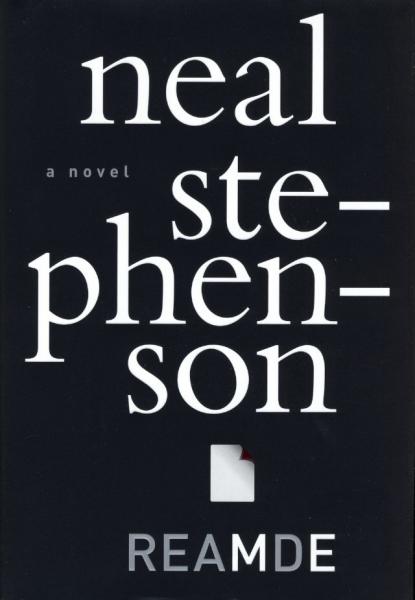
Neal Stephenson's Richard 'Dodge' Forthrast novels open with Reamde, a globe-spanning thriller that starts when ransomware inside an MMORPG economy pulls Richard's extended family into a real-world hostage crisis involving hackers, jihadists and Russian mobsters. The sequel Fall; or, Dodge in Hell shifts registers entirely, following Richard's digitally preserved mind after death into an afterlife simulation built from his scanned brain. The two books share a protagonist and family but differ sharply in genre and scale.
- The Light of Other Days
Arthur C. Clarke & Stephen Baxterstandalone novel2000
similar bytechnological singularity
An industrialist devises a technique to use tiny wormholes as light pipes to enable viewing of any event anywhere; and subsequently it becomes possible to use them to view any event in the past as well. The effects on society are enormous.
- Macx Family
series10 books2001
similar by+1 more
Charles Stross's Accelerando follows three generations of the Macx family as human and posthuman intelligence accelerates toward and through a technological singularity, told across nine interlinked stories originally published separately before being combined into a fix-up novel. Its early chapters, following economist Manfred Macx giving away business ideas for a living, give way to increasingly alien later sections as uploaded minds and artificial intelligences outpace human comprehension. It won the Locus Award and remains one of the defining fictional treatments of the singularity concept.
- Glasshouse
Charles Strossstandalone novel2006
similar by+1 more
Robin wakes in a rehabilitation clinic with his memory deliberately erased, convinced that whoever tried to kill him before is still out there. To disappear completely, he volunteers for an experimental study recreating a vanished slice of 20th/21st-century society inside a closed habitat called the glasshouse -- a former high-security detention facility for war criminals -- and is assigned a female body and a new name, Reeve. As the simulation's rules of gender and conformity close in, Reeve starts to suspect the experiment's organizers are running something considerably darker than sociology. A standalone posthuman-future novel by Charles Stross.
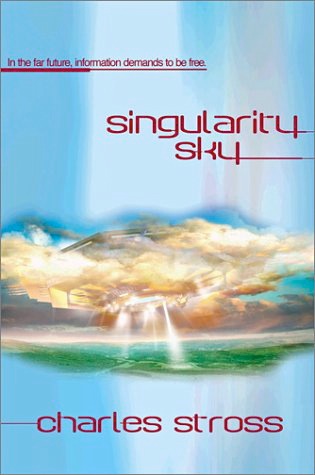
- Singularity Sky
series2 books2003
similar bytechnological singularity
Singularity Sky and its sequel Iron Sunrise are collectively known as the Eschaton novels, after the godlike posthuman intelligence that seeded human colonies across space on the condition they never attempt time travel or threaten causality - rules tested when a low-tech colony world is destabilized by a group calling itself the Festival. Charles Stross uses the setup for a mix of space opera, economics, and diplomatic intrigue.
- Schild's Ladder
Greg Eganstandalone novel2002
similar bytechnological singularity
Schild's Ladder is a 2002 science fiction novel by Australian author Greg Egan. The book derives its name from Schild's ladder, a construction in differential geometry, devised by the mathematician and physicist Alfred Schild.
- Diaspora
Greg Eganstandalone novel1997
similar by+1 more
Diaspora is a hard science fiction novel by the Australian writer Greg Egan which first appeared in print in 1997. It originated as the short story "Wang's Carpets" which originally appeared in the Greg Bear-edited anthology New Legends. The story appears as a chapter of the novel.
- Newton's Wake
Ken MacLeodstandalone novel2004
similar bytechnological singularity
Newton's Wake: A Space Opera is a science fiction novel by British writer Ken MacLeod, published in 2004. Set in the 24th century, it follows human life after a partially cataclysmic Singularity, and in particular a conflict on a far-flung planet that upsets the prevailing order. It has elements of both transhumanism and satire and is written using the printed versions of common translation stereotypes. The novel was nominated for the British Science Fiction Award in 2004, and the John W. Campbell Memorial Award for Best Science Fiction Novel in 2005.
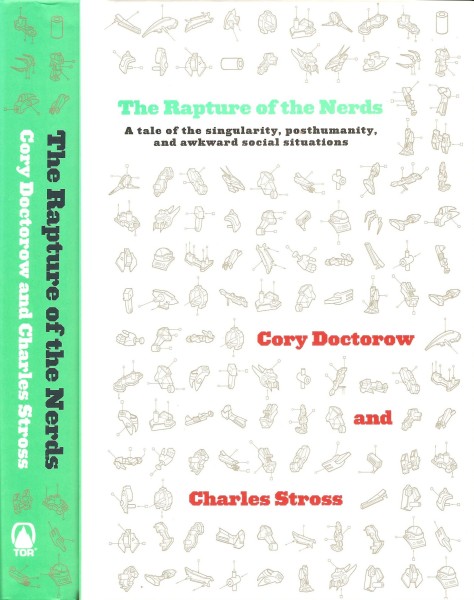
- The Rapture of the Nerds
Cory Doctorow & Charles Strossstandalone novel2012
similar bytechnological singularity
The Rapture of the Nerds is a 2012 novel by Cory Doctorow and Charles Stross. It was released on 4 September 2012 through Tor Books and as an ebook, DRM free, under the CC BY-NC-ND. The book can also be downloaded for free.
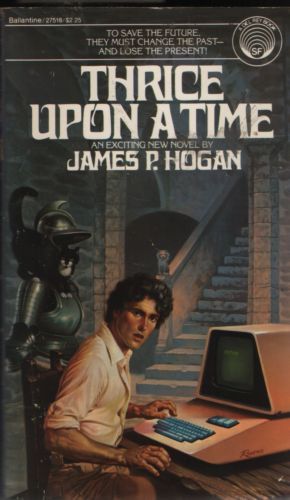
- Thrice Upon a Time
James P. Hoganstandalone novel1980
similar by+1 more
Amazon: When Murdoch was summoned to his grandfather's isolated Scottish castle, he had no idea of the old man's latest discovery -- nor where it would lead him. Sir Charles, a genius in far-out physics, had found a flaw in the law of conservation of energy; in any process, an incredibly tiny increment of energy escaped -- back through time! Using this "tau" radiation, he could send messages into the past. But Murdoch discovered records of messages he knew he had never sent. Were many futures possible? Could a message from Future X alter the past -- and thus wipe out Future X? But who would be foolish enough to send a message that could eliminate his own existence?
- Realtime
series3 books1984
completed
similar by+1 more
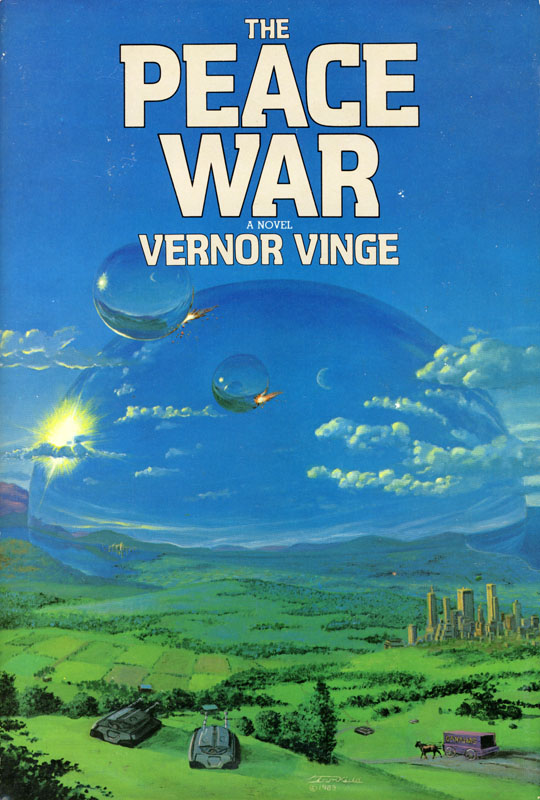
Vernor Vinge's The Peace War introduces Paul Hoehler, inventor of the 'bobble' — an impenetrable force-field technology seized by the authoritarian Peace Authority to enforce global dominance. Decades after being driven into hiding, Hoehler works in secret with fellow scientists, including a talented newcomer, to challenge the Authority's grip on the world. Marooned in Realtime continues the story decades further on; the two novels, along with the novella 'The Ungoverned', are collected together as Across Realtime.
- Nexus 5
series3 books2012
similar by+1 more
Nexus opens Ramez Naam's postcyberpunk trilogy in 2040 with scientist Kaden Lane, who works on Nexus, an experimental nano-drug that lets human minds be networked and reprogrammed, and finds himself caught between government and corporate interests once the technology's implications become clear. The trilogy continues through Crux and Apex, following the same central conflict over who controls the technology. Nexus tied for Best Novel at the 2014 Prometheus Awards and Apex won the 2015 Philip K. Dick Award.
- Implied Spaces
Walter Jon Williamsstandalone novel2008
similar by+1 more
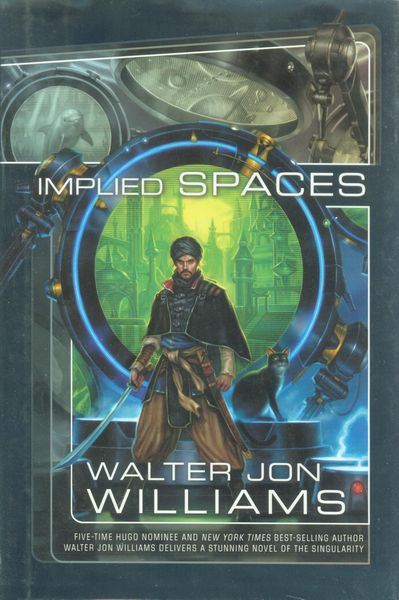
Implied Spaces is a 2008 space opera novel by American author Walter Jon Williams. It explores themes of transhumanism, artificial intelligence and ontology.
- Supermind
A. E. van Vogtstandalone novel1977
similar bytechnological singularity
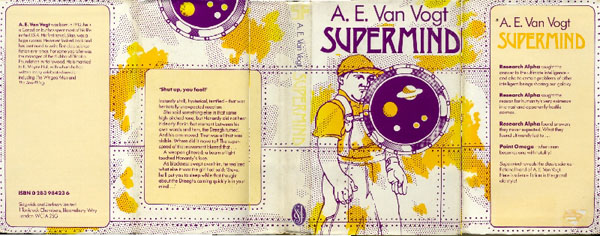
From the back cover of the DAW first edition: "Research Alpha sought the answer to the ultimate intelligence - and also to certain problems of other intelligent beings sharing our galaxy. Research Alpha sought the reason for humanity's very existence in a vast and apparently hostile cosmos. Research Alpha found answers they never expected. What they found would ultimately lead to... Point Omega - when man becomes one with totality!"
- The Golden Oecumene
series3 books2002
similar by+1 more
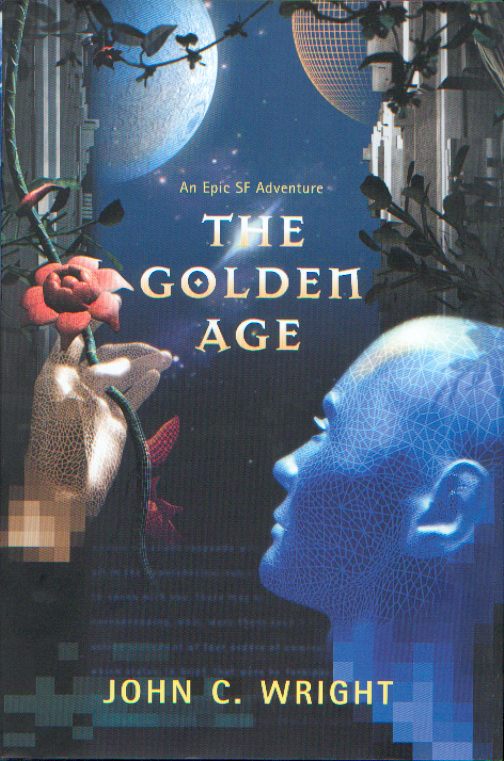
The Golden Oecumene is a science fiction trilogy by the American writer John C. Wright. It consists of three books, The Golden Age, The Phoenix Exultant and The Golden Transcendence.
- The God Machine
Martin Caidinstandalone novel1968
similar bytechnological singularity
The God Machine is a science-fiction novel by American writer Martin Caidin first published in 1968. Set in the near future, the novel tells the story of a top-secret cybernetic technician, Steve Rand, one of the brains behind Project 79, a top-secret US government project dedicated to creating artificial intelligence. Rand survives an attempt on his life before he realizes that Project 79 has gained sentience and is trying to control the minds of humans and take over the world. Assisted by a security agent and a mathematician, Rand sets out to destroy Project 79 before it is too late.