More like Something Bright
but
- Men Like Gods
H. G. Wellsstandalone novel1923
similar byparallel universeearly 20th century
Men Like Gods is a 1923 novel, referred to by the author as a "scientific fantasy", by English writer H. G. Wells. It features a utopia located in a parallel universe.
- The Heads of Cerberus
Francis Stevensstandalone novel1919
similar byearly 20th century+1 more
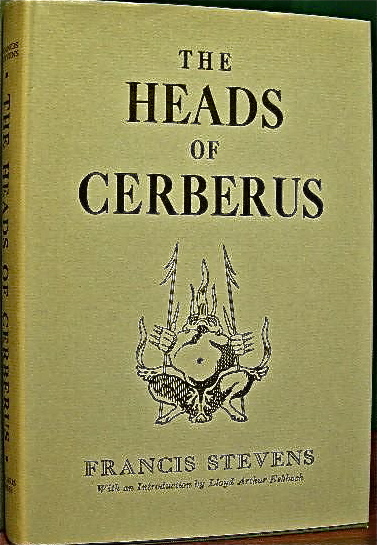
The Heads of Cerberus is a science fiction novel by American writer Francis Stevens. The novel was originally serialized in the pulp magazine The Thrill Book in 1919, and it was first published in book form in 1952 by Polaris Press in an edition of 1,563 copies. It was the first book published by Polaris Press. A scholarly reprint edition was issued by Arno Press in 1978, and a mass market paperback by Carroll & Graf in 1984.
- A Modern Utopia
H. G. Wellsstandalone novel1905
similar byparallel universeearly 20th century
Two travelers, an unnamed narrator and his skeptical companion, find themselves transported to a parallel world: a planet identical to Earth in geography and even population, down to duplicates of everyone they know, but shaped by a different history. There they examine a global order run by a voluntary elite called the Samurai, who try to hold together progress and stability without the coercion Wells thought inevitable in the utopias that came before his. Framed less as a story than as a philosophical travelogue, it is Wells's own argument with the utopian tradition, tested through the world he invents to make it.
- The Adjacent
Christopher Prieststandalone novel2013
similar by+2 more
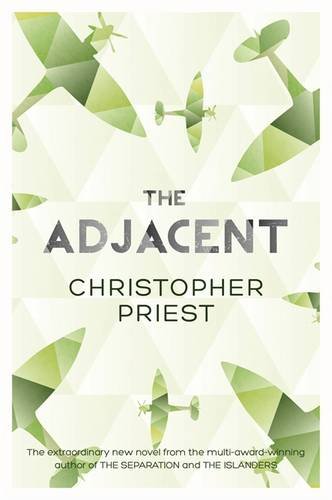
In the near future, Tibor Tarent, a freelance photographer, is recalled from Anatolia to Britain when his wife, an aid worker, is killed--annihilated by a terrifying weapon that reduces its target to a triangular patch of scorched earth. A century earlier, Tommy Trent, a stage magician, is sent to the Western Front on a secret mission to render British reconnaissance aircraft invisible to the enemy. Present day: a theoretical physicist develops a new method of diverting matter, a discovery with devastating consequences that will resonate through time.
- Darwinia
Robert Charles Wilsonstandalone novel1998
similar byearly 20th century+1 more
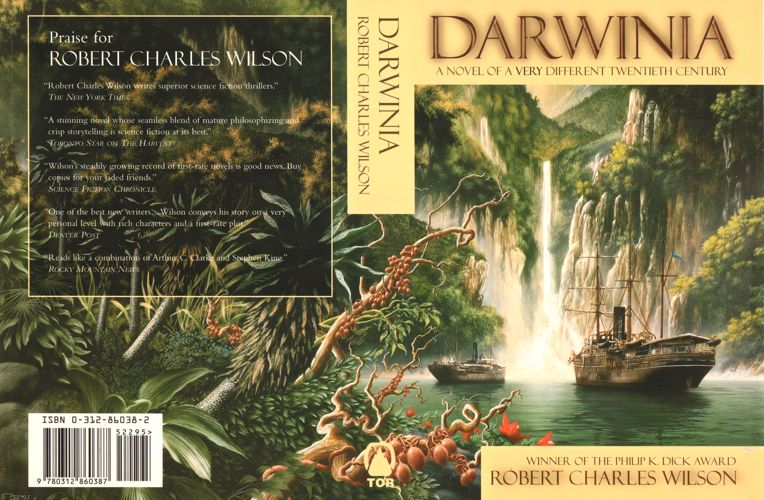
From the front flap of the Tor first edition: In 1912, history was changed by the Miracle, when the old world of Europe was replaced by Darwinia, a strange land of nightmarish jungle and antediluvian monsters. To some, the Miracle is an act of divine retribution; to others, it is an opportunity to carve out a new empire. Leaving an America now ruled by religious fundamentalists, young Guilford Law travels to Darwinia on a mission of discovery that will take him further than he can possibly imagine...to a shattering revelation about mankind's destiny in the universe.
- His Dark Materials Universe
universe13 books1995
Start hereHis Dark Materials · Start here
similar byparallel universe
In a world like ours and unlike it, every human soul walks outside the body in the shape of an animal — a daemon, who speaks, who cannot be lied to, and who settles into one fixed form only when childhood ends. This is the country of His Dark Materials: a company of parallel worlds across which an invisible dust of consciousness drifts down upon the waking mind; where a Church that calls itself the Magisterium would sooner sever a child's soul than let that Dust be understood; and where a golden instrument, the alethiometer, answers true questions for anyone with the patience to read it. Philip Pullman's design stands in two trilogies and a scatter of shorter tales. His Dark Materials — Northern Lights (published in America as The Golden Compass), The Subtle Knife, and The Amber Spyglass — carries Lyra Belacqua from the rooftops of a shadow Oxford across the borders between worlds. The Book of Dust returns to that same territory: La Belle Sauvage looks back to Lyra as an infant carried through a great flood, while The Secret Commonwealth follows her grown and less certain into adulthood, with a concluding volume closing the arc. Around them sit slim companion books — Lyra's Oxford, Once Upon a Time in the North, Serpentine — and Nicholas Wright's stage adaptation, made with Pullman's blessing. The register is grave and luminous at once, its title lifted from Milton and its quarrel drawn from Blake: a story that takes the side of curiosity, love, and the physical world against any authority that would forbid them. It reads as adventure — armoured bears, aeronauts, knife-cut windows between skies — yet reasons like philosophy. Begin with Northern Lights / The Golden Compass and read the first trilogy through before turning to The Book of Dust, which deepens everything the first has already made you feel.
- Doctor Dolittle
series27 books1920
similar byearly 20th century+1 more
Hugh Lofting's Doctor Dolittle books follow a Victorian-era English physician who gives up treating people to practice medicine among animals, whose languages he learns to speak, traveling the world with an ever-growing menagerie of companions. Lofting wrote twelve novels between 1920 and 1936, beginning with The Story of Doctor Dolittle, with two further story collections published after his 1947 death. Kathryn Knight and Nick Price, credited alongside Lofting in modern editions, are illustrators/editors of reissues rather than co-authors of new installments.
- The Food of the Gods and How It Came to Earth
H. G. Wellsstandalone novel1904
similar byearly 20th century+1 more
The Food of the Gods and How It Came to Earth is a science fiction novel by H. G. Wells that was first published in 1904. Wells called it "a fantasia on the change of scale in human affairs. ... I had hit upon [the idea] while working out the possibilities of the near future in a book of speculations called Anticipations (1901)".
- Five Children Universe
series27 books1902
completed
similar byearly 20th century
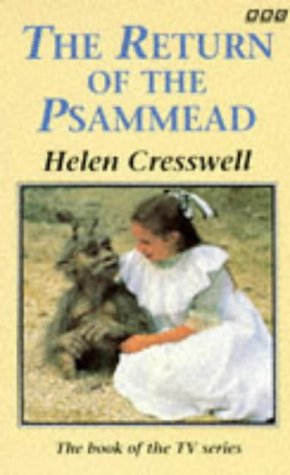
Two separate modern continuations of E. Nesbit's Psammead stories were written decades apart by different authors: Helen Cresswell's The Return of the Psammead (1992) brings the wish-granting sand fairy back for a new set of children, while Kate Saunders's Five Children on the Western Front (2014) follows the now-grown Lamb and his siblings as the First World War arrives, in a more somber sequel to Nesbit's original trilogy. Neither book is by Nesbit herself, and the two have no direct connection to each other beyond both drawing on her creation. Later writers have kept returning to Nesbit's premise long after her own trilogy ended.
- Narnia
series26 books1950
part of Narnia Universe
similar bychildren
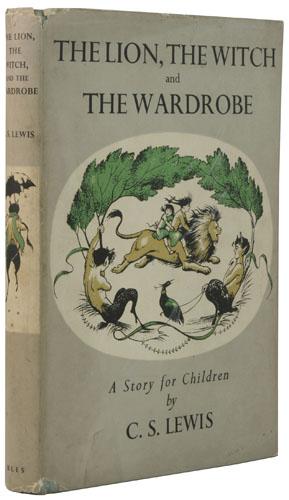
The Chronicles of Narnia is a series of seven portal fantasy novels by British author C. S. Lewis. Illustrated by Pauline Baynes and originally published between 1950 and 1956, the series is set in the fictional realm of Narnia, a fantasy world of magic, mythical beasts, and talking animals. It narrates the adventures of various children who play central roles in the unfolding history of the Narnian world. Except in The Horse and His Boy, the protagonists are all children from the real world who are magically transported to Narnia, where they are sometimes called upon by the lion Aslan to protect Narnia from evil. The books span the entire history of Narnia, from its creation in The Magician's Nephew to its eventual destruction in The Last Battle.
- Fata Morgana
Steven R. Boyett & Ken Mitchroneystandalone novel2017
similar byearly 20th century+1 more
At the height of the air war in Europe, Captain Joe Farley and the baseball-loving, wisecracking crew of the B-17 Flying Fortress Fata Morgana are in the middle of a harrowing bombing mission over East Germany when everything goes sideways. The bombs are still falling and flak is still exploding all around the 20-ton bomber as it is knocked like a bathtub duck into another world. Suddenly stranded with the final outcasts of a desolated world, Captain Farley navigates a maze of treachery and wonder—and finds a love seemingly decreed by fate—as his bomber becomes a pawn in a centuries-old conflict between remnants of advanced but decaying civilizations. Caught among these bitter enemies, a vast power that has brought them here for its own purposes, and a terrifying living weapon bent on their destruction, the crew must use every bit of their formidable inventiveness and courage to survive.
- Chrestomanci
series12 books1977
completed
similar byparallel universe
Chrestomanci, sometimes branded The Worlds of Chrestomanci, is a heptalogy of children's fantasy books written by British author Diana Wynne Jones, published from 1977 to 2006. In the context of the parallel universe setting of the books, Chrestomanci refers to both the British government office that is responsible for supervising the use of magic and Chrestomanci Castle in southern England, which is both residence and headquarters.
- A Tale of Time City
Diana Wynne Jonesstandalone novel1987
similar byearly 20th centurychildren
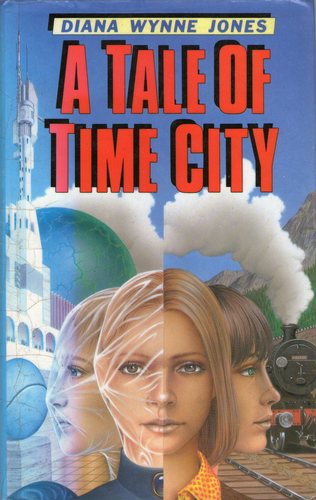
In 1939 an eleven-year-old London girl is kidnapped to Time City, a place existing outside the stream of time and manipulating the history of humanity, where she finds the inhabitants facing their worst hour of crisis.
- The Homeward Bounders
Diana Wynne Jonesstandalone novel1981
similar byparallel universechildren
The Homeward Bounders is a fantasy novel by Diana Wynne Jones in which a vast series of parallel universes serve as the game-boards for a race of demons that delight in war-games and fantasy-games.
- The Invisible Library
series12 books2014
similar by+1 more
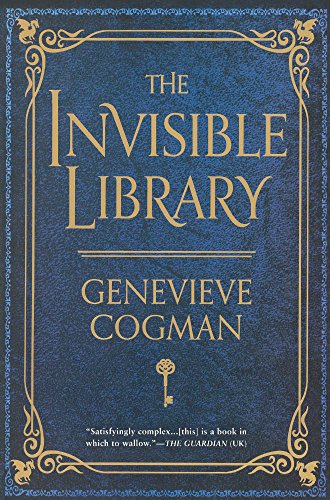
Genevieve Cogman's Invisible Library series follows Irene, an agent of an interdimensional Library that collects rare and dangerous books from across a multiverse of alternate worlds touched by varying degrees of magic and technology. Beginning with The Invisible Library (2014), the eight-book series continues through The Masked City and The Lost Plot on to The Untold Story (2021).
- Professor Branestawm
series24 books1933
completed
similar by+2 more
Professor Branestawm is a series of thirteen children's books written by the English author Norman Hunter. Professor Theophilus Branestawm is depicted throughout the books as the archetypal absent-minded professor and his name is a variant of the word "brainstorm". The first two books in the series were first published in the 1930s, but the other 11 appeared much later, from 1970 onwards.
- H. G. Wells' War of the Worlds
universe65 books1898
Start hereThe War of the Worlds · Start here
similar by+1 more
No one would have believed, in the closing years of the nineteenth century, that human affairs were being watched keenly and closely from the timeless worlds of space. And then the cylinders fell. H. G. Wells' War of the Worlds opens in the quiet of the Surrey commons, where a falling star proves to be the first Martian craft — and from the pit rise the towering tripods, the Heat-Ray, the choking Black Smoke and the creeping red weed, wielded by minds that regard mankind much as we regard the creatures we boil for supper. This is invasion rendered as natural disaster: cold, methodical, and vast beyond argument. Wells' 1898 novel is the seed; everything else grows from that Martian soil. The catalogue gathers direct sequels and continuations alongside a wide field of other hands. In War of the Worlds: Global Dispatches the invasion is retold across the whole planet through the eyes of Twain, Verne, Tolstoy, Lowell and Kipling; in the Manly Wade and Wade Wellman crossover, Sherlock Holmes, Watson and Professor Challenger take the field against the machines; and Scott Washburn's Great Martian War stretches the fighting into a decades-long alternate history of steam, artillery and grinding attrition. It is a loose shared world — no single decreed sequence, many voices answering one calamity. What sets this world apart is its refusal of heroics: the invaders fall not to generals but to the smallest things of Earth, humbling and indifferent. Begin, always, with Wells' original novel — it is short, and it is the ground every later book stands upon. From there follow your appetite: Global Dispatches for the panorama, the Holmes campaign for adventure, Washburn for the long war.
- Tarzan
series50 books1912
part of Tarzan Universe
similar byearly 20th century
Tarzan is a series of 24 adventure novels written by Edgar Rice Burroughs (1875–1950) and published between 1912 and 1966, followed by several novels either co-written by Burroughs, or officially authorized by his estate. There are also two works written by Burroughs especially for children that are not related to the main series.
- The Wind in the Willows Universe
series17 books1908
- Green Town
series31 books1946
completed
similar by+1 more
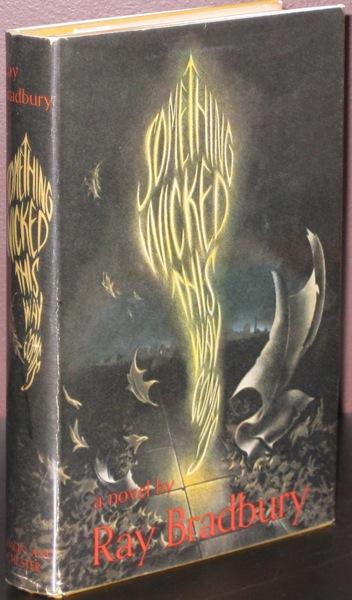
Green Town gathers two of Ray Bradbury's loosely linked novels set in his fictionalized version of his childhood home of Waukegan, Illinois: the dark fantasy Something Wicked This Way Comes (1962), in which a sinister traveling carnival led by the mysterious Mr. Dark descends on a small town and preys on its residents' desires, and the later Farewell Summer (2006), which follows Douglas Spaulding through an autumn stand-off between the town's boys and its elders. Written more than four decades apart, the two novels share Bradbury's recurring setting and nostalgic, myth-making tone rather than a single continuous plot.