Loreful
HomeDiscover
Search series, authors…⌘K
Loreful

Reading orders for SF/F series and shared universes — with your place kept in every one.

Explore

UniversesSeriesWorksAuthorsAtlas

Help

FAQAboutSite map

Account & legal

Sign inCreate accountPrivacyTerms

Data

Built on ISFDB, Wikipedia, Wikidata and Open Library. Curated reading orders carry their reasoning on the page; the rest follow publication order. Data sources & licenses

© Loreful · data: ISFDB · CC BY

More like Spatial Delivery

but

Mood

The mood the book leaves you in.

  • The reading experience is propelled by journeys, exploration, and physical risk; excitement and forward momentum dominate over dread or introspection.
  • Joy and loss are deliberately mixed; the resolution grants characters something real while taking something else away, leaving warmth and sorrow together.
  • The book demands work from the reader — dense prose, difficult structure, unfamiliar ideas, or morally uncomfortable material — as part of its intended effect.
  • Grim events, cruelty, or despair dominate the atmosphere, and the book does not soften them with comfort or comic relief.
  • The atmosphere is quietly unsettling — wrongness, unease, and the uncanny pervade the book without necessarily escalating into overt horror.
  • The book is built to move the reader; character feeling is foregrounded and major scenes aim at a strong emotional response.
  • Humor is a primary aim and the prose plays for laughs — comic situations, wit, or dialogue produce sustained comedy, not occasional levity.
  • The book insists that things can improve; effort and decency are shown to matter, and the arc bends toward better outcomes even through hardship.
  • The book teaches as it goes — real facts, history, science, or craft are conveyed in enough depth that learning is part of the reading experience.
  • The book is designed to uplift and motivate, presenting perseverance or achievement in a way that invites the reader to aspire or act.
  • The overall register is cheerful and easygoing; stakes are kept gentle and the book avoids dwelling on pain or dread.
  • Withheld information drives the experience; the book sustains enigmas and secrets the reader wants resolved, whatever its genre.
  • The book is contemplative and inward-looking, giving more weight to thought, memory, and meaning than to external events.
  • The book works as comfort reading — low tension, a soothing pace, and an atmosphere the reader can unwind in.
  • Grief, loss, or melancholy set the dominant register, and the book lets sorrow stand rather than resolving it into comfort.
  • Sustained suspense is the point; the book keeps the reader braced for what happens next through danger, pressure, or impending revelation.
  • Playful invention and charm define the register — fanciful conceits, light absurdity, and a narration that delights in its own oddity.

About

What the story runs on.

  • Stories in which a machine intelligence — an AI, computer mind, or sentient program — is a central character or the story's driving problem.
  • Stories in which extraterrestrial beings are central — as characters, cultures, or the object of the plot.
  • Stories driven by deliberate modification of genomes — designer organisms, engineered humans, and the consequences of remaking life.
  • Stories about venturing into space to explore — survey missions, astronauts, and the frontier of the unknown beyond Earth.
  • Stories about settling other planets or habitats — founding, sustaining, and governing colonies off Earth.
  • Stories about minds with paranormal abilities — telepathy, telekinesis, precognition, empathy — and how societies handle those who have them.
  • Stories in which staying alive against nature, catastrophe, or scarcity is the central problem.
  • Stories of growing up — a young protagonist crossing from childhood into adult knowledge and responsibility.
  • Stories about who a character truly is — self-discovery, doubled lives, and the search for a self.
  • Stories driven by maneuvering for power — factions, conspiracies, and statecraft conducted in shadow.
  • Stories about rising against rulers — uprisings, resistance movements, and revolutions and their aftermaths.
  • Stories in which war itself is the subject — combat, occupation, and what warfare does to soldiers and civilians.

Shelf

Where it sits in the library.

    • Fiction built on magic or other supernatural elements that have no scientific explanation.
    • Secondary-world fantasy at large scale, where the fate of nations or the world turns on the protagonists' struggle.
    • Fantasy set in a recognizably modern city or contemporary world where the supernatural intrudes on everyday life.
    • Fantasy that blends in horror's atmosphere and imagery, keeping a fantastical frame around grim or frightening material.
    • Action-driven fantasy following warriors or rogues with personal stakes against sorcerous threats, rather than world-spanning conflicts.
    • Fantasy set in a real historical period or a close analogue of one, with magic woven into the era.
    • Fantasy in which protagonists cross from the ordinary world into another world through a portal or similar passage.
    • Fiction that retells or reworks a traditional fairy tale in a new form or setting.
    • Fantasy drawing directly on myths, legends, and folklore, retelling them or building on their figures and logic.
    • Fantasy of ghosts, vampires, shapeshifters, psychics, and similar phenomena, usually set in an otherwise ordinary world.
    • Fiction mixing science-fictional trappings with overtly magical or impossible elements in one setting.
    • Low-stakes fantasy emphasizing comfort, community, and everyday pleasures over conflict and peril.
    • Speculative fiction of pervasive moral ambiguity, violence, and cynicism that rejects heroic conventions — fantasy and SF alike.
      • Fiction that extrapolates from science and technology — future societies, space travel, or speculative inventions — within at least nominally natural laws.
      • Science fiction of interstellar scope — starships, galactic polities, and adventure across star systems.
      • Science fiction committed to scientific rigor, where technical plausibility constrains the story.
      • Science fiction centered on armed forces and warfare, told largely from a military point of view.
      • Science fiction of networked, corporate-dominated near futures, pairing high technology with social decay.
      • Science fiction styled on nineteenth-century steam-powered technology, often in a Victorian or pseudo-Victorian setting.
      • Fiction depicting an oppressive or catastrophic society, presented as a warning.
      • Fiction set after civilization's collapse, following survivors in the ruins of the old world.
      • Fiction in which characters move between past and future, and the mechanics or consequences of that travel drive the plot.
      • Fiction exploring a world where a historical event went differently and history diverged from ours.
      • Science fiction about humanity's first encounter and communication with an alien intelligence.
      • Science fiction in which extraterrestrial forces attack or occupy Earth and humanity resists.
      • Fiction whose primary aim is to frighten or unsettle the reader through dread, menace, or the monstrous.
      • Horror of vast, indifferent, incomprehensible entities before which humanity is insignificant, in the Lovecraft tradition.
      • Horror of decaying houses, buried family secrets, and oppressive atmosphere in the Gothic literary tradition.
      • Horror centered on hauntings and the returning dead.
      • Horror located in the mind — paranoia, obsession, and unreliable perception rather than external monsters.
      • Horror built around the reanimated dead and survival amid their outbreaks.
      • Horror defined by explicit, transgressive gore that refuses to cut away from violence.
      • Speculative fiction of the strange and uncanny that resists both natural explanation and standard genre categories.
      • Fiction organized around solving a crime or puzzle, typically following an investigator toward the identification of a culprit.
      • A puzzle-first mystery that lays out clues so the culprit's identity can be deduced before the reveal.
      • Crime fiction of moral ambiguity, fatalism, and hard-edged style, set among the corrupt and the doomed.
      • A mystery following the realistic routines of police work — forensics, interviews, and case-building.
      • A gentle mystery with an amateur sleuth, a small community, and violence kept off the page.
      • A mystery set in a past era, where the investigation works within that period's methods and society.
      • Fast-paced fiction driven by imminent danger, pursuit, or high-stakes conspiracy, built to sustain tension.
      • A thriller of espionage — agents, tradecraft, and intelligence services in conflict.
      • A thriller centered on lawyers and the courtroom, where litigation carries the suspense.
      • A thriller driven by detailed contemporary or near-future technology, often military or scientific.
      • A thriller whose tension comes from mental states and manipulation between characters rather than external action.
      • Fiction whose central plot is a romantic relationship and its development toward an emotionally satisfying resolution.
      • Romance in which one or both partners are supernatural beings, blending fantasy elements into the love story.
      • A fantasy-romance hybrid in which the romantic arc and the fantasy plot carry equal weight.
      • Romance set in a past era, with courtship shaped by the period's society and manners.
      • Romance set in the present day, without supernatural or historical elements.
      • Fiction set in a real past period, where the historical setting materially shapes characters and events.
        • General and literary fiction emphasizing prose style, character interiority, or formal ambition over genre plot conventions.
        • Fiction in a realistic world where magical events occur and are treated as ordinary, in the tradition of Latin American literature.
        • Fiction that ridicules people, institutions, or society in order to criticize them.
        • Fiction of dreamlike, irrational imagery and logic that breaks from realistic representation.
        • Fiction that plays with narrative convention through metafiction, fragmentation, and self-reference.
        • Fiction propelled by journeys, exploration, and physical peril, where action and survival carry the plot.
        • Adventure fiction of ships and seafaring — naval engagements, voyages, and life at sea.
        • Fiction of the American frontier West — gunmen, ranchers, and lawmen, typically in the late nineteenth century.
        • Fiction centered on soldiers, campaigns, and the experience of warfare, historical or imagined.
          • Fiction written primarily to amuse, using comedic situations, wit, or parody as its organizing principle.
            • Multi-generational fiction following a family or dynasty across decades, with inheritance and kinship as the through-line.
              • Fiction whose world runs on explicit game mechanics — levels, stats, and skills that characters can see and exploit.
                • Fiction about costumed or superpowered heroes and their conflicts with comparable villains.

                Practical

                How long a commitment, whether it stands alone, and whether it has finished.

                Tap a chip to ask for it · tap again to rule it out · once more to clear. Numbers show what would be left.

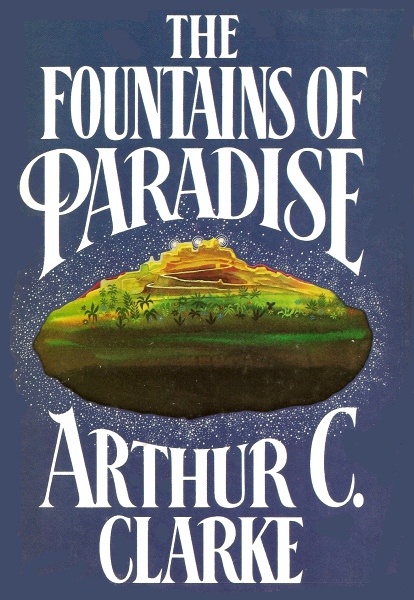
                • Cover of The Fountains of Paradise
                  The Fountains of Paradise

                  Arthur C. Clarke · standalone novel · 1979

                  similar byscience fictionspace station

                  The Fountains of Paradise is a 1979 science fiction novel by British writer Arthur C. Clarke. Set in the 22nd century, it describes the construction of a space elevator. This "orbital tower" is a giant structure rising from the ground and linking with a satellite in geostationary orbit at the height of approximately 36,000 kilometres. Such a structure would be used to raise payloads to orbit without the expense of using rockets. The novel won both the Hugo and Nebula Awards for Best Novel.

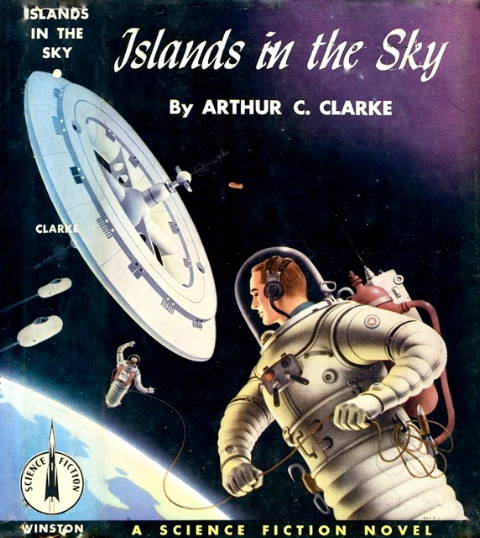
                • Cover of Islands in the Sky
                  Islands in the Sky

                  Arthur C. Clarke · standalone novel · 1952

                  similar byscience fictionspace station

                  Islands in the Sky is a 1952 science fiction novel by British writer Arthur C. Clarke. It is one of his earliest works. Clarke wrote the story as a travelogue of human settlement of cislunar space in the last half of the twenty-first century.

                • Cover of Between Planets
                  Between Planets

                  Robert A. Heinlein · standalone novel · 1951

                  similar byscience fiction+1 more

                  A teenager is pulled from his earthside boarding school when tensions rise between Earth and the Venus and Mars colonies. He is charged to bring an artifact to his scientist parents on Mars, but when hostilities break out, flights are cancelled and he is put down on Venus.

                • Cover of Company Wars
                  Company Wars

                  series · 7 books · 1981

                  part of Alliance-Union Universe

                  similar byscience fiction+1 more

                  Company Wars gathers the novels C. J. Cherryh set during the breakaway conflict between Earth's colonial Company and the newly independent Union, within her wider Alliance-Union future history. Anchored by the Hugo Award-winning Downbelow Station, the books follow different ships, stations, and crews caught on either side, from merchanter traders to military spacers, rather than a single continuing cast. Read in any order, they build up a picture of the political and economic pressure that reshapes Cherryh's larger Alliance-Union universe.

                • Cover of Earth
                  Earth

                  David Brin · standalone novel · 1990

                  similar byscience fiction+1 more

                  Earth is a 1990 science fiction novel by American writer David Brin. The book was nominated for the Hugo and Locus Awards in 1991.

                • Cover of Ender Wiggin
                  Ender Wiggin

                  series · 14 books · 1977

                  part of Ender's Game Universe

                  similar byscience fiction

                  Orson Scott Card's Ender's Game (1985, expanded from his 1977 novella) follows child prodigy Andrew "Ender" Wiggin as he is recruited into a military training program built to prepare Earth's defenses for an anticipated third war against an insectoid alien species known as the Formics. The saga continues years later through Speaker for the Dead and Xenocide, following an older Ender as he confronts the moral weight of his role in that earlier conflict, and concludes the core arc in Children of the Mind, with Ender in Exile filling in the years between the first two books. Set within the wider Ender's Game universe, the series shifts from military coming-of-age story to slower, more philosophical science fiction as it progresses.

                • Cover of Nemesis
                  Nemesis

                  Isaac Asimov · standalone novel · 1989

                  similar byscience fiction+1 more

                  The expanding population and ensuing ecological degradation of Earth leads to the establishment of orbital habitats which continue to compete with each other as well as with Earth, leading one of them to abandon the Solar System entirely, to establish itself around a neighboring star.

                • Cover of Venus Equilateral
                  Venus Equilateral

                  series · 15 books · 1942

                  completed

                  similar byscience fiction+1 more

                  The Venus Equilateral series is a set of 13 science fiction short stories by American writer George O. Smith, concerning the Venus Equilateral Relay Station, an interplanetary communications hub located at the L4 Lagrangian point of the Sun-Venus system. Most of the stories were first published in Astounding Science Fiction between 1942 and 1945.

                • Cover of Colony
                  Colony

                  Ben Bova · standalone novel · 1978

                  similar byscience fictionspace station

                  Colony continues the story Ben Bova began in Millennium, following astronaut-turned-administrator Chet Kinsman years later as the head of an orbiting space habitat that has become Earth's only real refuge from a planet buckling under overpopulation, food shortages and unrest. Getting a place in the habitat is a matter of life and death for millions who will never be chosen, and as Earth's governments grow more desperate to control or dismantle the colony outright, Kinsman has to decide how far he'll go to protect the world he's built off-world. Bova later folded both novels together into the omnibus The Kinsman Saga. Part of Ben Bova's Chet Kinsman series.

                • Cover of To the Stars (Leinster)
                  To the Stars (Leinster)

                  series · 3 books · 1953

                  completed

                  similar byscience fiction+1 more

                  Murray Leinster's Joe Kenmore trilogy follows a master machinist's son through the Cold War-era race to build and defend America's first space station, then a rescue tug, and finally a lunar outpost, in three techno-thriller adventures blending realistic 1950s spaceflight speculation with sabotage plots. Space Platform (1953) introduces Kenmore amid attempts to sabotage the orbital station project; Space Tug and City on the Moon carry the same hardware-focused approach into orbit and onto the Moon.

                • Cover of Seveneves
                  Seveneves

                  Neal Stephenson · standalone novel · 2015

                  similar byscience fiction+1 more

                  Seveneves is a science fiction novel by Neal Stephenson published in 2015. The story tells of the desperate efforts to preserve Homo sapiens in the wake of apocalyptic events on Earth after the unexplained disintegration of the Moon and the remaking of human society as a space-based civilization after a severe genetic bottleneck.

                • Cover of Sector General
                  Sector General

                  series · 36 books · 1957

                  similar byscience fictionspace station

                  Sector General is a series of twelve science fiction novels and various short stories (1957–1999) by the Northern Irish author James White. The series derives its name from the setting of the majority of the books, the Sector 12 General Hospital, a large hospital space station located in deep space, designed to treat a wide variety of life forms with a wide range of ailments and life-support requirements, and to house an equally diverse staff. The Hospital was founded to promote peace after humanity's first interstellar war, and in the fourth book the authorities conclude that its emergency services are the most effective way to make peaceful contact with new species.

                • Cover of Gravity
                  Gravity

                  Tess Gerritsen · standalone novel · 1999

                  similar byscience fictionspace station

                  Medical thriller set aboard the International Space Station where astronauts are dying one by one from a mysterious disease. Dr Emma Watson is a research physician on a mission to study living organisms in space. But the mission aboard the space station turns into a nightmare.

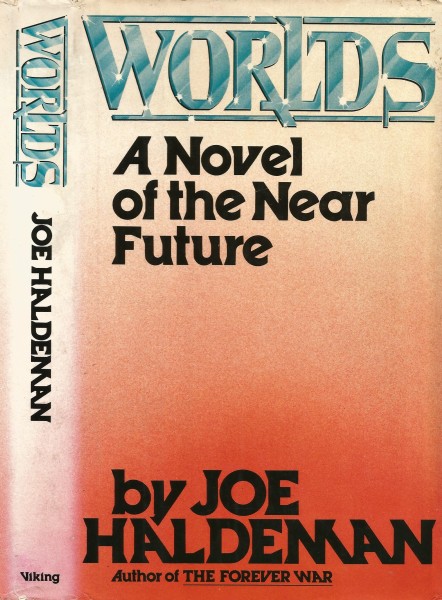
                • Cover of Worlds (Joe Haldeman)
                  Worlds (Joe Haldeman)

                  series · 3 books · 1981

                  similar byscience fiction+1 more

                  Joe Haldeman's trilogy is set among the Worlds, a network of orbital satellite colonies whose half-million residents watch Earth tear itself apart in a devastating war. Beginning with Worlds and continuing through Worlds Apart and Worlds Enough and Time, the series follows New New York's Marianne O'Hara as she's forced to choose between staying to help Earth's survivors and leading her people toward a new home among the stars.

                • Cover of Paratwa Saga
                  Paratwa Saga

                  series · 4 books · 1987

                  similar byscience fiction+1 more

                  Christopher Hinz's Paratwa Saga is set in orbital colonies built above a devastated, abandoned Earth, opening with Liege-Killer as those colonies confront the return of a genetically engineered assassin race, the Paratwa, thought long eliminated. The trilogy (continued in Ash Ock and The Paratwa) plays out as a blend of post-apocalyptic SF and thriller, with the colonies' survival resting on hunting down a threat their ancestors created and thought they'd destroyed. A later fourth book returned to the setting decades after the original trilogy closed.

                • Cover of Aftermath (Charles Sheffield)
                  Aftermath (Charles Sheffield)

                  series · 2 books · 1998

                  completed

                  similar byscience fiction+1 more

                  Charles Sheffield's Aftermath duology opens with a near-future Earth devastated by a nearby supernova's radiation, which knocks out electronics and forces survivors to rebuild without most modern technology. Starfire continues years later as a second, larger stellar threat approaches and humanity must recover enough capability to respond. Sheffield, a physicist by training, grounds both books in hard-science consequences of the disaster rather than treating it as mere backdrop.

                • Cover of An Accidental Goddess
                  An Accidental Goddess

                  Linnea Sinclair · standalone novel · 2002

                  similar byscience fictionspace station

                  From the back cover of the Bantam paperback: "Raheiran Special Forces captain Gillaine Davre has just woken up in some unknown space station, wondering where the last three hundred years have gone. The last thing she remembers is her ship being attacked. Now it seems that while she was time-traveling, she was ordained a goddess... Gillaine's only home of survival rests with dangerously seductive Admiral Mack Makarian, who suspects her of being a smuggler - or worse. But he can't begin to imagine the full extent of it. For Gillaine is now Lady Kiasidira, holy icon of countless believers, including Mack - a man who inspires feelings in her that are far from saintly... feelings she knows are mutual. But when their flirtation is interrupted by a treacherous enemy from the past, Gillaine's secret - and secret desires - could destroy them both..."

                • Cover of Juniper Time
                  Juniper Time

                  Kate Wilhelm · standalone novel · 1979

                  similar byscience fictionspace station

                  From back cover of Pocket Books paperback, June 1980: In a world now ravaged by drought and famine. Jean Brighton and Arthur Cluny grew up in the limelight, children of space pioneers who built the orbiting space laboratory. Now Arthur carried on his father's work at the lab. But Jean fled into isolation, harboring a hatred for the space station and the intrigue that surrounded it. How could she know that in her desert solitude she would hold the key to the future of the space station she so desperately wanted to forget... that for a moment international peace would rest in her hands... or that Arthur would come to wrest from her a secret she would rather not face, a secret that could return the world to... JUNIPER TIME?

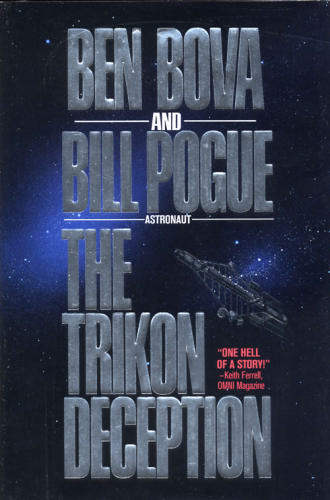
                • Cover of The Trikon Deception
                  The Trikon Deception

                  Ben Bova & Bill Pogue · standalone novel · 1992

                  similar byscience fictionspace station

                  The Trikon is a shared industrial space laboratory that was built in orbit, designed as the only risk-free environment for genetic experiments too controversial or dangerous to be performed on Earth.

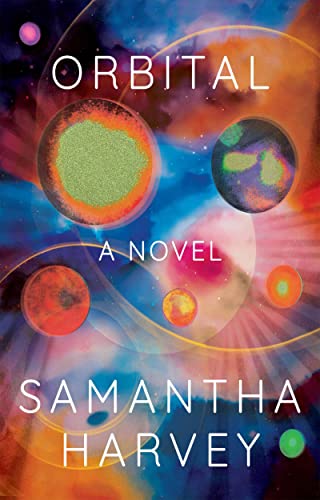
                • Cover of Orbital
                  Orbital

                  Samantha Harvey · standalone novel · 2023

                  similar byscience fictionspace station

                  Orbital is a 2023 novel by English novelist Samantha Harvey that incorporates elements of science fiction, literary fiction, and philosophical fiction, published by Jonathan Cape in the UK and by Grove Atlantic in the US. It follows six fictional astronauts over 24 hours on an orbiting space station.

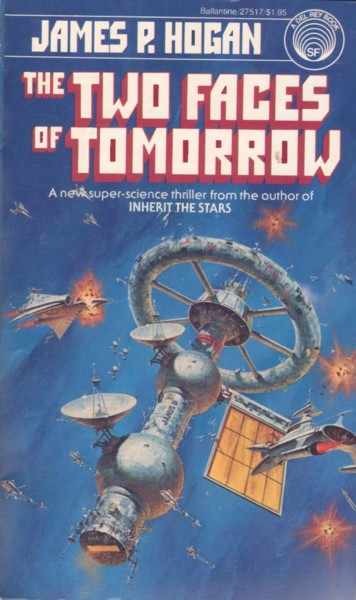
                • Cover of The Two Faces of Tomorrow
                  The Two Faces of Tomorrow

                  James P. Hogan · standalone novel · 1979

                  similar byscience fictionspace station

                  From the back cover: SURVIVAL TEST Civilization had grown so complex that only a world-wide computer network could control everything. But the computer was only logical -- it lacked common sense. And its all-too-logical decisions were beginning to cause too many near fatal accidents. The solution was on the drawing boards -- a universal self-aware and self-programming computer, equipped with judgment. But... could it be controlled? Or would it attempt to take over, disregarding its creators? If so, could it be turned off? Raymond Dyer and his team of computer specialists knew they had to find answers to these questions, but the project was to dangerous to test on Earth. So they installed the super computer on an orbiting satellite and programmed it to survive at all costs. Then they sent a group of men to attack the computer... to goad it into trying to kill them. They they would turn it off. Obviously if things went wrong, they might lose a few men -- but the satellite and the computer could always be destroyed. Obviously... But the computer didn't quite see it that way!

                • Cover of Dream Thief
                  Dream Thief

                  Stephen R. Lawhead · standalone novel · 1983

                  similar byscience fictionspace station

                  Dr. Spencer Reston, a scientist doing dream research aboard the space station, Gotham, begins having unexplained blackouts and concludes that someone is deliberately tampering with his mind.

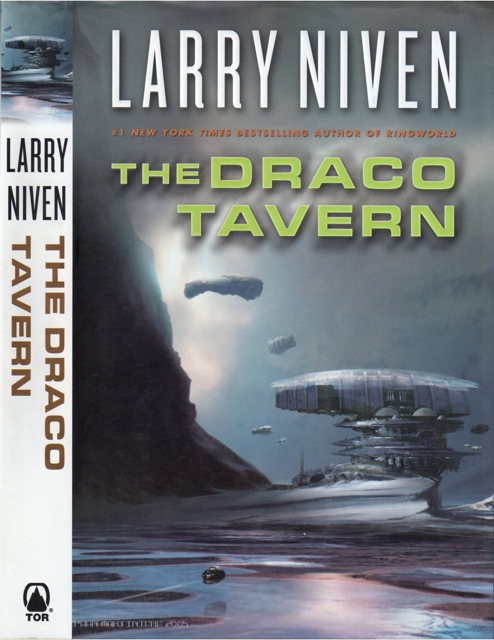
                • Cover of Draco Tavern
                  Draco Tavern

                  series · 32 books · 1977

                  similar byscience fiction+1 more

                  The Draco Tavern collects Larry Niven's linked short stories set in and around a bar on Earth that serves as neutral ground for encounters between humans and the dozens of alien species passing through, mostly narrated by the tavern's long-running human owner. Each story is a self-contained conversation or incident rather than part of a continuous plot, used by Niven to explore a new alien culture or idea. The collection was assembled in 2006 from stories written across three decades.
                • E
                  EarthCent

                  series · 24 books · 2014

                  similar byscience fictionspace station