More like SQ
anchored on:science fiction
but
- A Clockwork Orange
series4 books1962
completed
similar byscience fictionnear futurefirst person+1 more
Anthony Burgess's 1962 novel is narrated by Alex, a teenage gang leader in a near-future Britain gripped by a youth subculture of extreme violence, recounting his crimes in Nadsat, an invented slang blending English with Russian-derived words. After his crimes catch up with him, Alex is made the subject of a controversial state program meant to forcibly reform his behavior, and the novel uses his ordeal to question whether imposed goodness is worth the loss of free will. It is a standalone novel.
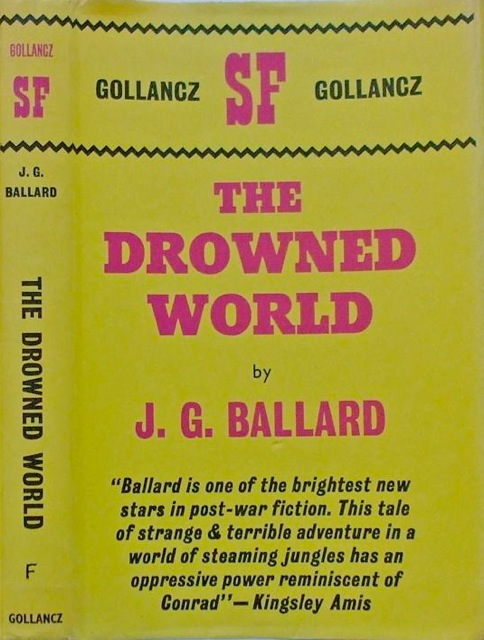
- The Drowned World
J. G. Ballardstandalone novel1962
similar bymadnessscience fictionnear future
The Drowned World is a 1962 science fiction novel by J. G. Ballard. It first appeared in shortened form in the January 1962 issue of the UK edition of Science Fiction Adventures and was published in book form later that year by Victor Gollancz Ltd in London; an American edition followed from Berkley Medallion. Critics have grouped The Drowned World with Ballard's early science-fiction novels as part of an "ambiguous apocalypse" sequence that also includes The Drought and The Crystal World, from the period in which he was developing the ideas he described as "inner space". Set in a future in which solar radiation has melted the polar ice caps and transformed London into a flooded tropical lagoon, the novel follows biologist Robert Kerans as he becomes increasingly drawn toward the altered environment rather than toward restoring the old social order.
- Library of America P. K. Dick Collection
series9 books1962
completed
similar byscience fictionnear future+1 more
- The Lathe of Heaven
Ursula K. Le Guinstandalone novel1971
similar byscience fictionnear future+1 more
The Lathe of Heaven is a 1971 science fiction novel by American writer Ursula K. Le Guin, first serialized in the American science fiction magazine Amazing Stories. It won the 1972 Locus Award for Best Novel and was a finalist for the 1971 Nebula Award for Best Novel and 1972 Hugo Award for Best Novel. Two television film adaptations were released: the PBS production, The Lathe of Heaven (1980), and Lathe of Heaven (2002), a remake produced by the A&E Network.
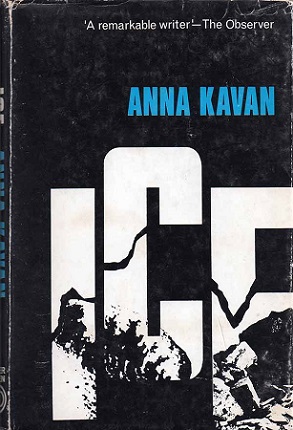
- Ice
Anna Kavanstandalone novel1967
similar bymadnessscience fiction+1 more
Ice is a novel by British writer Anna Kavan, published in 1967. Ice was Kavan's last work to be published before her death, the first to land her mainstream success, and remains her best-known work. Generally regarded as genre-defying, it has been labelled a work of science fiction, Nouveau roman, and slipstream fiction.
- High-Rise
J. G. Ballardstandalone novel1975
similar bymadnessscience fictionnear future
High-Rise is a 1975 novel by British writer J. G. Ballard. The story describes the disintegration of a luxury high-rise building as its affluent residents gradually descend into violent chaos. As with Ballard's previous novels Crash (1973) and Concrete Island (1974), High-Rise inquires into the ways in which modern social and technological landscapes could alter the human psyche in provocative and hitherto unexplored ways. It was adapted into a film of the same name, in 2015, by director Ben Wheatley.
- The Invisible Man
series6 books1897
similar byscience fiction+1 more
The Invisible Man is H. G. Wells's 1897 science fiction novel about Griffin, a scientist who works out how to make living tissue invisible and tests the process on himself, only to discover he has no way to reverse it. Unseen and increasingly cut off from other people, he turns to theft and violence while trying to survive and find a cure, making the book as much about his moral collapse as about the invisibility premise itself. It's a single self-contained novel; the two listed titles here are duplicate editions rather than separate books.
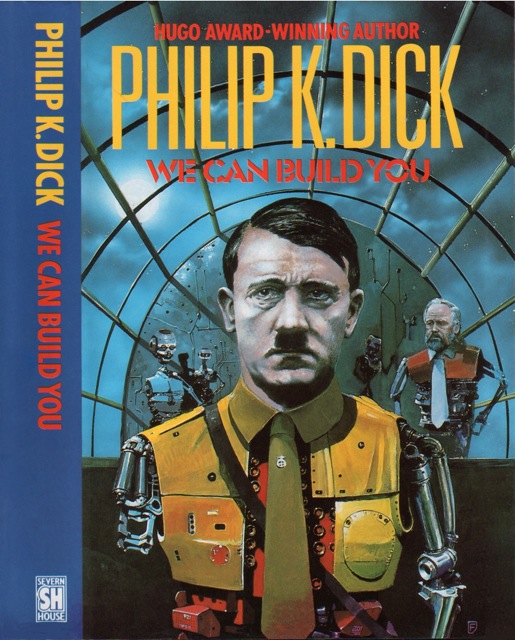
- We Can Build You
Philip K. Dickstandalone novel1972
similar byscience fictionnear future+1 more
We Can Build You is a 1972 science fiction novel by American writer Philip K. Dick. Written in 1962 as The First in Our Family, it remained unpublished until appearing in serial form as A. Lincoln, Simulacrum in the November 1969 and January 1970 issues of Amazing Stories magazine, re-titled by editor Ted White. The novel was issued as a mass market paperback original by DAW Books in 1972, its final title provided by publisher Donald A. Wollheim. Its first hardcover edition was published in Italy in 1976, and Vintage issued a trade paperback in 1994.
- Under Pressure
Frank Herbertstandalone novel1956
similar bymadnessscience fictionnear future
From back cover Del Rey paperback September 1978: FOUR MEN Were on board the atomic subtug Fenian Ram S1881. They were on a mission to steal vitally needed oil from underwater deposits in enemy territory -- a mission from which none of the last twenty tugs had returned... FOUR MEN Fighting a war a mile and half under the ocean, isolated by the unrelenting pressure of the water and by their own hellish fears... FOUR MEN Who knew everything they had to know about one another -- except which one of them was the saboteur who could destroy them all!
- Beyond Apollo
Barry N. Malzbergstandalone novel1972
similar bymadnessscience fictionnear future
Beyond Apollo is a science fiction novel by American writer Barry N. Malzberg, first published in 1972 in a hardcover edition by Random House. Malzberg credits the inspiration for the novel to "I Have My Vigil", a 1969 short story by fellow science fiction writer Harry Harrison.
- Dream Thief
Stephen R. Lawheadstandalone novel1983
similar bymadnessscience fictionnear future
Dr. Spencer Reston, a scientist doing dream research aboard the space station, Gotham, begins having unexplained blackouts and concludes that someone is deliberately tampering with his mind.
- VALIS
series4 books1981
completed
similar byscience fiction+1 more
The VALIS trilogy is a set of science fiction/philosophical novels by author Philip K. Dick which include VALIS (1981), The Divine Invasion (1981), and The Transmigration of Timothy Archer (1982). Dick's first novel about the VALIS concept originally titled "VALISystem A", was published as Radio Free Albemuth after Dick's death in 1985.
- The Sheep Look Up
John Brunnerstandalone novel1972
similar byscience fictionnear future+1 more
The Sheep Look Up is a 1972 dystopian science fiction novel by British author John Brunner, dealing with the deterioration of the environment in the United States. It was nominated for the 1972 Nebula Award for Best Novel.
- The Thanatos Syndrome
Walker Percystandalone novel1987
similar bymadnessscience fictionnear future
The Thanatos Syndrome (1987) was Walker Percy's last novel. It is a sequel to Love in the Ruins. Set in the near future in Feliciana, it tells the story of an imprisoned psychiatrist who is freed and returns to his town with the active members demonstrating new mysterious behaviors. He suspects that something or someone is making everyone in his town crazy and reversing them to be like primitive apes.
- Southern Reach Trilogy
series4 books2014
similar bymadnessscience fiction+1 more
The Southern Reach Series is a series of novels by the American author Jeff VanderMeer first published in 2014—Annihilation, Authority, Acceptance, and Absolution. The series takes its name from the secret agency that is central to the plot. In 2013, Paramount Pictures bought the movie rights for the series, and a film adaptation of Annihilation was made with Alex Garland as writer-director. The film was released in 2018. The most recent book in the series, Absolution, was released on 22 October 2024.
- MirrorWorld
Jeremy Robinsonstandalone novel2015
similar bymadnessscience fictionnear future
"Crazy has no memory and feels no fear. Dangerous and unpredictable, he's locked away in SafeHaven, a psychiatric hospital, where he spends the long days watching Wheel of Fortune and wondering what the outside world smells like. When a mysterious visitor arives and offers him a way out Crazy doesn't hesitate to accept. But outside the hospital Crazy is faced with a world on the brink of nuclear annihilation, and find himself relocated to Neuro Inc., a secretive corporation with strange government ties. When he discovers evidence of human experimentation he escapes with a syringe, the contents of which are unknown to him but precious to Neuro. Cornered and with a complete disregard for the results, Crazy makes himself indispensable by injecting the substance into his leg. As the substance enters his bloodstream, though, his eyes are opened to a world beyond human experience, where fear is a tool and the shadows hide the source of mankind's nightmares. Struggling to understand his new abilities, Crazy allies himself with the company he fled and begins peeling back the layers of his past, the brewing war between worlds, how he can stop it and what he did to start it. With Crazy, Robinson, whose trademarked pacing and inventive plots have been highly praised by bestselling authors like Jonathan Maberry, Scott Sigler and James Rollins, treats readers to a wildly imaginative, frenetically paced thriller exploring the origins of fear"--
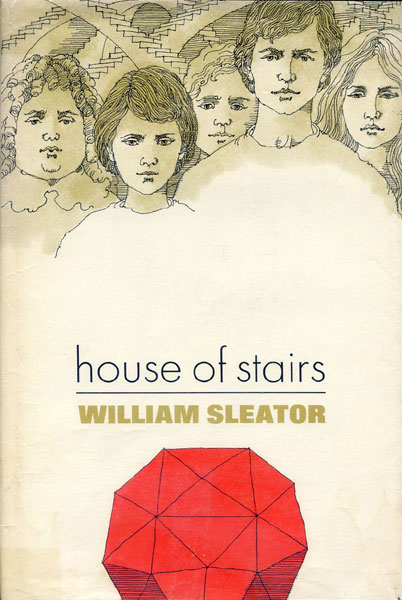
- House of Stairs
William Sleatorstandalone novel1974
similar byscience fictionnear future+1 more
Publisher's description: "Five fifteen-year-old orphans of widely varying personality characteristics are involuntarily placed in a house of endless stairs as subjects for a psychological experiment on conditioned human response."
- Love in the Ruins
Walker Percystandalone novel1971
similar bymadnessscience fictionnear future
Love in the Ruins is a novel of speculative or science fiction by author Walker Percy from 1971. It follows its main character, Dr Thomas More, namesake and descendant of Sir Thomas More, a psychiatrist in a small town in Louisiana called Paradise.
- Time Out of Joint
Philip K. Dickstandalone novel1959
similar bymadnessscience fiction
Time Out of Joint is a science fiction novel by American writer Philip K. Dick, first published in novel form in the United States in 1959. An abridged version was also serialised in the British science fiction magazine New Worlds Science Fiction in several installments from December 1959 to February 1960.
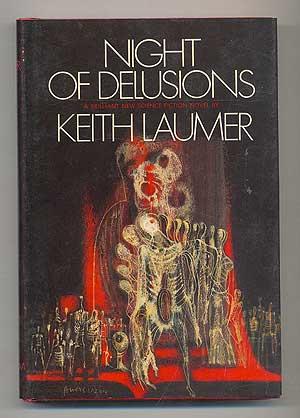
- Night of Delusions
Keith Laumerstandalone novel1972
similar bymadnessscience fictionnear future
A soldier of fortune named Florin, whose earlier adventures have left his mental faculties in a precarious state, is hired to bodyguard one Lance Bardell, a Senator whose own mental state is utter chaos. In exploring Bardell's delusions, Florin must enter the Dream Machine - which assaults not merely the senses but reality itself. Plunging into and out of hair-raising adventures, combating an extra-galactic threat to Earth's existence, as well as defending his own sanity, Florin comes to astonishing discoveries about the universe he lives in and defends - and about himself! (adapted from the text published with the first edition)
- The Falling Astronauts
Barry N. Malzbergstandalone novel1971
similar bymadnessscience fictionnear future
The Falling Astronauts is a science fiction novel by American writer Barry N. Malzberg, first published in 1971 in a paperback edition by Ace Books.
- The R-Master
Gordon R. Dicksonstandalone novel1973
similar bymadnessscience fictionnear future
The World Economic Council said the world had become Utopia. There should be no cause for dissatisfaction. But for those who were still restless, there was the new mind-stimulating drug R-47. Those who took R-47 were engaging in a sort of lottery whose rare winners would be super-geniuses and whose losers might be fit only for asylums. Etter Ho, whose brother was one of the losers, took the drug on the chance that, if he won, he could cure his brother. But what he became when he emerged from the mainlining was something none expected. For he became a menace to Utopian order, a danger to those who knew him, and the only man who might, just possibly, diagnose the real illnesses of the world. (from the back cover of the DAW Books first printing)
- Dhalgren
Samuel R. Delanystandalone novel1975
similar bymadnessscience fiction
Dhalgren is a 1975 science fiction novel by American writer Samuel R. Delany. It features an extended trip to and through Bellona, a fictional city in the American Midwest cut off from the rest of the world by an unknown catastrophe. It is number 33 on the 20th Century's Greatest Hits: 100 English-Language Books of Fiction list.