More like Stasis
but
- Stephen King multiverse
universe46 books1967
Start hereThe Gunslinger · Start here
similar by+2 more
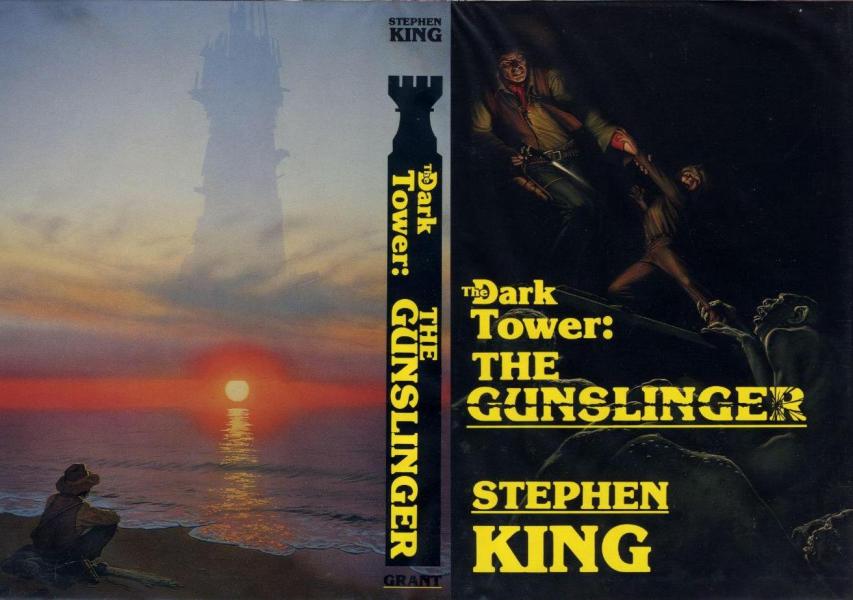
The man in black fled across the desert, and the gunslinger followed. So begins the long walk of Roland Deschain, last of an order of knight-errant pistoleers, across a land that has "moved on" — where the compass points drift, dead machines rot toward sentience, and the weave of what's real wears thin. His quest is the Dark Tower itself: a spire standing at the hub of every world that exists, the linchpin that holds all of them back from ruin. Roland's road runs eight volumes, from The Gunslinger through the closing Dark Tower, with the later, interleaved tale The Wind Through the Keyhole folding a story-within-a-story back into his youth. Along the way he draws a ka-tet — a fellowship bound by fate, not choosing — through doorways between worlds: a heroin-shackled New Yorker, a woman of two minds, a boy who dies twice. The Tower is also the secret axle around which the wider shelf of King's work turns; threads from The Stand, 'Salem's Lot and beyond wind quietly toward it. Expect a mongrel of Western, high fantasy, horror and decayed science fiction, told in a dusty, incantatory dialect all its own — ka, thankee-sai, the world that has moved on. This is King at his most mythic and most personal, a decades-spanning circle that rewards a patient reader. Begin at the beginning: The Gunslinger, then walk forward in publication order. There are other worlds than these — but this door opens first.
- Alliance-Union Universe
universe173 books1976
Start hereCompany Wars · The central sequence
similar byscience fiction+1 more
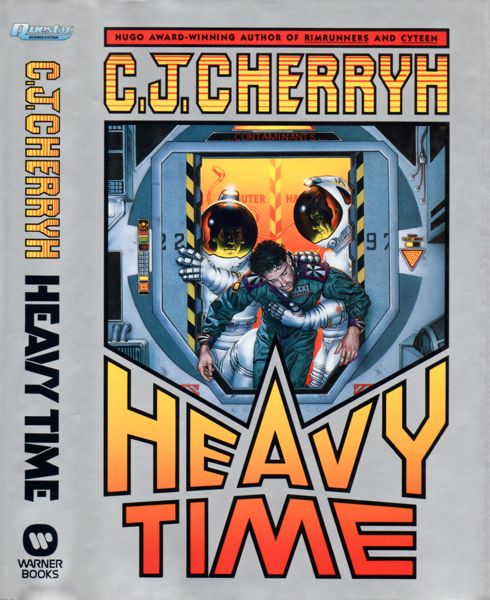
The dark between the stars belongs to no one, and everyone who lives out here knows it: the merchanter Families hauling cargo between stations that cannot feed themselves, the Earth Company clutching at colonies it can no longer supply, the Union breeding its cloned azi to settle worlds faster than birth allows. C. J. Cherryh's Alliance-Union is a future history of humankind's spread across the third and fourth millennia, told from inside the pressure — no clean empires, only stations, ships, treaties, and the people caught in the machinery of who holds the jump-points. The sequence runs from the first laborious pre-FTL stations through the Company Wars, the independence struggle that breaks over Pell in Downbelow Station (Hugo, 1981), to the genetics and cold politics of Union's homeworld in Cyteen (Hugo, 1988) and its sequel Regenesis. Around that spine cluster the merchanter novels of trader Families, the Faded Sun trilogy of human envoys among the martial alien Mri, and the Chanur books, narrated from the hierarchical, whiskered viewpoint of the hani. On the isolated world of Merovin, the Merovingen Nights anthologies open the setting to other hands — Mercedes Lackey, Janet and Chris Morris, Nancy Asire — a shared world braided into the whole. What sets it apart is intimacy at scale. Cherryh drops you without a map into a single skull and lets you assemble the politics from what that person fears and bargains for; the aliens are genuinely alien, loyalty is always provisional, and the real antagonist is usually logistics. Most books stand alone, in her words, "like real history." The surest way in is Downbelow Station — the war seen from one besieged station — then Cyteen, for the mind that shaped the other side.
- Legends of Saint Camber
series3 books1976
part of Deryni
similar bytensesecondary world
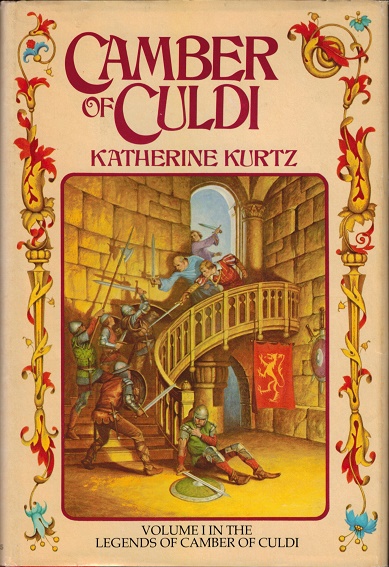
Legends of Saint Camber tells the story of Camber MacRorie, a Deryni lord who helps restore a persecuted human dynasty to the throne of Gwynedd and is venerated as a saint after his death, at a cost the trilogy gradually reveals. Camber of Culdi, Saint Camber, and Camber the Heretic were published as the fourth Deryni novel onward but are set two centuries before Katherine Kurtz's original Chronicles of the Deryni trilogy. They lay the groundwork - persecution of Deryni magic-users - that shapes the political and religious world of everything published earlier in reading order.
- The Change / The Event
series41 books1998
similar byscience fiction+1 more
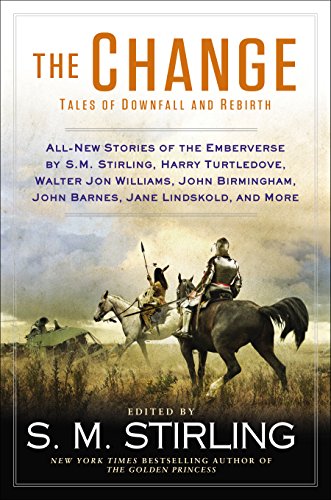
The Change: Tales of Downfall and Rebirth is a shared-world anthology of stories set in the years right after a mysterious global event instantly disables gunpowder, electricity, and combustion engines, the founding premise of S. M. Stirling's Emberverse. Sixteen different authors, coordinated by Stirling, each contribute stories set in various corners of the suddenly de-industrialized world as survivors scramble to rebuild. It's a companion volume to the Change/Emberverse novels rather than a novel itself.
- Red Queen
series14 books2015
similar bytensesecondary world
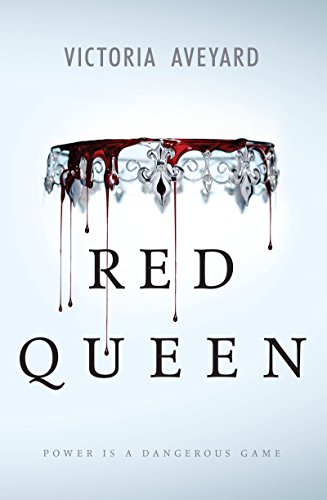
Red Queen is set in a world split between Reds, an oppressed servant class, and Silvers, a ruling class with superhuman abilities, where a Red girl discovers she has Silver-like powers of her own and is forced into the royal court to hide what she is. Victoria Aveyard's debut novel opens a four-book main sequence - Red Queen, Glass Sword, King's Cage, War Storm - plus the interstitial novella Cruel Crown and the epilogue novella Broken Throne. It's YA dystopian fantasy built around a class-based magic system and a slow-burn political rebellion.
- The Lost Regiment
series9 books1990
similar byscience fictiontensesecondary world
William R. Forstchen's Lost Regiment series begins with Rally Cry, in which a Civil War Union regiment is swept onto a distant world where humans transplanted from many eras and cultures are farmed as food by an alien race. Arriving with nineteenth-century gunpowder weapons and organized tactics, the regiment's survivors fight to build a defensible nation and turn the war back on their captors, a conflict that escalates across nine novels of technology, politics, and generations.
- The Cinder Spires
series3 books2015
similar bysecondary world+2 more
Jim Butcher's Cinder Spires series opens with The Aeronaut's Windlass (2015), a steampunk fantasy set among tower-dwelling city-states where airships duel with etheric weapons and intelligent cats share the world with humans. Continuing with Warriorborn and The Olympian Affair, it marks a departure in setting from Butcher's contemporary-fantasy Dresden Files while keeping his fast-paced adventure style.
- Transit
Edmund Cooperstandalone novel1964
similar byscience fictiontensesecondary world
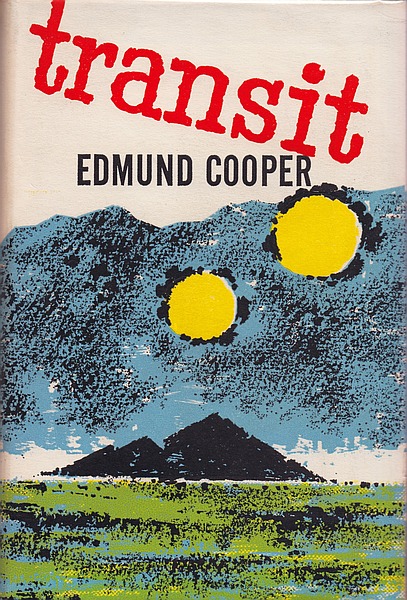
Transit... to another world. As a human being - an Earthman - Richard Avery was not particularly successful. He was mediocre as a teacher, and a failure as an artist. The rewards of Earth had passed him by. Still... Earth was home. It was where he belonged, where he could at least go his way unnoticed. Until that afternoon in Kensington Gardens, and that gleaming, hypnotic crystal that transported him - instantaneously - to a new and alien world. He was not alone, at least. There were three other Earth people marooned with him, all without a hint of the location or reason. And four more oddly assorted individuals would have been hard to imagine... Together, they faced sudden, savage onslaughts from an unknown foe. Together, they faced a fantastic implacable environment. And alone, they faced themselves - for to win, or even to survive, they had to re-discover what it meant to be human... (from the back cover of the Lancer first American edition)
- The Histories of King Kelson
series4 books1984
part of Deryni
similar bytensesecondary world
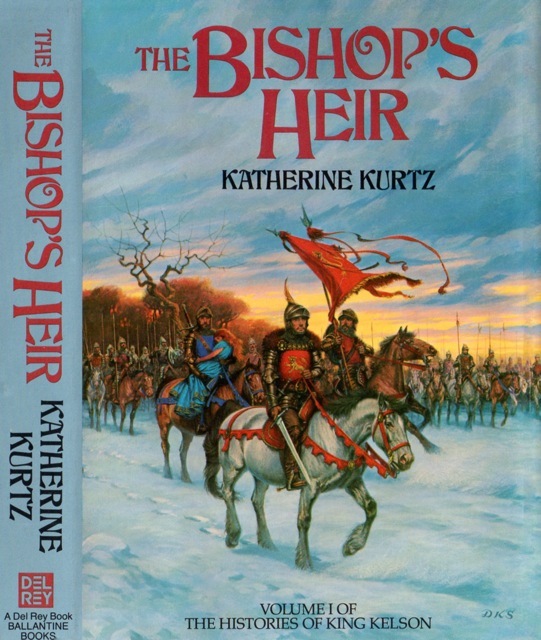
Katherine Kurtz's Histories of King Kelson, part of her Deryni universe, follows King Kelson of Gwynedd's reign as he balances a kingdom uneasily shared between ordinary humans and the magically gifted Deryni against continuing prejudice and political threats from within and beyond his borders. The four novels, opening with The Bishop's Heir, continue the Deryni chronicles a generation on from Kurtz's earlier trilogies.
- His Dark Materials Universe
universe13 books1995
Start hereHis Dark Materials · Start here
similar by+1 more
In a world like ours and unlike it, every human soul walks outside the body in the shape of an animal — a daemon, who speaks, who cannot be lied to, and who settles into one fixed form only when childhood ends. This is the country of His Dark Materials: a company of parallel worlds across which an invisible dust of consciousness drifts down upon the waking mind; where a Church that calls itself the Magisterium would sooner sever a child's soul than let that Dust be understood; and where a golden instrument, the alethiometer, answers true questions for anyone with the patience to read it. Philip Pullman's design stands in two trilogies and a scatter of shorter tales. His Dark Materials — Northern Lights (published in America as The Golden Compass), The Subtle Knife, and The Amber Spyglass — carries Lyra Belacqua from the rooftops of a shadow Oxford across the borders between worlds. The Book of Dust returns to that same territory: La Belle Sauvage looks back to Lyra as an infant carried through a great flood, while The Secret Commonwealth follows her grown and less certain into adulthood, with a concluding volume closing the arc. Around them sit slim companion books — Lyra's Oxford, Once Upon a Time in the North, Serpentine — and Nicholas Wright's stage adaptation, made with Pullman's blessing. The register is grave and luminous at once, its title lifted from Milton and its quarrel drawn from Blake: a story that takes the side of curiosity, love, and the physical world against any authority that would forbid them. It reads as adventure — armoured bears, aeronauts, knife-cut windows between skies — yet reasons like philosophy. Begin with Northern Lights / The Golden Compass and read the first trilogy through before turning to The Book of Dust, which deepens everything the first has already made you feel.
- Dune
series20 books1963
part of Dune Universe
similar byscience fiction+1 more
Frank Herbert's Dune Chronicles opens with 1965's Dune, set on the desert planet Arrakis where House Atreides takes control of the only source of the vital spice melange and young Paul Atreides is pulled into a struggle over its politics and religion. Herbert carried the story forward across five further novels — Dune Messiah, Children of Dune, God Emperor of Dune, Heretics of Dune, and Chapterhouse: Dune — following Paul's line over the following millennia, before Brian Herbert and Kevin J. Anderson later extended the saga. Many other editions of these six novels are omnibus and box-set repackagings rather than separate stories.
- Seeker
series3 books2015
similar byscience fictiontense+1 more
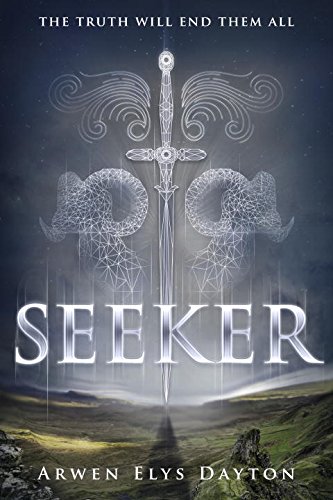
Quin Kincaid has spent her life training to take her Oath and join the Seekers, an ancient order sworn to protect the weak — but the night of her initiation reveals that her family, her order, and the boy she loves are not what she believed. Arwen Elys Dayton's trilogy (Seeker, Traveler, Disruptor) follows Quin and her companions as the order's true, morally compromised history comes into focus.
- The Chrysalids
John Wyndhamstandalone novel1955
similar byscience fictiontensesecondary world
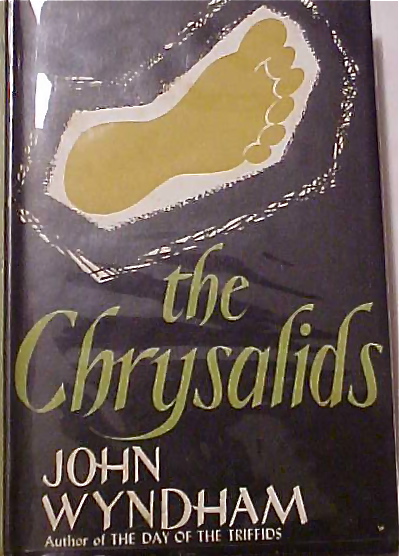
The Chrysalids is a science fiction novel by British writer John Wyndham, first published in 1955 by Michael Joseph. It is the least typical of Wyndham's major novels, but regarded by some as his best. An early manuscript version was entitled Time for a Change.
- The Courier's Daughter Trilogy
series3 books2012
similar byscience fictiontensesecondary world
The Courier's Daughter Trilogy is C. J. Redwine's YA fantasy series: Defiance (2012), Deception and Deliverance. Set in a walled, post-collapse city ruled by rigid survival laws, it follows a young woman searching for her missing father against the city's authorities and the monstrous forces beyond its walls. The trilogy follows one continuous search and its fallout across all three books.
- His Dark Materials
series8 books1995
part of His Dark Materials Universe
similar by+2 more
His Dark Materials is a trilogy of fantasy novels by Philip Pullman consisting of Northern Lights, The Subtle Knife (1997), and The Amber Spyglass (2000). It follows the coming of age of two children, Lyra Belacqua and Will Parry, as they wander through a series of parallel universes. The novels have won a number of awards, including the Carnegie Medal in 1995 for Northern Lights and the 2001 Whitbread Book of the Year for The Amber Spyglass. In 2003, the trilogy was ranked third on the BBC's The Big Read poll.
- Metropolitan
series2 books1995
similar bytense+2 more
Metropolitan is set on a world entirely covered by one interconnected city and enclosed by a Shield that provides light and heat while burning away anything that rises too high, leaving a planet with no day, night, or seasons. It follows Aiah, a refugee working for the Plasm Authority, who discovers a powerful reserve of the city's magical power source and shares it with Constantine, an exiled political operator with revolutionary ambitions for a new order. Walter Jon Williams continued the story in a direct sequel, City on Fire, two years later.
- Kairos
series11 books1962
completed
similar byscience fiction
The Time Quintet is a science fantasy series of five young adult novels written by American author Madeleine L'Engle and made up of A Wrinkle in Time (1962), A Wind in the Door (1973), A Swiftly Tilting Planet (1978), Many Waters (1986), and An Acceptable Time (1989).
- Iron Widow
series2 books2021
similar bysecondary world+2 more
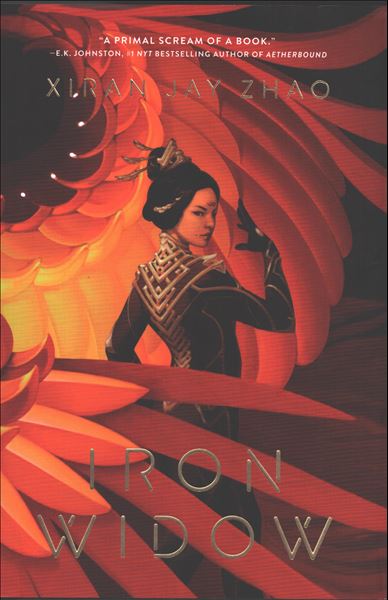
Xiran Jay Zhao's Iron Widow reimagines the rise of Chinese Empress Wu Zetian as a mecha-piloting heroine in Huaxia, a futuristic reinvention of Medieval China. Heavenly Tyrant continues the story as the second book in this young-adult science-fantasy duology.
- Incarceron
series2 books2007
similar by+3 more
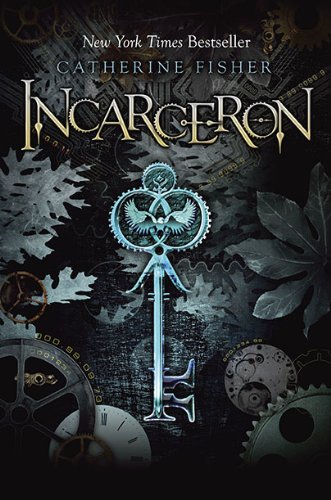
Incarceron follows two teenagers on opposite sides of an impossible prison: Finn, trapped inside the vast penal structure of Incarceron with no memory of how he got there, and Claudia, the warden's daughter living in a rigidly controlled world outside who comes to suspect Incarceron is more than a building. Catherine Fisher's 2007 novel blends fantasy and science fiction as the two search for a way to breach the boundary between them. The 2008 sequel, Sapphique, continues both characters' stories.
- The Bone World Trilogy
series3 books2007
similar byscience fictionsecondary world+1 more
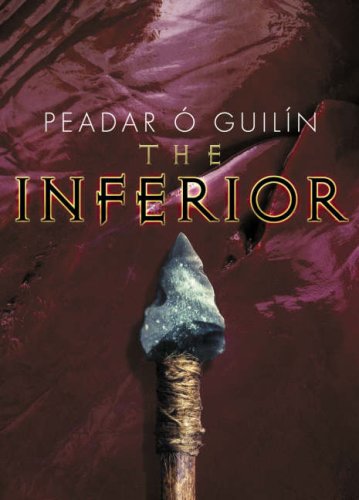
The Bone World Trilogy is a trilogy for young adults by Irish author Peadar Ó Guilín. The series has elements of science fiction and fantasy.
- The Broken Earth
series5 books2014
similar bysecondary world+2 more
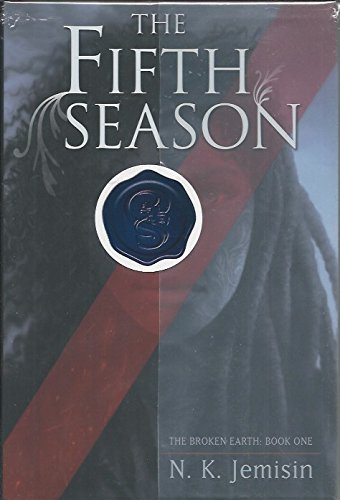
N. K. Jemisin's Broken Earth trilogy is set on the Stillness, a single supercontinent wracked every few centuries by civilization-ending climate catastrophes called Fifth Seasons. It follows orogenes, people born with the power to move earth and quell earthquakes, who are trained and controlled by the state even as they are feared and despised. The Fifth Season, the opening volume, traces three women revealed to be the same person at different stages of her life, setting up the two sequels that follow her search for her daughter after an orogene shatters the continent.