More like The Cassandra Complex
anchored on:science fictiongenetic engineeringour worldnear futurethriller & suspensepolitical intrigue+1 more
but
- The Eyes of Heisenberg
Frank Herbertstandalone novel1966
similar bytenseour worldgenetic engineeringscience fictionthriller & suspenseimmortality
Tens of thousands of years in the future, Earth is ruled by the Optimen, a genetically engineered aristocracy that has made itself functionally immortal, while ordinary people, the Folk, live under strict reproductive control. When Harvey and Lizbeth Durant arrive to have their embryo genetically screened, the examining doctor finds something in the child no one has seen in a very long time: real potential for both fertility and life span, traits the Optimen have arrogated to themselves. Rather than destroy the embryo as policy demands, the doctor hesitates, setting off a chain of surveillance, suspicion and resistance. A tightly wound Frank Herbert thriller about genetic caste and rebellion.
- Friday
Robert A. Heinleinstandalone novel1982
similar bytensenear futuregenetic engineeringscience fiction+1 more
Friday is a 1982 science fiction novel by American writer Robert A. Heinlein. It is the story of a female "artificial person", the eponymous Friday, genetically engineered to be stronger, faster, smarter, and generally better than normal humans. Artificial humans are widely resented, and much of the story deals with Friday's struggle both against prejudice and to conceal her enhanced attributes from other humans. The story is set in a Balkanized 21st century, in which the nations of the North American continent have been split up into a number of smaller states.
- Wired (Douglas E. Richards)
series2 books2012
similar bytensenear futuregenetic engineeringscience fictionour world+1 more
Wired opens Douglas E. Richards's two-book techno-thriller about genetic engineer Kira Miller, whose discovery of a way to unlock temporary savant-level intelligence turns her into both a scientific breakthrough and a fugitive, and David Desh, the former special-forces operative sent to track her down. The story escalates from a bioterror investigation into a fight over the future of engineered human cognition, continuing directly into the 2012 sequel Amped. Richards, primarily a science-fiction and thriller writer, built both books into New York Times and USA Today bestsellers rather than a longer franchise.
- Darwin
series2 books1999
completed
similar bytensenear futuregenetic engineeringscience fiction+1 more
Greg Bear's Darwin's Radio imagines a dormant retrovirus in human DNA activating worldwide, triggering an accelerated leap in human evolution that governments respond to as a plague. The 1999 novel won the Nebula Award; its sequel Darwin's Children follows the first generation of changed children as society decides what to do with them. Together they're speculative near-future science fiction grounded in genetics rather than space opera.
- The Children of Men
P. D. Jamesstandalone novel1992
similar bytenseour worldnear futurescience fictionpolitical intrigue
"The human race has become infertile, and under the despotic rule of Xan Lyppiatt, the Warden of England the old are despairing and the young cruel. Theo Faren, a cousin of the Warden, lives a solitary life in this ominous atmosphere. That is, until a chance encounter with a young woman leads him into contact with a group of dissenters. Suddenly his life is changed irrevocably, as he faces agonising choices which could affect the future of mankind." (pdjames.co.uk)
- The Oracle Year
Charles Soulestandalone novel2018
similar bytenseour worldnear futurescience fictionpolitical intriguethriller & suspense
Awakening from a dream with more than one hundred predictions about the future in his head, an unassuming Manhattan bassist becomes one of the world's most powerful men and hides his identity behind an online persona that is targeted by greedy corporations and dangerous enemies.
- Islands in the Net
Bruce Sterlingstandalone novel1988
similar bytenseour worldnear futurescience fictionpolitical intrigue
Islands in the Net is a 1988 science fiction novel by American writer Bruce Sterling. It won the John W. Campbell Memorial Award for Best Science Fiction Novel in 1989, and was nominated for both the Hugo and Locus Awards that same year. It offers a view of an early 21st century world, apparently peaceful, with delocalised, networking corporations. The protagonist, swept up in events beyond her control, finds herself in places that are off the net, from a datahaven in Grenada, to a Singapore under terrorist attack, to the poorest and most disaster-struck parts of Africa.
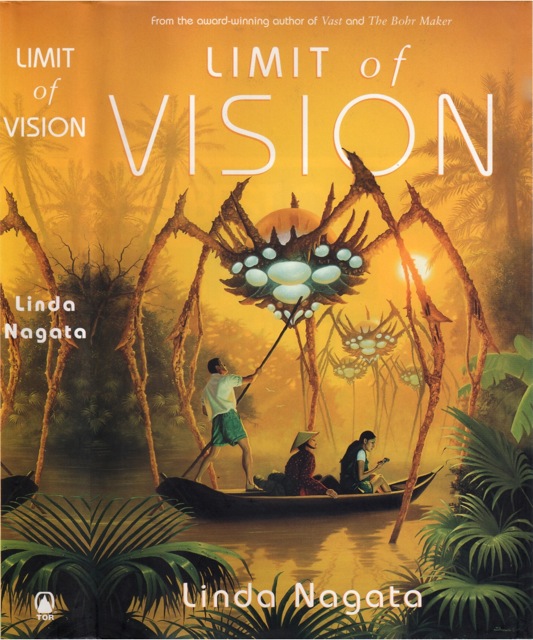
- Limit of Vision
Linda Nagatastandalone novel2001
similar bytenseour worldnear futuregenetic engineeringscience fictionpolitical intrigue
Limit of Vision is a 2001 science fiction book by American writer Linda Nagata. Like many of Nagata's novels, it contains themes of nanotechnology and genetic engineering, as well as government and corporate corruption, in this case as suppressors of positive and liberating transhumanizing technology.
- Termination Shock
Neal Stephensonstandalone novel2021
similar bytenseour worldnear futurescience fictionpolitical intrigue
Termination Shock is a science fiction novel by American writer Neal Stephenson, published in 2021. The book is set in a near-future when climate change has significantly altered human society and follows the attempts of a solar geoengineering scheme. The novel focuses on the geopolitical and social consequences of the rogue fix for climate change, themes common in the growing climate fiction genre.
- Nexus 5
series3 books2012
similar bytenseour worldnear futurescience fiction+3 more
Nexus opens Ramez Naam's postcyberpunk trilogy in 2040 with scientist Kaden Lane, who works on Nexus, an experimental nano-drug that lets human minds be networked and reprogrammed, and finds himself caught between government and corporate interests once the technology's implications become clear. The trilogy continues through Crux and Apex, following the same central conflict over who controls the technology. Nexus tied for Best Novel at the 2014 Prometheus Awards and Apex won the 2015 Philip K. Dick Award.
- Quantum Night
Robert J. Sawyerstandalone novel2016
similar bytenseour worldnear futurescience fictionthriller & suspense+1 more
Quantum Night is a 2016 science-fiction thriller novel written by Canadian novelist Robert J. Sawyer. Set in 2020, the book touches on themes of quantum physics, psychology, current politics and ethics.
- Mother of Storms
John Barnesstandalone novel1994
similar bytenseour worldnear futurescience fictionpolitical intrigue
From the flaps of the Tor first edition: "It is 2028. A strike to destroy an illegal Arctic weapons cache has a catastrophic side effect. Massive amounts of energy are liberated from the polar ice, suddenly warming the Earth's climate. In the middle of the Pacific, a gigantic hurricane thousands of miles across is forming, larger than any in human history. A storm with winds of supersonic speed. A storm that changes direction at whim. A storm that refuses to die. A storm so vast it spawns dozens more in its wake... Blinded by intrigue, expedience, and greed, the world's politicians and power brokers have ignored the killer storms threat until it is too late. Already the death toll is in the tens of millions, as it savages the Pacific coast, while its devil's brood of smaller storms are wreaking havoc across the face of the planet. While the survivors scramble for advantage, a handful of courageous men and women undertake a daring, desperate plan to save humanity from total destruction - a plan so visionary it may alter forever the future of the human race."
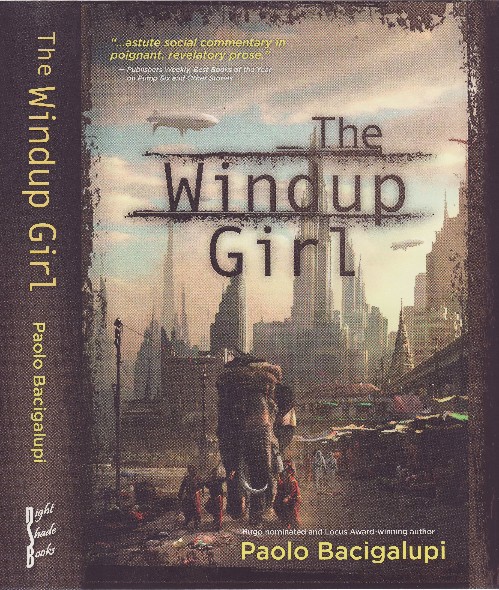
- The Windup Universe
series3 books2005
similar bynear futurescience fictiongenetic engineeringour world+1 more
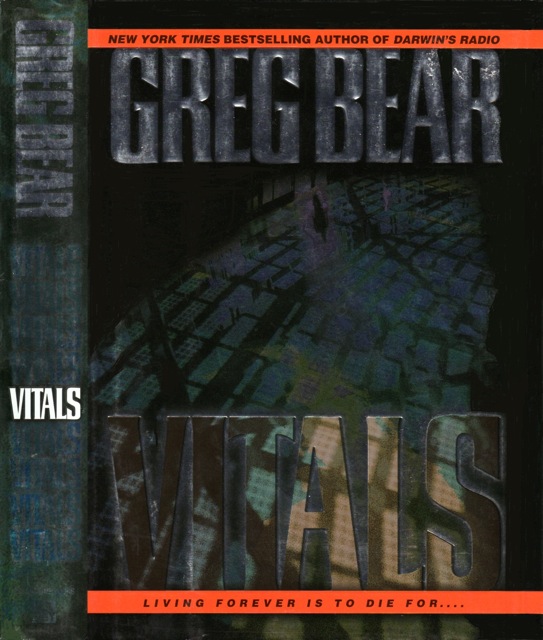
- Vitals
Greg Bearstandalone novel2002
similar bytenseour worldscience fictiongenetic engineeringthriller & suspenseimmortality
From the flaps of the Del Rey first edition: "Hal Cousins is one of a handful of scientists nearing the most sought after discovery in human history: the key to short-circuiting the aging process. Fueled by a wealth of research, an overdose of self-confidence, and the money of influential patrons to whom he makes outrageous promises, Hal experiments with organisms living in the hot thermal plumes in the ocean depths. But as he journeys beneath the sea, his other world is falling apart. Across the country, scientists are being inexplicably murdered - including Hal's identical twin brother, who is also working to unlock the key to immortality. Hal himself barely eludes a cold-blooded attack at sea, and when he returns home to Seattle, he finds himself walking into an eerie realm where voices speak to him from the dead ... where a once-brilliant historian turned crackpot is leading him on a deadly game of hide-and-seek ... and where the beautiful, rich widow of his twin is more than willing to pick up the pieces of Hal's life-and take him places he's never been before. Suddenly Hal is trapped inside an ever-twisting maze of shocking revelations. For he is not the first person to come close to ending aging forever - and those who came before him will stop at nothing to keep the secret to themselves. Now every person on earth is at risk of being made an unsuspecting player in one man's spectacular and horrifying master plan. From the bottom of Russia's Lake Baikal to a billionaire's bionic house built into the cliffs of the Washington seashore, from the darkest days of World War II and the reign of Josef Stalin to the capitalist free-for-all that is the United States, Vitals tells an astounding tale of the most unimaginable scientific secret of all - exposed by the quest for immortality itself..."
- Hopscotch
Kevin J. Andersonstandalone novel2002
similar bytenseour worldnear futurescience fictionthriller & suspenseimmortality
From the flaps of the Bantam first edition: "Suppose you could switch bodies with another person? What exciting new experiences would you choose to explore? What forbidden desires would you indulge? Suppose someone stole your life–how far would you go to get it back? From ... author Kevin J. Anderson comes a pure adrenaline thriller of hijacked identities, elusive motives, and deeply buried secrets–a disturbing, thought-provoking excursion into a sleek, hedonistic society where nothing is your own...not even your soul. Hopscotch - For a fee, Eduard Swan will swap bodies with people in distress–those facing surgeries, emotional crises, moments of unpleasantness or discomfort they can't or would rather not deal with. Eduard will experience the suffering for them. It's a lucrative business, and in a world in which no one is required to feel any pain, there is no end of clients. But someone doesn't want to play by the rules. Someone doesn't want to return his body. And, unfortunately for Eduard, that someone is one of the world's most powerful men. Now Eduard has no choice but to steal back his life. He has the perfect alibi–or so he thinks. For even in a world where you can hopscotch from body to body, you always leave a trail. And following that trail is a relentless dispenser of "justice" named Daragon, a childhood friend, now a zealous and ambitious agent of state security, who won't let old friendships stand in the way of doing his duty. When Eduard goes on the run, hounded at every turn by Daragon, his only hope is two other childhood friends: Garth, a tormented artist who gains success beyond his wildest dreams, only to discover the terrible price of fame; and Teresa, a spiritual seeker who risks losing her own body to a fanatical religious cult as she embarks on a harrowing quest to find her true identity. Moving from underground hopscotch pleasure bars to the highest enclaves of power to a seamy underworld of illegal Phantoms, ancient minds who steal younger bodies in a quest for eternal life, Eduard and his friends seek the meaning of identity in a society in which appearances mean everything–and nothing–and where everything is relative...even murder."
- The Lathe of Heaven
Ursula K. Le Guinstandalone novel1971
similar bytenseour worldnear futurescience fiction
The Lathe of Heaven is a 1971 science fiction novel by American writer Ursula K. Le Guin, first serialized in the American science fiction magazine Amazing Stories. It won the 1972 Locus Award for Best Novel and was a finalist for the 1971 Nebula Award for Best Novel and 1972 Hugo Award for Best Novel. Two television film adaptations were released: the PBS production, The Lathe of Heaven (1980), and Lathe of Heaven (2002), a remake produced by the A&E Network.
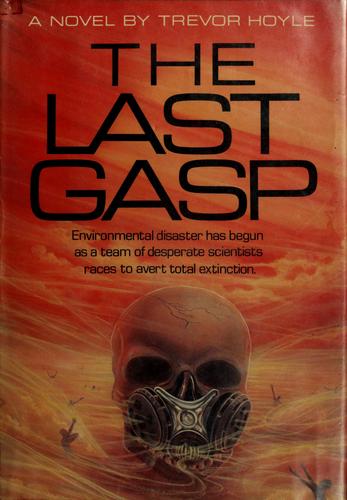
- The Last Gasp
Trevor Hoylestandalone novel1983
similar bytenseour worldnear futurescience fictionthriller & suspense+1 more
From the flaps of the Crown first edition: "When British marine biologist Gavin Chase stepped out into the windswept wastes at the Halley Bay antarctic research station one morning, the last thing he expected to see was a sled team coming out of nowhere carrying a half-mad, half-frozen Russian scientist babbling an incomprehensible warning. But that warning would threaten the future of the human race and force Chase to make some of the hardest decisions of his life. Months later, at a Geneva environmental conference, Chase meets Cheryl Detrick, the daughter of Theo Detrick, the grand old man of diatom research. Chase, the Detricks, and Soviet scientist Boris Stanovnik theorize that the oxygen-producing microscopic plants of the world's oceans are dying and the level of atmospheric pollutants has finally exceeded the ability of the planet's ecology to recycle them. There is also good reason to believe that the superpowers are planning to wage a new type of environmental warfare. Sooner or later there will be nothing left to breathe. So begins a race against the future. Chase and Cheryl, now lovers, struggle to avert ecological catastrophe as agents of the military-industrial complex hunt them down... and as a growing belt of unbreathable gases spreads outward from the equator, uprooting millions. Their enemies are Lloyd Madden, an insane military mastermind planning to seed the earth with poison and then repopulate it with a race of mutants, and Joseph Earl Gelstrom, a wealthy chemical manufacturer who has Cheryl's father killed to hide his involvement. But Gelstrom himself falls victim to pollution sickness, and he repents. To raise money to finance a research team, Chase must make an unholy alliance with the dying Gelstrom, but this is too much for Cheryl, who leaves him. As more and more of the world becomes uninhabitable, as industries and governments collapse and chaos reigns, as the oceans fill up with dioxin, as the climate changes and mutant life-forms encroach upon the last refuges of humankind, Chase leads a last desperate mission to find and rescue Cheryl and to lead his team of scientists to safety."
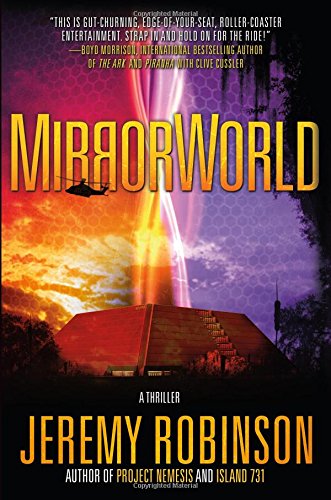
- MirrorWorld
Jeremy Robinsonstandalone novel2015
similar bytenseour worldnear futuregenetic engineeringscience fictionthriller & suspense
"Crazy has no memory and feels no fear. Dangerous and unpredictable, he's locked away in SafeHaven, a psychiatric hospital, where he spends the long days watching Wheel of Fortune and wondering what the outside world smells like. When a mysterious visitor arives and offers him a way out Crazy doesn't hesitate to accept. But outside the hospital Crazy is faced with a world on the brink of nuclear annihilation, and find himself relocated to Neuro Inc., a secretive corporation with strange government ties. When he discovers evidence of human experimentation he escapes with a syringe, the contents of which are unknown to him but precious to Neuro. Cornered and with a complete disregard for the results, Crazy makes himself indispensable by injecting the substance into his leg. As the substance enters his bloodstream, though, his eyes are opened to a world beyond human experience, where fear is a tool and the shadows hide the source of mankind's nightmares. Struggling to understand his new abilities, Crazy allies himself with the company he fled and begins peeling back the layers of his past, the brewing war between worlds, how he can stop it and what he did to start it. With Crazy, Robinson, whose trademarked pacing and inventive plots have been highly praised by bestselling authors like Jonathan Maberry, Scott Sigler and James Rollins, treats readers to a wildly imaginative, frenetically paced thriller exploring the origins of fear"--
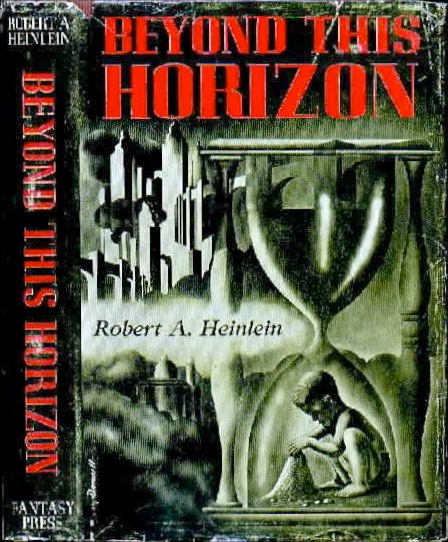
- Beyond This Horizon
Robert A. Heinleinstandalone novel1948
similar byour worldgenetic engineeringscience fiction+3 more
From the front flap of a 2001 Baen reprint: "Utopia has been achieved. For centuries, disease, hunger, poverty, and war have been things found only in the history tapes. And applied genetics has given men and women the bodies of athletes and a lifespan of over a century. They should all have been very happy... But Hamilton Felix is bored. And he is the culmination of a star line, each of his last thirty ancestors chosen for superior genes. Hamilton is, as far as genetics can produce one, the ultimate man. And this ultimate man can see no reason why the human race should survive, and has no intention of continuing the pointless comedy. However, Hamilton's life is about to become less boring. A secret cabal of revolutionaries who find utopia not just boring, but desperately in need of leaders who know just What Needs to be Done, are planning to revolt and put themselves in charge. Knowing of Hamilton's disenchantment with the modern world, they have recruited him to join their Glorious Revolution. Big mistake! The revolutionaries are about to find out that recruiting a superman was definitely not a good idea..."
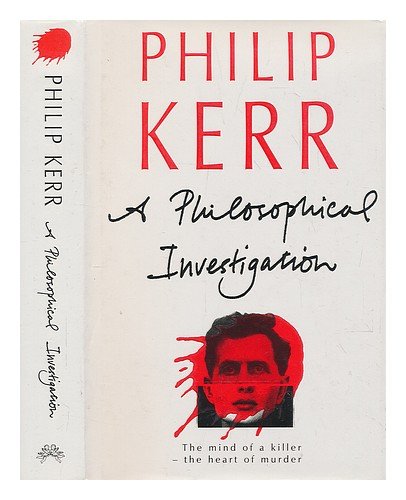
- A Philosophical Investigation
Philip Kerrstandalone novel1992
similar bytenseour worldnear futurescience fictiongenetic engineeringthriller & suspense
A near future thriller about a medical breakthrough that allows to identify violent sociopaths and the social changes that it triggers.
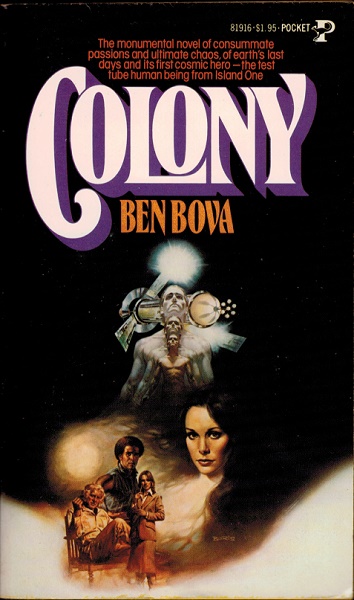
- Colony
Ben Bovastandalone novel1978
similar bytensenear futurescience fictionpolitical intrigue+2 more
Colony continues the story Ben Bova began in Millennium, following astronaut-turned-administrator Chet Kinsman years later as the head of an orbiting space habitat that has become Earth's only real refuge from a planet buckling under overpopulation, food shortages and unrest. Getting a place in the habitat is a matter of life and death for millions who will never be chosen, and as Earth's governments grow more desperate to control or dismantle the colony outright, Kinsman has to decide how far he'll go to protect the world he's built off-world. Bova later folded both novels together into the omnibus The Kinsman Saga. Part of Ben Bova's Chet Kinsman series.
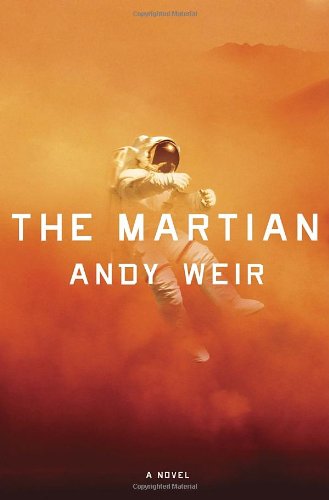
- The Martian
series2 books2012
similar bytensenear futurescience fictionour world
Andy Weir's novel The Martian, first self-published in 2011 before a commercial re-release, follows astronaut Mark Watney after he is stranded alone on Mars when his crew presumes him dead and departs. Using scientific improvisation and dark humor, Watney works to keep himself alive long enough for a rescue to reach him. It is a single, self-contained survival story.
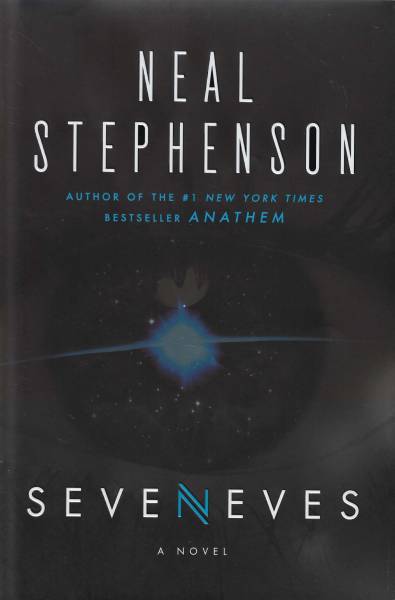
- Seveneves
Neal Stephensonstandalone novel2015
similar bytensenear futurescience fictiongenetic engineeringour world
Seveneves is a science fiction novel by Neal Stephenson published in 2015. The story tells of the desperate efforts to preserve Homo sapiens in the wake of apocalyptic events on Earth after the unexplained disintegration of the Moon and the remaking of human society as a space-based civilization after a severe genetic bottleneck.
- Earth
David Brinstandalone novel1990
similar bytenseour worldnear futurescience fiction
Earth is a 1990 science fiction novel by American writer David Brin. The book was nominated for the Hugo and Locus Awards in 1991.