More like Time Gladiator
anchored on:science fictionmilitary science fiction
but
- H. G. Wells' War of the Worlds
universe65 books1898
Start hereThe War of the Worlds · Start here
similar byscience fiction+1 more
No one would have believed, in the closing years of the nineteenth century, that human affairs were being watched keenly and closely from the timeless worlds of space. And then the cylinders fell. H. G. Wells' War of the Worlds opens in the quiet of the Surrey commons, where a falling star proves to be the first Martian craft — and from the pit rise the towering tripods, the Heat-Ray, the choking Black Smoke and the creeping red weed, wielded by minds that regard mankind much as we regard the creatures we boil for supper. This is invasion rendered as natural disaster: cold, methodical, and vast beyond argument. Wells' 1898 novel is the seed; everything else grows from that Martian soil. The catalogue gathers direct sequels and continuations alongside a wide field of other hands. In War of the Worlds: Global Dispatches the invasion is retold across the whole planet through the eyes of Twain, Verne, Tolstoy, Lowell and Kipling; in the Manly Wade and Wade Wellman crossover, Sherlock Holmes, Watson and Professor Challenger take the field against the machines; and Scott Washburn's Great Martian War stretches the fighting into a decades-long alternate history of steam, artillery and grinding attrition. It is a loose shared world — no single decreed sequence, many voices answering one calamity. What sets this world apart is its refusal of heroics: the invaders fall not to generals but to the smallest things of Earth, humbling and indifferent. Begin, always, with Wells' original novel — it is short, and it is the ground every later book stands upon. From there follow your appetite: Global Dispatches for the panorama, the Holmes campaign for adventure, Washburn for the long war.
- Childe Cycle
series19 books1957
similar bywarscience fictionmilitary science fiction+1 more
The Childe Cycle is an unfinished series of science fiction novels by American writer Gordon R. Dickson. The name Childe Cycle is an allusion to "Childe Roland to the Dark Tower Came", a poem by Robert Browning, which provided inspiration for elements in the work. The series is sometimes referred to as the Dorsai series, after the Dorsai people who are central to it. The related short stories and novellas all center on the Dorsai, primarily members of the Graeme and Morgan families.
- The Long Earth
series7 books2012
similar byadventurousnear futurescience fiction+1 more
Terry Pratchett and Stephen Baxter's Long Earth series (five novels, 2012-2016) begins when a cheap, simple device called a Stepper lets people step sideways into a vast, possibly infinite chain of parallel Earths, none of which developed human civilization. The books follow a natural stepper and an AI that believes itself the reincarnation of a Tibetan repairman as they travel millions of steps out along the chain, encountering other hominid species and the dangers, ecological and social, of an endless open frontier.
- Galactic Milieu
series10 books1981
completed
similar byscience fiction+2 more
Galactic Milieu is a series of science fiction novels by Julian May. It is linked to her previously published series, the Saga of Pliocene Exile; and through the fantastical device of time-travel, acts as both a prequel and a sequel to this earlier series. The "Galactic Milieu" of the title is an interplanetary federation, and Earth's membership of it is a central plot concern.
- Nicholas Seafort
series7 books1994
completed
similar bywarscience fictionmilitary science fiction+1 more
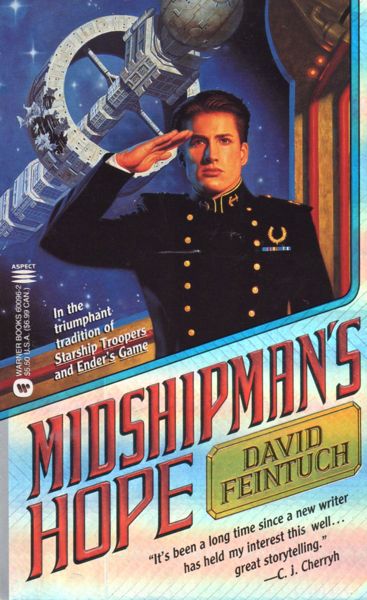
The Seafort Saga is a series of science fiction novels written by American author David Feintuch. The novels are set from the late 22nd century to the mid-23rd century and relate the adventures of Nicholas Seafort, an officer in the (fictional) UNNS| United Nations Naval Service. The series is a collection of personal accounts, usually from the perspective of Nicholas Seafort, describing Seafort's adventures, beginning as a lowly midshipman, to the elected leader of earth, and finally to the captain of the UNNS flagship Olympiad. Although most books in the series are told from a single perspective, usually Seafort's, Voices of Hope is a collection of accounts from several sources: Seafort's son, PT, the son of a friend of Seafort's, and a transient boy named Pook. Additionally, Children of Hope is narrated by Randy Carr, the son of a close friend of Seafort.
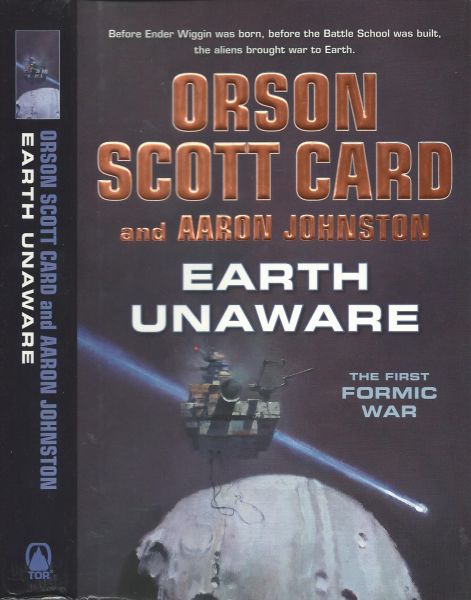
- First Formic War
series3 books2012
part of Ender's Game Universe
similar bywaradventurousscience fictionmilitary science fiction+1 more
- Reckoners
series6 books2013
similar byadventurousnear futurescience fiction+1 more
The Reckoners is a series of young adult superhero novels written by American author Brandon Sanderson. The series consists of Steelheart (2013), Firefight (2015), Calamity (2016) and Lux (2021). The series depicts a post-apocalyptic world in which the appearance of an orbiting cosmic phenomenon known as Calamity has given random people superhuman powers in apparent defiance of known physical laws, turning them into "Epics". These Epics prey upon or enslave the rest of humanity, causing the collapse of traditional governments. One young man orphaned by a High Epic joins a group that is killing Epics.
- The High Crusade
Poul Andersonstandalone novel1960
similar bywaradventurousscience fictionmilitary science fiction+1 more
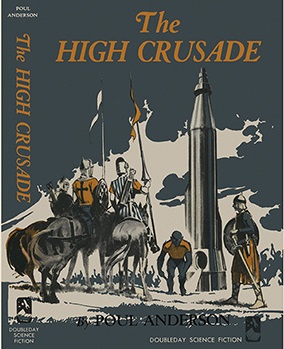
The High Crusade is a science fiction novel by American writer Poul Anderson, about the consequences of an extraterrestrial scoutship landing in medieval England. Poul Anderson described the novel as "one of the most popular things I've ever done, going through many book editions in several languages."
- Insignia
series5 books2012
similar bywaradventurousnear futurescience fictionmilitary science fiction+1 more
- Ender's Shadow
series5 books1999
part of Ender's Game Universe
similar bywarscience fiction+1 more
Orson Scott Card's Ender's Shadow retells the events of Ender's Game from the perspective of Bean, a physically stunted but ferociously intelligent street child recruited into the same Battle School program as Ender Wiggin. It launches the Shadow series, which follows Bean and other secondary Battle School characters into the political aftermath of the Formic Wars back on Earth, running parallel to and eventually past the timeline of Card's main Ender Quintet.
- Starship Troopers
Robert A. Heinleinstandalone novel1959
similar bywaradventurousscience fictionmilitary science fiction
Starship Troopers is a military science fiction novel by American writer Robert A. Heinlein. Written in a few weeks in reaction to the US suspending nuclear tests, the story was first published as a two-part serial in The Magazine of Fantasy & Science Fiction as Starship Soldier, and published as a book by G. P. Putnam's Sons on November 5, 1959.
- The Gone-Away World
Nick Harkawaystandalone novel2008
similar bywaradventurousour worldnear futurescience fiction
The Gone-Away World is the debut novel of British author Nick Harkaway, a science fiction story set in a post-apocalyptic world crippled by the 'Go-Away War'. The book was first published in June 2008 by Heinemann.
- The Crimson Deathbringer
series1 book2019
similar bywaradventurousnear futurescience fictionmilitary science fiction
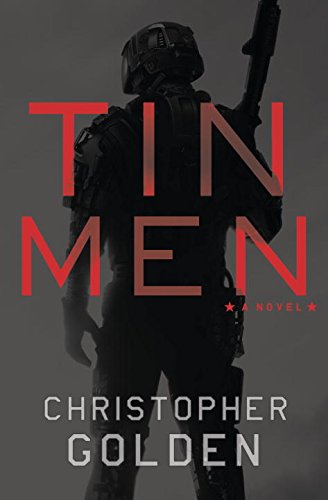
- Tin Men
Christopher Goldenstandalone novel2015
similar bywarour worldnear futurescience fictionmilitary science fiction+1 more
"In the near future, the U.S. has deployed the Remote Infantry Corps: thousands of robots remote-piloted by soldiers whose bodies lie hidden in underground bases. But the worst occurs when anarchists set off a global pulse that shorts out electrical connections. In Damascus, Private Danny Kelso, Corporal Kate Wade, and their platoon realize they are trapped inside the Tin Men--something the government never warned them could happen. In Athens, the G20 Summit comes under fire, and a band of security soldiers and advisors risk everything in an effort to shepherd the President to safety. As chaos descends, and with anarchist Bot Killers on their trail, the Tin Men must survive a gauntlet of violence on the road from Damascus to the heart of Europe, half of them determined to stay true to their mission and save their president, half of them hellbent to save themselves.."--
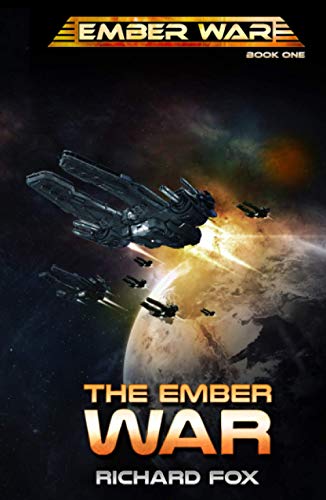
- The Ember War Saga
series12 books2015
part of The Ember War
similar byscience fictionmilitary science fiction+2 more
- Temporal Regulatory Authority / Jason Thanou
series6 books2006
similar byadventurousscience fiction+3 more
- Forever War
series10 books1972
similar byscience fictionmilitary science fiction+1 more
Joe Haldeman's The Forever War (1974) follows a soldier conscripted into a centuries-long interstellar war against the alien Taurans, using relativistic space travel so that months spent in transit correspond to years or decades passing back on Earth. Haldeman later returned to the same conflict in Forever Peace (1997), a thematically connected but separate story, and Forever Free (1999), a direct sequel set years after the original war's end. The first novel won the Hugo, Nebula, and Locus awards and is considered a foundational work of military science fiction.
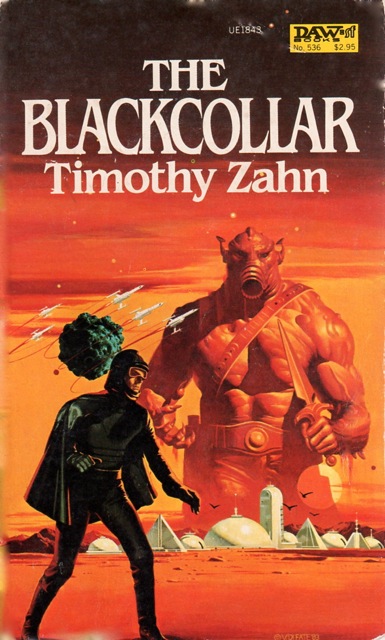
- Blackcollar
series3 books1983
similar bywarour worldscience fictionmilitary science fiction+1 more
Timothy Zahn's Blackcollar trilogy, his debut work, follows survivors of Earth's underground resistance against the Ryqril, an alien empire that conquered the planet a generation earlier. The Blackcollars themselves are elite commando-agents trained before the invasion, presumed a spent, aging force until circumstances pull survivors back into action against their occupiers. The Backlash Mission and The Judas Solution continue the resistance's fight as the underground network is drawn deeper into interstellar politics beyond Earth.
- The Change / The Event
series41 books1998
similar byadventurousscience fiction+2 more
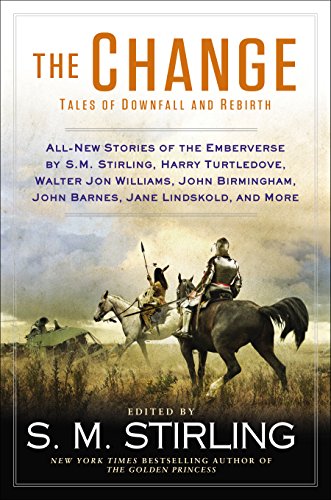
The Change: Tales of Downfall and Rebirth is a shared-world anthology of stories set in the years right after a mysterious global event instantly disables gunpowder, electricity, and combustion engines, the founding premise of S. M. Stirling's Emberverse. Sixteen different authors, coordinated by Stirling, each contribute stories set in various corners of the suddenly de-industrialized world as survivors scramble to rebuild. It's a companion volume to the Change/Emberverse novels rather than a novel itself.
- Psychotechnic League
series29 books1949
similar byscience fiction+1 more
The Psychotechnic League is Poul Anderson's earliest future history, tracing humanity's recovery from a devastating third world war under the guidance of a scientific institute trying to steer civilization away from repeating its mistakes, and eventually expanding into interstellar exploration. Anderson wrote it before his better-known Technic History and later adjusted its internal chronology to fit later work; it has been collected across several anthologies, including a three-volume Complete Psychotechnic League set.