Loreful
HomeDiscover
Search series, authors…⌘K
Loreful

Reading orders for SF/F series and shared universes — with your place kept in every one.

Explore

UniversesSeriesWorksAuthorsAtlas

Help

FAQAboutSite map

Account & legal

Sign inCreate accountPrivacyTerms

Data

Built on ISFDB, Wikipedia, Wikidata and Open Library. Curated reading orders carry their reasoning on the page; the rest follow publication order. Data sources & licenses

© Loreful · data: ISFDB · CC BY

More like Timeline

anchored on:science fictiontime traveleuropemedievaladventuroussurvival+3 more

but

Mood

The mood the book leaves you in.

  • The reading experience is propelled by journeys, exploration, and physical risk; excitement and forward momentum dominate over dread or introspection.
  • Joy and loss are deliberately mixed; the resolution grants characters something real while taking something else away, leaving warmth and sorrow together.
  • The book demands work from the reader — dense prose, difficult structure, unfamiliar ideas, or morally uncomfortable material — as part of its intended effect.
  • Grim events, cruelty, or despair dominate the atmosphere, and the book does not soften them with comfort or comic relief.
  • The atmosphere is quietly unsettling — wrongness, unease, and the uncanny pervade the book without necessarily escalating into overt horror.
  • The book is built to move the reader; character feeling is foregrounded and major scenes aim at a strong emotional response.
  • Humor is a primary aim and the prose plays for laughs — comic situations, wit, or dialogue produce sustained comedy, not occasional levity.
  • The book insists that things can improve; effort and decency are shown to matter, and the arc bends toward better outcomes even through hardship.
  • The book teaches as it goes — real facts, history, science, or craft are conveyed in enough depth that learning is part of the reading experience.
  • The book is designed to uplift and motivate, presenting perseverance or achievement in a way that invites the reader to aspire or act.
  • The overall register is cheerful and easygoing; stakes are kept gentle and the book avoids dwelling on pain or dread.
  • Withheld information drives the experience; the book sustains enigmas and secrets the reader wants resolved, whatever its genre.
  • The book is contemplative and inward-looking, giving more weight to thought, memory, and meaning than to external events.
  • The book works as comfort reading — low tension, a soothing pace, and an atmosphere the reader can unwind in.
  • Grief, loss, or melancholy set the dominant register, and the book lets sorrow stand rather than resolving it into comfort.
  • Sustained suspense is the point; the book keeps the reader braced for what happens next through danger, pressure, or impending revelation.
  • Playful invention and charm define the register — fanciful conceits, light absurdity, and a narration that delights in its own oddity.

About

What the story runs on.

  • Stories in which extraterrestrial beings are central — as characters, cultures, or the object of the plot.
  • Stories about venturing into space to explore — survey missions, astronauts, and the frontier of the unknown beyond Earth.
  • Stories structured as a quest — a journey undertaken to find, deliver, or destroy something of great import.
  • Stories in which staying alive against nature, catastrophe, or scarcity is the central problem.
  • Stories of lovers kept apart by law, family, faith, or station, where the obstacle to love is the plot.
  • Stories in which a friendship — its making, testing, or loss — is the emotional center.
  • Stories of growing up — a young protagonist crossing from childhood into adult knowledge and responsibility.
  • Stories about who a character truly is — self-discovery, doubled lives, and the search for a self.
  • Stories in which a buried family truth — hidden parentage, crimes, or shames — surfaces and reorders the present.
  • Stories driven by maneuvering for power — factions, conspiracies, and statecraft conducted in shadow.
  • Stories in which war itself is the subject — combat, occupation, and what warfare does to soldiers and civilians.
  • Stories organized around investigating a killing — the case, the clues, and the pursuit of the killer, in any genre's clothing.

Shelf

Where it sits in the library.

    • Fiction built on magic or other supernatural elements that have no scientific explanation.
    • Secondary-world fantasy at large scale, where the fate of nations or the world turns on the protagonists' struggle.
    • Fantasy set in a recognizably modern city or contemporary world where the supernatural intrudes on everyday life.
    • Fantasy that blends in horror's atmosphere and imagery, keeping a fantastical frame around grim or frightening material.
    • Action-driven fantasy following warriors or rogues with personal stakes against sorcerous threats, rather than world-spanning conflicts.
    • Fantasy set in a real historical period or a close analogue of one, with magic woven into the era.
    • Fantasy in which protagonists cross from the ordinary world into another world through a portal or similar passage.
    • Fiction that retells or reworks a traditional fairy tale in a new form or setting.
    • Fantasy drawing directly on myths, legends, and folklore, retelling them or building on their figures and logic.
    • Fantasy of ghosts, vampires, shapeshifters, psychics, and similar phenomena, usually set in an otherwise ordinary world.
    • Fiction mixing science-fictional trappings with overtly magical or impossible elements in one setting.
    • Low-stakes fantasy emphasizing comfort, community, and everyday pleasures over conflict and peril.
    • Speculative fiction of pervasive moral ambiguity, violence, and cynicism that rejects heroic conventions — fantasy and SF alike.
      • Fiction that extrapolates from science and technology — future societies, space travel, or speculative inventions — within at least nominally natural laws.
      • Science fiction of interstellar scope — starships, galactic polities, and adventure across star systems.
      • Science fiction committed to scientific rigor, where technical plausibility constrains the story.
      • Science fiction centered on armed forces and warfare, told largely from a military point of view.
      • Science fiction of networked, corporate-dominated near futures, pairing high technology with social decay.
      • Science fiction styled on nineteenth-century steam-powered technology, often in a Victorian or pseudo-Victorian setting.
      • Fiction depicting an oppressive or catastrophic society, presented as a warning.
      • Fiction set after civilization's collapse, following survivors in the ruins of the old world.
      • Fiction in which characters move between past and future, and the mechanics or consequences of that travel drive the plot.
      • Fiction exploring a world where a historical event went differently and history diverged from ours.
      • Science fiction about humanity's first encounter and communication with an alien intelligence.
      • Science fiction in which extraterrestrial forces attack or occupy Earth and humanity resists.
      • Fiction whose primary aim is to frighten or unsettle the reader through dread, menace, or the monstrous.
      • Horror of vast, indifferent, incomprehensible entities before which humanity is insignificant, in the Lovecraft tradition.
      • Horror of decaying houses, buried family secrets, and oppressive atmosphere in the Gothic literary tradition.
      • Horror centered on hauntings and the returning dead.
      • Horror located in the mind — paranoia, obsession, and unreliable perception rather than external monsters.
      • Horror built around the reanimated dead and survival amid their outbreaks.
      • Horror defined by explicit, transgressive gore that refuses to cut away from violence.
      • Speculative fiction of the strange and uncanny that resists both natural explanation and standard genre categories.
      • Fiction organized around solving a crime or puzzle, typically following an investigator toward the identification of a culprit.
      • A puzzle-first mystery that lays out clues so the culprit's identity can be deduced before the reveal.
      • Crime fiction of moral ambiguity, fatalism, and hard-edged style, set among the corrupt and the doomed.
      • A mystery following the realistic routines of police work — forensics, interviews, and case-building.
      • A gentle mystery with an amateur sleuth, a small community, and violence kept off the page.
      • A mystery set in a past era, where the investigation works within that period's methods and society.
      • Fast-paced fiction driven by imminent danger, pursuit, or high-stakes conspiracy, built to sustain tension.
      • A thriller of espionage — agents, tradecraft, and intelligence services in conflict.
      • A thriller centered on lawyers and the courtroom, where litigation carries the suspense.
      • A thriller driven by detailed contemporary or near-future technology, often military or scientific.
      • A thriller whose tension comes from mental states and manipulation between characters rather than external action.
      • Fiction whose central plot is a romantic relationship and its development toward an emotionally satisfying resolution.
      • Romance in which one or both partners are supernatural beings, blending fantasy elements into the love story.
      • A fantasy-romance hybrid in which the romantic arc and the fantasy plot carry equal weight.
      • Romance set in a past era, with courtship shaped by the period's society and manners.
      • Romance set in the present day, without supernatural or historical elements.
      • Fiction set in a real past period, where the historical setting materially shapes characters and events.
        • General and literary fiction emphasizing prose style, character interiority, or formal ambition over genre plot conventions.
        • Fiction in a realistic world where magical events occur and are treated as ordinary, in the tradition of Latin American literature.
        • Fiction that ridicules people, institutions, or society in order to criticize them.
        • Fiction of dreamlike, irrational imagery and logic that breaks from realistic representation.
        • Fiction that plays with narrative convention through metafiction, fragmentation, and self-reference.
        • Fiction propelled by journeys, exploration, and physical peril, where action and survival carry the plot.
        • Adventure fiction of ships and seafaring — naval engagements, voyages, and life at sea.
        • Fiction of the American frontier West — gunmen, ranchers, and lawmen, typically in the late nineteenth century.
        • Fiction centered on soldiers, campaigns, and the experience of warfare, historical or imagined.
          • Fiction written primarily to amuse, using comedic situations, wit, or parody as its organizing principle.
            • Multi-generational fiction following a family or dynasty across decades, with inheritance and kinship as the through-line.
              • Fiction whose world runs on explicit game mechanics — levels, stats, and skills that characters can see and exploit.
                • Fiction about costumed or superpowered heroes and their conflicts with comparable villains.

                Practical

                How long a commitment, whether it stands alone, and whether it has finished.

                Tap a chip to ask for it · tap again to rule it out · once more to clear. Numbers show what would be left.

                • Cover of Oxford Time Travel
                  Oxford Time Travel

                  series · 6 books · 1982

                  similar byscience fictiontime travelsurvivaltenseeuropebritish isles+1 more

                  Connie Willis's Oxford Time Travel novels are set at a near-future Oxford University where historians travel into the past as observers, constrained by a version of history that resists any change large enough to alter real events. Doomsday Book sends a medieval historian to what should be 1320 but turns out to be the Black Death year of 1348, intercut with a present-day epidemic at Oxford; To Say Nothing of the Dog returns to the same time-travel program for a lighter, Victorian-set story with different characters. The two novels share their setting and rules rather than a directly continuing plot.

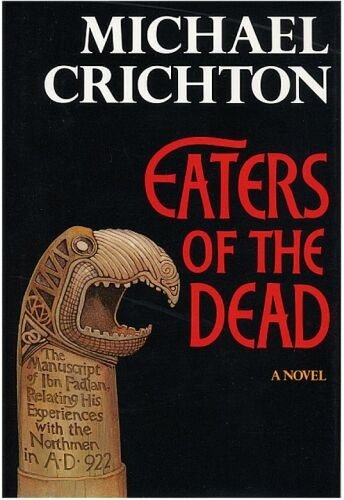
                • Cover of Eaters of the Dead
                  Eaters of the Dead

                  Michael Crichton · standalone novel · 1976

                  similar bysurvivalexpeditionsmedievaltenseeurope+1 more

                  Eaters of the Dead: The Manuscript of Ibn Fadlan Relating His Experiences with the Northmen in AD 922 is a 1976 novel by Michael Crichton, the fourth novel under his own name and his 14th overall. The story is about a 10th-century Muslim Arab who travels with a group of Vikings to their settlement.

                • Cover of Fire in the Abyss
                  Fire in the Abyss

                  Stuart Gordon · standalone novel · 1983

                  similar bysurvivalexpeditionsadventurousscience fictiontime traveltensebritish isles

                  Fire in the Abyss is a 1983 science fiction novel by Stuart Gordon, pen name of Richard Gordon, having as its main character the Elizabethan adventurer Humphrey Gilbert, an actual historical figure, as a time traveler.

                • Cover of Congo
                  Congo

                  Michael Crichton · standalone novel · 1980

                  similar bysurvivalexpeditionsadventuroustenselate 20th century+1 more

                  WorldCat: On an expedition to return Amy, his talking gorilla, to her home in the Congo, Professor Peter Elliot is joined by others who hope to find a legendary diamond mine guarded by mutant gorillas.

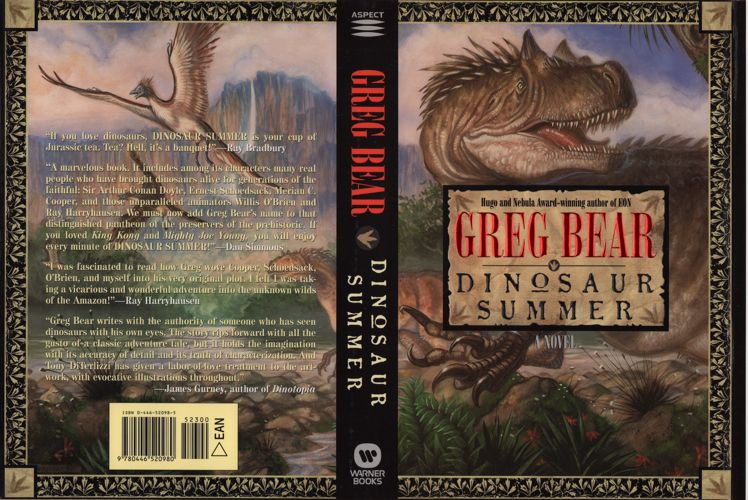
                • Cover of Dinosaur Summer
                  Dinosaur Summer

                  Greg Bear · standalone novel · 1998

                  similar bysurvivalexpeditionsadventuroustensescience fiction

                  From the flaps of the Warner first edition: "It's the year 1947, and nobody's interested in dinosaurs anymore. Less than fifty years after Professor Challenger's famed journey to the Lost World, America's last dinosaur circus is closing down... but the adventure of a lifetime is about to begin. In a dramatic change of pace, multiple Hugo and Nebula award-winning science fiction master Greg Bear, ... presents a lavishly illustrated thriller that is certain to become a new classic adventure beyond time... Peter Belzoni is dreading summer in Manhattan. Then his father, photojournalist Anthony Belzoni, offers the youth a job, a byline in National Geographic... and a trip to South America. For the Lothar Gluck Circus, once the world's foremost dinosaur attraction, had gone bankrupt. Left behind is a menagerie of avisaurs, centrosaurs, and ankylosaurs, as well as one large predatory raptor named Dagger. And now two filmmakers and the circus trainer plan to return the giants to the wild - with Peter and his dad chronicling the odyssey for Geographic. The task seems impossible. Many have died trying to bring beasts our of the Lost World, the plateau of El Grande in Venezuela, but nobody has ever attempted to transport nearly a dozen full-grown, multiton prehistoric creatures across continents, down rivers, through jungles, and up mountains that has been isolated for 70,000,000 years... The trek will strain the technologies of trains, cargo ships, barges, trucks... en route lurk robbers and hostile, trigger-happy soldiers... and each mile toward freedom excites Dagger toward an unstoppable primal killing frenzy. When the unthinkable threatens to strand Peter and the rest of the crew in an uncharted realm, four modern Americans will face all the unknown dangers, mysteries, and terrors of El Grande..."

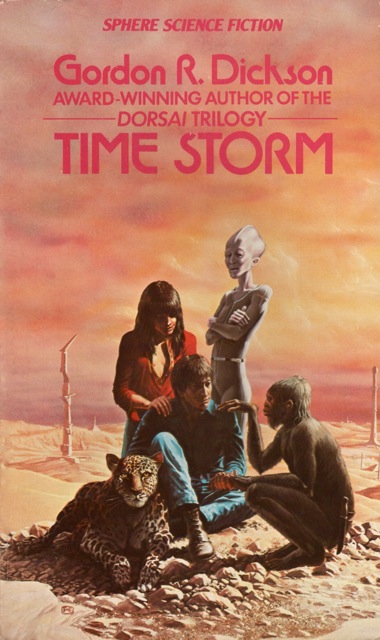
                • Cover of Time Storm
                  Time Storm

                  Gordon R. Dickson · standalone novel · 1977

                  similar bysurvivaladventurousscience fictiontensetime travel

                  A time storm has devastated the Earth, and only a small fraction of humankind remains. From the rubble, three survivors form an unlikely alliance: a young man, a young woman, and a leopard. "A masterful science fiction story told by a masterful science fiction writer". -- Milwaukee Journal. A time storm strikes the Earth. The Earth remains, but different parts of the Earth are in different eras. Travel between the different zones is thought to be impossible. The main character, Marc Despard, resolves to fight the time storm. After some struggles, he assembles a small band of people, including one alien, to help him try to understand what has happened and to stop the time storm. He has 2 extraordinary relationships with a older teenaged girl who is speechless for the first part of the book (she was "struck dumb" by the time storm) and with, believe it or not, a leopard. Dickson's writing makes the extraordinary seem quite normal. Ultimately, after being harried by a Mad Max-like group of survivors, he uses a machine found in a different era of time to bring his small band of followers into the future so that he can find those who are trying to fight the time storm. He convinces those future beings that he is capable of fighting the time storm, and ultimately stops it, and gets the girl in the end.

                • Cover of Thunder
                  Thunder

                  series · 3 books · 1995

                  similar bysurvivalscience fictionadventuroustensetime travel+2 more

                • Cover of Tunnel in the Sky
                  Tunnel in the Sky

                  Robert A. Heinlein · standalone novel · 1955

                  similar bysurvivaladventurousscience fictiontense

                  As the final test of a survivalist/explorer class, teenagers are dumped on an alien planet to use their skills while awaiting pickup. But something has gone wrong, and they find they are on their own.

                • Cover of Have Space Suit - Will Travel
                  Have Space Suit - Will Travel

                  Robert A. Heinlein · standalone novel · 1958

                  similar bysurvivaladventurousscience fictiontense

                  From the back cover of the Del Rey 9th printing: "Skyjacked - Everything happened at once. One minute Kip Russell was walking about in his own backyard, testing out an old space suit and dreaming about going to the moon - and the next he was out cold and the captive of an insidious space pirate. The whole thing seemed like a very bad dream until he discovered he wasn't the only prisoner on board. Then the reality of the situation became inescapable. He - along with the daughter of a world-renowned scientist and a beautiful creature from an alien planet - had been skyjacked by a monstrous extraterrestrial and they were on their way to the Moon... a journey toward a fate worse than death!"

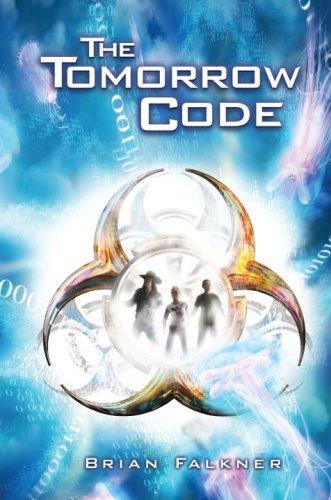
                • Cover of The Tomorrow Code
                  The Tomorrow Code

                  Brian Falkner · standalone novel · 2008

                  similar bysurvivalscience fictiontime traveladventuroustense

                  THE END OF THE WORLD started quietly enough for Tane Williams and Rebecca Richards. . . .Tane and Rebecca aren't sure what to make of it--a sequence of 1s and 0s, the message looks like nothing more than a random collection of alternating digits. Working to decode it, however, Tane and Rebecca discover that the message contains lottery numbers . . . lottery numbers that win the next random draw! Suddenly Tane and Rebecca are rich, but who sent the numbers? And why? More messages follow, and slowly it becomes clear--the messages are being sent back in time from Tane and Rebecca's future. Something there has gone horribly wrong, and it's up to them to prevent it from happening. As they follow the messages' cryptic instructions, Tane and Rebecca begin to suspect the worst--that the very survival of the human race may be at stake.From the Hardcover edition.

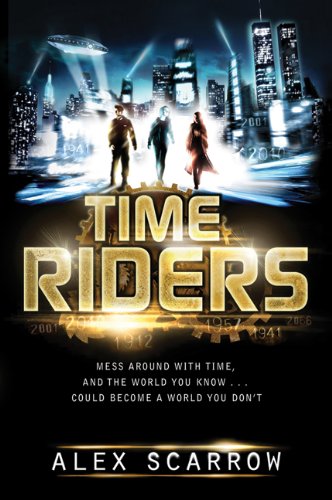
                • Cover of TimeRiders
                  TimeRiders

                  series · 9 books · 2010

                  similar bysurvivalscience fictiontime traveladventuroustense

                  TimeRiders is a series of teen science fiction novels written by Alex Scarrow. The series consists of nine books and is published by Puffin Books.

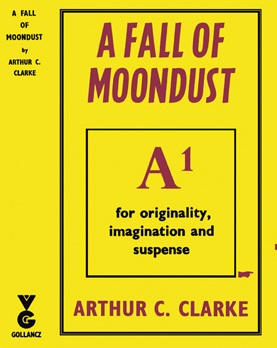
                • Cover of A Fall of Moondust
                  A Fall of Moondust

                  Arthur C. Clarke · standalone novel · 1961

                  similar bysurvivalscience fictionadventuroustense

                  From the back cover of the Harbrace paperback: "The action of A Fall of Moondust takes place almost a century from now when tours on the moon are a common occurrence. One of the high points of each tour is a cruise around the Sea of Thirst, a body of volcanic dust, in a specially designed vessel called the Selene On a perfectly routine voyage one day the Selene suddenly disappears. How do you locate a small tourist "cruiser" buried beneath fifty feet of dust? If you find it, how do you rescue the passengers and crew? If you are on board, how do you feel and what do you do while brave men and expert technicians join forces in a race against time? Sustained excitement, lively humor, and an engaging cast of characters make this one of Arthur C. Clarke's most intriguing novels."

                • Cover of Dian of the Lost Land
                  Dian of the Lost Land

                  Edison Marshall · standalone novel · 1935

                  similar bysurvivalexpeditionsadventurousscience fiction+1 more

                  Adam knew that the creatures who surrounded him had vanished from the earth five million years ago. Their beautiful art, their terrible weaponry, their religion, customs and language, even the animals they hunted and the alien dark tribe against whom they waged eternal war, all belonged to a time before the great glaciers had retreated and man had assumed control of the globe. But Adam was in no position to deny their reality. For now he and his companion, the renowned Professor Karl Belgrade, were being led to their ruler-the young and beautiful Queen who would decide whether the intruders would live or die. The last ravings of a man dying from a mysterious fever and the haunting hypothesis of a brilliant and obsessed scientist were all that the two explorers had to go on as their tiny plane winged high over the menacing Antarctic ice. They find a secret valley that only one human being had ever visited and lived to tell about it, a lost world ruled by creatures from the darkest depths of time, who even now might be playing out a gigantic contest between good and evil to its strange and terrible conclusion. (adapted from the texts published with the 1972 edition)

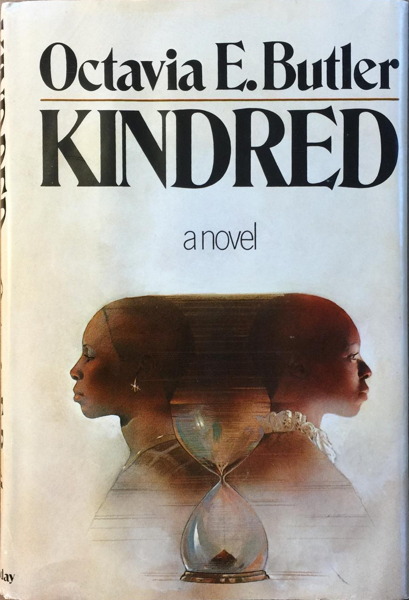
                • Cover of Kindred
                  Kindred

                  Octavia E. Butler · standalone novel · 1979

                  similar bysurvivalscience fictiontime traveltense

                  Kindred (1979) is a novel by American writer Octavia E. Butler that incorporates time travel and is modeled on slave narratives. Widely popular, it has frequently been chosen as a text by community-wide reading programs and book organizations, and for high school and college courses.

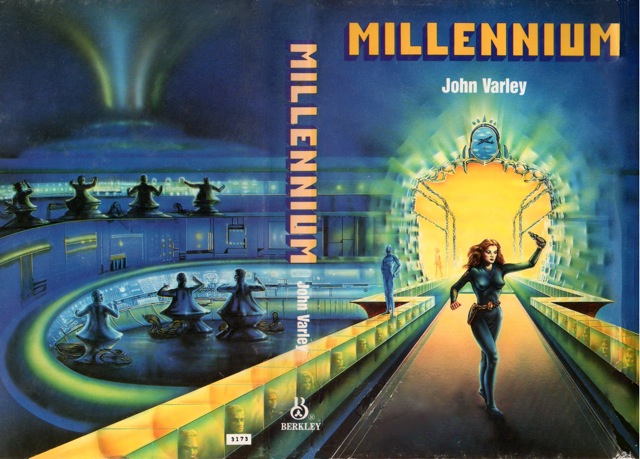
                • Cover of Millennium
                  Millennium

                  John Varley · standalone novel · 1983

                  similar bysurvivalscience fictiontime traveltenselate 20th century

                  Millennium is a 1983 time travel science fiction novel by John Varley. Varley later turned this novel into the script for the 1989 film Millennium, both of which are based on Varley's short story "Air Raid", which was published in 1977.

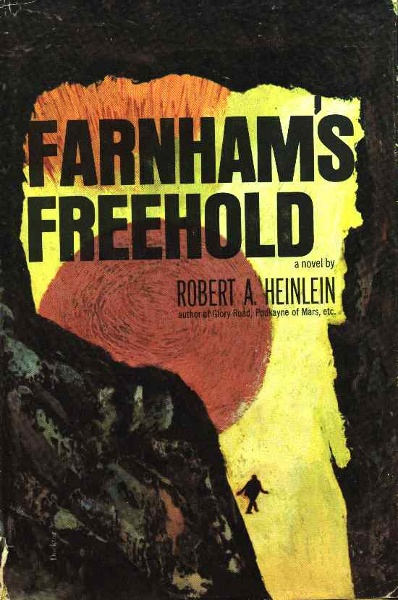
                • Cover of Farnham's Freehold
                  Farnham's Freehold

                  Robert A. Heinlein · standalone novel · 1964

                  similar bysurvivalscience fictiontensetime travel

                  Farnham's Freehold is a science fiction novel by American writer Robert A. Heinlein. A serialized version, edited by Frederik Pohl, appeared in Worlds of If magazine. The complete version was published in novel form by G. P. Putnam later in 1964.

                • Cover of Restoree
                  Restoree

                  Anne McCaffrey · standalone novel · 1967

                  similar bysurvivalscience fictionadventuroustense

                  Torn from Earth by a bizarre and nameless black force, Sara has no idea where she is or why she inhabits a beautiful new body. Controlled by brutal guards and tamed by terror, she can not comprehend her role as a nurse for a man who appears to be an idiot. She discovers that the planet she had been brought to was Lothar and that the man she was caring for was its Regent, Sara knows the restorees had to escape. When they do, they become fugitives on a world of multiple evils. (adapted from the back cover of the Baen edition)

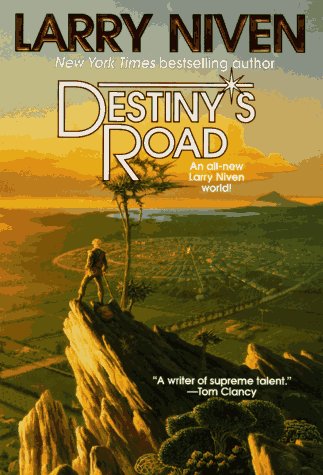
                • Cover of Destiny's Road
                  Destiny's Road

                  Larry Niven · standalone novel · 1997

                  similar bysurvivalexpeditionsscience fictionadventurous

                  Destiny's Road is a science fiction novel by American writer Larry Niven, first published in 1998. It follows Jemmy Bloocher's exploration of Destiny's Road, a long scar of once-melted rock seared onto the planet's surface by a spaceship's fusion drive. Jemmy is descended from the original Destiny colonists, who were stranded when their landing craft deserted them.

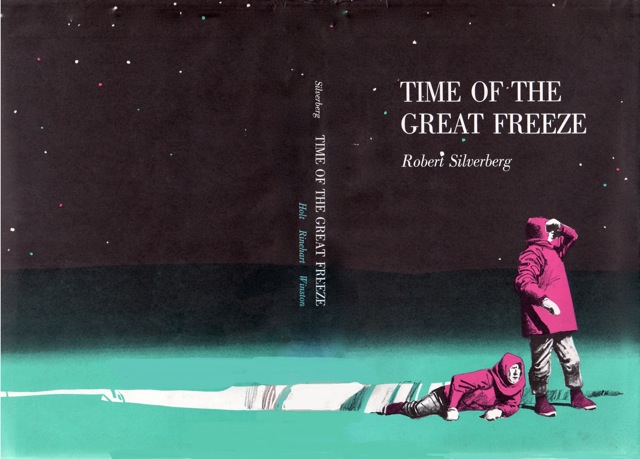
                • Cover of Time of the Great Freeze
                  Time of the Great Freeze

                  Robert Silverberg · standalone novel · 1964

                  similar bysurvivalexpeditionsscience fictiontense

                  Publisher's description: "During the receding Fifth Ice Age seven men expelled from underground New York in 2650 and one deserter of that isolated colony attempt to travel to London, where contact has been made with other people."

                • Cover of Hello America
                  Hello America

                  J. G. Ballard · standalone novel · 1981

                  similar bysurvivalexpeditionsscience fictionadventurous

                  Hello America is a science fiction novel by British writer J. G. Ballard, published in 1981. First edition cover designed by Bill Botten. The plot follows an expedition to a North America rendered uninhabitable by an ecological disaster following an energy crisis.

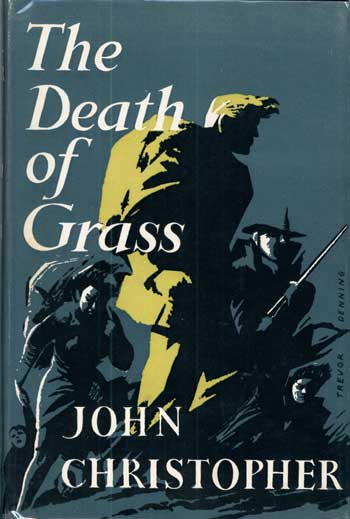
                • Cover of The Death of Grass
                  The Death of Grass

                  John Christopher · standalone novel · 1956

                  similar bysurvivalscience fictiontenseeuropebritish isles

                  The Death of Grass is a 1956 post-apocalyptic science fiction novel written by the English author Sam Youd under the pen name John Christopher. The plot concerns a virus that kills off grass species, including rice and wheat. The Death of Grass was the first of several post-apocalyptic novels written by Youd. The novel was written in a matter of weeks and liberated him from his day job.

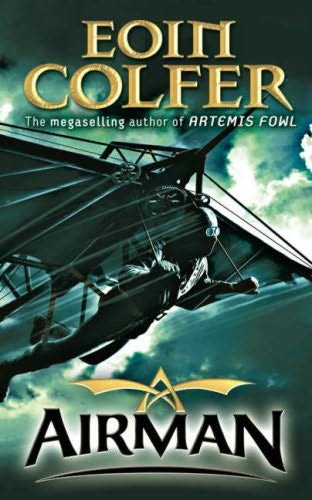
                • Cover of Airman
                  Airman

                  Eoin Colfer · standalone novel · 2008

                  similar bysurvivaladventuroustenseeuropebritish isles

                  Airman, by Eoin Colfer, is a best-selling historical adventure novel set in the 19th century. It was released in the UK, Ireland and US in January 2008. The novel was shortlisted for the 2009 Carnegie Medal.

                • Cover of Predator X
                  Predator X

                  C. J. Waller · standalone novel · 2014

                  similar bysurvivalexpeditionsscience fictionadventuroustense

                  "When deep level oil fracking uncovers a vast subterranean sea, a crack team of cavers and scientists are sent down to investigate. Upon their arrival, they disappear without a trace. A second team, including sedimentologist Dr. Megan Stoker, are ordered to seek out Alpha Team and report back their findings. But Alpha team are nowhere to be found–instead, they are faced with something unexpected in the depths. Something ancient. Something dangerous." – excerpted from the product description that is found on this book's product page on Amazon.com as of 2014-05-12

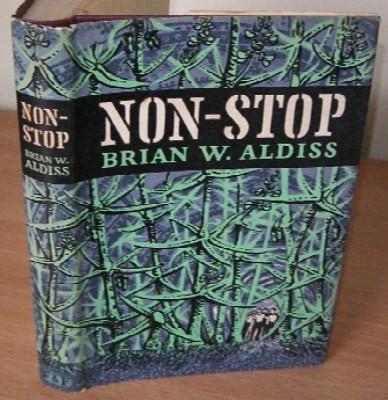
                • Cover of Non-Stop
                  Non-Stop

                  Brian W. Aldiss · standalone novel · 1958

                  similar bysurvivalexpeditionsscience fictionadventurous

                  Non-Stop is a 1958 science fiction novel by British writer Brian Aldiss. The book features members of a primitive tribe, who set out on a mission of exploration, and gradually uncover a series of revelations about their world.