More like War Planet
anchored on:science fiction
but
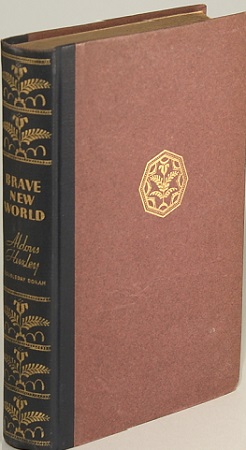
- Brave New World
series8 books1932
similar byscience fictionfar futuredystopia+1 more
Aldous Huxley's 1932 novel imagines a future World State where reproduction, social caste, and desire are all engineered before birth, and the population is kept content through conditioning, sleep-hypnosis, and a mood-altering drug called soma. The story follows the disruption this seemingly stable order suffers when an outsider raised beyond its reach is brought into it, exposing what the society traded away for comfort and order. Some editions pair the novel with Huxley's own 1958 nonfiction essay collection, Brave New World Revisited, which reassesses the book's ideas rather than continuing its story.
- Pax / Astra
series2 books1954
completed
similar byscience fictionadventurousfar futuretense+2 more
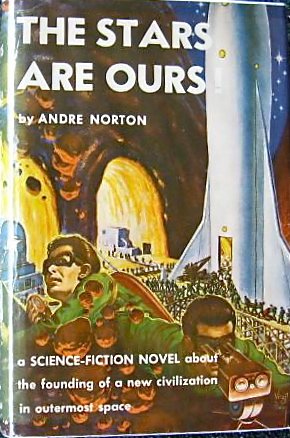
Andre Norton's The Stars Are Ours! (1954) and its sequel Star Born (1957) follow a group of scientists and their families who flee a repressive future Earth to colonize a distant world they name Astra, and then the next generation, who must contend with that world's original inhabitants. Star Flight appears to be a later omnibus or reissue rather than a third original novel.
- Future History
series42 books1939
completed
similar byscience fiction+3 more
The Future History is a series of science fiction stories written by American author Robert A. Heinlein (1907–1988). It describes a projected future of the human race from the middle of the 20th century through the early 23rd century. The term Future History was coined by John W. Campbell Jr. in the February 1941 issue of Astounding Science Fiction. Campbell published an early draft of Heinlein's chart of the series in the May 1941 issue.
- The Hunger Games Universe
universe5 books2008
Start hereThe Hunger Games · Start here
similar bytotalitarianismscience fictionfar futuretensedystopia
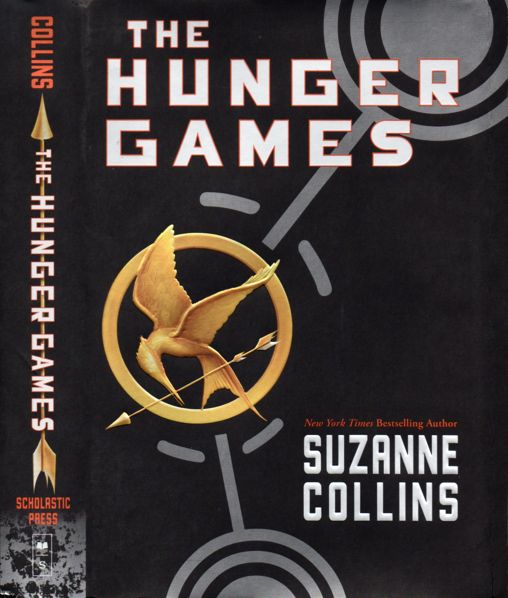
Panem, they call it now — a nation raised on the drowned bones of North America, a glittering Capitol ringed by twelve districts it once starved into obedience. Every year the Capitol collects its debt in children: two tributes from each district, drawn by lottery, dropped into an engineered arena, and made to kill one another on live television while the whole country is required to watch. This is the Hunger Games — entertainment, punishment, and government at once. Suzanne Collins tells it in a compact, unified body of work. The founding trilogy — The Hunger Games, Catching Fire, and Mockingjay — follows Katniss Everdeen, a girl from the coal-mining District 12 who volunteers in her sister's place and becomes something the Capitol never scripted. Two prequels reach back into the same machinery: The Ballad of Songbirds and Snakes traces a young Coriolanus Snow long before he is President, and Sunrise on the Reaping returns to District 12 a generation ahead of Katniss. Begin with the trilogy, in order — it is Katniss's voice, close and present-tense, that makes Panem breathe, and the prequels land hardest once you know how her story ends. Beneath the spectacle sits one steady, uncomfortable question: who profits when we agree to look away.
- Weapon Shops of Isher
series5 books1941
completed
similar byscience fictionfar future+3 more
A.E. van Vogt's Weapon Shops of Isher novels (The Weapon Shops of Isher, The Weapon Makers, 1941-1951 magazine-to-book) are set in a far-future empire ruled by the Isher dynasty, where the mysterious, technologically superior Weapon Shops sell defensive arms directly to citizens outside government control. The books follow the immortal Robert Hedrock, secretly the Shops' founder, as he works to keep the balance between the crown and the Shops intact -- not to overthrow the government, but to guarantee ordinary people always retain the means to resist it.
- Harvest of Stars
series5 books1993
completed
similar byscience fictionfar future+3 more
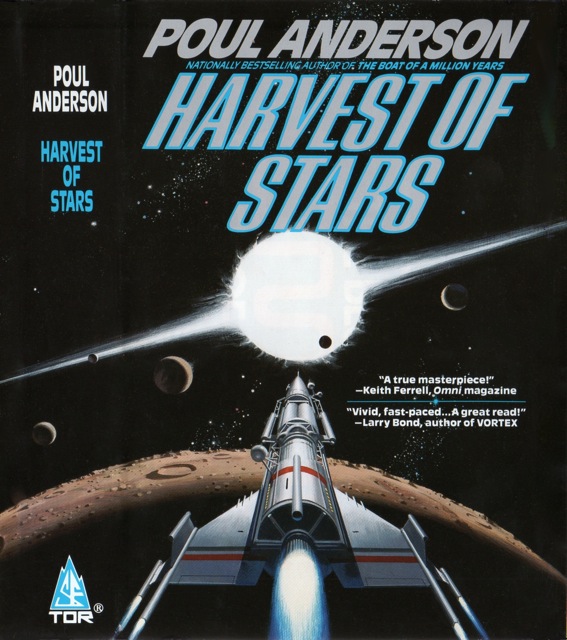
Harvest of Stars follows a spaceship captain and an interstellar power struggle across a near-future solar system where an authoritarian Earth government is losing its grip on off-world colonies and artificial intelligences with their own agendas. Poul Anderson's four-book sequence - Harvest of Stars, The Stars Are Also Fire, Harvest the Fire, The Fleet of Stars - was one of his last major works, extending across generations as its opening characters are succeeded by their descendants.
- Urban Monad
series7 books1970
similar byscience fictionfar futuredystopia+2 more
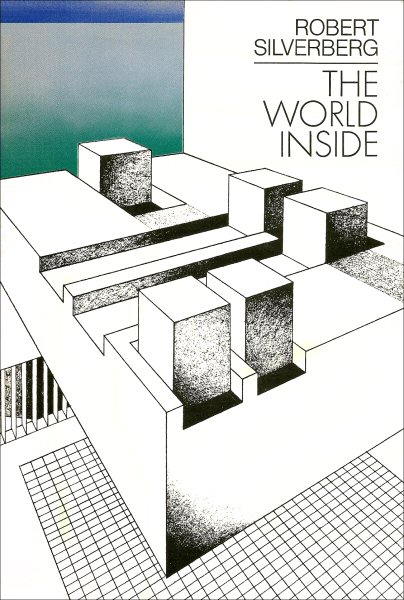
Robert Silverberg's Urban Monad sequence, gathered into the fix-up novel The World Inside (serialized in Galaxy in 1970-71 and a Hugo finalist Silverberg declined), is set inside towering high-rise arcologies -- urban monads -- built to house a wildly overpopulated future Earth. Moving between residents of one tower, the linked stories examine a tightly regulated, sexually permissive society engineered to cope with constant population growth, and the discontent that surfaces underneath it.
- Uglies Universe
series9 books2005
similar byscience fictiondystopia+3 more
Scott Westerfeld's Uglies series is set roughly three centuries in the future, after industrial collapse, in a society that classifies everyone by mandatory cosmetic-surgery life stages - Uglies, Pretties, Middle Pretties, and Crumblies - policed by the surveillance division Special Circumstances. Tally Youngblood, the original tetralogy's protagonist, initially awaits her own operation before learning it also surgically dulls independent thought, driving her toward the hidden resistance community called the Smoke. Beyond the four core novels (Uglies, Pretties, Specials, Extras), the franchise extends into other formats, including the manga-influenced graphic novel Shay's Story, co-written with Devin Grayson, and a later Impostors spin-off series.
- To the Stars (Harrison)
series3 books1980
completed
similar byscience fictionfar futuretensedystopia+2 more
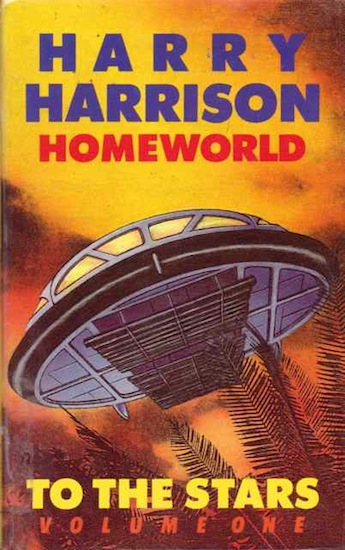
The To the Stars trilogy is a series of science fiction novels by Harry Harrison, first published in 1980 (Homeworld) and 1981. The three books were re-published in an omnibus edition in 1981.
- The Universe After
series3 books2018
similar byscience fictionfar future+2 more
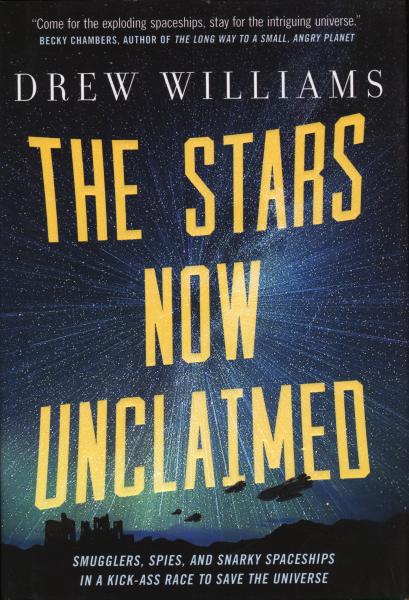
In The Stars Now Unclaimed, Justified operative Jane Kamali is sent to retrieve a teenage girl named Esa whose latent abilities make her a target for the raiders and cults competing to control the last working technology in a galaxy where a mysterious cataclysm wiped out most advanced civilizations centuries ago. Drew Williams' Universe After trilogy follows Jane and Esa across A Chain Across the Dawn and The Firmament of Flame as the stakes widen from one rescue to the fate of the galaxy's remaining worlds.
- Legend (Marie Lu)
series5 books2011
similar byscience fictiontensedystopia+1 more
Marie Lu's Legend follows two teenagers from opposite ends of a divided, war-torn future society — one a celebrated young military prodigy, the other a hunted fugitive — whose paths collide and gradually complicate what each believed about the system that shaped them. The story continues through Prodigy and Champion, with a fourth book, Rebel, added years after the original trilogy closed; Lu has cited the film Les Misérables among her inspirations for its shape.
- The Hunger Games
series3 books2008
part of The Hunger Games Universe
similar bytotalitarianismscience fictionfar futuretensedystopia
The Hunger Games is a series of young adult dystopian novels written by American author Suzanne Collins. The series consists of a trilogy that follows teenage protagonist Katniss Everdeen, as well as two prequels. The Hunger Games universe is a dystopia set in Panem, a post-apocalyptic North American country consisting of the wealthy Capitol and 12 districts in varying states of poverty. As punishment for rebellion, the Capitol hosts an annual battle royale competition called The Hunger Games. Each of the 12 districts must send two children between the ages of 12 and 18 to participate, and the last surviving child is dubbed the victor.
- The Tenth Planet
Edmund Cooperstandalone novel1973
similar bytotalitarianismscience fictionadventurousfar future+1 more
Minerva - The Tenth Planet. So distant, the Sun is just another star, cold and dim... Earth had finally succumbed to nuclear horror. Refugees of the holocaust fled beyond the bounds even of Pluto's orbit - to Sol's Tenth Planet. Grief-stricken at Earth's fate, they have also fled the adventurous spirit which at once was Earth's pride and her downfall. But their static existence under a benevolent dictatorship was about to end for the Minervans. Miraculously, from 50 centuries in the past, comes a man whose bold and daring spirit threatens to lay their very civilization on the rack of rebellion. (from the back cover of the Berkley Medallion first paperback printing)
- Colsec
series3 books1984
completed
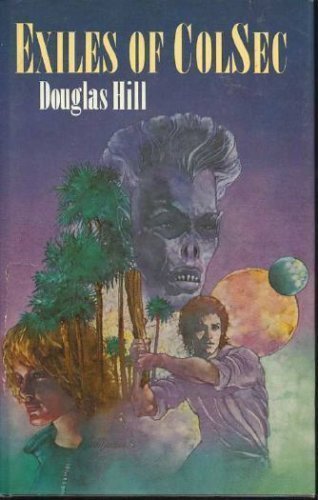
similar bytotalitarianismscience fictionadventurousfar futuretense+1 more
- The Lathe of Heaven
Ursula K. Le Guinstandalone novel1971
similar byscience fictionbig citytensedystopia+1 more
The Lathe of Heaven is a 1971 science fiction novel by American writer Ursula K. Le Guin, first serialized in the American science fiction magazine Amazing Stories. It won the 1972 Locus Award for Best Novel and was a finalist for the 1971 Nebula Award for Best Novel and 1972 Hugo Award for Best Novel. Two television film adaptations were released: the PBS production, The Lathe of Heaven (1980), and Lathe of Heaven (2002), a remake produced by the A&E Network.
- A Clockwork Orange
series4 books1962
completed
similar bytotalitarianismscience fictionbig citydystopia
Anthony Burgess's 1962 novel is narrated by Alex, a teenage gang leader in a near-future Britain gripped by a youth subculture of extreme violence, recounting his crimes in Nadsat, an invented slang blending English with Russian-derived words. After his crimes catch up with him, Alex is made the subject of a controversial state program meant to forcibly reform his behavior, and the novel uses his ordeal to question whether imposed goodness is worth the loss of free will. It is a standalone novel.
- The Fall Revolution
series4 books1995
similar byscience fiction+2 more
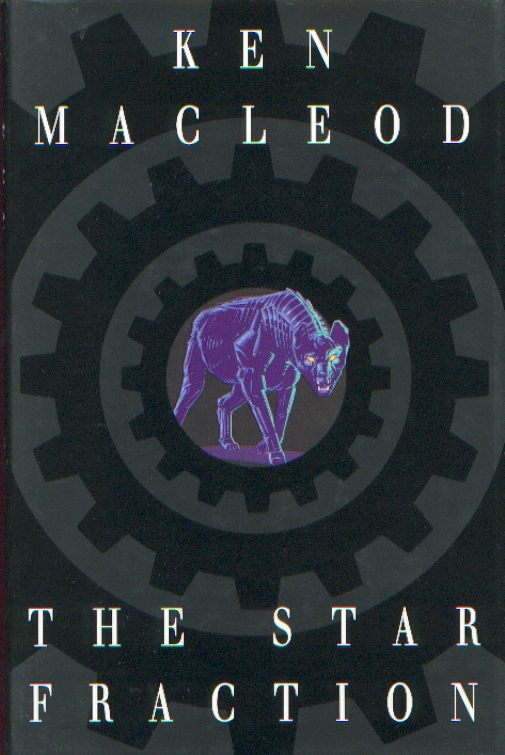
Ken MacLeod's Fall Revolution sequence opens with The Star Fraction (1995), his Arthur C. Clarke Award-nominated debut set in a fractured near-future Britain where a functioning anarchist microstate and rival revolutionary factions vie for power. The four connected novels — continuing through The Stone Canal, The Cassini Division, and The Sky Road — each stand largely alone while tracing overlapping characters and politics across a shared future history, later collected in the omnibus volumes Fractions and Divisions.
- Logan
series8 books1967
similar byscience fictionfar futuredystopia+2 more
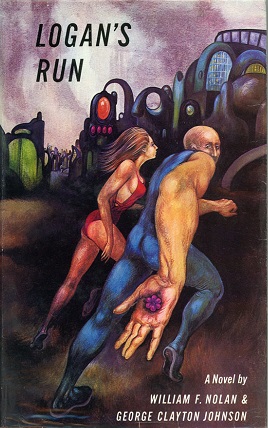
William F. Nolan and George Clayton Johnson's Logan's Run imagines a future society that maintains its population and resources by requiring everyone to die at 21, hunted down by enforcers called Sandmen if they refuse. The 1967 novel's own Sandman protagonist, Logan, becomes a fugitive from the system he once served; Nolan continued the story alone across several further novels decades later, with other writers later adding to the franchise. It's a classic of youth-obsessed dystopian SF, better known today through its 1976 film adaptation.
- Divergent
series10 books2011
similar byscience fictionbig citytensedystopia
Divergent, also known as The Divergent Series, is a series of young adult dystopian novels by American novelist Veronica Roth set in a post-apocalyptic dystopian Chicago. The trilogy consists of Divergent (2011), Insurgent (2012), and Allegiant (2013). A related book, Four (2014), presents a series of short stories told from the perspective of one of the trilogy's characters, the male love interest Tobias. A later short story, We Can Be Mended (2018), serves as an epilogue five years after the events of the trilogy, again from Tobias/Four's perspective.
- The Sheep Look Up
John Brunnerstandalone novel1972
similar byscience fictionbig citydystopia+2 more
The Sheep Look Up is a 1972 dystopian science fiction novel by British author John Brunner, dealing with the deterioration of the environment in the United States. It was nominated for the 1972 Nebula Award for Best Novel.
- Childe Cycle
series19 books1957
similar byscience fictionfar future+2 more
The Childe Cycle is an unfinished series of science fiction novels by American writer Gordon R. Dickson. The name Childe Cycle is an allusion to "Childe Roland to the Dark Tower Came", a poem by Robert Browning, which provided inspiration for elements in the work. The series is sometimes referred to as the Dorsai series, after the Dorsai people who are central to it. The related short stories and novellas all center on the Dorsai, primarily members of the Graeme and Morgan families.
- Julian West
series7 books1888
similar byscience fiction+1 more
Julian West is the time-displaced narrator of Edward Bellamy's Looking Backward, 2000-1887 (1888), a utopian novel in which a nineteenth-century Bostonian wakes from a mesmeric sleep to find his city transformed into a cooperative society more than a century later. Bellamy followed it with Equality (1897), a direct sequel that returns to Julian West's perspective to further elaborate the ideas only sketched in the first book, functioning more as an extended argument than a plotted story. Together the two novels were highly influential on turn-of-the-century utopian and socialist thought.