More like When Michael Calls
anchored on:horrorghost storiesmid 20th centuryeeriegrief and lossfamily secrets+2 more
but
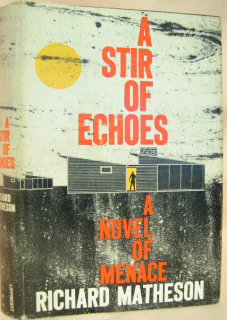
- A Stir of Echoes
Richard Mathesonstandalone novel1958
similar bymid 20th centuryeeriehorrortensenorth americaghost storiesour world+1 more
A Stir of Echoes is a supernatural novel by American writer Richard Matheson, published in 1958. It served as the inspiration for the 1999 film Stir of Echoes.
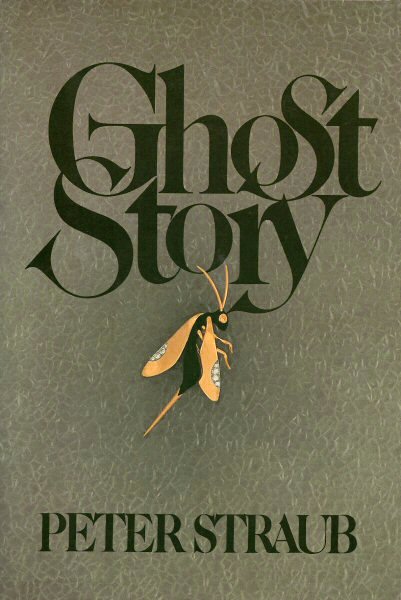
- Ghost Story
Peter Straubstandalone novel1979
similar byhorrorgrief and lossfamily secretseerietensenorth americaghost stories
Four prominent citizens of a small town in upstate New York who share guilt over something that happened in their youth are revisited late in life by a destructive evil force which uses their guilt as an opportunity to destroy them as well as the entire town.
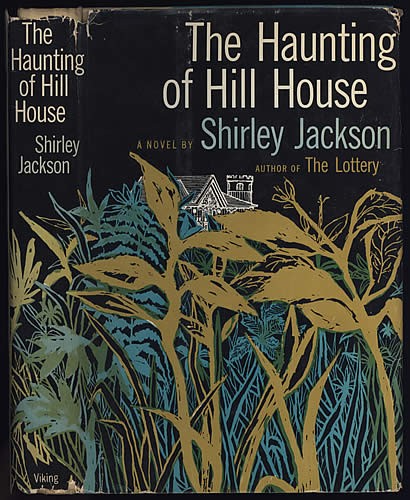
- The Haunting of Hill House
Shirley Jacksonstandalone novel1959
similar bymid 20th centuryeeriehorrornorth americaghost storiesmadness+1 more
The Haunting of Hill House is a 1959 gothic horror novel by American author Shirley Jackson. It was a finalist for the National Book Award and has been made into two feature films, a play, and is the basis of a Netflix series.
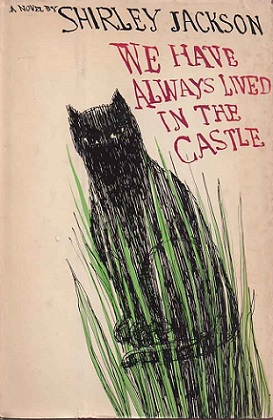
- We Have Always Lived in the Castle
Shirley Jacksonstandalone novel1962
similar bymid 20th centuryeeriefamily secretsnorth americahorrormadness+1 more
A young woman lives with her older sister and sickly uncle in their old family house, after a mysterious tragedy turns the townsfolk against them.
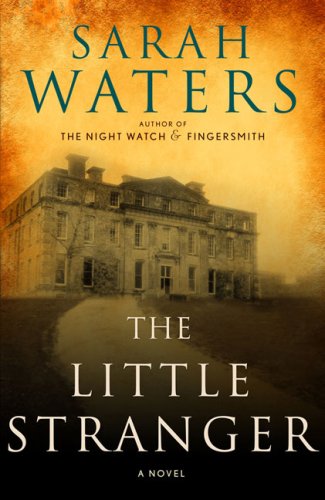
- The Little Stranger
Sarah Watersstandalone novel2009
similar bymid 20th centuryeeriegrief and lossfamily secretstenseghost stories+1 more
The Little Stranger is a 2009 gothic novel written by Sarah Waters. It is a ghost story set in a dilapidated mansion in Warwickshire, England in the 1940s. Departing from her earlier themes of lesbian and gay fiction, Waters' fifth novel features a male narrator, a country doctor who makes friends with an old gentry family of declining fortunes who own a very old estate that is crumbling around them. The stress of reconciling the state of their finances with the familial responsibility of keeping the estate coincides with perplexing events which may or may not be of supernatural origin, culminating in tragedy.
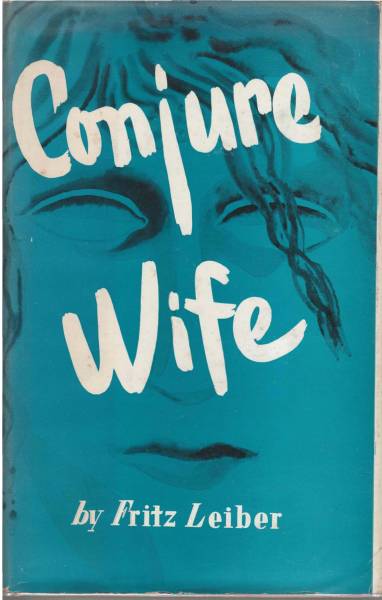
- Conjure Wife
Fritz Leiberstandalone novel1943
similar bymid 20th centuryhorroreerietensenorth americaour world+1 more
From the front cover of the Lion first paperback: "Potions in the house... evil in the air... and a witch in his bed." From the back cover of the Lion first paperback: ""Conjure Wife... is easily the most frightening (and necessarily) the most thoroughly convincing of all modern horror stories. Its premise is that witchcraft still flourishes, or at any rate survives, an open secret among women, a closed book to men. Under the rational overlay of 20th-century civilization this sickly growth, uncultivated, unsuspected, still manages to propagate itself. Leiber develops this theme with the utmost dexterity, piling up alternate layers of the mundane and outre, until at the story's real climax, the shocker at the end of chapter 14, I am not ashamed to say that I jumped an inch out of my seat. From that point onward the story anticlimax so skillfully managed that I am not really certain I touched the slipcover again until after the last page. Leiber has never written anything better... which perhaps is all that needed to be said." Damon Knight, Science Fiction Adventures"
- Wildwood Road
Christopher Goldenstandalone novel2005
similar byeeriehorrortensenorth americaghost storiesour world+3 more
Michael and Jillian Dansky seemed to have it all--a happy marriage, two successful careers, a bright future. But late one October evening, all that changed. Driving home from a Halloween masquerade, Michael momentarily nods off behind the wheel--and wakes to find nothing is the same.Standing by his car is the little girl he came within a breath of running down. She leads Michael to her "home," an empty house haunted by whispers, and sends him away with a haunting whisper of her own: "come find me." But in the weeks to follow, it's clear that someone--or some thing--doesn't want Michael to find her: ominous figures in grey coats with misshapen faces are following him everywhere. And then Jillian wakes one morning replaced by a cold, cruel, vindictive woman Michael hardly recognizes as his wife. Michael must now search not only for the lost girl, but for a way to find the Jillian he's always loved, and to do so he must return to where the nightmare began. Down an isolated lane where he'll find them, or die trying.From the Trade Paperback edition.
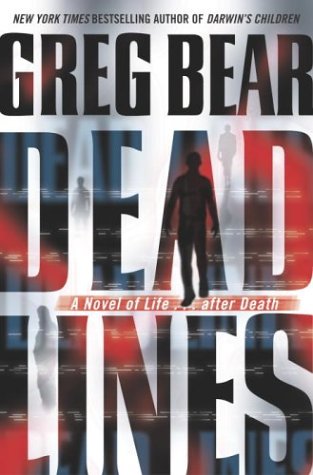
- Dead Lines
Greg Bearstandalone novel2004
similar byhorrorgrief and losseerienorth americaghost storiesmadnessour world+1 more
From the flaps of the Ballantine first edition: "For the last two years, Peter Russell has mourned the death of one of his twin daughters - who was just ten when she was murdered. Recent news of his best friend's fatal heart attack has now come as another devastating blow. Divorced, despondent, and going nowhere in his career, Peter fears his life is circling the drain. Then Trans comes along. The brainchild of an upstart telecom company, Trans is (as its name suggests) a transcendent marvel, a sleek, handheld interpersonal communication device capable of flawless operation anywhere in the world, at any time. "A cell phone, but not" - transmitting with crystal clarity across a newly discovered, never-utilized bandwidth... and poised to spark a new-technology revolution. When its creators offer Peter a position on their team, it should be a golden opportunity for him. If only he wasn't seemingly going mad. Everywhere Peter turns, inexplicable apparitions are walking before him or reaching out in torment. After a chilling encounter with his own lost child he begins to grasp the terrifying truth: Trans is a Pandora's box that has tapped into a frequency not of this world... but of the next. And now, via this open channel to oblivion, the dead have gained access to the living. For Peter, and for humankind, a long shadowy night of the soul has descended, bringing with it the stuff of a horrifying nightmare from which they may never awaken."
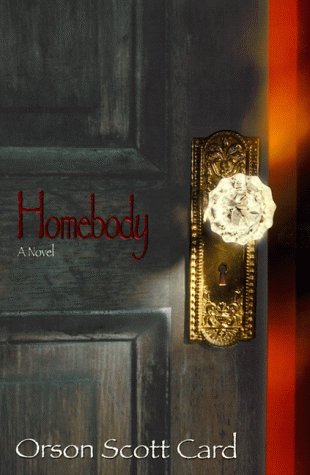
- Homebody
Orson Scott Cardstandalone novel1998
similar byeeriehorrorgrief and lossfamily secretsnorth americaghost storiesmadness
Homebody (1998) is a horror novel by American writer Orson Scott Card. It takes place in modern-day America.
- Jerusalem's Lot
series3 books1975
similar byhorrortensenorth americagrief and losseerieour world
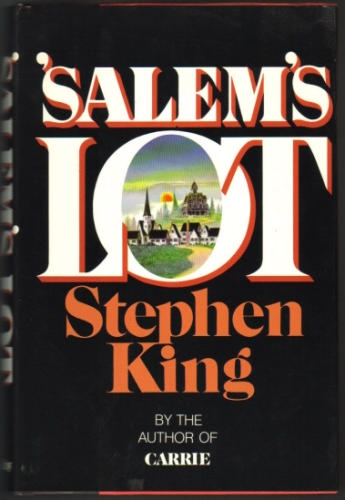
Stephen King's 1975 novel 'Salem's Lot follows writer Ben Mears as he returns to his childhood town of Jerusalem's Lot, Maine, only to discover that its residents are being turned into vampires by a newly arrived stranger. It transplants Gothic vampire horror into a small New England community, tracking that community's collapse under a supernatural siege. It is a single, self-contained novel.
- Floating Staircase
Ronald Malfistandalone novel2010
similar byhorrorghost storiesfamily secretseerietensenorth america+1 more
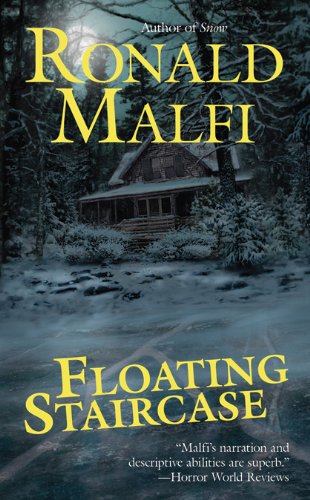
Floating Staircase is a ghost story/mystery novel by American writer Ronald Malfi. It was published in 2011 by Medallion Press, with a limited edition hardcover collectors edition from Thunderstorm Books, which contained an original author's "Afterward" not in the paperback novel. The novel was nominated by the Horror Writers Association for a Bram Stoker Award for Best Novel, and it won a Gold IPPY Award for best horror novel of 2011.
- The Crying Child
Barbara Michaelsstandalone novel1971
similar bymid 20th centuryeeriegrief and lossfamily secretsnorth americaghost storiesour world+1 more
The Crying Child is a 1971 mystery novel by Barbara Mertz, published under the pen name Barbara Michaels. It follows a woman named Joanne who arrives on an island off the coast of Maine to help comfort her sister, Mary, who has been behaving oddly after having multiple miscarriages. Mary claims to hear the sound of a child crying; eventually, Joanne begins to hear it as well.
- Dagon
Fred Chappellstandalone novel1968
similar bymid 20th centuryhorrorfamily secretseerienorth americamadnessour world+1 more
Dagon is a novel by author Fred Chappell published in 1968. The novel is a psychological thriller with supernatural elements, attempting to tell a Cthulhu Mythos story as a psychologically realistic Southern Gothic novel. It was awarded the Best Foreign Book of the Year prize by the French Academy in 1972.
- Julia
Peter Straubstandalone novel1975
similar byeeriehorrorgrief and lossfamily secretsghost stories+1 more
Julia is a 1975 novel by American writer Peter Straub. The work is Straub's first novel to deal with the supernatural and was published through Coward, McCann & Geoghegan. Julia was later adapted into the 1977 film Full Circle, starring Mia Farrow.
- If You Could See Me Now
Peter Straubstandalone novel1976
similar byhorrorgrief and losseerienorth americaghost storiesour world+1 more
If You Could See Me Now is a horror novel by American author Peter Straub. It is his third novel and his second work of gothic or supernatural fiction. The book was published by Jonathan Cape in June 1977 – the same London publisher who published Julia in 1976. Coward, McCann & Geoghegan published an American edition also in June 1977.
- Fatal Secrets
Richie Tankersley Cusickstandalone novel1992
similar byeeriegrief and lossfamily secretstensenorth americaghost storiesour world+1 more
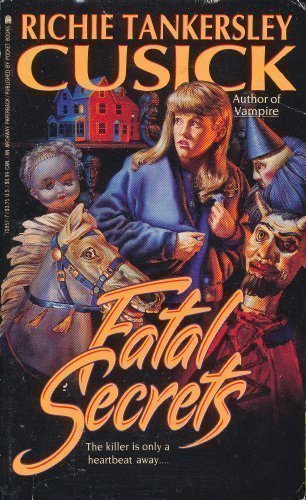
After her sister drowns, Ryan McCauley is haunted by the dead girl’s past.. Two sisters walk through a snowy wood, collecting pinecones for Christmas decorations. Something has frightened Marisa, and she’s about to explain it to Ryan, her younger sister, when she steps onto a patch of thin ice. Marisa plummets into the frigid water below, and though Ryan tries to save her, there’s nothing she can do. Even though the accident wasn’t her fault, Ryan is consumed by guilt. But guilt is not what she should be afraid of. Three weeks after Marisa’s death, Ryan sees her everywhere. At night she feels something following her, but when she turns around there’s nothing there. A creepy college friend of Marisa’s shows up at Ryan’s house, and her mother asks him to stay through Christmas. To free herself of guilt, Ryan must unlock Marisa’s terrible secret—before death takes her too.
- The Haunting of Blackwood House
Darcy Coatesstandalone novel2015
similar byeeriehorrorghost storiesfamily secretstensenorth americaour world
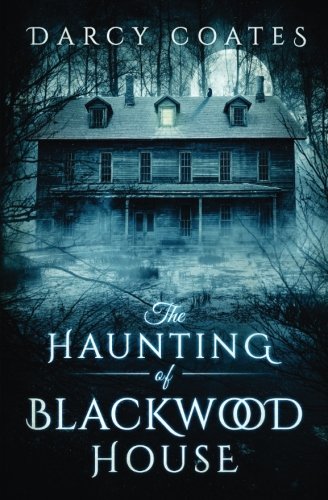
"Could you survive a week in a haunted house? Mara is the daughter of spiritualists. Her childhood was filled with séances, scam mediums and talk of ghostly presences. When Mara finally left her family's home, she vowed she would never allow superstition or false religion into her life again. Now she's ready to start over with her fiancé, Neil, in a world based on rationality and facts. But her past isn't ready to let her go just yet. Mara and Neil purchase Blackwood House, a derelict property outside of town. They're warned about strange occurrences in the crumbling building. Doors open by themselves, voices whisper in the night, bloody handprints appear on the walls, and cold spots linger in the basement, where the house's original owner was murdered. But Blackwood was dirt-cheap and came with a large plot of overgrown land. Mara loves her new home, and disregards the warnings. Because ghosts aren't real...are they?" – quoted from this book's product page on Amazon.com as of 2018-01-20.
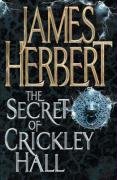
- The Secret of Crickley Hall
James Herbertstandalone novel2006
similar byeeriehorrorghost storiesfamily secretstense+1 more
The Secret of Crickley Hall is a 2006 supernatural thriller novel by the British writer James Herbert.
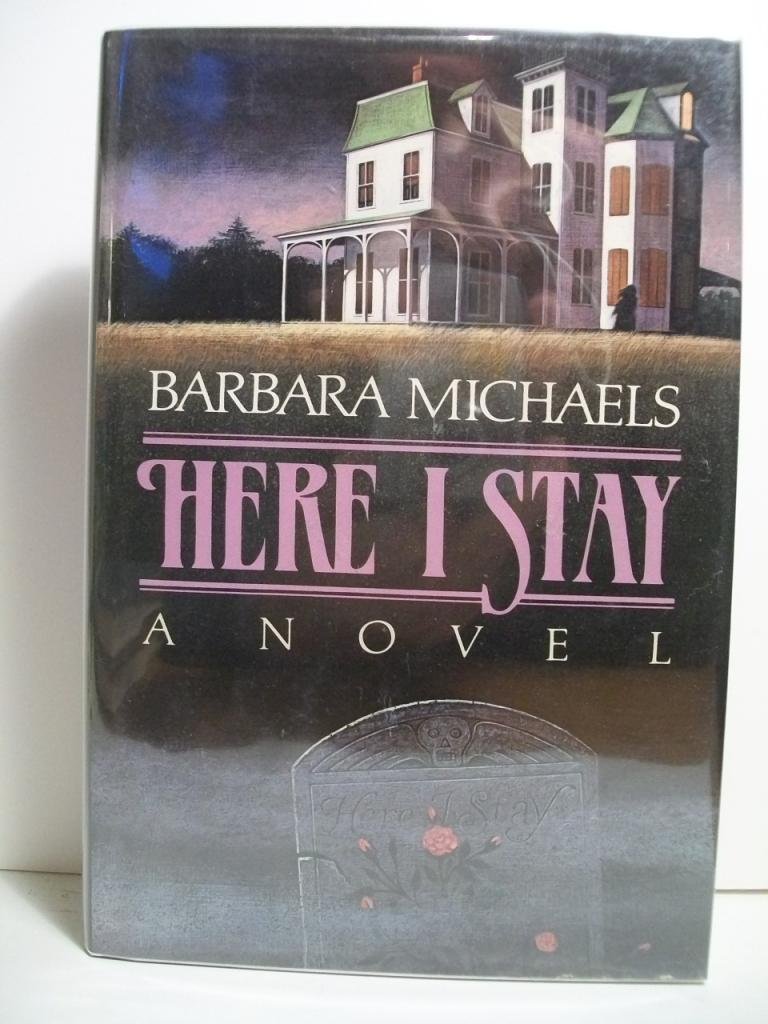
- Here I Stay
Barbara Michaelsstandalone novel1983
similar byeeriefamily secretstensenorth americahorrorghost stories+1 more
Andrea Torgesen is certain that hard work is exactly what her younger brother Jim needs to help him recover from the trauma of a serious car accident—and turning a decrepit old mansion into a beautiful country inn seems to be the perfect project. But unearthly voices and eerie visions haunt Jim from almost the first instant he sets foot in the dreary old house. And his strange obsession with a long-neglected graveyard is most troubling to his concerned sibling. There is evil in this place where the unthinkable is possible—a terrifying force that Andrea and Jim must confront . . . or forfeit their lives.
- Insomnia
Stephen Kingstandalone novel1994
similar byhorrorgrief and losseerietensenorth americamadness
When an elderly widower in Maine finds himself with sleep maintenance insomnia, awakening early every morning, this state of exhaustion allows him to perceive a higher state of reality, where he learns of an impending disaster which will shake not just the Earthly reality. but all the higher realities, and which he has been recruited to prevent.
- Peace
Gene Wolfestandalone novel1975
similar bymid 20th centuryfamily secretseerienorth americaghost stories+2 more
Peace is a 1975 psychological fantasy/ghost story novel by American writer Gene Wolfe. It is the story of a man from a small Midwestern town in the early to mid-20th century, Alden Dennis Weer, who narrates various memories from different parts of his life, including his childhood, early adulthood, and middle to old age.
- White Smoke
Tiffany D. Jacksonstandalone novel2021
similar byhorrorfamily secretseerietensenorth americaghost stories+1 more
Marigold is running from ghosts. The phantoms of her old life keep haunting her, but a move with her newly blended family from their small California beach town to the embattled Midwestern city of Cedarville might be the fresh start she needs. Her mom has accepted a new job with the Sterling Foundation that comes with a free house, one that Mari now has to share with her bratty ten-year-old stepsister, Piper. The renovated picture-perfect home on Maple Street, sitting between dilapidated houses, surrounded by wary neighbors has its... secrets. That’s only half the problem: household items vanish, doors open on their own, lights turn off, shadows walk past rooms, voices can be heard in the walls, and there’s a foul smell seeping through the vents only Mari seems to notice. Worse: Piper keeps talking about a friend who wants Mari gone. But "running from ghosts" is just a metaphor, right? As the house closes in, Mari learns that the danger isn’t limited to Maple Street. Cedarville has its secrets, too. And secrets always find their way through the cracks.
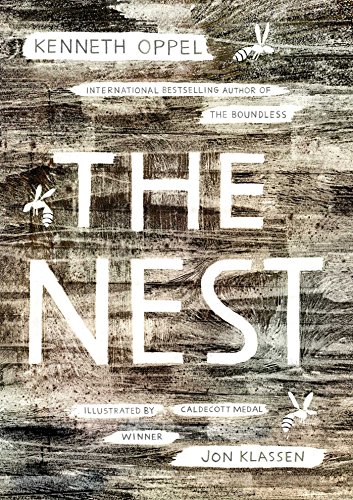
- The Nest
Kenneth Oppelstandalone novel2015
similar byeeriehorrorgrief and losstensenorth americaour world+1 more
For some kids summer is a sun-soaked season of fun. But for Steve, it s just another season of worries. Worries about his sick newborn baby brother who is fighting to survive, worries about his parents who are struggling to cope, even worries about the wasp s nest looming ominously from the eaves. So when a mysterious wasp queen invades his dreams, offering to fix the baby, Steve thinks his prayers have been answered. All he has to do is say Yes. But yes is a powerful word. It is also a dangerous one. And once it is uttered, can it be taken back?
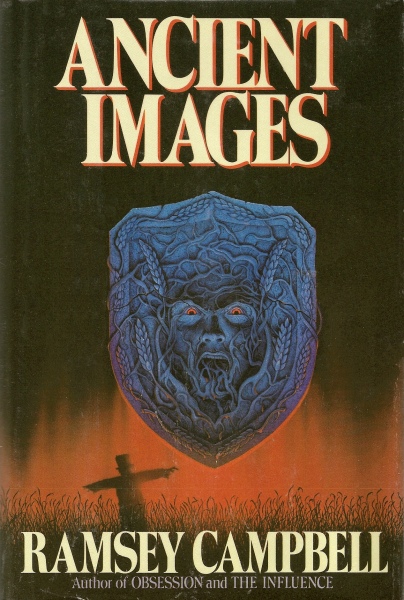
- Ancient Images
Ramsey Campbellstandalone novel1989
similar byhorrorfamily secretseerietensenorth americaour world+1 more
A lost horror film holds the key to terrifying secrets. The legends have persisted for decades of a lost horror film starring Boris Karloff and Bela Lugosi that was never released. Rumor has it that, for reasons long forgotten, powerful forces suppressed the film and burned all known prints. Nobody now living has seen the finished film. But that might no longer be true… Film researcher Sandy Allan is invited to a screening of a newly-discovered sole-surviving print, but then the film disappears and the real horror begins. Sandy’s search for the film leads her to Redfield, a rural community known its rich soil, fertilized by blood from an ancient massacre. But Redfield guards its secrets closely, with good reason. During every step of her search, Sandy is watched, shadowed by strange figures. Is it paranoia, or is someone—or something—determined to keep the lost film and the secrets it reveals buried forever?