Loreful
HomeDiscover
Search series, authors…⌘K
Loreful

Reading orders for SF/F series and shared universes — with your place kept in every one.

Explore

UniversesSeriesWorksAuthorsAtlas

Help

FAQAboutSite map

Account & legal

Sign inCreate accountPrivacyTerms

Data

Built on ISFDB, Wikipedia, Wikidata and Open Library. Curated reading orders carry their reasoning on the page; the rest follow publication order. Data sources & licenses

© Loreful · data: ISFDB · CC BY

More like Wrack & Roll

anchored on:science fictionmusicalternate historynorth americafunny

but

Mood

The mood the book leaves you in.

  • The reading experience is propelled by journeys, exploration, and physical risk; excitement and forward momentum dominate over dread or introspection.
  • Joy and loss are deliberately mixed; the resolution grants characters something real while taking something else away, leaving warmth and sorrow together.
  • The book demands work from the reader — dense prose, difficult structure, unfamiliar ideas, or morally uncomfortable material — as part of its intended effect.
  • Grim events, cruelty, or despair dominate the atmosphere, and the book does not soften them with comfort or comic relief.
  • The atmosphere is quietly unsettling — wrongness, unease, and the uncanny pervade the book without necessarily escalating into overt horror.
  • The book is built to move the reader; character feeling is foregrounded and major scenes aim at a strong emotional response.
  • Humor is a primary aim and the prose plays for laughs — comic situations, wit, or dialogue produce sustained comedy, not occasional levity.
  • The book insists that things can improve; effort and decency are shown to matter, and the arc bends toward better outcomes even through hardship.
  • The book teaches as it goes — real facts, history, science, or craft are conveyed in enough depth that learning is part of the reading experience.
  • The book is designed to uplift and motivate, presenting perseverance or achievement in a way that invites the reader to aspire or act.
  • The overall register is cheerful and easygoing; stakes are kept gentle and the book avoids dwelling on pain or dread.
  • Withheld information drives the experience; the book sustains enigmas and secrets the reader wants resolved, whatever its genre.
  • The book is contemplative and inward-looking, giving more weight to thought, memory, and meaning than to external events.
  • The book works as comfort reading — low tension, a soothing pace, and an atmosphere the reader can unwind in.
  • Grief, loss, or melancholy set the dominant register, and the book lets sorrow stand rather than resolving it into comfort.
  • Sustained suspense is the point; the book keeps the reader braced for what happens next through danger, pressure, or impending revelation.
  • Playful invention and charm define the register — fanciful conceits, light absurdity, and a narration that delights in its own oddity.

About

What the story runs on.

  • Stories in which extraterrestrial beings are central — as characters, cultures, or the object of the plot.
  • Stories about venturing into space to explore — survey missions, astronauts, and the frontier of the unknown beyond Earth.
  • Stories about minds with paranormal abilities — telepathy, telekinesis, precognition, empathy — and how societies handle those who have them.
  • Stories in which staying alive against nature, catastrophe, or scarcity is the central problem.
  • Stories in which a friendship — its making, testing, or loss — is the emotional center.
  • Stories of growing up — a young protagonist crossing from childhood into adult knowledge and responsibility.
  • Stories about who a character truly is — self-discovery, doubled lives, and the search for a self.
  • Stories about mourning — living through the death of a loved one and what loss does to the survivors.
  • Stories in which a buried family truth — hidden parentage, crimes, or shames — surfaces and reorders the present.
  • Stories driven by maneuvering for power — factions, conspiracies, and statecraft conducted in shadow.
  • Stories in which war itself is the subject — combat, occupation, and what warfare does to soldiers and civilians.
  • Stories organized around investigating a killing — the case, the clues, and the pursuit of the killer, in any genre's clothing.

Shelf

Where it sits in the library.

    • Fiction built on magic or other supernatural elements that have no scientific explanation.
    • Secondary-world fantasy at large scale, where the fate of nations or the world turns on the protagonists' struggle.
    • Fantasy set in a recognizably modern city or contemporary world where the supernatural intrudes on everyday life.
    • Fantasy that blends in horror's atmosphere and imagery, keeping a fantastical frame around grim or frightening material.
    • Action-driven fantasy following warriors or rogues with personal stakes against sorcerous threats, rather than world-spanning conflicts.
    • Fantasy set in a real historical period or a close analogue of one, with magic woven into the era.
    • Fantasy in which protagonists cross from the ordinary world into another world through a portal or similar passage.
    • Fiction that retells or reworks a traditional fairy tale in a new form or setting.
    • Fantasy drawing directly on myths, legends, and folklore, retelling them or building on their figures and logic.
    • Fantasy of ghosts, vampires, shapeshifters, psychics, and similar phenomena, usually set in an otherwise ordinary world.
    • Fiction mixing science-fictional trappings with overtly magical or impossible elements in one setting.
    • Low-stakes fantasy emphasizing comfort, community, and everyday pleasures over conflict and peril.
    • Speculative fiction of pervasive moral ambiguity, violence, and cynicism that rejects heroic conventions — fantasy and SF alike.
      • Fiction that extrapolates from science and technology — future societies, space travel, or speculative inventions — within at least nominally natural laws.
      • Science fiction of interstellar scope — starships, galactic polities, and adventure across star systems.
      • Science fiction committed to scientific rigor, where technical plausibility constrains the story.
      • Science fiction centered on armed forces and warfare, told largely from a military point of view.
      • Science fiction of networked, corporate-dominated near futures, pairing high technology with social decay.
      • Science fiction styled on nineteenth-century steam-powered technology, often in a Victorian or pseudo-Victorian setting.
      • Fiction depicting an oppressive or catastrophic society, presented as a warning.
      • Fiction set after civilization's collapse, following survivors in the ruins of the old world.
      • Fiction in which characters move between past and future, and the mechanics or consequences of that travel drive the plot.
      • Fiction exploring a world where a historical event went differently and history diverged from ours.
      • Science fiction about humanity's first encounter and communication with an alien intelligence.
      • Science fiction in which extraterrestrial forces attack or occupy Earth and humanity resists.
      • Fiction whose primary aim is to frighten or unsettle the reader through dread, menace, or the monstrous.
      • Horror of vast, indifferent, incomprehensible entities before which humanity is insignificant, in the Lovecraft tradition.
      • Horror of decaying houses, buried family secrets, and oppressive atmosphere in the Gothic literary tradition.
      • Horror centered on hauntings and the returning dead.
      • Horror located in the mind — paranoia, obsession, and unreliable perception rather than external monsters.
      • Horror built around the reanimated dead and survival amid their outbreaks.
      • Horror defined by explicit, transgressive gore that refuses to cut away from violence.
      • Speculative fiction of the strange and uncanny that resists both natural explanation and standard genre categories.
      • Fiction organized around solving a crime or puzzle, typically following an investigator toward the identification of a culprit.
      • A puzzle-first mystery that lays out clues so the culprit's identity can be deduced before the reveal.
      • Crime fiction of moral ambiguity, fatalism, and hard-edged style, set among the corrupt and the doomed.
      • A mystery following the realistic routines of police work — forensics, interviews, and case-building.
      • A gentle mystery with an amateur sleuth, a small community, and violence kept off the page.
      • A mystery set in a past era, where the investigation works within that period's methods and society.
      • Fast-paced fiction driven by imminent danger, pursuit, or high-stakes conspiracy, built to sustain tension.
      • A thriller of espionage — agents, tradecraft, and intelligence services in conflict.
      • A thriller centered on lawyers and the courtroom, where litigation carries the suspense.
      • A thriller driven by detailed contemporary or near-future technology, often military or scientific.
      • A thriller whose tension comes from mental states and manipulation between characters rather than external action.
      • Fiction whose central plot is a romantic relationship and its development toward an emotionally satisfying resolution.
      • Romance in which one or both partners are supernatural beings, blending fantasy elements into the love story.
      • A fantasy-romance hybrid in which the romantic arc and the fantasy plot carry equal weight.
      • Romance set in a past era, with courtship shaped by the period's society and manners.
      • Romance set in the present day, without supernatural or historical elements.
      • Fiction set in a real past period, where the historical setting materially shapes characters and events.
        • General and literary fiction emphasizing prose style, character interiority, or formal ambition over genre plot conventions.
        • Fiction in a realistic world where magical events occur and are treated as ordinary, in the tradition of Latin American literature.
        • Fiction that ridicules people, institutions, or society in order to criticize them.
        • Fiction of dreamlike, irrational imagery and logic that breaks from realistic representation.
        • Fiction that plays with narrative convention through metafiction, fragmentation, and self-reference.
        • Fiction propelled by journeys, exploration, and physical peril, where action and survival carry the plot.
        • Adventure fiction of ships and seafaring — naval engagements, voyages, and life at sea.
        • Fiction of the American frontier West — gunmen, ranchers, and lawmen, typically in the late nineteenth century.
        • Fiction centered on soldiers, campaigns, and the experience of warfare, historical or imagined.
          • Fiction written primarily to amuse, using comedic situations, wit, or parody as its organizing principle.
            • Multi-generational fiction following a family or dynasty across decades, with inheritance and kinship as the through-line.
              • Fiction whose world runs on explicit game mechanics — levels, stats, and skills that characters can see and exploit.
                • Fiction about costumed or superpowered heroes and their conflicts with comparable villains.

                Practical

                How long a commitment, whether it stands alone, and whether it has finished.

                Tap a chip to ask for it · tap again to rule it out · once more to clear. Numbers show what would be left.

                • Cover of You Don't Love Me Yet
                  You Don't Love Me Yet

                  Jonathan Lethem · standalone novel · 2007

                  similar bymusicfunnynorth america

                  You Don't Love Me Yet (2007) is a comic novel about alternative music from Jonathan Lethem, set in modern Los Angeles.

                • Cover of Cat's Cradle
                  Cat's Cradle

                  Kurt Vonnegut & Jr. · standalone novel · 1963

                  similar byfunnyscience fiction+2 more

                  Cat's Cradle is a satirical postmodern novel, with science fiction elements, by American writer Kurt Vonnegut. Vonnegut's fourth novel, it was first published on March 18, 1963, exploring and satirizing issues of science, technology, the purpose of religion, and the arms race, often through the use of morbid humor. The novel was nominated for the Hugo Award for Best Novel in 1964.

                • Cover of Jennifer Government
                  Jennifer Government

                  Max Barry · standalone novel · 2003

                  similar byfunnynorth americascience fictionalternate history

                  In the near future, where most of the English-speaking world is part of the United States, whose government has become vestigial, police departments are for hire, and corporations and their customer loyalty alliances possess almost unlimited power; a sundry cast of characters are caught up in various levels of a power struggle.

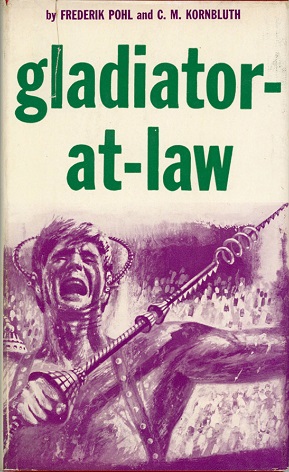
                • Cover of Gladiator-at-Law
                  Gladiator-at-Law

                  C. M. Kornbluth & Frederik Pohl · standalone novel · 1955

                  similar byfunnynorth americascience fiction

                  Gladiator-At-Law is a satirical science fiction novel by American writers Frederik Pohl and Cyril M. Kornbluth. It was first published in 1955 by Ballantine Books and republished in 1986 by Baen Books.

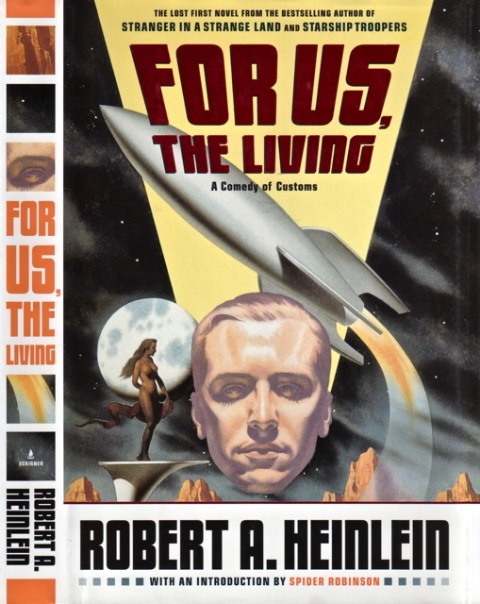
                • Cover of For Us, the Living: A Comedy of Customs
                  For Us, the Living: A Comedy of Customs

                  Robert A. Heinlein · standalone novel · 2004

                  similar byfunnynorth americascience fiction

                  For Us, the Living: A Comedy of Customs is a science fiction novel by American writer Robert A. Heinlein. It was written in 1938 and published for the first time in 2003. Heinlein admirer and science fiction author Spider Robinson titled his introductory essay "RAH DNA", as he believes this first, unpublished novel formed the DNA of Heinlein's later works.

                • Cover of Crosstalk
                  Crosstalk

                  Connie Willis · standalone novel · 2016

                  similar byfunnynorth americascience fiction

                  Crosstalk is a science fiction novel by Connie Willis, published in 2016. It is a romantic comedy that explores the intersection of telephones and telepathy. In a similar situation to Bellwether and Passage, the main character, Briddey Flannigan, is part of a larger institution who gets caught up in series of escalating events. Additionally, Crosstalk like Bellwether and Passage feature themes of neuroscience, communication and technology.

                • Cover of Agent to the Stars
                  Agent to the Stars

                  John Scalzi · standalone novel · 2005

                  similar byfunnynorth americascience fiction

                  "The space-faring Yherajk have come to Earth to meet us and to begin humanity's first interstellar friendship. There's just one problem: They're hideously ugly and they smell like rotting fish. Gaining humanity's trust isn't easy when you look like a B-movie terror. The Yherajk need someone who can help them close the deal. Thomas Stein knows all about closing deals - he's one of Hollywood's hottest young agents who's just closed the biggest deal of his career. But it's one thing to sell your client when she's a hot young starlet. It's another thing entirely when your client is an entire alien species, depending on you to pull off the greatest introduction in this history of man. Stein's going to need all his smarts, all his skills, and all his wits to earn his percentage and his place in history." [Source: front dust jacket flap of Subterranean Press edition]

                • Cover of Buddy Holly Is Alive and Well on Ganymede
                  Buddy Holly Is Alive and Well on Ganymede

                  Bradley Denton · standalone novel · 1991

                  similar byfunnymusicscience fiction

                  Buddy Holly is Alive and Well on Ganymede is a 1991 comedic science fiction novel by Bradley Denton.

                • Cover of Year Zero
                  Year Zero

                  Rob Reid · standalone novel · 2012

                  similar byfunnynorth americascience fiction+1 more

                  Low-level entertainment lawyer Nick Carter thinks it's a prank, not an alien encounter, when a redheaded mullah and a curvaceous nun show up at his office. But Frampton and Carly are highly advanced (if bumbling) extraterrestrials. The entire cosmos, they tell him, has been hopelessly hooked on American pop songs ever since "Year Zero" (1977 to us), resulting in the biggest copyright violation since the Big Bang and bankrupting the whole universe. Nick has just been tapped to clean up this mess before things get ugly. Thankfully, this unlikely galaxy-hopping hero does know a thing or two about copyright law. Now, with Carly and Frampton as his guides, Nick has forty-eight hours to save humanity—while hoping to wow the hot girl who lives down the hall from him. (Source: publisher's website)

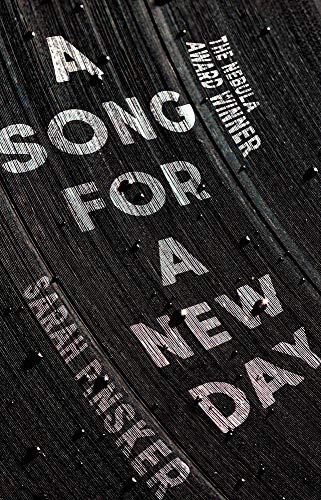
                • Cover of A Song for a New Day
                  A Song for a New Day

                  series · 4 books · 2015

                  similar bymusicnorth americascience fiction

                • Cover of Mr. Adam
                  Mr. Adam

                  Pat Frank · standalone novel · 1946

                  similar byfunnynorth americascience fiction

                  Publisher: Would you like to be the only man in the world who could be a father? Mr. Adam was that man! What happened to him after an atom bomb explosion made every other living male sterile is an extremely funny story.

                • Cover of The Armageddon Rag
                  The Armageddon Rag

                  George R. R. Martin · standalone novel · 1983

                  similar bymusicnorth america+1 more

                  The Armageddon Rag is a 1983 mystery/fantasy novel by American author George R. R. Martin, first co-published in hardcover by both Poseidon Press and The Nemo Press. The novel contains subdued and hidden fantasy elements and is structured in the form of a murder mystery; it is also a meditation on the rock music era of the 1960s and what became of both by the mid-1980s. The novel contains a detailed account of the history and repertoire of its imaginary rock band, including concert setlists and album track timings. Each of the novel's chapter headings open with actual famous rock lyrics, whose meanings resonate throughout that chapter.

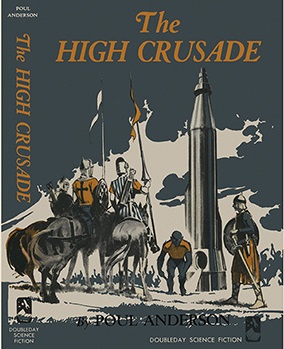
                • Cover of The High Crusade
                  The High Crusade

                  Poul Anderson · standalone novel · 1960

                  similar byfunnyscience fictionalternate history

                  The High Crusade is a science fiction novel by American writer Poul Anderson, about the consequences of an extraterrestrial scoutship landing in medieval England. Poul Anderson described the novel as "one of the most popular things I've ever done, going through many book editions in several languages."

                • Cover of All Our Wrong Todays
                  All Our Wrong Todays

                  Elan Mastai · standalone novel · 2017

                  similar bynorth americascience fictionalternate history+1 more

                  All Our Wrong Todays is a 2017 science fiction novel by Canadian screenwriter Elan Mastai. It is Mastai's debut novel and was first published in February 2017 in the United States by Dutton, in Canada by Doubleday Canada, and in the United Kingdom in March 2017 by Michael Joseph. The novel is about a man from a utopia in an alternate reality who finds himself stuck in our reality after a time travel accident.

                • Cover of A Specter Is Haunting Texas
                  A Specter Is Haunting Texas

                  Fritz Leiber · standalone novel · 1968

                  similar byfunnynorth americascience fiction

                  A Specter is Haunting Texas is a science fiction novel by American writer Fritz Leiber, first published as a novel in 1969. It was originally published as a three-part serial in the magazine Galaxy Science Fiction in 1968. The title appears to be based on a Karl Marx quote from The Communist Manifesto: "A spectre is haunting Europe...the spectre of communism."

                • Cover of Black No More
                  Black No More

                  George S. Schuyler · standalone novel · 1931

                  similar byfunnynorth americascience fiction

                  Black No More: Being an Account of the Strange and Wonderful Workings of Science in the Land of the Free, A.D. 1933-1940 is a 1931 Harlem Renaissance satire on American race relations by George S. Schuyler. In the novel, Schuyler targets both the Ku Klux Klan and NAACP in condemning the ways in which race functions as both an obsession and a commodity in early twentieth-century America. The central premise of the novel is that an African American scientist invents a process that can transform Black people into white people. Those who have internalized white racism, those who are tired of inferior opportunities socially and economically, and those who simply want to expand their sexual horizons, undergo the procedure. As the country "whitens", the economic importance of racial segregation in the South as a means of maintaining elite white economic and social status becomes increasingly apparent, as the South relies on Black labor through sharecropping.

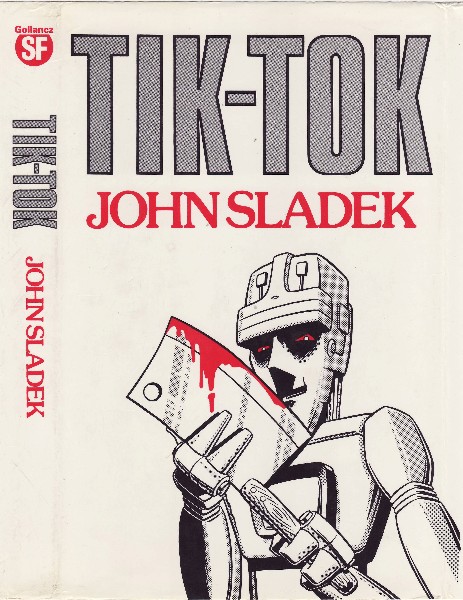
                • Cover of Tik-Tok
                  Tik-Tok

                  John Sladek · standalone novel · 1983

                  similar byfunnynorth americascience fiction

                  From the back cover DAW paperback: ""A robot shall not injure a human being or through inaction allow a human being to come to harm." - Asimov's First Law of Robotics. Tik-Tok was one of the finest domestic robots ever made, but his asimov circuits were defective. He could injure people as much as he pleased - and he pleased to do it often! But the life of a robot (if that isn't a contradiction) is still all service and unpaid labor. Tik Tok served many masters, all of whom came to a bad end. Happily he went on gathering steam with a trail of catastrophes getting bigger and bigger, destined to culminate with his campaign for the vice-presidency of the United States! Science Fiction Review calls John Sladek "one of the true and original lunatics of science fiction... one of the funniest writers in the field." Now read the hilarious autobiography of Sladek's asimovian scofflaw!"

                • Cover of Little Green Men
                  Little Green Men

                  Christopher Buckley · standalone novel · 1999

                  similar byfunnynorth americascience fiction

                  Little Green Men is a satirical novel by Christopher Buckley, first published in 1999. The novel follows a fictional "Inside the Beltway" talk-show host whose career and life is altered forever when he is abducted by aliens.

                • Cover of Be More Chill
                  Be More Chill

                  Ned Vizzini · standalone novel · 2004

                  similar byfunnynorth americascience fiction

                  Be More Chill is a novel written by American author Ned Vizzini and published on June 1, 2004. It follows unpopular high school student and social outcast Jeremy Heere, who is considered a loser by his peers. Deeply unsatisfied with his poor reputation and lack of romantic and sexual progress with his crush Christine, Jeremy obtains a SQUIP, a supercomputer in the form of a pill that travels to his brain upon ingestion and radically transforms Jeremy’s behavior and social status by giving him advice on how to be cool. The book was received positively for its amusing premise, plot, and humor. It has been adapted into a popular stage musical and a graphic novel.

                • Cover of As She Climbed Across the Table
                  As She Climbed Across the Table

                  Jonathan Lethem · standalone novel · 1997

                  similar byfunnynorth americascience fiction

                  As She Climbed Across the Table is a 1997 science fiction novel by the American writer Jonathan Lethem. It is a satirical story set on the fictional campus of Beauchamp University in Northern California. Particle physicist Alice Coombs rooms with narrator Philip Engstrand, an anthropologist researching conflicts between and within disciplines. Their relationship drives the romantic aspect of this story. The novel deals thematically with many of the philosophical issues pertaining to modern quantum physics, as well as human interaction with artificial intelligence.

                • Cover of The Adventures of Ook and Gluk, Kung-fu Cavemen from the Future
                  The Adventures of Ook and Gluk, Kung-fu Cavemen from the Future

                  Dav Pilkey · standalone novel · 2010

                  similar byfunnynorth americascience fiction

                  The world's most evil corporation of the future invades Caveland, Ohio and enslaves the inhabitants, until a time portal takes Ook and Gluk to the year 2222, where they meet a wise new friend who provides them with the means of saving the day.

                • Cover of The Asylum World
                  The Asylum World

                  John Jakes · standalone novel · 1969

                  similar byfunnynorth americascience fiction

                  Synopsis - Take a trip to the asylum world, a mind blowing science fiction satire of our times-and times to come! Gears ground and the mechanical voice started describing Newyork. “....such noted tourist attractions as the Mailer Obelisk, the Streisand Catafalque, the ever popular Wax Museum of the Performing Arts...charming ethnic dining spots, prices beginning at 70 credits. Recommended are Nedick’s Flaming Filet, Mother’s Hot Chicken Soup Eatateria...” But the visitors from Mars couldn’t get to Newyork after all-it was closed except to official personnel. Juts then a trainload of lunatics passed the barrier. Official personnel? What on earth was wrong with earth

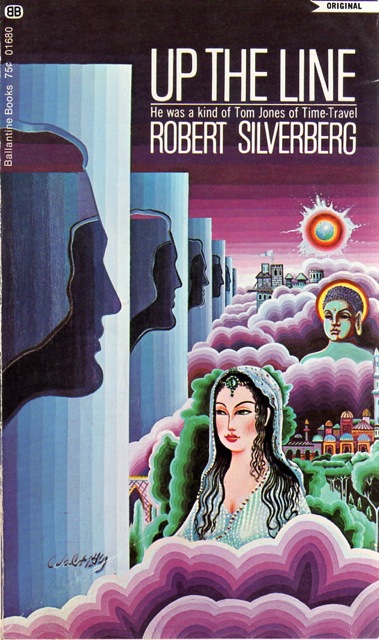
                • Cover of Up the Line
                  Up the Line

                  Robert Silverberg · standalone novel · 1969

                  similar byfunnyscience fiction+1 more

                  Up the Line (1969) is a time travel novel by American science fiction author Robert Silverberg. The plot revolves mainly around the paradoxes brought about by time travel and is considered an example of the more sexually-permissive era of late 1960s American science-fiction, a reflection of the counterculture of its day. It was nominated for a Nebula Award for Best Novel in 1969 and a Hugo Award for Best Novel in 1970 but lost to Ursula K. Le Guin's The Left Hand of Darkness both times.

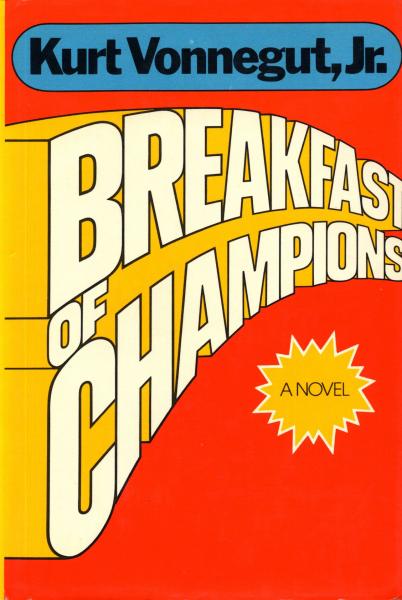
                • Cover of Breakfast of Champions
                  Breakfast of Champions

                  Kurt Vonnegut & Jr. · standalone novel · 1973

                  similar byfunnynorth america+1 more

                  The author decides to liberate the characters he created, including an author who decides to try to help a mentally ill reader who was driven over the edge by the book's assertion that he was the only creature with free will in a universe of preprogrammed automatons.