More like Zenya
anchored on:science fictionspace operaspacefar futureadventurousquests+1 more
but
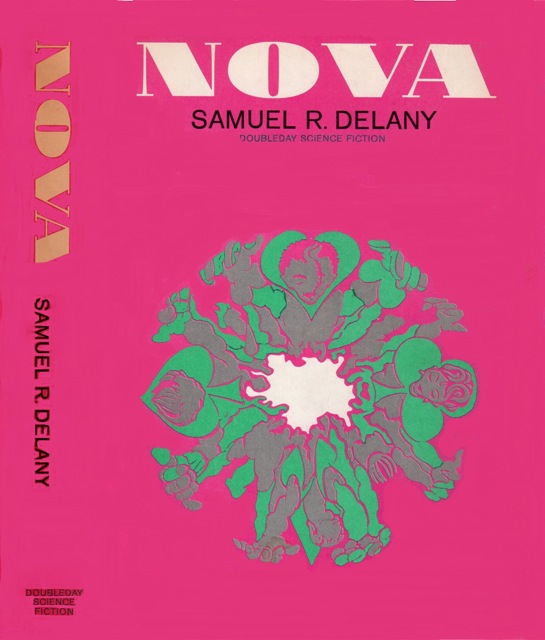
- Nova
Samuel R. Delanystandalone novel1968
similar byquestsadventurousfar futurescience fictionspace operaspaceother star systems
Nоva is a science fiction novel by American writer Samuel R. Delany published in 1968. The plot concerns the spaceship captain Lorq Von Ray's search for a nova, which will produce the essential power source Illyrion, and his vendetta with the Red family, who seek to kill him. Nominally space opera, it explores the politics and culture of a future where cyborg technology is universal, yet making major decisions can involve using tarot cards. It has strong mythological overtones, relating to both the Grail Quest and Jason's quest for the Golden Fleece.
- Endless Blue
Wen Spencerstandalone novel2007
similar byquestsadventurousfar futurescience fictionspacespace operaother star systems
The appearance of the warp drive from a long lost spaceship, the Fenrir, triggers an epic quest fort he rest oft the ship, a mission led by Captain Mikhail Volkov. According to the drive’s computers, Fenrir had been lost to a hypothetical “nowhere” of subspace, but since the drive’s housing is covered with coral and sea life, obviously Fenrir has gone somewhere. Faced with genocide at the hands of aliens known as the nefrim, humans need a miracle to survive. On the chance that Fenrir’s mysterious location holds such a miracle, Mikhail jumps into the unknown and crashes into the endless blue of the Sargasso. (from the cover)
- Dumarest
series35 books1967
completed
similar byadventurousfar futurescience fictionspace operaspaceother star systems+1 more
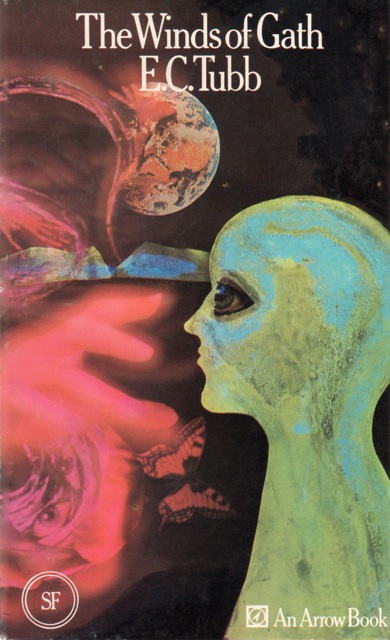
Dumarest of Terra is a 33-volume series of science fiction novels by Edwin Charles Tubb. Each story is a self-contained adventure, but throughout the series, Earl Dumarest, the protagonist, searches for clues to the location of his home world, Earth.
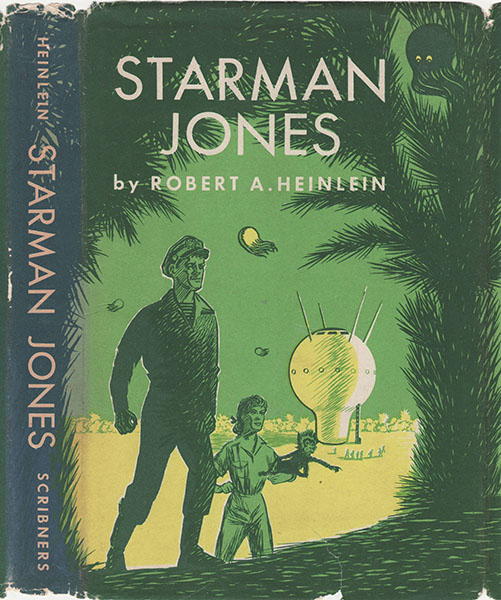
- Starman Jones
Robert A. Heinleinstandalone novel1953
similar byadventurousfar futurescience fictionspacespace operaother star systems
Starman Jones, a 1953 science fiction novel by Robert A. Heinlein, features a farm boy who wants to go to the stars. Charles Scribner's Sons published the book as part of the Heinlein juveniles series.
- Legion of Space
series7 books1947
completed
similar byadventurousfar futurescience fictionspace operaspaceother star systems
The Legion of Space is a space opera science fiction series by American writer Jack Williamson. The story takes place in an era when humans have colonized the Solar System but dare not go farther, as the first extra-solar expedition to Barnard's Star failed and the survivors came back as babbling, grotesque, diseased madmen. They spoke of a gigantic planet, populated by ferocious animals and the single city left of the evil "Medusae". The Medusae bear a vague resemblance to jellyfish, but are actually elephant-sized, four-eyed, flying beings with hundreds of tentacles. The Medusae cannot speak, and communicate with one another via a microwave code.
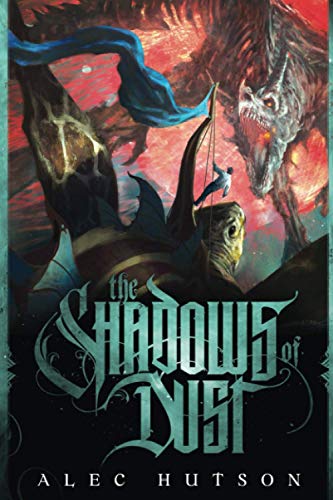
- The Shadows of Dust
Alec Hutsonstandalone novel2020
similar byquestsadventurousfar futurescience fictionspace operaspaceother star systems
The Streams bind together the vast reaches of the stellar tributary, plied by brave streamsurfers and their telepathic starbeasts. Some of these adventurers are heroes. Some are rogues. And some just want to return from the void with their bodies and minds unbroken . . . Kerin thon Talisien is the heir to a legendary name. When he was a young boy, his grandfather swooped down from the stars and rescued him from the slums of his homeworld. But with the death of the infamous old streamsurfer, Kerin and his crew have fallen on hard times, exiled from the Starfarers Guild and forced to take on risky contracts in the shadowy margins of the stellar tributary. A strange encounter in a glimmer den offers a chance at redemption and glory . . . but the stakes are high, with the fate of the Known potentially hanging in the balance.
- Pip & Flinx
series18 books1972
part of Humanx Commonwealth
similar byadventurousfar futurescience fictionspace operaspaceother star systems
The Pip & Flinx novels follow Flinx, a young man with an unusual, mysterious origin, and his ever-present animal companion Pip, across Alan Dean Foster's Humanx Commonwealth setting. Beginning with The Tar-Aiym Krang (1972) — chronologically the second entry, since Foster later filled in Flinx's earlier life — the series grew to fifteen novels published between 1972 and 2017, mixing planetary adventure with a slowly unfolding personal mystery.
- Ringworld
series5 books1970
part of Known Space
similar byadventurousfar futurescience fictionspace operaspaceother star systems
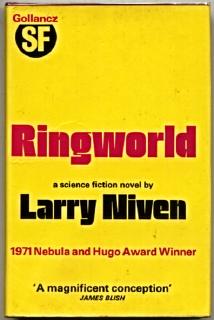
The Ringworld series is a series of science fiction novels written by American author Larry Niven. It is part of his Known Space series of stories. Its backdrop is the Ringworld, a giant artifact 3 million times the surface area of Earth circling a star. The series is composed of four standalone science fiction novels, the original award-winning book and its three sequels:1970: Ringworld 1979: The Ringworld Engineers 1996: The Ringworld Throne 2004: Ringworld's Children
- The Rule of Five
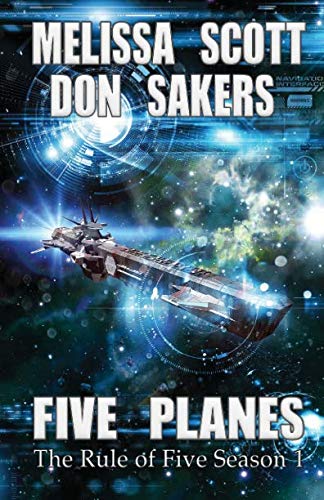
series1 book2018
similar byquestsadventurousfar futurescience fictionspace operaspaceother star systems
- The Stars My Destination
Alfred Besterstandalone novel1956
similar byadventurousfar futurescience fictionspacespace operaother star systems
When a passing spaceship refuses to rescue the lone survivor from the drifting wreck of another ship, he dedicates his life to discovering who made that decision and exacting his revenge, in the process altering human history and his own character.
- Beyond Infinity
Gregory Benfordstandalone novel2004
similar byadventurousfar futurescience fictionspacespace operaother star systems+1 more
From the flaps of the Warner Aspect first edition: "Billions of years from now, the last true human must find her place - and her destiny - within the inconceivable vastness of multiple universes. ... Cley is an Original, a genetically pure member of the most ancient Ur-Human beings. Like others of her forest-dwelling tribe, she expects to spend her few centuries working in the great subterranean Library of Life. Then catastrophe strikes when strange transdimensional life-forms obliterate the Library and kill all of Earth's Originals - except for Cley. These uncanny beings also attack the planet's most advanced human species, the highly evolved Supras, who cannot reconstruct the knowledge and DNA lost in the Library's ruins. Nor can they protect Cley... Forced to flee, Cley must begin a desperate quest for survival, answers, and hope. Joined by a raccoonlike companion called Seeker, she will journey across the myriad environments of her wildly transformed world... and then far, far beyond. For somewhere - past planets that have been reengineered, past sentient ship-worlds evolving deep between stars, past creatures the size of solar systems - waits the Malign. A being so powerful that it can escape a black hole, the Malign is destroying the galaxy as it hunts down the one thing it fears... Cley."
- Citizen of the Galaxy
Robert A. Heinleinstandalone novel1957
similar byadventurousfar futurescience fictionspace operaspaceother star systems
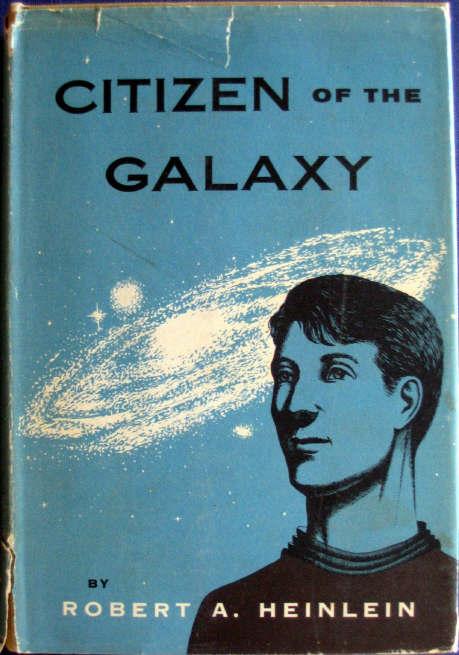
On a planet far distant from Earth, a lame beggar buys a young boy slave who has forgotten his origins. The beggar is more than he seems, and gives the boy an extensive education while employing him as an observer of activity in their city. Years later, the beggar is captured by the government, and the youth must escape the planet.
- The Stainless Steel Rat
series21 books1957
completed
similar byadventurousfar futurescience fictionspace operaspace+1 more
James Bolivar diGriz, alias "Slippery Jim" and "The Stainless Steel Rat", is a fictional character and a series of comic science fiction novels written by Harry Harrison.
- Star Winds
Barrington J. Bayleystandalone novel1978
similar byquestsadventurousfar futurescience fictionspace+1 more
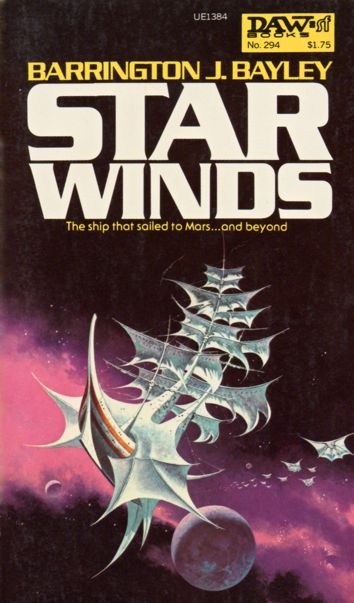
From the back cover of the DAW first edition: "Star Winds - The sails were the product of the Old Technology, lost long ago in the depleted Earth, and they were priceless. For with those fantastic sheets of etheric material, ships could sail the sky and even brave the radiant tides between worlds and stars. The alchemists who had replaced the scientists still sought the ancient secrets... and Rachad, apprentice to such a would-be wizard, learned that the key to his quest lay in a book abandoned in a Martian colonial ruin long, long ago. But how to get to Mars? There was one way left - take a sea vessel, caulk it airtight, steal new sails, and fly the star winds in the way of the ancient windjammers. Here is an intriguing, unusual and colorful novel of ships that sail the stars riding before the solar breeze that blows between the worlds."
- Arcot, Morey and Wade
series7 books1930
completed
similar byadventurousfar futurescience fictionspace operaspaceother star systems
Arcot, Morey and Wade collects John W. Campbell Jr.'s pulp-era stories, starting with The Black Star Passes, a fixup built from stories originally serialized in Amazing Stories during the early 1930s. The books follow the same trio of scientist-adventurers through escalating, gadget-driven space adventures typical of early Golden Age SF, continuing through Islands of Space and Invaders from the Infinite. It's foundational pulp science fiction, heavier on speculative engineering than characterization by later standards.
- Vatta's War
series6 books2003
part of Vatta
similar byadventurousfar futurescience fictionspace operaspaceother star systems
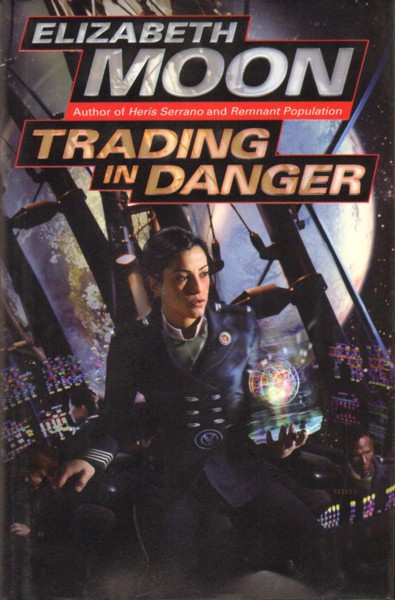
Vatta's War is a science fiction series by American writer Elizabeth Moon, comprising five books: Trading in Danger (2003), Marque and Reprisal, Engaging the Enemy (2006), Command Decision (2007), and Victory Conditions (2008). They have been characterized as military science fiction similar in style to the works of Lois McMaster Bujold, David Weber and Walter Jon Williams.
- Fifth Imperium
series3 books1991
similar byadventurousfar futurescience fictionspace operaspace+1 more
David Weber's Fifth Imperium series opens with the discovery that Earth's Moon is in fact a disguised alien starship, the Dahak, that has orbited undetected for tens of thousands of years - a relic of the fallen Fourth Imperium, a multi-star civilization destroyed while defending against the genocidal Achuultani. Mutineers' Moon follows humanity's first contact with Dahak and the mutineers still aboard it; The Armageddon Inheritance and Heirs of Empire escalate from that discovery into interstellar war and dynastic politics as humanity inherits the old empire's legacy and its enemies. The three novels were later collected as the omnibus Empire from the Ashes.
- Well World
series11 books1977
similar byfar futurescience fictionspace operaother star systemsspace+2 more
- Old Man's War
series16 books2005
similar byadventurousfar futurescience fictionspace operaspaceother star systems
The Old Man's War series is a series of science fiction novels by John Scalzi. The first book in the series, Old Man's War, was first published in 2005 by Tor Books, and was nominated for the Hugo Award for Best Novel in 2006. In 2026 it was a finalist for the Hugo Award for Best Series.
- Earthblood
Keith Laumer & Rosel George Brownstandalone novel1966
similar byadventurousfar futurescience fictionspace operaspaceother star systems
From the flaps of the BCE Dust Jacket: "A thundering "space opera" in the old fashioned tradition of Science Fiction: redolent with people who vault across galactic distances, villainous engines of destruction, and a universe populated by humans, humanoids, monsters - tailed, scaled, and proper tentacled. The story begins in the year 13,000 A.D. The central character is Roan, a pure-strain human, who, as a boy, is kidnapped by the owner of a freak show and sent on a "summer stock" tour by means of spaceship. This weird interplanetary circus troupe is suddenly pirated by another vessel. But its outlaw Commander, the dashing Henry Dread, turns out to be a pure-strain human and he instantly takes a liking to our youthful hero. From her on out, Earthblood explodes with wild cascades of pure adventure and excitement - the reader follows Dread and Roan as they wander through the universe, sacking planets, keeping a sharp look-out for errant pure-strains, landing at last on the planet Terra, where - to their endless horror - the two realize exactly who the broken-down, corrupt, and decadent inhabitants are: their fellow human-beings."
- Gaean
series3 books1979
completed
similar byadventurousscience fictionfar futurespace operaspace+1 more
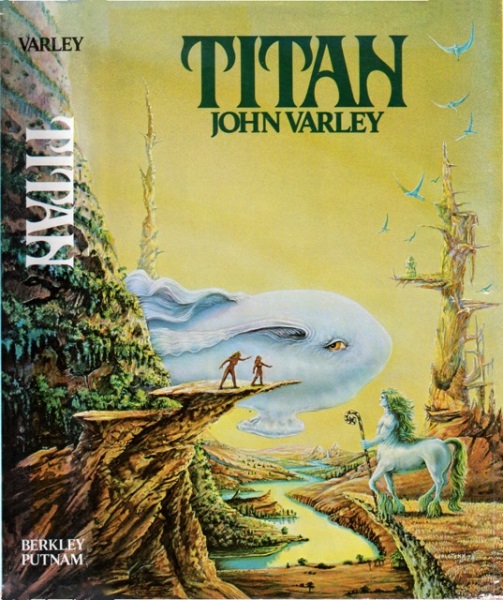
The Gaea Trilogy consists of three science fiction novels by John Varley. The stories tell of humanity's encounter with a living being in the shape of a 1,300 km diameter Stanford torus, inhabited by many different species, most notably the centaur-like Titanides, in orbit around the planet Saturn.
- Wildcatter
Dave Duncanstandalone novel2012
similar byadventurousfar futurescience fictionspacespace operaother star systems+1 more
"Throughout human history wildcatters, the first great explorers and prospectors to lay claim to newly discovered lands, have marched to the beat of a different drummer ? motivated by a deep yearning to be the first to walk on uncharted land and benefit from treasures yet to be discovered. In the future, wildcatters in space will travel to exoplanets, located in The Big Nothing, to search for new chemicals which, when transformed into pharmaceuticals, might bring untold wealth and fame to the individuals and corporations that stake their claim for exclusive exploitation rights. Such is the quest of the crew of the independent starship Golden Hind, whose mission is to travel a year and a half to ?Cacafuego?, beat the larger corporations to the exoplanets? resources, and strike it rich for themselves. But will a yellow warning flag, already planted above the planet, stop them? Or will the Golden Hind?s prospector foray to the planet?s surface, possibly never to return alive?"--Amazon.com.
- Venus on the Half-Shell
Philip José Farmerstandalone novel1975
similar byquestsadventurousfar futurescience fictionspaceother star systems
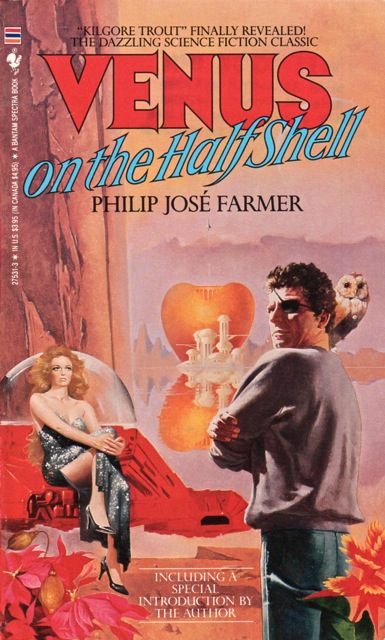
Venus on the Half-Shell is a science fiction novel by American writer Philip José Farmer, writing pseudonymously as "Kilgore Trout", a fictional recurring character in many of the novels of Kurt Vonnegut. This book first appeared as a fictitious "excerpt"—attributed to Trout —in the ninth chapter of Vonnegut's God Bless You, Mr. Rosewater (1965). With Vonnegut's permission, Farmer expanded the fragment into an entire standalone novel. Farmer's story was first published in two parts beginning in the December 1974 issue of The Magazine of Fantasy and Science Fiction. The plot, in which Earth is destroyed by cosmic bureaucrats doing routine maintenance and the sole human survivor goes on a quest to find the "Definitive Answer to the Ultimate Question", was an inspiration for the plot of the later Hitchhiker's Guide to the Galaxy series.
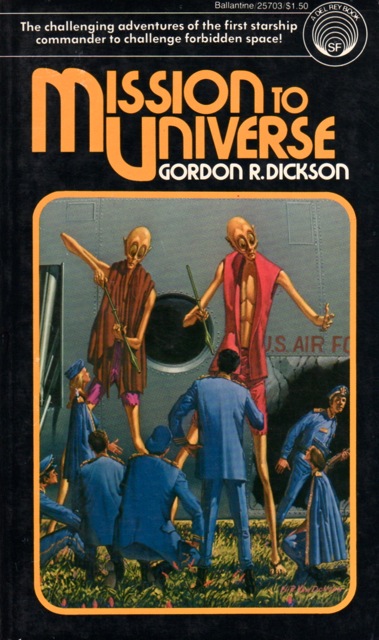
- Mission to Universe
Gordon R. Dicksonstandalone novel1965
similar byadventurousfar futurescience fictionspacespace operaother star systems
Forever and a day - Brigadier General Benjamin Shore ignores a Presidential command and launches a revolutionary phase ship and its crew on an incredible journey deep into uncharted regions toward Galactic Centerpoint... Investigating one planet after another in search of a habitable world, they encounter: the vicious vine-tigers, weasel-like pre-men, who live on an innocent looking planet lit by the sun of Polaris; the slim Gray-furs, a race possessing fantastic knowledge, yet strangely inept; and the giant conquerers, the Golden People, with their magnificent cities, and their deadly javelin guns... With half his crew lost, General Shore prepares to return to Earth, only to find his most formidable foe aboard the phase ship itself... (from the back cover of the Berkley first edition)