More like A World Between
anchored on:science fictiongender and societyfar futurepolitical intrigueother star systemschallenging
but
- Triton
Samuel R. Delanystandalone novel1976
similar byscience fictionchallenginggender and societyfar futureother star systemspolitical intrigue
Trouble on Triton: An Ambiguous Heterotopia (1976) is a science fiction novel by American writer Samuel R. Delany. It was nominated for the 1976 Nebula Award for Best Novel, and was shortlisted for a retrospective James Tiptree, Jr. Award in 1995. It was originally published under the shorter title Triton.
- Dune
series20 books1963
part of Dune Universe
similar byscience fictionfar futureother star systemspolitical intrigue+1 more
Frank Herbert's Dune Chronicles opens with 1965's Dune, set on the desert planet Arrakis where House Atreides takes control of the only source of the vital spice melange and young Paul Atreides is pulled into a struggle over its politics and religion. Herbert carried the story forward across five further novels — Dune Messiah, Children of Dune, God Emperor of Dune, Heretics of Dune, and Chapterhouse: Dune — following Paul's line over the following millennia, before Brian Herbert and Kevin J. Anderson later extended the saga. Many other editions of these six novels are omnibus and box-set repackagings rather than separate stories.
- Glory Season
David Brinstandalone novel1993
similar byscience fictionchallenginggender and societyfar futureother star systems
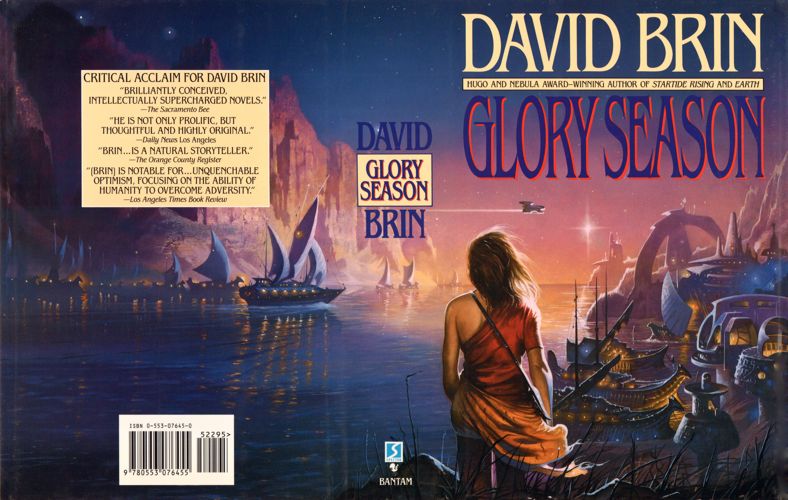
Glory Season is a 1993 science fiction novel by David Brin. It was nominated for both the Hugo and Locus Awards in 1994. An announcement in the back of one edition of Earth is for a novel titled Stratos, to be released in the spring of 1992. It seems likely that this was delayed, and renamed Glory Season.
- The Gods Themselves
Isaac Asimovstandalone novel1972
similar byscience fictionchallengingfar futureother star systems
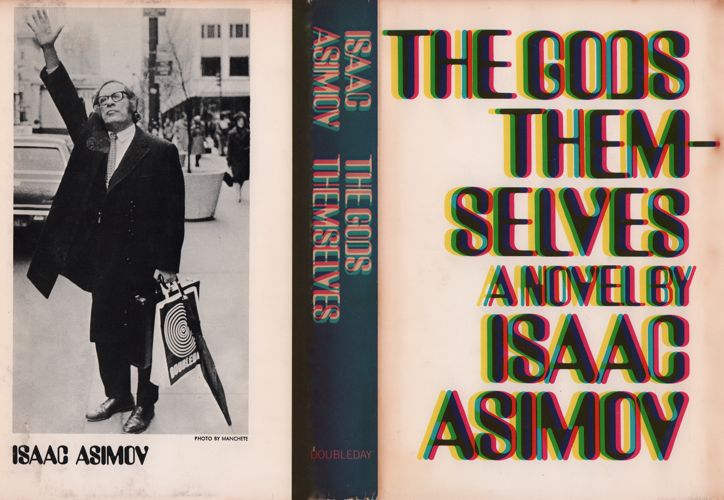
The Gods Themselves is a 1972 science fiction novel written by Isaac Asimov, and his first original novel in fifteen years. It won the Nebula Award for Best Novel in 1972, and the Hugo Award for Best Novel in 1973.
- Dune Universe
universe78 books1963
Start hereDune · Start here
similar byscience fictionfar futureother star systemspolitical intrigue
Arrakis. Dune. The desert planet, where empire runs on a single substance: the spice melange, which folds space, prolongs life, and unlocks prescience, and which exists nowhere else in the known universe. Frank Herbert's saga is a meditation dressed as an adventure — feudal houses and a secret sisterhood, engineered messiahs and the patient ecology of a world without water, all turning on the terrible gravity of who commands the spice. It reads like scripture and schemes like a war room, ten thousand years hence, among people who have outlawed the thinking machine and made instruments of themselves instead. At its heart stand Herbert's original six — Dune, Dune Messiah, Children of Dune, God Emperor of Dune, Heretics of Dune, Chapterhouse: Dune — a single deepening arc across millennia, arguing the whole way between prophecy and free will. Around that spine his son Brian Herbert and Kevin J. Anderson have raised a vast prequel architecture: Prelude to Dune, tracing the great houses a generation before Paul; Legends of Dune, reaching back to the crusade that broke the machines; the Schools of Dune cycle on the founding of Bene Gesserit, Mentat, and Navigator; the Caladan Trilogy and Heroes of Dune filling years the originals left in shadow. Many hands, dozens of volumes, one desert. What sets Dune apart is its refusal of the simple: religion is manufactured, heroes are hazards, and the sand itself — worm, water, ecology — acts as a political power. Begin where the universe did, with Frank Herbert's Dune (1965), and read the original six in order; you need nothing else to feel the full weight. The prequels are a country to explore afterward, taken by era. Beginnings are delicate times.
- Carnival
Elizabeth Bearstandalone novel2006
similar byscience fictionchallengingfar futureother star systemspolitical intriguegender and society
Carnival is a 2006 science fiction novel by Elizabeth Bear, published in the US by Bantam Spectra. It was nominated for a Philip K. Dick Award, a Locus Award for Best Science Fiction Novel and a Lambda Literary Award.
- Hainish
series33 books1964
completed
similar byscience fictionfar futureother star systems+3 more
The Hainish Cycle consists of a number of science fiction novels and stories by Ursula K. Le Guin. The cycle is set in a future history that features civilizations of human beings on planets orbiting a number of nearby stars, including Terra ("Earth"); these humans are contacting each other for the first time and establishing diplomatic relations, as well as setting up a confederacy under the guidance of the oldest of the human worlds, the peaceful planet Hain. In this history, human beings did not evolve on Earth, but they were instead the result of interstellar colonies planted by Hain in the distant past, after which interstellar travel ceased for an extended period. Some of the human races have new genetic traits, a result of ancient Hainish experiments in genetic engineering; this includes people who can dream while awake, and a world of hermaphroditic people who only enter active sexuality once per month, not knowing which sex will manifest in them. In keeping with Le Guin's narrative approach, she uses varied social and environmental settings to explore the anthropological and sociological outcomes of human evolution in those environments. The author often discounted the characterization of a so-called "Hainish Cycle".
- Embassytown
China Miévillestandalone novel2011
similar byscience fictionchallengingfar futureother star systemspolitical intrigue
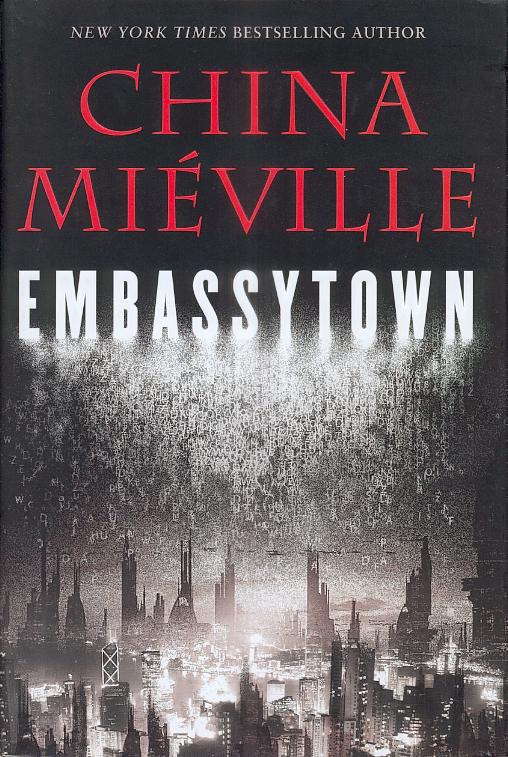
In the far future, humans have colonized a distant planet, home to the enigmatic Ariekei, sentient beings famed for a language unique in the universe, one that only a few altered human ambassadors can speak. Avice Benner Cho, a human colonist, has returned to Embassytown after years of deep-space adventure. She cannot speak the Ariekei tongue, but she is an indelible part of it, having long ago been made a figure of speech, a living simile in their language. When distant political machinations deliver a new ambassador to Arieka, the fragile equilibrium between humans and aliens is violently upset. Catastrophe looms, and Avice is torn between competing loyalties—to a husband she no longer loves, to a system she no longer trusts, and to her place in a language she cannot speak yet speaks through her.
- Singularity Sky
series2 books2003
similar byscience fictionchallengingfar futureother star systems+1 more
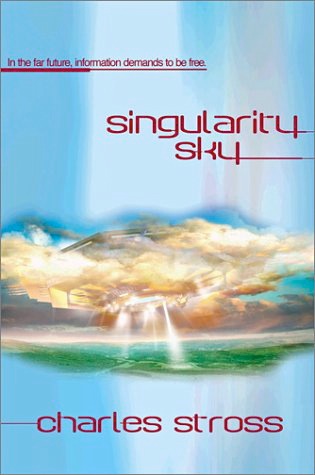
Singularity Sky and its sequel Iron Sunrise are collectively known as the Eschaton novels, after the godlike posthuman intelligence that seeded human colonies across space on the condition they never attempt time travel or threaten causality - rules tested when a low-tech colony world is destabilized by a group calling itself the Festival. Charles Stross uses the setup for a mix of space opera, economics, and diplomatic intrigue.
- We Who Are About to ...
Joanna Russstandalone novel1977
similar byscience fictionchallengingfar futureother star systemsgender and society
We Who Are About To... is a feminist science fiction novella by Joanna Russ. It first appeared in magazine form in the January 1976 and February 1976 issues of Galaxy Science Fiction and was first published in book form by Dell Publishing in July 1977.
- Aurora
Kim Stanley Robinsonstandalone novel2015
similar byscience fictionchallengingfar futureother star systems+1 more
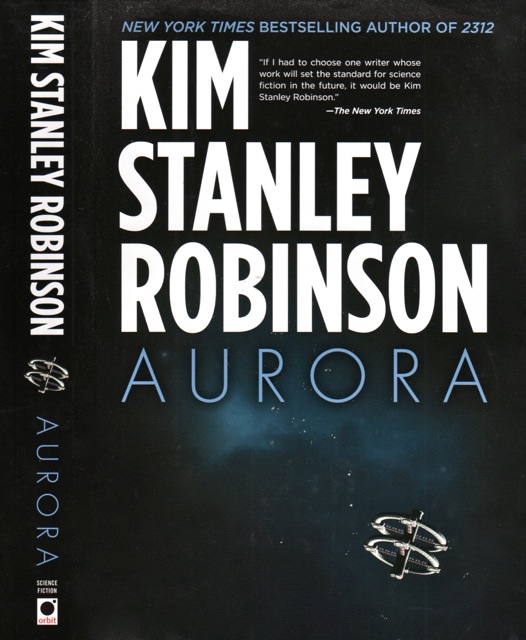
Aurora is a 2015 novel by American science fiction author Kim Stanley Robinson. The novel concerns a generation ship built in the style of a Stanford torus, traveling to Tau Ceti to start a human colony. The novel's primary narrative voice is that of the starship's artificial intelligence. Aurora was well received by critics.
- Diaspora
Greg Eganstandalone novel1997
similar byscience fictionchallengingfar futureother star systemsspace exploration
Diaspora is a hard science fiction novel by the Australian writer Greg Egan which first appeared in print in 1997. It originated as the short story "Wang's Carpets" which originally appeared in the Greg Bear-edited anthology New Legends. The story appears as a chapter of the novel.
- Helliconia
series4 books1982
completed
similar byscience fictionchallengingfar futureother star systems
The Helliconia trilogy is a series of science fiction books by British writer Brian W. Aldiss, set on the Earth-like planet Helliconia. It is an epic chronicling the rise and fall of a civilisation over thousands of years as the planet progresses through its incredibly long seasons, which last for centuries.
- The Algebraist
Iain M. Banksstandalone novel2004
similar byscience fictionfar futureother star systemspolitical intrigue+1 more
The Algebraist is a science fiction novel by Scottish writer Iain M. Banks, published in print in 2004. It was nominated for a Hugo Award for Best Novel in 2005.
- Kefahuchi Tract Trilogy
series3 books2002
similar byscience fictionchallengingfar futureother star systems
M. John Harrison's Kefahuchi Tract trilogy circles a strange, physics-breaking anomaly in deep space that draws scientists, smugglers, and drifters into its pull across different eras. Light moves between a near-future timeline and a far-future one drawn to the Tract itself; its sequel Nova Swing stays within one future period, where a fragment of the anomaly's altered space bleeds into the run-down port city of Saudade, giving the book a noir, Roadside-Picnic-like atmosphere; Empty Space concludes the sequence. The three novels share a setting and mood more than a continuous plot or cast.
- Jean le Flambeur
series3 books2010
similar byscience fictionchallengingfar futureother star systems
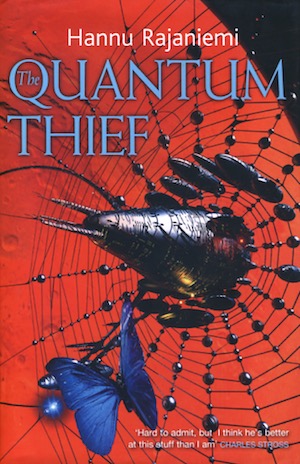
Jean le Flambeur is a master thief broken out of a virtual prison to pull off one more impossible heist, in a solar system reshaped by uploaded minds, post-human factions, and economies built on memory and privacy themselves. Hannu Rajaniemi's trilogy - The Quantum Thief, The Fractal Prince, The Causal Angel - is dense, idea-heavy hard SF that trusts readers to piece its future together from context rather than exposition.
- Moties
series4 books1974
part of CoDominium
similar byscience fictionfar futureother star systemspolitical intrigue+1 more
Larry Niven and Jerry Pournelle's The Mote in God's Eye (1974) depicts humanity's first contact with an alien species, the Moties, set within the far-future interstellar setting of Pournelle's codominium future history. The Gripping Hand continues that first-contact crisis years later, and Outies, written by J. R. Pournelle, carries the story forward into a new generation. Together the three books trace an escalating encounter between human and Motie civilizations within the codominium universe.
- The Crucible of Time
John Brunnerstandalone novel1983
similar byscience fictionchallengingfar futureother star systems+1 more
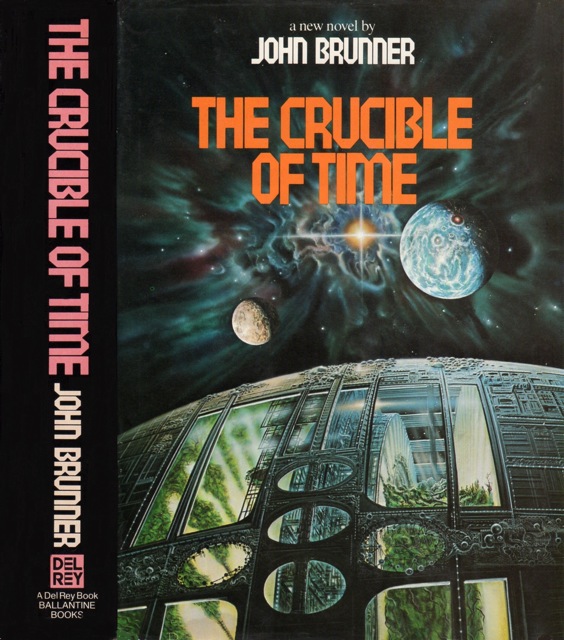
The Crucible of Time is a fix-up science fiction novel by John Brunner. It was first published in 1983.
- Flesh
Philip José Farmerstandalone novel1960
similar byscience fictionfar futureother star systemsgender and society+1 more
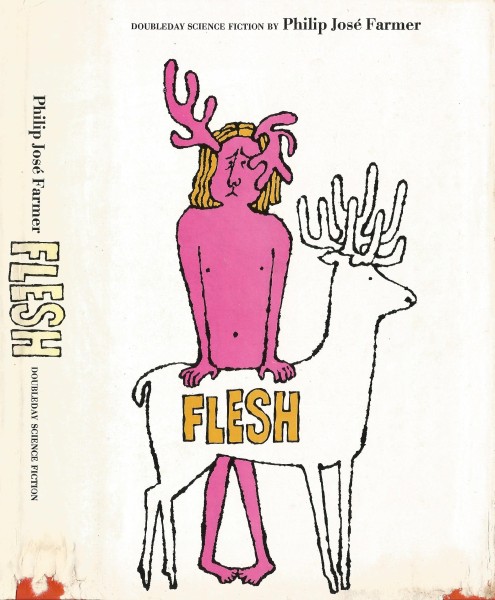
Flesh is an American science fiction novel written by Philip José Farmer. Originally released in 1960, it was Farmer's second novel-length publication, after The Green Odyssey. Flesh features many sexual themes, as is typical of Farmer's earliest work.
- Shaper/Mechanist
series6 books1982
similar byscience fictionchallengingfar futureother star systems+1 more
Shaper/Mechanist is Bruce Sterling's future-history of a fractured solar system, split between the genetically engineered Shapers and the cybernetically augmented Mechanists as humanity spreads beyond Earth. Schismatrix, the only full-length novel in the setting, follows a diplomat-schemer across decades of shifting factions and post-human politics. Schismatrix Plus collects that novel together with five earlier short stories set in the same future.
- Incandescence
Greg Eganstandalone novel2008
similar byscience fictionchallengingfar futureother star systemsspace exploration
Incandescence is a 2008 science fiction novel by Australian author Greg Egan. The book is based on the idea that the theory of general relativity could be discovered by a pre-industrial civilisation.
- Schild's Ladder
Greg Eganstandalone novel2002
similar byscience fictionchallengingfar futurespace exploration+1 more
Schild's Ladder is a 2002 science fiction novel by Australian author Greg Egan. The book derives its name from Schild's ladder, a construction in differential geometry, devised by the mathematician and physicist Alfred Schild.
- Past Master
R. A. Laffertystandalone novel1968
similar byscience fictionchallengingfar futurepolitical intrigue
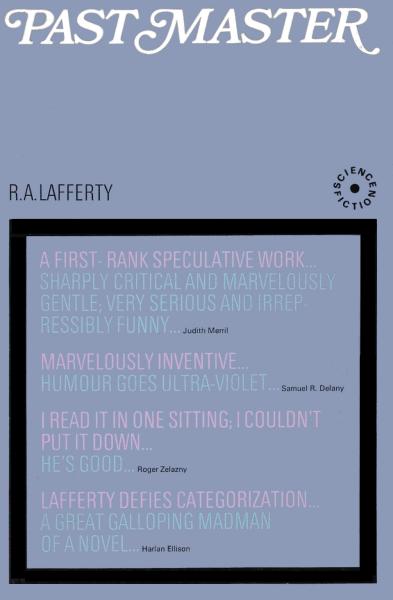
Past Master is a science fiction novel by American writer R. A. Lafferty, first published in 1968. The novel follows the attempt of a future Utopian society in preventing its decline, by bringing Sir Thomas More to the year 2535.