More like Alpha 8
anchored on:science fictionmid 20th centuryaliensspace explorationspacereflective
but
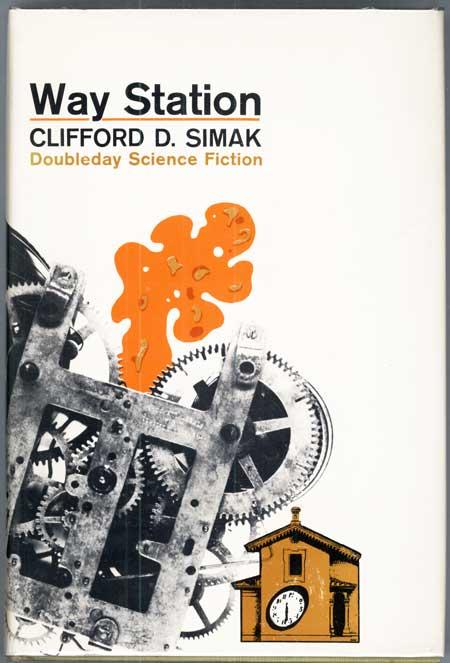
- Way Station
Clifford D. Simakstandalone novel1963
similar byscience fictionreflectivemid 20th centuryaliensspace exploration
The human operator of a transfer station for aliens traveling between planets, kept secret from the human race, deals with discovery by the US government and interplanetary political crisis, as well as his own emotional issues.
- The Man Who Fell to Earth
Walter Tevisstandalone novel1963
similar byscience fictionreflectivemid 20th centuryaliens+1 more
The Man Who Fell to Earth is a 1963 science-fiction novel by American writer Walter Tevis. Published by Gold Medal Books as a paperback original, it was Tevis's second novel, following The Hustler. The novel follows Thomas Jerome Newton, an extraterrestrial from the drought-stricken planet Anthea, who comes to Earth hoping to build a spacecraft that can save the surviving members of his species.
- Childhood's End
Arthur C. Clarkestandalone novel1953
similar byscience fictionreflectivealiensidentity+1 more
Childhood's End is a 1953 science fiction novel by the British author Arthur C. Clarke. The story follows a peaceful alien invasion of Earth by mysterious Overlords, whose arrival begins decades of apparent utopia under indirect alien rule, at the cost of human identity and culture.
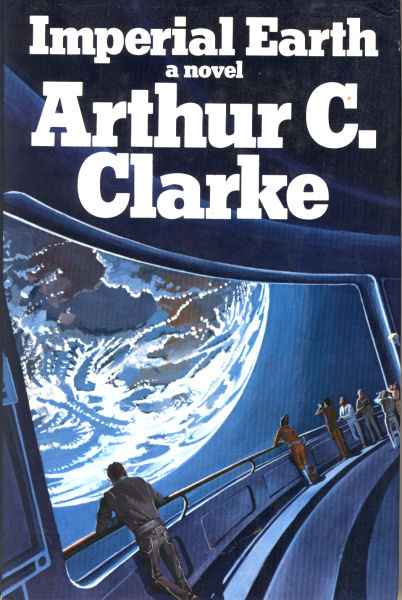
- Imperial Earth
Arthur C. Clarkestandalone novel1975
similar byscience fictionreflectivespacespace exploration
Imperial Earth is a science fiction novel by British writer Sir Arthur C. Clarke, published in 1975 by Gollancz Books. The plot follows the protagonist, Duncan Makenzie, on a trip to Earth from his home on Titan, in large part as a diplomatic visit to the U.S. for its quincentennial in 2276, but also to have a clone of himself produced. The book was published in time for the U.S. bicentennial in 1976.
- Stranger in a Strange Land
Robert A. Heinleinstandalone novel1961
similar byscience fictionreflectivealiensidentity
Stranger in a Strange Land is a 1961 science fiction novel by the American author Robert A. Heinlein. It tells the story of Valentine Michael Smith, a human who comes to Earth in early adulthood after being born on the planet Mars and raised by Martians, and explores his interaction with and eventual transformation of Terran culture.
- Memoirs of a Spacewoman
Naomi Mitchisonstandalone novel1962
similar byscience fictionreflectivespacealiensspace exploration
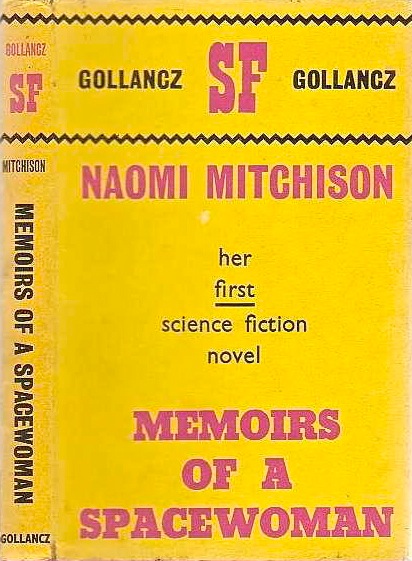
Memoirs of a Spacewoman is a science fiction novel by Scottish novelist and poet Naomi Mitchison published in 1962 by Victor Gollancz Ltd.
- Contact
Carl Saganstandalone novel1985
similar byscience fictionreflectivealiensspace exploration+1 more
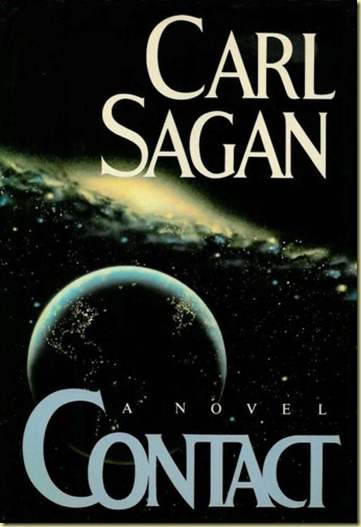
From the front flap of the Simon and Schuster first edition: For centuries humanity has dreamed of life and intelligence beyond the Earth; for decades scientists have searched for it in every corner of the sky; for years Project Argus, a vast, sophisticated complex of radio telescopes, has listened for a signal indicating the existence, somewhere in the universe, of extraterrestrial intelligence. Then, one afternoon, the course of human history is changed, abruptly and forever. The Message, awaited for so long, its very possibility doubted by so many, arrives. Contact has been made. Life, intelligence, someone, something beyond Earth, 26 light-years away, in the vicinity of the star Vega, is calling, beaming across space a wholly unexpected message to say that we are not - have never been - alone. In Contact, Carl Sagan, whose Cosmos enthralled millions of readers and television viewers, has brilliantly employed the freedom of fiction to imagine the greatest adventure of all - humanity's first encounter with other intelligent beings. But the novel is not only about contact between humans and extraterrestrials; it is also about contact, down here on Earth, with each other and ourselves. At its center is a brilliant scientist, Eleanor Arroway, director of Project Argos, who is the first to realize that chapter one of human history is over. It is she who is instrumental in decoding the Message - and in persuading world leaders not to treat it as a threat - she who finds her own life changed by the immense challenge of responding to the Message; she who finally journeys out to experience, in circumstances at once profoundly religious and scientific, the most fateful encounter in human history.
- A Meeting with Medusa
series2 books1971
similar byscience fictionreflectivespacealiensspace exploration+1 more
Arthur C. Clarke's A Meeting with Medusa follows an astronaut, badly injured in an earlier disaster, on a solo balloon expedition into Jupiter's atmosphere, where he encounters vast floating lifeforms unlike anything previously catalogued. Decades later, Stephen Baxter and Alastair Reynolds continued the story in The Medusa Chronicles, following the same protagonist across a much longer span of future history. The original novella won the 1972 Nebula Award.
- Learning the World
Ken MacLeodstandalone novel2005
similar byscience fictionreflectivespacealiensspace exploration
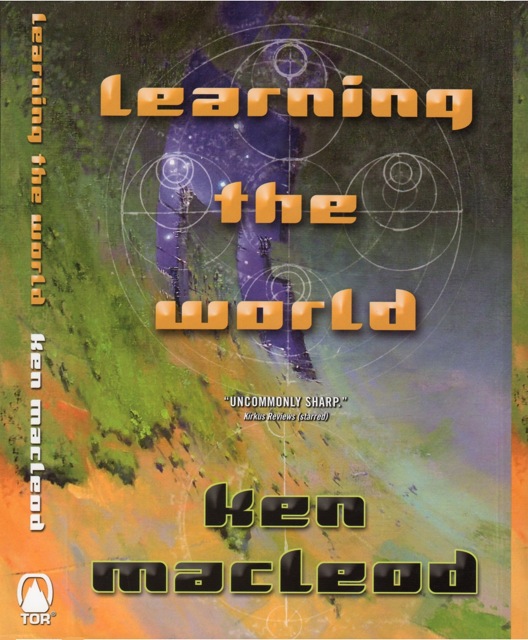
From the front flap of the Tor first printing: "Humanity has spread to every star within 500 light-years of its half-forgotten origin, coloring the sky with a haze of habitats. Societies rise and fall. Incautious experiments burn fast and fade. On the fringes, less modified humans get on with the job of settling a universe that has, so far, been empty of intelligent life. The ancient starship But the Sky, My Lady! The Sky! is entering orbit around a promising new system after a four hundred year journey. For its long-lived inhabitants, the centuries have been busy. Now a younger generation is eager to settle the system. The ship is a seed-pod ready to burst. Then they detect curious electromagnetic emissions from the system's Earth-like world. As the nature of the signals becomes clear, the choices facing the humans become stark. On Ground, second world from the sun, a young astronomer searches for his system's outermost planet. A moving point of light thrills, then disappoints him. It's only a comet. His physicist colleague Orro takes time off from trying to invent a flying-machine to calculate the comet's trajectory. Something is very odd about that comet's path. They are not the only ones for whom the world has changed. "We are not living in the universe we thought we lived in yesterday. We have to start learning the world all over again.""
- Those Who Watch
Robert Silverbergstandalone novel1967
similar byscience fictionreflectivemid 20th centuryaliensidentity
Those Who Watch is a science fiction novel by American writer Robert Silverberg, first published by Signet in 1967. The novel concerns a trio of alien explorers, each one surgically altered so as to appear outwardly human, who find themselves separated, and permanently stranded on Earth, after their ship explodes while hovering in low orbit. Each of the aliens is injured during the accident, and all are taken in and nursed back to health by kindly human beings.
- Fifth Planet
Fred Hoyle & Geoffrey Hoylestandalone novel1963
similar byscience fictionmid 20th centuryspacealiensspace exploration
Fifth Planet is a science fiction novel written by astrophysicist Sir Fred Hoyle and his son Geoffrey Hoyle.
- Radiance
Catherynne M. Valentestandalone novel2015
similar byscience fictionreflectivespacealiensspace exploration
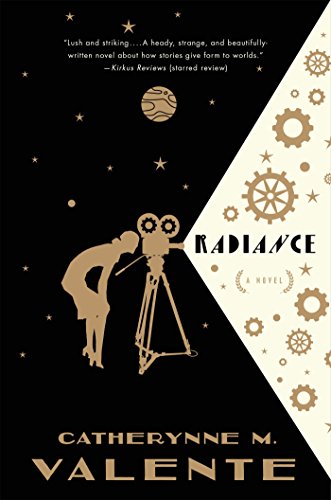
Severin Unck's father is a famous director of Gothic romances in an alternate 1986 in which talking movies are still a daring innovation due to the patent-hoarding Edison family. Rebelling against her father's films of passion, intrigue, and spirits from beyond, Severin starts making documentaries, traveling through space and investigating the levitator cults of Neptune and the lawless saloons of Mars. For this is not our solar system, but one drawn from classic science fiction in which all the planets are inhabited and we travel through space on beautiful rockets. Severin is a realist in a fantastic universe. But her latest film, which investigates the disappearance of a diving colony on a watery Venus populated by island-sized alien creatures, will be her last. Though her crew limps home to earth and her story is preserved by the colony's last survivor, Severin will never return.
- Venus Plus X
Theodore Sturgeonstandalone novel1960
similar byscience fictionreflectivemid 20th centuryidentity
Charlie Johns wakes in a featureless silver room with no memory of how he got there and a watch that's inexplicably running backward. He's been brought, how and by whom is never explained to him, to Ledom, an isolated, technologically advanced society whose members are all both male and female and have done away with fixed sex roles entirely. Guides walk him through Ledom's customs and machinery while making clear he's there to judge them before he can go home. Interwoven with Charlie's tour are chapters following an ordinary mid-century American family, setting the utopia against the world it's implicitly critiquing. Theodore Sturgeon's provocative novel about gender and social design.
- The City and the Stars
Arthur C. Clarkestandalone novel1956
similar byscience fictionreflectivespace exploration+1 more
The City and the Stars is a science fiction novel by British writer Arthur C. Clarke, published in 1956. This novel is a complete rewrite of Clarke's earlier Against the Fall of Night, his first novel, which had been published in Startling Stories magazine in 1948 after being rejected by the editor of Astounding Science-Fiction, according to the author.
- Slaughterhouse-Five or the Children's Crusade: A Duty-Dance with Death
Kurt Vonnegut & Jr.standalone novel1969
similar byreflectivescience fictionmid 20th century+2 more
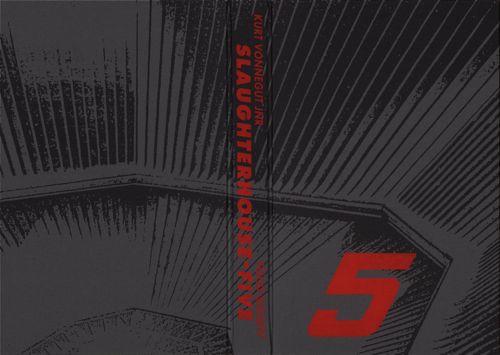
Vonnegut opens in his own voice, describing the twenty years it took him to face writing about surviving the firebombing of Dresden as a POW. He then hands the story to Billy Pilgrim, an awkward, fatalistic American chaplain's assistant swept into the Battle of the Bulge and captured by German forces alongside a soldier who dies blaming him for it. Imprisoned in a disused slaughterhouse in Dresden, Billy survives the firebombing that follows, and, we're told upfront, has also come 'unstuck in time,' living his life out of order, including a stretch on the alien world of Tralfamadore. Vonnegut's best-known novel folds war memoir into science fiction and black comedy.
- Earth Abides
George R. Stewartstandalone novel1949
similar byscience fictionreflectivemid 20th century
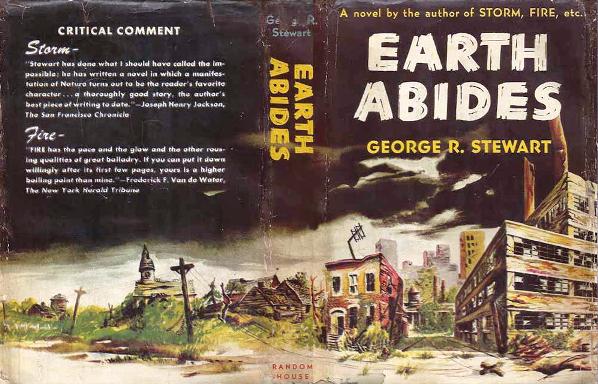
The novel tells the story of the fall of civilization from deadly disease and the emergence of a new culture with simpler tools. Set in the 1940s in Berkeley, California, the story is told by Isherwood Williams, who emerges from isolation in the mountains to find almost everyone dead. en.wikipedia.org
- Cosmic Trilogy (C. S. Lewis)
series4 books1938
completed
similar byscience fictionaliens+4 more
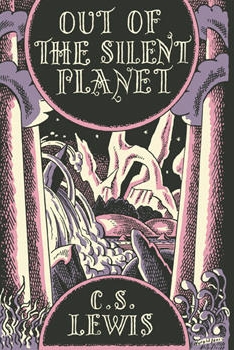
The Space Trilogy is a series of science fiction novels by British writer C. S. Lewis. The trilogy consists of Out of the Silent Planet (1938), Perelandra (1943), and That Hideous Strength (1945). A philologist named Elwin Ransom is the protagonist of the first two novels and an important character in the third.
- 2312
Kim Stanley Robinsonstandalone novel2012
similar byscience fictionreflectivespace+1 more
In the eponymous year, when Earth's ecology is degraded and humanity has settled throughout the solar system by terraforming and genetic engineering, mysterious disasters strike some human communities and an assortment of human types from throughout the system seek to find and eliminate the cause.
- The Secret of the Ninth Planet
Donald A. Wollheimstandalone novel1959
similar byscience fictionmid 20th centuryspacealiensspace exploration
The Secret of the Ninth Planet is a science-fiction novel written by Donald A. Wollheim and first published in the United States in 1959 by the John C. Winston Co. Wollheim takes his heroes on a grand tour of the Solar System as that team struggles to prevent an alien force from Pluto from blowing up the Sun. This is the last of three juvenile novels that Wollheim wrote for Winston, the other two being The Secret of Saturn's Rings and The Secret of the Martian Moons.
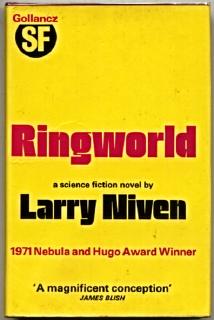
- Ringworld
series5 books1970
part of Known Space
similar byscience fictionspacespace explorationaliens
The Ringworld series is a series of science fiction novels written by American author Larry Niven. It is part of his Known Space series of stories. Its backdrop is the Ringworld, a giant artifact 3 million times the surface area of Earth circling a star. The series is composed of four standalone science fiction novels, the original award-winning book and its three sequels:1970: Ringworld 1979: The Ringworld Engineers 1996: The Ringworld Throne 2004: Ringworld's Children
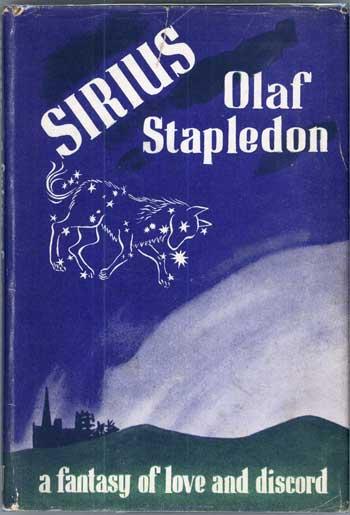
- Sirius: A Fantasy of Love and Discord
Olaf Stapledonstandalone novel1944
similar byscience fictionreflectivemid 20th centuryidentity
Sirius is a 1944 science fiction novel by the British philosopher and author Olaf Stapledon, whose title character is a dog named Sirius with humanlike intelligence. A sense of existential questioning suffuses the book, as the author delves into aspects of Sirius's psyche. The novel deals with many human issues through Sirius and his experiences, his unusual nature, his ideas and his relationships with humans. The characters go to great lengths to prevent Sirius from becoming a circus-type wonderdog, and instead, they seek to develop Sirius's character much like a family would create and foster that of a human child.
- Imperial Radch
series7 books2012
part of Radchaai Universe
similar byscience fictionspaceartificial intelligenceidentity+1 more
Ann Leckie's Imperial Radch trilogy (Ancillary Justice, Ancillary Sword, Ancillary Mercy, 2013-2015) follows Breq, the sole surviving fragment of an AI that once inhabited both a troop-transport starship and dozens of soldier bodies, now alone and hunting for revenge inside the vast, expansionist Radch empire. Breq's quest widens across the trilogy into a conflict with the empire's own fractured ruler, and the books use her alien difficulty perceiving gender to unsettle the space-opera conventions around her.
- A Different Light
Elizabeth A. Lynnstandalone novel1978
similar byscience fictionreflectivespacespace exploration
Jimson had twenty years to live. Or one. Twenty if he stayed in space-normal, where his disease could be treated. One year if he followed the Starcaptain into the Hype - the "not-space" that trip was the only way to the stars, where jeweled voyagers sailed the light-centuries in color-shifting ships; humankind's outriders, star-burned lovers to a Universe heavy with stars... This is the story of that year. (from the back cover of the first edition)