More like Angelmaker
anchored on:contemporaryscience fiction
but
- Laundry Files
series22 books2004
similar byscience fictioncontemporarybritish isles+4 more
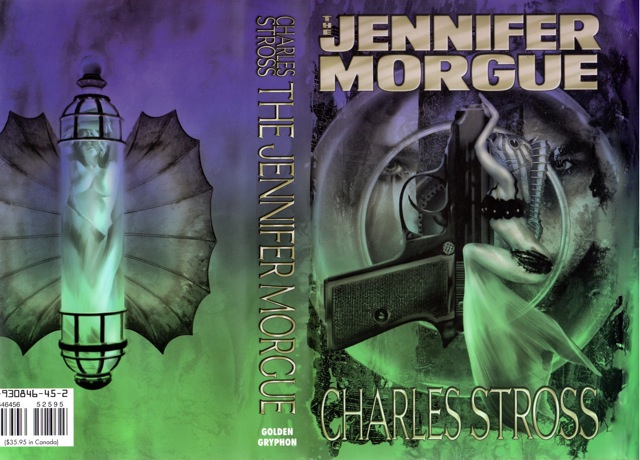
The Laundry Files is a series of novels by British writer Charles Stross. They mix the genres of Lovecraftian horror, spy thriller, science fiction, and workplace humour. Their main character for the first five novels is "Bob Howard", a one-time I.T. consultant turned occult field agent. Howard is recruited to work for the Q-Division of SOE, otherwise known as "the Laundry", the British government agency which deals with occult threats. "Magic" is described as being a branch of applied computation (mathematics), therefore computers and equations are just as useful as, and perhaps more potent than, classical spellbooks, pentagrams, and sigils for the purpose of influencing ancient powers and opening gates to other dimensions. These occult struggles happen largely out of view of the public, as the Laundry seeks to keep the methods for contacting such powers under wraps. There are also elements of dry humour and satirisation of bureaucracy.
- The Merchant Princes
series14 books2004
similar byscience fictioncontemporarypolitical intrigueour worldtense+1 more
The Merchant Princes is a science fantasy and alternate history series of nine novels by British writer Charles Stross. In the series, there exist a number of parallel worlds, all of which are on the same geographical Earth but with different societies at different points of development. Members of a certain bloodline can travel between these worlds along with their immediate possessions. The series largely follows Miriam Beckstein, a technology journalist raised in a familiar "normal" Earth, who discovers she was born in a parallel world and is a member of this bloodline. She quickly becomes entangled in political maneuvering and assassination plots with her estranged family. Miriam uses modern technology and investigative journalism to attempt to stay a step ahead.
- Artemis Fowl
series15 books2001
similar bycontemporaryour worldadventurous+1 more
Artemis Fowl is a series of eleven fantasy novels by Irish author Eoin Colfer, revolving around various members of the Fowl family. The first cycle, the Artemis Fowl series, consists of eight books, and the second cycle, The Fowl Twins series, is a trilogy. Both releases have received commercial success and positive critical reception in the children's literature genre, and also originated graphic novel adaptations. As of 2013, the novels have sold more than 21 million copies in 44 languages, and are one of the best-selling series of all time. In 2010, Artemis Fowl was voted by readers as their favorite Puffin Books title of all time.
- The Blue Ant Trilogy
series3 books2003
similar bycontemporaryscience fictionthriller & suspense+4 more
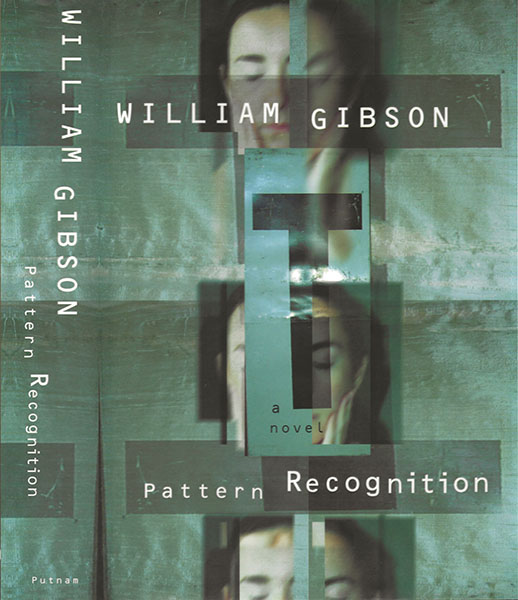
Hubertus Bigend is a fictional character appearing in the third trilogy of novels of science fiction and literary author William Gibson. Bigend is the antihero of Gibson's Pattern Recognition (2003), Spook Country (2007) and Zero History (2010). In an interview Gibson says "I've always had a sense of Bigend as someone who presents himself as though he knows what's going on, but who in fact doesn't. It's just my sense of the subtext of the character: he's bullshitting himself, at the same time as he's bullshitting all of us."
- Hitchhiker's Guide to the Galaxy
series16 books1979
part of The Hitchhiker's Guide to the Galaxy Universe
similar byscience fictionfunny+1 more
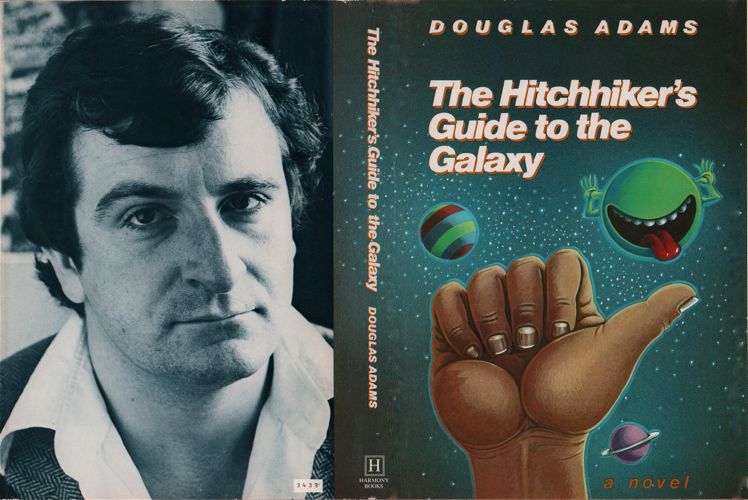
The Hitchhiker's Guide to the Galaxy is a comedy science fiction franchise created by Douglas Adams. Originally a radio sitcom broadcast over two series on BBC Radio 4 between 1978 and 1980, it was soon adapted to other formats, including both novels and comic books, a 1981 BBC television series, a 1984 text adventure game, stage shows and a 2005 feature film.
- D. O. D. O. (Department of Diachronic Operations)
series2 books2017
similar byscience fictionpolitical intrigueour worldadventurous+2 more
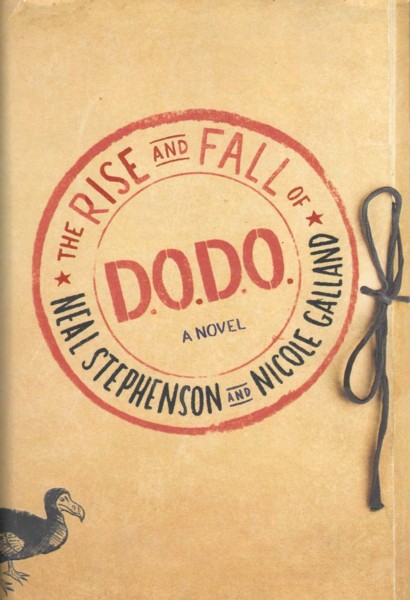
Neal Stephenson and Nicole Galland's D.O.D.O. novels center on the Department of Diachronic Operations, a covert U.S. government agency that discovers magic vanished from the world in the nineteenth century and sets out to use time travel to bring it back. The Rise and Fall of D.O.D.O. (2017) is followed by Master of the Revels, continuing the pair's earlier collaboration on The Mongoliad.
- Dirk Gently
series3 books1987
completed
part of The Hitchhiker's Guide to the Galaxy Universe
similar byfunnycontemporaryscience fictionbritish isles+1 more
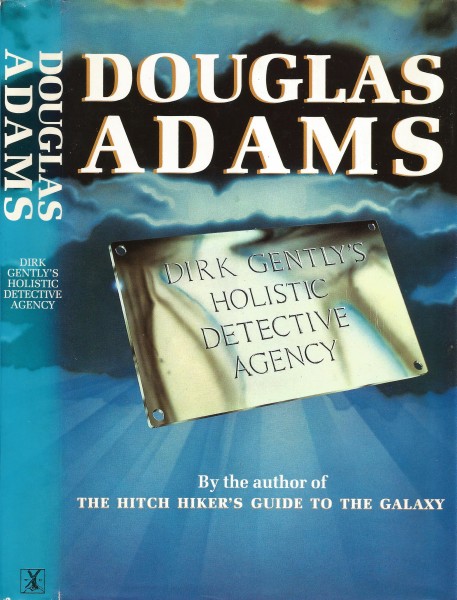
Dirk Gently's Holistic Detective Agency (1987) introduces Douglas Adams's eccentric investigator, whose approach treats all events and objects as ultimately connected however implausibly, as a case involving time travel, a ghost, and a Cambridge murder tangles into one plot. Adams completed one further full novel, The Long Dark Tea-Time of the Soul (1988), before his death; The Salmon of Doubt (2002) later collected his unfinished notes toward a third book alongside essays and other writing, rather than completing the story.
- The Green Gene
Peter Dickinsonstandalone novel1973
similar byscience fictionfunnycontemporaryour worldbritish isles+1 more
Green is the color of my true love's skin. The Irish were having green-skinned babies, until they all were "wearing of the green" permanently! The Scots kept right up with them and turned green too! And the Welsh, being fellow Celtics, also became grass-colored! In all the world only one meek little Indian genius had tracked down the wild gene that was doing it. So they called him to the British Isles - and thereby upset the whole delicately balanced green-apple cart! (from the back cover of the DAW Books first printing)
- Thursday Next
series8 books2001
similar byfunnyscience fictioncontemporarybritish isles
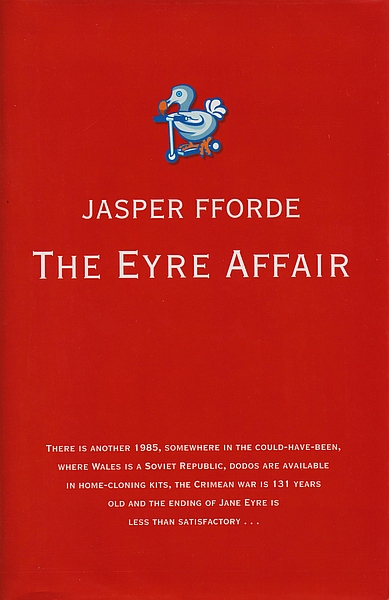
Jasper Fforde's Thursday Next novels follow a literary detective in an alternate England who can jump physically into the world of books to solve crimes against literature itself. Beginning with The Eyre Affair, the series mixes metafiction, wordplay and parody across increasingly personal plots as Thursday balances family life with adventures inside classic novels. Fforde has extended the sequence across eight books and several decades, with further installments in the works.
- Departure
A. G. Riddlestandalone novel2014
similar byscience fictioncontemporarypolitical intrigueour worldmultiple povtensethriller & suspense
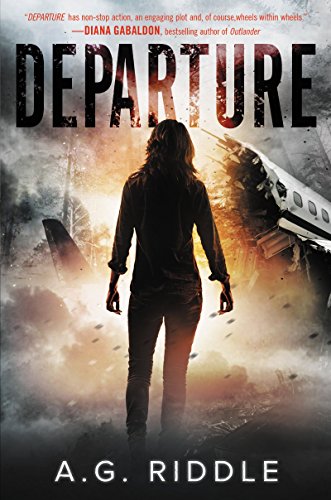
"The world's past and future rests in the hands of five unwitting strangers in this definitive edition of A. G. Riddle's time-traveling, mind-bending speculative thriller. En route to London from New York, Flight 305 suddenly loses power and crash-lands in the English countryside, plunging a group of strangers into a mysterious adventure that will have repercussions for all of humankind.Struggling to stay alive, the survivors soon realize that the world they've crashed in is very different from the one they left. But where are they? Why are they here? And how will they get back home? Five passengers seem to hold clues about what's really going on: writer Harper Lane, venture capitalist Nick Stone, German genetic researcher Sabrina Schroeder, computer scientist Yul Tan, and Grayson Shaw, the son of a billionaire philanthropist.As more facts about the crash emerge, it becomes clear that some in this group know more than they're letting on--answers that will lead Harper and Nick to uncover a far-reaching conspiracy involving their own lives. As they begin to piece together the truth, they discover they have the power to change the future and the past--to save our world. or end it. A wildly inventive and propulsive adventure full of hairpin twists, Departure is a thrilling tale that weaves together power, ambition, fate, memory, and love, from a bold and visionary talent"--
- Dissolution
Nicholas Bingestandalone novel2025
similar byscience fictioncontemporaryfamily secretsour worldmultiple povtensethriller & suspense
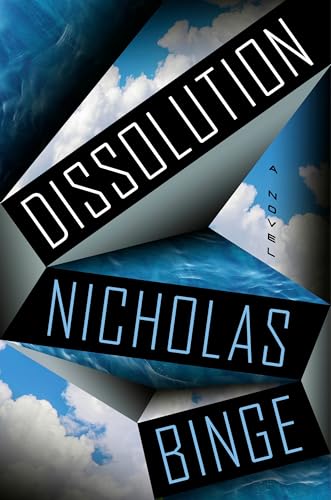
Dissolution is a 2025 science fiction novel by Nicholas Binge, published in the UK by Harper Voyager, and in the US by Riverhead Books. It is published or forthcoming in multiple languages, including Spanish, German, Hungarian, and Arabic. The novel tells the story of Margaret (Maggie) Webb, who discovers that her husband Stanley’s Alzheimer’s is a false cover for the fact that his memories are being purposefully erased to keep something he did in his past hidden. The book alternates between Maggie and Stanley’s perspectives as they move through multiple decades of their relationship.
- The Humans
Matt Haigstandalone novel2013
similar byscience fictioncontemporaryour world+2 more
When an extraterrestrial arrives on Earth, his first impressions of humans are less than positive. Taking the form of Professor Andrew Martin at Cambridge University, the visitor is eager to complete his task and hurry back to his own utopian planet. Disgusted by the way humans look, what they eat, their capacity for murder and war, he is equally baffled by the concepts of love and family. But as time goes on, he starts to reconsider.
- The Chronicles of St. Mary's
series46 books2013
similar byscience fictionfunnycontemporaryour world+1 more
Jodi Taylor's Chronicles of St Mary's follows the disaster-prone historians of St Mary's Institute of Historical Research, who insist they don't 'time travel' but merely 'investigate major historical events in contemporary time' — usually while narrowly avoiding death and causing chaos. Beginning with Just One Damned Thing After Another, the comic time-travel series has grown to nineteen novels ranging across historical periods from the Cretaceous to the twentieth century.
- Little Brother
series7 books2008
similar byscience fictioncontemporarytense+3 more
Cory Doctorow's Little Brother follows Marcus, a San Francisco teenager who builds a covert mesh network, the Xnet, to organize resistance after the Department of Homeland Security uses a terrorist attack as pretext for mass surveillance and civil-rights violations. Homeland continues Marcus's fight years later, and Attack Surface completes the trilogy; a companion story, 'Lawful Interception,' and other short pieces extend the same near-future world. Throughout, the series doubles as a working explanation of the surveillance and cryptography tools its characters use.
- Kairos
series11 books1962
completed
similar byscience fiction+4 more
The Time Quintet is a science fantasy series of five young adult novels written by American author Madeleine L'Engle and made up of A Wrinkle in Time (1962), A Wind in the Door (1973), A Swiftly Tilting Planet (1978), Many Waters (1986), and An Acceptable Time (1989).
- Rivers of London
series32 books2011
similar bycontemporarybritish isles+2 more
The Rivers of London series is a series of urban fantasy novels by English author Ben Aaronovitch, and comics/graphic novels by Aaronovitch and Andrew Cartmel, illustrated by Lee Sullivan.
- H. G. Wells' War of the Worlds
universe65 books1898
Start hereThe War of the Worlds · Start here
similar byscience fiction+2 more
No one would have believed, in the closing years of the nineteenth century, that human affairs were being watched keenly and closely from the timeless worlds of space. And then the cylinders fell. H. G. Wells' War of the Worlds opens in the quiet of the Surrey commons, where a falling star proves to be the first Martian craft — and from the pit rise the towering tripods, the Heat-Ray, the choking Black Smoke and the creeping red weed, wielded by minds that regard mankind much as we regard the creatures we boil for supper. This is invasion rendered as natural disaster: cold, methodical, and vast beyond argument. Wells' 1898 novel is the seed; everything else grows from that Martian soil. The catalogue gathers direct sequels and continuations alongside a wide field of other hands. In War of the Worlds: Global Dispatches the invasion is retold across the whole planet through the eyes of Twain, Verne, Tolstoy, Lowell and Kipling; in the Manly Wade and Wade Wellman crossover, Sherlock Holmes, Watson and Professor Challenger take the field against the machines; and Scott Washburn's Great Martian War stretches the fighting into a decades-long alternate history of steam, artillery and grinding attrition. It is a loose shared world — no single decreed sequence, many voices answering one calamity. What sets this world apart is its refusal of heroics: the invaders fall not to generals but to the smallest things of Earth, humbling and indifferent. Begin, always, with Wells' original novel — it is short, and it is the ground every later book stands upon. From there follow your appetite: Global Dispatches for the panorama, the Holmes campaign for adventure, Washburn for the long war.
- Soon I Will Be Invincible
Austin Grossmanstandalone novel2007
similar byscience fictionfunnycontemporarymultiple pov+1 more
Soon I Will Be Invincible is a novel by Austin Grossman, published by Pantheon Books and released on June 5, 2007. The novel uses two alternating first person narratives—the first told from the point of view of Fatale, a female cyborg recruited by the superhero group The New Champions as they investigate the disappearance of a superhero named CoreFire. The other narrative is told from the point of view of Dr. Impossible, a supervillain possessing super-human strength and intellect who suffers from Malign Hypercognition Disorder. The plot follows Impossible's thirteenth attempt to take over the world after escaping from prison.
- The Themis Files
series3 books2015
similar byscience fictioncontemporaryour worldtense+3 more
Sylvain Neuvel's Themis Files opens when a girl falls into a hole in South Dakota and lands on the palm of a giant metal hand buried underground; the trilogy picks up years later as she leads the team trying to determine what the hand is part of and why it's there. Sleeping Giants and its sequels are told almost entirely through interview transcripts conducted by an unnamed, evasive interrogator, giving the series a documentary, oral-history feel unusual for first-contact SF. The mystery escalates from an archaeological puzzle into a question of who else is looking for the same answer.
- The Casual Vacancy
J. K. Rowlingstandalone novel2012
similar bycontemporarypolitical intriguebritish islesmultiple pov+2 more
Publisher: "When Barry Fairbrother dies unexpectedly in his early forties, the little town of Pagford is left in shock. Pagford is, seemingly, an English idyll, with a cobbled market square and an ancient abbey, but what lies behind the pretty façade is a town at war. Rich at war with poor, teenagers at war with their parents, wives at war with their husbands, teachers at war with their pupils…. Pagford is not what it first seems. And the empty seat left by Barry on the town's council soon becomes the catalyst for the biggest war the town has yet seen. Who will triumph in an election fraught with passion, duplicity and unexpected revelations?"
- Foundation Universe
universe123 books1940
Start hereFoundation · Start here
similar byscience fiction+3 more
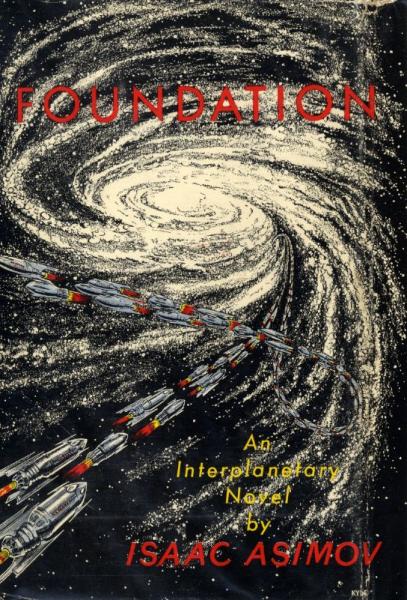
There is a science that reads the future of quadrillions the way an astronomer reads the orbits of stars. It is called psychohistory, and its equations foresee something the ruling Galactic Empire cannot admit: the throne is rotting, and thirty thousand years of barbarism are coming. One man, Hari Seldon, cannot stop the fall. He can only shorten it — by seeding a Foundation of scholars at the rim of the galaxy, a fragile institution built to carry knowledge across the dark and cut the interregnum to a single millennium. This is a universe told in the register of history itself: the long view, the calm of deep time, empires measured in centuries and men measured against them. The spine is Asimov's original trilogy — Foundation, Foundation and Empire, Second Foundation — followed decades later by the sequels Foundation's Edge and Foundation and Earth and the prequels Prelude to Foundation and Forward the Foundation. Late in life Asimov braided this in with his other future histories: the Robot novels of detective Elijah Baley and his humaniform partner R. Daneel Olivaw (The Caves of Steel, The Naked Sun, The Robots of Dawn, Robots and Empire) and the early Galactic Empire novels (Pebble in the Sky and its kin), until one continuous chronicle ran from the first thinking robots to the Second Empire. Other hands extend it — the Second Foundation Trilogy by Gregory Benford, Greg Bear, and David Brin, and shared-world spinoffs such as Robot City — so the corpus sprawls beyond a single author's tidy shelf. What distinguishes it is that the drama is intellectual: crises resolved by insight, nerve, and dialogue rather than fleets and blades, each turn hinging on the hidden logic of the Seldon Plan. Begin where readers have always begun — with Foundation, and the original trilogy in publication order. The rest opens outward from there.
- Ender's Shadow
series5 books1999
part of Ender's Game Universe
similar byscience fictionpolitical intriguetense+1 more
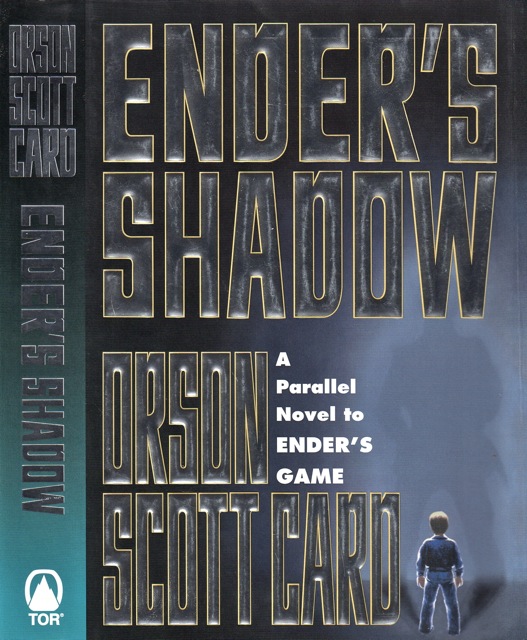
Orson Scott Card's Ender's Shadow retells the events of Ender's Game from the perspective of Bean, a physically stunted but ferociously intelligent street child recruited into the same Battle School program as Ender Wiggin. It launches the Shadow series, which follows Bean and other secondary Battle School characters into the political aftermath of the Formic Wars back on Earth, running parallel to and eventually past the timeline of Card's main Ender Quintet.