More like Bedlam Planet
anchored on:science fictionspace colonizationother star systemsfar futurealiensmadness+1 more
but
- Armor
John Steakleystandalone novel1984
similar byscience fictiontenseother star systemsfar futurealiensmadness
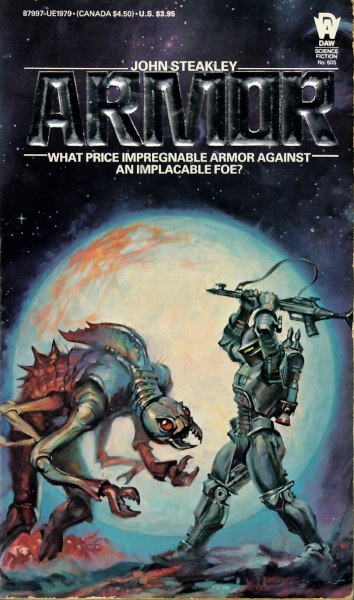
Armor is a military science fiction novel by John Steakley. It features the military use of exoskeletons and insect-like alien enemies but concentrates on the psychological effects of violence on human beings.
- The Outposter
Gordon R. Dicksonstandalone novel1972
similar byscience fictiontenseother star systemsfar futurespace colonization+1 more
From the flap of the Lippincott first edition: "Rich man, poor man, beggarman, thief - the lottery played no favorites. If your number came up, you joined the rest of the losers marked for exile from overcrowded Earth. Shipped to a raw new outpost in space, you were officially called a colonist. But your whispered name was "garbage," your destination was oblivion, and you had few illusions about your chances of survival. The Outposters - a token band of specially trained personnel - were given the impossible task of guiding and protecting these outcasts in their harsh new environment. Will indifferent support from Earth, supply lines ran thin and raids by hostile aliens were increasing unchecked. Only one young Outposter, Mark Ten Roos, dared to challenge the system and change the odds. To help him, Mark hand-picked a strange assortment of allies from the new shipment of colonists: a brash opportunist, every instinct honed for personal survival; a midget woman with a professorship in philosophy; a widowed mathematician, expert in position astrophysics; an ex-marine with a dishonorable discharge. And help came to Mark from a source he had not expected - the daughter of the Outer Navy's ranking officer. When Mark Ten Roo put his plan into action, he knew he was also putting his life on the line."
- Moties
series4 books1974
part of CoDominium
similar byscience fictionfar futureother star systemsaliens+1 more
Larry Niven and Jerry Pournelle's The Mote in God's Eye (1974) depicts humanity's first contact with an alien species, the Moties, set within the far-future interstellar setting of Pournelle's codominium future history. The Gripping Hand continues that first-contact crisis years later, and Outies, written by J. R. Pournelle, carries the story forward into a new generation. Together the three books trace an escalating encounter between human and Motie civilizations within the codominium universe.
- The Dosadi Experiment
Frank Herbertstandalone novel1977
similar byscience fictiontenseother star systemsfar futurealiens
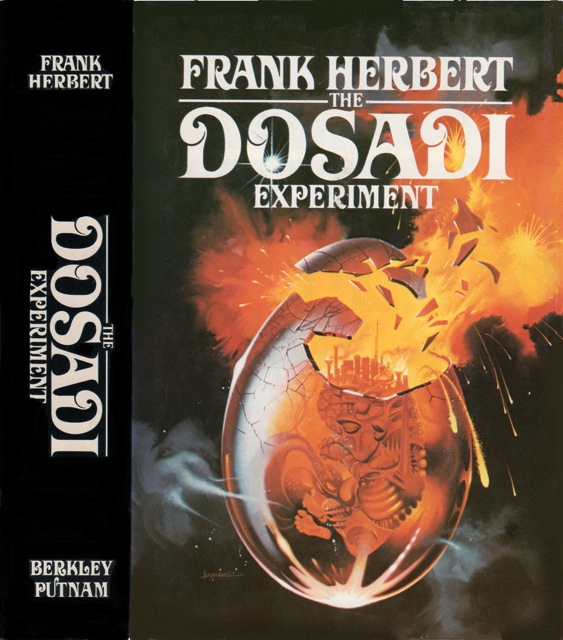
From the flaps of the Berkley Putnam first edition: "In his first new work of science fiction since the best-selling Children of Dune, Frank Herbert returns to his world of Whipping Star, and involves Jorj X. McKie, Saboteur Extraordinary, in a new intrigue. In Whipping Star, McKie discovered that some of the stars in the universe are actually intelligent, super-powerful beings, and was able to befriend one of them, the star Alcyone - affectionately known as Fannie Mae. As The Dosadi Experiment opens, McKie is assigned to investigate the planet Dosadi, which is isolated from the rest of the galaxy by a "god-wall," a barrier set up by one of the intelligent stars. Dosadi is rumored to be an experimental planet, and the experimenters are the froglike Gowachin, whose culture is founded upon a strange legal system in which McKie is the only human ever trained. He learns that humans and Gowachin have been placed on Dosadi, without their consent, for an experiment that could last centuries: an experiment in extreme overcrowding. But this monstrous plot is apparently out of control, and it seems the Gowachin may be prepared to destroy Dosadi rather than expose its secret, thus breaking the peace among the races, and starting the first interstellar war. But this is just the beginning. When McKie finally reaches Dosadi he discovers that the Dosadis have taken control of their own evolution and produced a competitive, highly evolved elite, of both humans and Gowachin, who have been able to extrapolate the existence of a universe beyond the god-wall and hate whoever has imprisoned them like this. They plan to break out and avenge themselves on the galaxy."
- Dune
series20 books1963
part of Dune Universe
similar byscience fictionfar futureother star systems+1 more
Frank Herbert's Dune Chronicles opens with 1965's Dune, set on the desert planet Arrakis where House Atreides takes control of the only source of the vital spice melange and young Paul Atreides is pulled into a struggle over its politics and religion. Herbert carried the story forward across five further novels — Dune Messiah, Children of Dune, God Emperor of Dune, Heretics of Dune, and Chapterhouse: Dune — following Paul's line over the following millennia, before Brian Herbert and Kevin J. Anderson later extended the saga. Many other editions of these six novels are omnibus and box-set repackagings rather than separate stories.
- Dune Universe
universe78 books1963
Start hereDune · Start here
similar byscience fictionfar futureother star systems+1 more
Arrakis. Dune. The desert planet, where empire runs on a single substance: the spice melange, which folds space, prolongs life, and unlocks prescience, and which exists nowhere else in the known universe. Frank Herbert's saga is a meditation dressed as an adventure — feudal houses and a secret sisterhood, engineered messiahs and the patient ecology of a world without water, all turning on the terrible gravity of who commands the spice. It reads like scripture and schemes like a war room, ten thousand years hence, among people who have outlawed the thinking machine and made instruments of themselves instead. At its heart stand Herbert's original six — Dune, Dune Messiah, Children of Dune, God Emperor of Dune, Heretics of Dune, Chapterhouse: Dune — a single deepening arc across millennia, arguing the whole way between prophecy and free will. Around that spine his son Brian Herbert and Kevin J. Anderson have raised a vast prequel architecture: Prelude to Dune, tracing the great houses a generation before Paul; Legends of Dune, reaching back to the crusade that broke the machines; the Schools of Dune cycle on the founding of Bene Gesserit, Mentat, and Navigator; the Caladan Trilogy and Heroes of Dune filling years the originals left in shadow. Many hands, dozens of volumes, one desert. What sets Dune apart is its refusal of the simple: religion is manufactured, heroes are hazards, and the sand itself — worm, water, ecology — acts as a political power. Begin where the universe did, with Frank Herbert's Dune (1965), and read the original six in order; you need nothing else to feel the full weight. The prequels are a country to explore afterward, taken by era. Beginnings are delicate times.
- Chanur
series7 books1982
part of Alliance-Union Universe
similar byscience fictiontensefar futureother star systemsaliens
The Chanur novels are a series of five science fiction novels, forming three separate stories, written by American author C. J. Cherryh and published by DAW Books between 1982 and 1992. The first novel in the series is The Pride of Chanur (1982), which was nominated for both the Hugo and Locus Awards in 1983. The Pride of Chanur, originally a stand-alone story, was followed by the Chanur's Venture trilogy, Chanur's Venture (1984), which was shortlisted for a Locus Award in 1985; The Kif Strike Back (1985) and Chanur's Homecoming (1986). These were followed by a later sequel, Chanur's Legacy (1992). The five novels were also published in two omnibus editions: the first three in The Chanur Saga in 2000 and the next two in Chanur's Endgame in 2007.
- Heorot
series4 books1987
similar byscience fictionother star systemsfar futurespace colonization+2 more
Larry Niven, Jerry Pournelle and Steven Barnes's The Legacy of Heorot strands human colonists on an idyllic-seeming alien world where they discover apex predators -- grendels -- hidden beneath the surface, forcing them to fight for survival. Beowulf's Children continues the colony a generation later as the children born on the planet clash with their parents over how to live alongside the grendels, and a fourth book, Starborn and Godsons, returns to the settlement decades further on. It's hard-SF creature-horror crossed with generational colony drama.
- Rider at the Gate
C. J. Cherryhstandalone novel1995
similar byscience fictiontenseother star systemsfar futurespace colonizationaliens
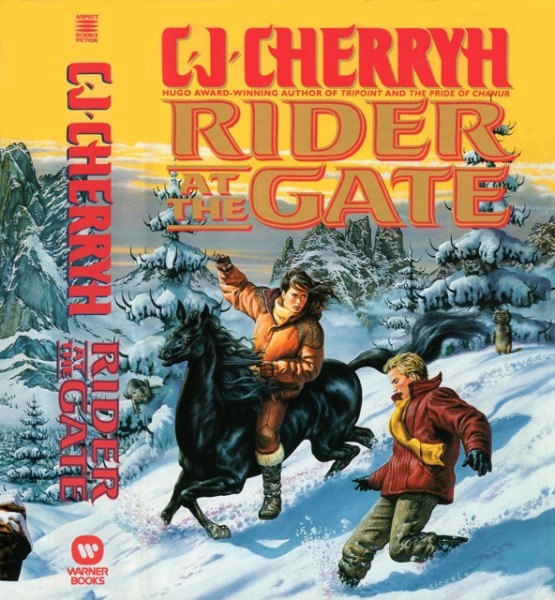
Rider at the Gate is a science fiction novel by American writer C. J. Cherryh, first published by Warner Books in August 1995. It is the first of a series of two novels written by Cherryh and is set in the author's Finisterre universe. The second book in the series, Cloud's Rider, was published in September 1996. The series is about the descendants of lost colonists stranded many generations ago on the hostile planet of Finisterre.
- Hestia
C. J. Cherryhstandalone novel1979
similar byscience fictiontenseother star systemsfar futurealiensspace colonization
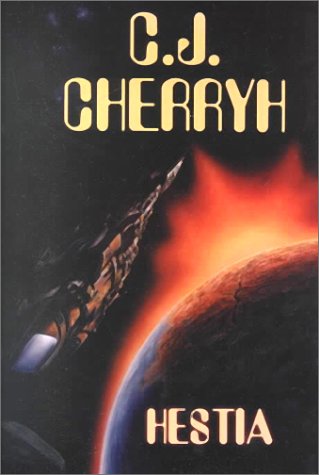
Hestia is a 1979 science fiction novel by American writer C. J. Cherryh. It is an early novel in her career, about colonists on an alien world and their interactions with the catlike natives, centering on a young engineer sent to solve the colonists' problems, and his relationship with the young native cat-woman in scanty clothing on the cover.
- Pushing Ice
Alastair Reynoldsstandalone novel2005
similar byscience fictiontensefar futureother star systemsaliens
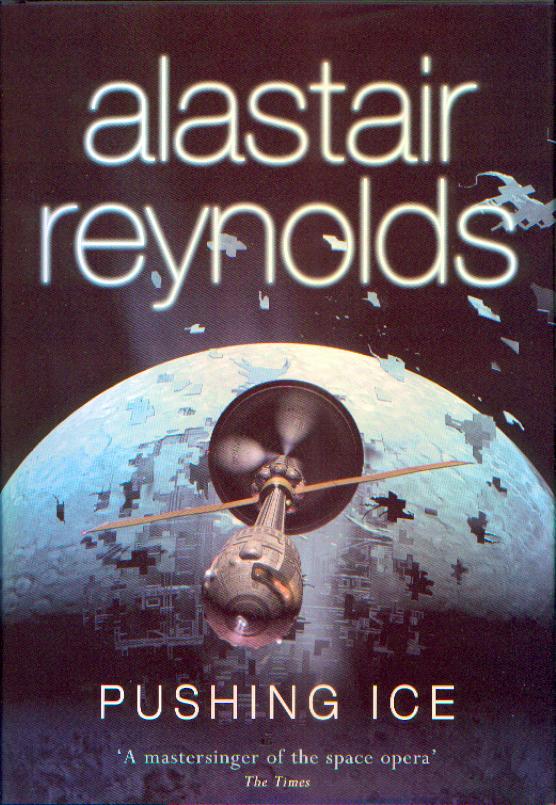
When Saturn's moon Janus suddenly takes off into interstellar space, an ice mining spaceship sent to investigate finds itself swept along into distant space until it ends up trapped in a gigantic alien structure, wherein the crew must prepare to reside for the foreseeable future.
- The Seed of Earth
Robert Silverbergstandalone novel1962
similar byscience fictiontenseother star systemsfar futurespace colonizationaliens
Back of book: The leaders of Earth intend to spread Mankind throughout the universe, until every habitable planet boasts a human civilization. 60 colony ships leave Earth every day on a one-way trip to the stars. Each ship carries 100 draftees. 6000 a day. 48,000 a week. Two and one half million every year. If your number comes up, one of them is YOU. The Draftees for the planet Osiris are a typical colony group: fifty men and fifty women with little in common, except their courage and determination to make the best of a situation they cannot change. But sacrifice and brave resolve are not enough to save them in their struggle to survive on a hostile new planet. The tiny band of colonists is torn apart by violence, and threatened by an alien menace. They face disaster, unless someone can discover the secret of survival on a world so different from the one they left behind.
- Janissaries
series4 books1979
similar byscience fictiontenseother star systemsfar future+1 more
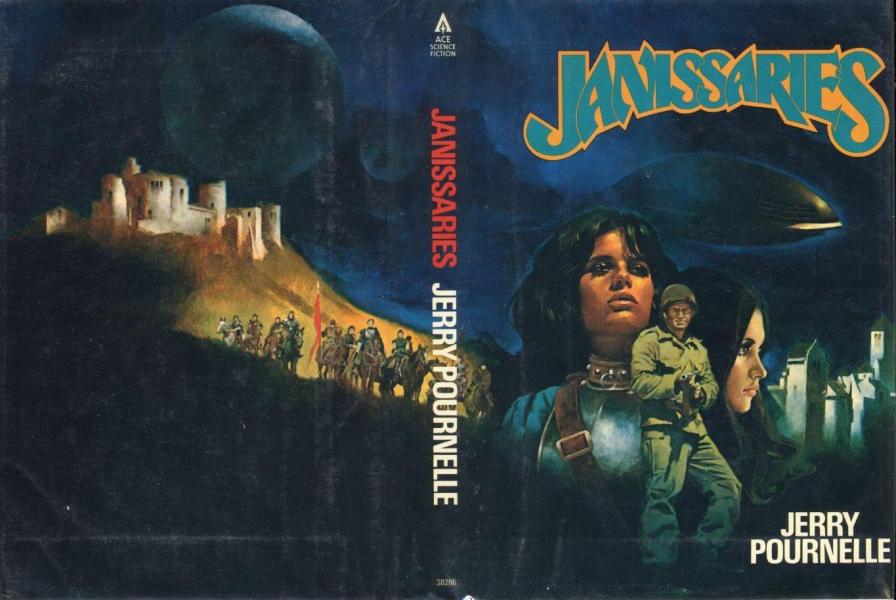
Janissaries are an American series of military and political-based science fiction novels are set in an interstellar confederation of races, in which humans are a slave race entrusted with military affairs and law enforcement. They were written by Jerry Pournelle, with Roland J. Green co-authoring the second two books.
- Cycle of Fire
Hal Clementstandalone novel1957
similar byscience fictiontenseother star systemsfar futurealiens
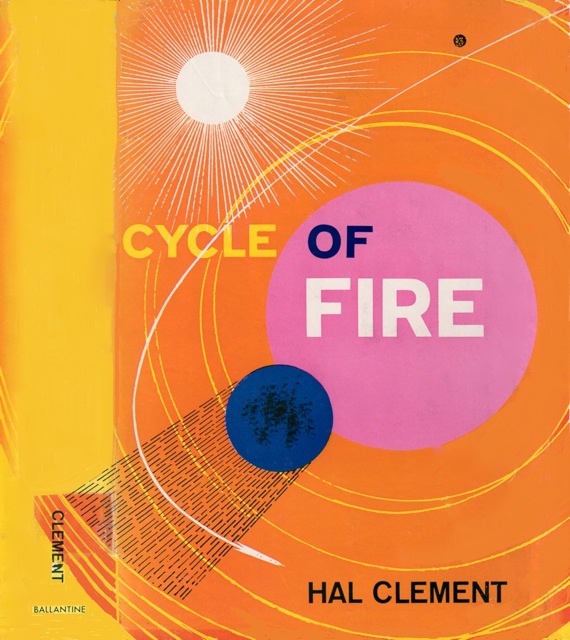
After his ship crashed on the inhospitable planet Abyorman, Nils Kruger had spent weeks wandering across the face of the planet.suffering from blistering heat, the searing cold of an alien climate. Now he had found a fellow wanderer, Dar, an alien castaway. They may both die. The human opts to do something about it. Dar, who knows the time of his death in advance, opts to do nothing. Which of them is right? Perhaps both
- In the Company of Others
Julie E. Czernedastandalone novel2001
similar byscience fictiontensefar futurespace colonizationother star systemsaliens
When humans set out to explore the universe, they found a number of planets suitable for colonizing. The one thing they didn't find was intelligent life. And so the terraforming of worlds began, with eager immigrant families temporarily housed in space stations till their new home planets were ready. But the technicians made one all important mistake by introducing the alien Quill to worlds where they did not belong. The Quill were supposed to be destroyed when the crews finished their work, but some survived, multiplied, and mutated till they were no longer harmless. They were deadly. Suddenly mankind was in retreat, leaving colonists stranded in space. In the ensuing chaos many stations failed. For the survivors, the only hope lay in finding a way to wipe out the Quill. Earth scientist, Dr. Gail Smith, thought one special human, Aaron Pardell, might hold the answer. Found as a baby and raised by a stationer in the "Outsider" settlement that clung to Thromberg Station, Aaron may have survived Quill contact. Still, finding Aaron and winning his help might be the least of Dr. Smith"s problems.... (from the back cover of the DAW Books first edition)
- Tunnel in the Sky
Robert A. Heinleinstandalone novel1955
similar byscience fictiontenseother star systemsfar future
As the final test of a survivalist/explorer class, teenagers are dumped on an alien planet to use their skills while awaiting pickup. But something has gone wrong, and they find they are on their own.
- West of the Sun
Edgar Pangbornstandalone novel1953
similar byscience fictionother star systemsfar futurespace colonizationaliens+1 more
From the back cover of the Dell first paperback printing: "After eleven years in space the Argo landed... West of the Sun ... on the dangerous planet Lucifer. The crew faced and untamed world of huge carnivorous birds with wolverine heads and flashing black teeth; furred, ten-foot tall men; red-skinned man-eating pygmies. They fought for mere survival but - their duty was to colonize and populate the planet - four men and only two women."
- Man-Kzin Wars
series84 books1986
part of Known Space
similar byscience fictiontensefar futureother star systemsaliens
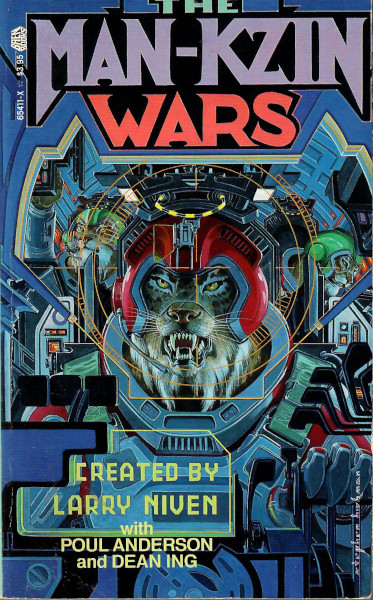
The Man–Kzin Wars is the name of a series of military science fiction anthologies as well as the name of the first book in the series. The short stories detail the eponymous conflicts between mankind and the Kzinti, set in Larry Niven's Known Space universe. However, Niven himself has written only a small number of the stories; most were written by other science fiction writers, as Niven opened this part of the Known Space to collaboration in the form of a shared universe. The cover art for the books in the series is created by Stephen Hickman.
- Wolfling
Gordon R. Dicksonstandalone novel1969
similar byscience fictiontenseother star systemsfar futurealiens
From the flaps of the Baen/SFBC edition: "Is Earth merely the lost colony of a superior race? - She was well over six feet tall, and beautiful in a sculpted, abstract way. She had skin the color of white onyx, and her eyes... her eyes were large and feline - a startling lemon yellow in color. She was the Princess Afuan, one of the High-born, and she had chosen the Earthman Kim Keil to return to the Throne World with her - for she had decided that his performance in the bull-ring might amuse the Emperor. She didn't know that Jim was a bull-fighter only by virtue of six months' intensive training, nor that the bull was programmed - his behavior following and impressively fierce but unswerving pattern. Jim was just another wolfling to Afuan - a lesser being from a backward colony world. Jim, however, was keenly aware that he was playing a role, one which might prove to be extremely dangerous. Up until 10 years earlier, when their first ship had reached Alpha Centauri, the people of Earth hadn't even known that the vast Empire of human-occupied worlds existed. The discovery had been a profound shock. Had we evolved independently? Or were we merely descendants of the Empire's first space pioneers - a lost colony found at last, perhaps with devastating consequences? That's what Jim Keil had to find out. Chosen from among numerous highly qualified candidates - an anthropologist trained, mentally and physically, beyond the limits of his profession - it was his mission to observe the Throne World and the High-born... to determine whether or not they posed a threat to Earth. One thing was apparent from the start. The High-born were superior beings - physically taller and stronger than other humans, endowed with faster reflexes, superior mental capacity... and extraordinary technological resources. Their contempt for the new wolfling in their midst was open, their intrigues complex. An enormous gulf separated the people of the Throne World from Earthlings. But that gulf was not so wide that Jim couldn't recognize an enemy when he met one. Clearly, if he remained merely a passive observer of the High-born, he'd never survive among them."
- The Winged Man
A. E. van Vogt & E. Mayne Hullstandalone novel1966
similar byscience fictiontenseother star systemsfar futurealiens
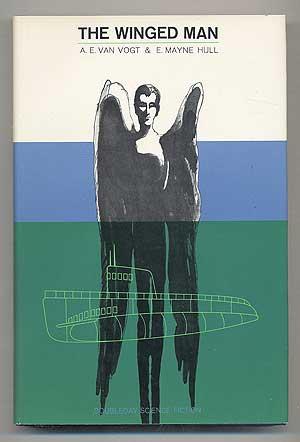
The crew of the submarine Sea Serpent and the submarine itself are taken by a strange winged man to the year 24,999, where a war is going on between the winged men and gigantic fishmen living under the sea. The winged men want the crew of the Sea Serpent to destroy the fishmen with their submarine, the only thing capable of going under water and destroying the city of the fishmen.
- Naked to the Stars
Gordon R. Dicksonstandalone novel1961
similar byscience fictiontenseother star systemsfar futurealiens
The subject of the cosmic soldier has become a matter of concern for the science fiction reader. With the award-winning success of The Forever War, and with the great classic novels of Gordon R. Dickson's genetically bred mercenaries, the Dorsai, it is clear that the role of a fighter in a universe of expanding technology and competing alien intelligences is on science fiction's orders of the day. Gordon R. Dickson has been the master of that field, and his novel, Naked to the Stars, is one of his masterpieces. Long out of print, it is the story of a star soldier who, during a battle against a non-human foe on a far planet, somehow lost sixteen hours from his memory. Discharged for the potential danger those lost hours might have programmed, Cal Truant made it his fixation to uncover the mystery buried in his mind - to find out what had happened in those missing hours - and block the peril it might present to his fellow troopers, to his war command, and to the planet for which they fought - Earth.
- Catteni Sequence
series5 books1970
completed
similar byscience fictionother star systemsfar futurealiens+2 more
The Catteni series is a tetralogy of science fiction novels by American writer Anne McCaffrey. In this universe, humans are slaves of aliens, the humanoid Catteni. Woven through all four of the books are details of the relationship between Kristin Bjornsen, a former slave, and Zainal, a renegade Catteni.
- Red Planet
Robert A. Heinleinstandalone novel1949
similar byscience fictionfar futurespace colonizationaliens+1 more
A boy colonist on Mars takes his bouncing ball Martian pet with him to boarding school, but the new Headmaster is a controlling tyrant. Things get worse when he discovers a plot that will jeopardize all of the colonists.