More like Deadly Memory
anchored on:science fictionour world
but
- Library of America P. K. Dick Collection
series9 books1962
completed
similar byscience fictionnear future+2 more
- Total Recall
Piers Anthonystandalone novel1989
similar byscience fictionour worldamnesiaidentitynear futuremysterioustense
Douglas Quail is haunted by nightmares of Mars, covert missions and a life more glamorous than his earthbound 2089 AD reality. So he turns to "Recall", manufacturers of synthetic memories. They implant a memory into him but he soon finds that his nightmares are true memories.
- The Mind Cage
A. E. van Vogtstandalone novel1957
similar byscience fictionour worldnear futuretense+2 more
The Mind Cage is a 1957 science fiction novel by American writer A. E. van Vogt, adapted from the short story "The Great Judge" (1948).
- Foundation Universe
universe123 books1940
Start hereFoundation · Start here
similar byscience fiction+2 more
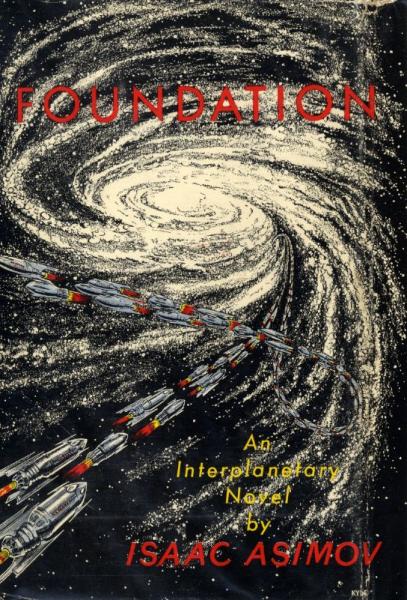
There is a science that reads the future of quadrillions the way an astronomer reads the orbits of stars. It is called psychohistory, and its equations foresee something the ruling Galactic Empire cannot admit: the throne is rotting, and thirty thousand years of barbarism are coming. One man, Hari Seldon, cannot stop the fall. He can only shorten it — by seeding a Foundation of scholars at the rim of the galaxy, a fragile institution built to carry knowledge across the dark and cut the interregnum to a single millennium. This is a universe told in the register of history itself: the long view, the calm of deep time, empires measured in centuries and men measured against them. The spine is Asimov's original trilogy — Foundation, Foundation and Empire, Second Foundation — followed decades later by the sequels Foundation's Edge and Foundation and Earth and the prequels Prelude to Foundation and Forward the Foundation. Late in life Asimov braided this in with his other future histories: the Robot novels of detective Elijah Baley and his humaniform partner R. Daneel Olivaw (The Caves of Steel, The Naked Sun, The Robots of Dawn, Robots and Empire) and the early Galactic Empire novels (Pebble in the Sky and its kin), until one continuous chronicle ran from the first thinking robots to the Second Empire. Other hands extend it — the Second Foundation Trilogy by Gregory Benford, Greg Bear, and David Brin, and shared-world spinoffs such as Robot City — so the corpus sprawls beyond a single author's tidy shelf. What distinguishes it is that the drama is intellectual: crises resolved by insight, nerve, and dialogue rather than fleets and blades, each turn hinging on the hidden logic of the Seldon Plan. Begin where readers have always begun — with Foundation, and the original trilogy in publication order. The rest opens outward from there.
- Flashforward
Robert J. Sawyerstandalone novel1999
similar byscience fictionour worldidentitynear futuremysterioustense
Flashforward is a science fiction novel by Canadian author Robert J. Sawyer first published in 1999. The novel is set in 2009. At CERN, the Large Hadron Collider accelerator is performing a run to search for the Higgs boson. The experiment has a unique side effect; the entire human race loses their consciousness for about two minutes. During that time, nearly everyone sees themselves roughly twenty-one years and six months in the future. Each individual experiences the future through the senses of their future self. This "flashforward" results in countless deaths and accidents involving vehicles, aircraft, and any other device needing human control at the time of the experiment. The novel was adapted into the 2009 television series FlashForward.
- Eva
Peter Dickinsonstandalone novel1988
similar byscience fictionour worldidentitynear futuremysterious+1 more
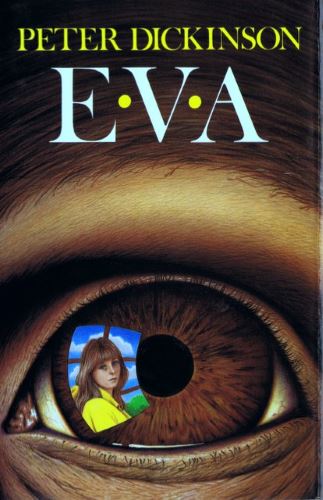
From the back cover: "Thirteen-year-old Eva wakes up in the hospital unable to remember anything since the picnic on the beach. Her mother leans over the bed and begins to explain. A traffic accident, a long coma... But there is something, Eva senses, she is not being told, some other price she must pay to be alive at all. What have they done, with their amazing medical technology, to save her?"
- Cas Russell / Russell's Attic
series5 books2014
similar byscience fictionour worldidentitynear futuretense+1 more
- Jenna Fox Chronicles
series4 books2008
similar byscience fictionidentitynear future+2 more
The Jenna Fox Chronicles opens with a teenage girl waking from a year-long coma with gaps in her memory, only to uncover unsettling truths about the medical technology that saved her life. Mary E. Pearson's trilogy, beginning with The Adoration of Jenna Fox, explores questions of identity and what makes someone human as the story continues through The Fox Inheritance and Fox Forever.
- More Than This
Patrick Nessstandalone novel2013
similar byscience fictionour worldidentitynear futuremysterious+1 more
More Than This is a young adult novel by Patrick Ness, published by Candlewick Press in 2013. It follows a teenage boy named Seth who, after drowning in the ocean, wakes up alone on a desolate suburban English street in what he believes to be hell.
- The Body Electric
Beth Revisstandalone novel2014
similar byscience fictionour worldamnesiaidentitynear futuremysterioustense
Ella Shepherd discovers that she has the ability to alter other people's memories, but soon learns that she may have been a victim of memory alteration herself as she seeks to uncover the mystery surrounding the technology.
- The Light of Other Days
Arthur C. Clarke & Stephen Baxterstandalone novel2000
similar byscience fictionour worldnear futuretense+1 more
An industrialist devises a technique to use tiny wormholes as light pipes to enable viewing of any event anywhere; and subsequently it becomes possible to use them to view any event in the past as well. The effects on society are enormous.
- Childhood's End
Arthur C. Clarkestandalone novel1953
similar byscience fictionidentitynear futureour world
Childhood's End is a 1953 science fiction novel by the British author Arthur C. Clarke. The story follows a peaceful alien invasion of Earth by mysterious Overlords, whose arrival begins decades of apparent utopia under indirect alien rule, at the cost of human identity and culture.
- Escape from Memory
Margaret Peterson Haddixstandalone novel2003
similar byscience fictionour worldamnesiaidentitymysterious+1 more
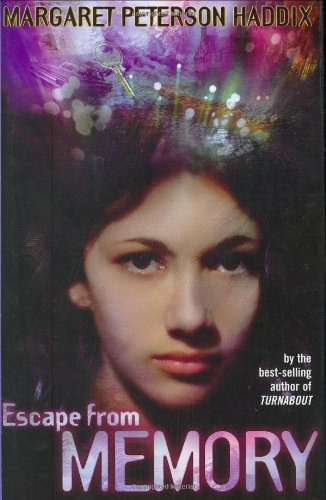
Escape from Memory is a young adult novel by Margaret Peterson Haddix. It was published in 2003 by Simon & Schuster.
- The Idlewild Trilogy
series3 books2003
similar byscience fictionidentitynear futureour world+1 more
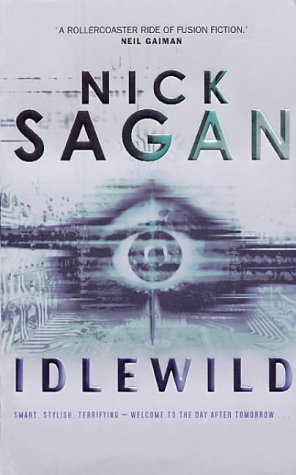
Nick Sagan's Idlewild trilogy opens with Idlewild (2003), a science-fiction novel that alternates between mid-21st-century interludes and events a generation later, following humanity's ten last survivors, cast in a modern mythological framework as god-like figures. It continues across Edenborn and Everfree.
- Coils
Roger Zelazny & Fred Saberhagenstandalone novel1982
similar byscience fictionour worldamnesiaidentitymysterioustense
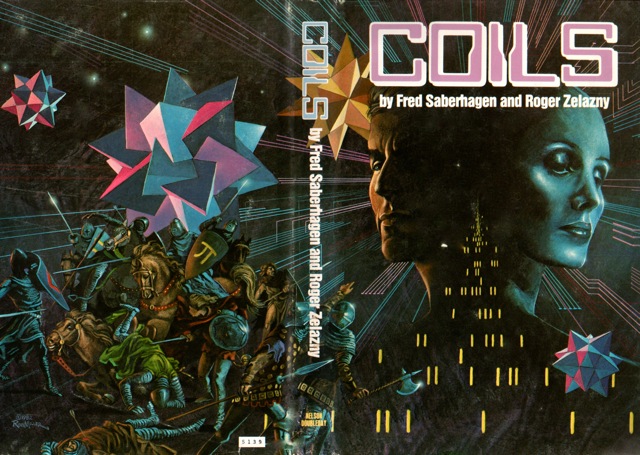
A man discovers that his memories of childhood are false, and when he begins to investigate his psychiatrist is murdered and his girlfriend is kidnapped. As his actual past begins to return to his memory, he realizes that he has the ability to mentally connect to computer circuitry, an ability he used to use for illegal advantage for the corporation which employed him, along with a small group of others with paranormal powers. He concludes that the corporation is behind all this and sets out to find and rescue his girlfriend while the corporation pursues him.
- The Zap Gun
Philip K. Dickstandalone novel1967
similar byscience fictionour worldnear future+2 more
The Zap Gun is a 1967 science fiction novel by American writer Philip K. Dick. It was first published as the two-part serial Project Plowshare in Worlds of Tomorrow in 1965 and 1966, before Pyramid Books issued it in paperback under its present title. The novel originated in a title-first commission devised by Pyramid editor Don Bensen and was written in 1964 during a period of rapid production in Dick's career.
- The Werewolf Principle
Clifford D. Simakstandalone novel1967
similar byscience fictionour worldamnesiaidentitymysterious
From the back cover of the first DAW printing: "Andrew Blake, found in a space capsule on a distant planet, was brought back to an unfamiliar Earth, where antigravity devices had replaced the wheel and houses talk and even fly! Yet nothing was as strange as Blake's own feelings. Tormented by eerie sensations and a loss of memory, he didn't know who he really was nor exactly where he came from. His destiny only began to grow frighteningly clear when he met a weird, tassel-eared creature who darkly hinted at the truth about Blake's origins. Slowly Blake became aware of the long hushed-up "Werewolf Principle," a scientific theory buried in the past, which held the key to Blake's own fate - and the future of the human race..."
- The Oracle Year
Charles Soulestandalone novel2018
similar byscience fictionour worldidentitynear futuremysterioustense
Awakening from a dream with more than one hundred predictions about the future in his head, an unassuming Manhattan bassist becomes one of the world's most powerful men and hides his identity behind an online persona that is targeted by greedy corporations and dangerous enemies.
- Time Is the Simplest Thing
Clifford D. Simakstandalone novel1961
similar byscience fictionour worldnear future+2 more
Time Is the Simplest Thing is a science fiction novel by American writer Clifford D. Simak, first published in 1961. The story combines paranormal abilities with themes of space and time travel. The underlying theme is intolerance of ordinary people towards those with unusual abilities.
- Otherland
series6 books1996
similar byscience fictionnear futuretenseour world+1 more
Otherland is a science fiction tetralogy by American writer Tad Williams, published between 1996 and 2001. The story is set on Earth near the end of the 21st century, probably between 2082 and 2089, in a world where technology has advanced somewhat beyond the present. The most notable advancement is the widespread availability of full-immersion virtual reality installations, which allow people from all walks of life to access an online world, called simply the Net. Tad Williams weaves an intricate plot spanning four thick volumes, and creates a picture of a future society where virtual worlds are fully integrated into everyday life.