More like Death Count
anchored on:science fictionfar futurespace operamystery & detectivepolitical intriguemurder investigation+4 more
but
- Company Wars
series7 books1981
part of Alliance-Union Universe
similar byfar futuretensepolitical intriguescience fictionspacespace opera+1 more
Company Wars gathers the novels C. J. Cherryh set during the breakaway conflict between Earth's colonial Company and the newly independent Union, within her wider Alliance-Union future history. Anchored by the Hugo Award-winning Downbelow Station, the books follow different ships, stations, and crews caught on either side, from merchanter traders to military spacers, rather than a single continuing cast. Read in any order, they build up a picture of the political and economic pressure that reshapes Cherryh's larger Alliance-Union universe.
- Quadrail
series5 books2005
similar byfar futuremysteriousscience fictionpolitical intriguespacespace opera+3 more
Timothy Zahn's Quadrail series follows ex-intelligence operative Frank Compton, recruited by the enigmatic Spider caretakers of the Quadrail, an interstellar train network that lets a dozen alien empires travel between worlds at a light-year a minute. Paired with the telepathically gifted Bayta, Compton investigates and fights the Modhri, a parasitic group-mind quietly seizing control of galactic leaders from within. The five novels, published 2005-2012, follow one continuous investigation from first contact with the threat to its final confrontation.
- Dune Universe
universe78 books1963
Start hereDune · Start here
similar byfar futurepolitical intriguescience fictionspace opera+1 more
Arrakis. Dune. The desert planet, where empire runs on a single substance: the spice melange, which folds space, prolongs life, and unlocks prescience, and which exists nowhere else in the known universe. Frank Herbert's saga is a meditation dressed as an adventure — feudal houses and a secret sisterhood, engineered messiahs and the patient ecology of a world without water, all turning on the terrible gravity of who commands the spice. It reads like scripture and schemes like a war room, ten thousand years hence, among people who have outlawed the thinking machine and made instruments of themselves instead. At its heart stand Herbert's original six — Dune, Dune Messiah, Children of Dune, God Emperor of Dune, Heretics of Dune, Chapterhouse: Dune — a single deepening arc across millennia, arguing the whole way between prophecy and free will. Around that spine his son Brian Herbert and Kevin J. Anderson have raised a vast prequel architecture: Prelude to Dune, tracing the great houses a generation before Paul; Legends of Dune, reaching back to the crusade that broke the machines; the Schools of Dune cycle on the founding of Bene Gesserit, Mentat, and Navigator; the Caladan Trilogy and Heroes of Dune filling years the originals left in shadow. Many hands, dozens of volumes, one desert. What sets Dune apart is its refusal of the simple: religion is manufactured, heroes are hazards, and the sand itself — worm, water, ecology — acts as a political power. Begin where the universe did, with Frank Herbert's Dune (1965), and read the original six in order; you need nothing else to feel the full weight. The prequels are a country to explore afterward, taken by era. Beginnings are delicate times.
- Teixcalaan
series2 books2019
similar byfar futurepolitical intriguescience fictiontensespace opera+4 more
Arkady Martine's space opera duology follows Mahit Dzmare, ambassador from the small, independent Lsel Station, as she arrives in the vast Teixcalaanli Empire to investigate her predecessor's death and finds herself caught up in the empire's own succession crisis. A Memory Called Empire and A Desolation Called Peace pair court intrigue with Mahit's conflicted, outsider fascination with an empire she can't help admiring.
- Dune
series20 books1963
part of Dune Universe
similar byfar futurepolitical intriguescience fictionspace opera+1 more
Frank Herbert's Dune Chronicles opens with 1965's Dune, set on the desert planet Arrakis where House Atreides takes control of the only source of the vital spice melange and young Paul Atreides is pulled into a struggle over its politics and religion. Herbert carried the story forward across five further novels — Dune Messiah, Children of Dune, God Emperor of Dune, Heretics of Dune, and Chapterhouse: Dune — following Paul's line over the following millennia, before Brian Herbert and Kevin J. Anderson later extended the saga. Many other editions of these six novels are omnibus and box-set repackagings rather than separate stories.
- Honor Harrington
series14 books1993
part of Honorverse
similar byfar futuretensepolitical intriguescience fictionspacespace operawar
David Weber's Honor Harrington novels follow the title character's rise through the Manticoran navy in the 'Honorverse,' a space-opera setting built around Age-of-Sail-style naval combat, interstellar politics and a decades-long war between rival star nations. Beginning with On Basilisk Station, the core series runs to fourteen books, alongside spin-off subseries, prequels and shared-world anthologies also set in the Honorverse. It's one of the longest-running modern military science fiction series, published by Baen.
- Moties
series4 books1974
part of CoDominium
similar byfar futurescience fictionpolitical intriguespacespace opera+2 more
Larry Niven and Jerry Pournelle's The Mote in God's Eye (1974) depicts humanity's first contact with an alien species, the Moties, set within the far-future interstellar setting of Pournelle's codominium future history. The Gripping Hand continues that first-contact crisis years later, and Outies, written by J. R. Pournelle, carries the story forward into a new generation. Together the three books trace an escalating encounter between human and Motie civilizations within the codominium universe.
- Vatta's War
series6 books2003
part of Vatta
similar byfar futuretensepolitical intriguescience fictionspacespace operawar
Vatta's War is a science fiction series by American writer Elizabeth Moon, comprising five books: Trading in Danger (2003), Marque and Reprisal, Engaging the Enemy (2006), Command Decision (2007), and Victory Conditions (2008). They have been characterized as military science fiction similar in style to the works of Lois McMaster Bujold, David Weber and Walter Jon Williams.
- Janissaries
series4 books1979
similar byfar futuretensepolitical intriguescience fictionwar+2 more
Janissaries are an American series of military and political-based science fiction novels are set in an interstellar confederation of races, in which humans are a slave race entrusted with military affairs and law enforcement. They were written by Jerry Pournelle, with Roland J. Green co-authoring the second two books.
- Chanur
series7 books1982
part of Alliance-Union Universe
similar byfar futurepolitical intriguetensescience fictionspacespace opera
The Chanur novels are a series of five science fiction novels, forming three separate stories, written by American author C. J. Cherryh and published by DAW Books between 1982 and 1992. The first novel in the series is The Pride of Chanur (1982), which was nominated for both the Hugo and Locus Awards in 1983. The Pride of Chanur, originally a stand-alone story, was followed by the Chanur's Venture trilogy, Chanur's Venture (1984), which was shortlisted for a Locus Award in 1985; The Kif Strike Back (1985) and Chanur's Homecoming (1986). These were followed by a later sequel, Chanur's Legacy (1992). The five novels were also published in two omnibus editions: the first three in The Chanur Saga in 2000 and the next two in Chanur's Endgame in 2007.
- Hellspark
Janet Kaganstandalone novel1988
similar byfar futuremysterioustensepolitical intriguemurder investigationscience fictionmystery & detective
Lassti, a newly discovered planet, is the center of political intrigue. Recently, Oloitokitok, the planet survey team's physicist was found dead. Was he killed? If so, by who? One of his fellow surveyors? Or by one of the Sprookjes, the birdlike natives of Lassti? Are the Sprookjes intelligent? If so, then parties that want the planet for development will lose it. Why is the survey team having so much trouble finding out? Into this situation arrives Tocohl, a Hellspark trader who just wanted to have a vacation on Sheveschke at the St. Veschke festival. After being attacked, rescuing a young woman, and going before a judge, Tocohl has learned all she ever wanted to know about being in the wrong place at the wrong time. Now she is on her way to find Lasti to find answers to the mysteries there.
- Vatta
universe10 books2003
Start hereVatta's War · Start here
similar byfar futuretensescience fictionspacespace opera+2 more
Get kicked out of the Academy and the family still hands you a ship. That is the arithmetic Kylara Vatta lives by. Born into Vatta Transport, Ltd. — a dynasty of interstellar traders who reckon their honor in delivered cargo and honored contracts — Ky wants a soldier's commission and gets a merchant hull instead. Then someone starts murdering her relatives and burning the ledgers, and the daughter learns that a trade fleet, armed and angry, is its own kind of war. This is military science fiction run on a merchant's books. The core cycle, Vatta's War, moves in five volumes — Trading in Danger, Marque and Reprisal, Engaging the Enemy, Command Decision, Victory Conditions — as piracy, a sabotaged faster-than-light communications network, and a scattered family push Ky from cautious captain to fleet commander. The later duology Vatta's Peace (Cold Welcome, Into the Fire) drops her, older and decorated, into a colder survival ordeal on her own homeworld. Moon writes clean, competent, procedural: supply lines and boarding actions, chains of command, the cost of a signature on a bad contract. Expect capable women, hard decisions costed to the last credit, and space combat that respects physics and paperwork alike. Begin at the beginning — Trading in Danger — and read straight through in publication order; the arc is chronological and cumulative, no side doors required.
- The Midsolar Murders
series3 books2022
similar byfar futuremysterioustensemurder investigationscience fictionmystery & detectivespacespace station
- Sten
series11 books1982
completed
similar byfar futurepolitical intriguescience fictionspacespace operawar+1 more
The Sten Chronicles, also called The Sten Adventures, are a series of eight military science fiction and space opera novels by Chris Bunch and Allan Cole published from 1982 to 1993. The series was originally published by Del Rey and then re-released by Orbit.
- The Familias Regnant
series7 books1993
part of Familias Regnant Universe
similar byfar futurepolitical intriguetensescience fictionspacespace operawar
The Serrano Legacy, also known as Familias Regnant, is a series of military science fiction / space opera books by Elizabeth Moon. The series includes seven books total, published from 1993 to 2000, and portrays a society in the distant future where the Familias Regnant serves as the governing body for an area of the galaxy. The books feature female lead protagonists—daughters and aunts, following the story of an entire family, including unique family dynamics. The books "depict women in the military who have a greater aptitude for command than the military men in their lives". The universe of the books is also ethnically diverse.
- Hellhole
series3 books2011
similar byfar futurepolitical intriguetensescience fictionspacespace opera+1 more
Brian Herbert and Kevin J. Anderson's Hellhole trilogy follows the settlers of a harsh penal-colony planet who discover it hides a far stranger secret beneath its surface, even as a former general turned governor plots rebellion against the ruling Constellation. Hellhole: Awakening and Hellhole: Inferno escalate both the political revolt and the planet's own hidden nature. It's an original setting for the two authors, separate from their Dune continuation work.
- A Matter of Profit
Hilari Bellstandalone novel2001
similar byfar futuremysterioustensepolitical intriguescience fictionspace operawar
Publisher's description: "Sick of the horrors of conquering beings on other planets, Ahvrem will end his service as a soldier and save his sister from an unhappy marriage if he can discover who is behind a rumored plot to assassinate the Emperor."
- The Demolished Man
Alfred Besterstandalone novel1953
similar byfar futuretensemurder investigationscience fictionmystery & detective
In the year 2301, guns are only museum pieces and benign telepaths sweep the minds of the populace to detect crimes before they happen. In 2301 murder is virtually impossible, but one man is about to change that..
- Bureau of Special Investigations
series3 books2006
similar byfar futuremysterioustensemurder investigationpolitical intriguescience fictionspacemystery & detective+1 more
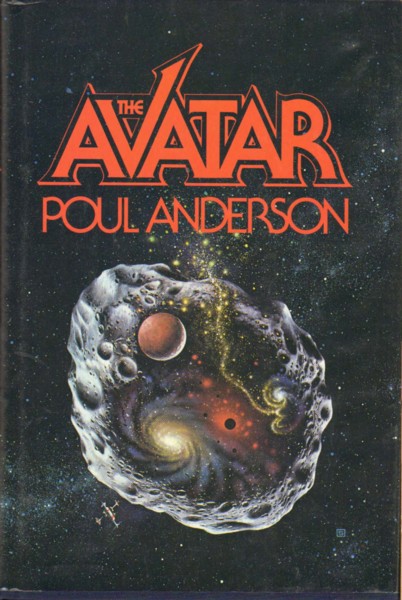
- The Avatar
Poul Andersonstandalone novel1978
similar byfar futuremysteriouspolitical intriguescience fictionspacespace opera
After humanity discovers portals that transport a space vessel through time and space, a crew which has visited the planet of another species returns to Earth, only to find a political faction in power which seeks to conceal this knowledge in the name of social stability. With the aid of the political opposition, they escape and journey through the portal in search of knowledge, and perhaps even to meet those who created the portal system.
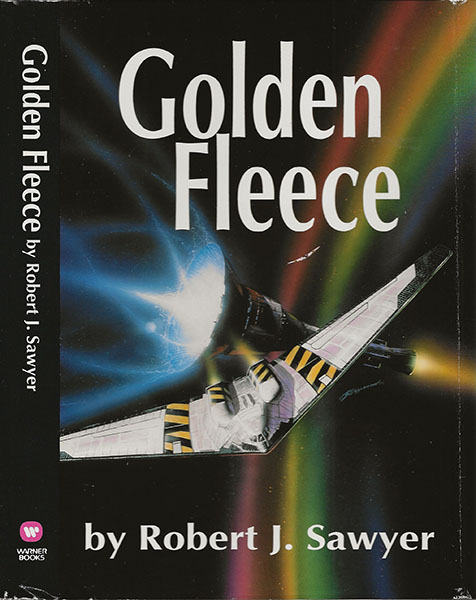
- Golden Fleece
Robert J. Sawyerstandalone novel1990
similar byfar futuremysterioustensemurder investigationscience fictionmystery & detective+1 more
From the back cover of the Questar first edition: "Murder in space - Starcolony Argo. A superstarship on a mission to a distant world. Controlled by a monumental computer named Jason, the Argo proceeds flawlessly... until death strikes its sleek decks with sudden and mysterious precision. Astrophysicist Diana Chandler is dead of radiation. Her body lies in Argo's ramfield - where hydrogen ions are funneled into the engines. Chandler's death has been deemed suicide. But her ex-husband, Aaron Rossman, is so sure. As the probes further, he becomes certain that Diana's death is a matter of murder - and that the murderer is Jason! Now Rossman must face the unthinkable; why would an artificial intelligence conceive and execute the most heinous of human crimes? And if so, can a mortal mind take on a cunning computer... and survive?"
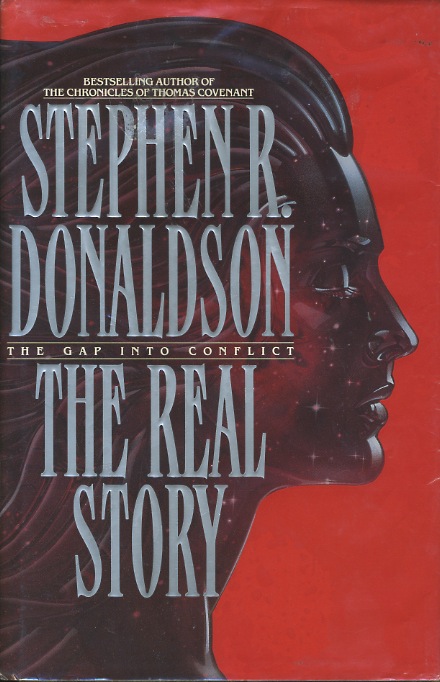
- The Gap
series5 books1990
similar byfar futuretensepolitical intriguescience fictionspacespace opera+1 more
The Gap Cycle is a series of science fiction novels by Stephen R. Donaldson, more usually known for his works of epic fantasy. The series was originally published between 1991 and 1996 by Bantam Books and was reprinted by Gollancz in 2008 in the UK. Here, Donaldson gave a loose retelling of Wagner's Ring cycle.
- Old Man's War
series16 books2005
similar byfar futurescience fictionspacewarspace opera+2 more
The Old Man's War series is a series of science fiction novels by John Scalzi. The first book in the series, Old Man's War, was first published in 2005 by Tor Books, and was nominated for the Hugo Award for Best Novel in 2006. In 2026 it was a finalist for the Hugo Award for Best Series.
- Honorverse
universe83 books1993
Start hereHonor Harrington · Start here
similar byfar futurescience fictionspace operaspace+3 more
The wedge comes up, the sidewalls burn to life, and two walls of battle close across light-minutes of empty vacuum trading missile broadsides — because in the Honorverse, war is still fought by the doctrine of the age of sail, only the ocean is the interstellar void and the ships-of-the-line are dreadnoughts. This is David Weber's future, two millennia on: a galaxy of star nations bound by treaty, trade, and old grudges, where the small, wealthy Star Kingdom of Manticore holds a wormhole junction the commerce of humanity runs through, and the expansionist People's Republic of Haven means to take it. At the center stands one officer, Honor Harrington — captain, then something far larger — and the six-limbed empathic treecat who rides her shoulder. The spine is the Honor Harrington novels, more than a dozen books that carry her from an overlooked frontier picket up through fleet command and the knife-politics of a monarchy at war. Around that spine branch parallel lines, several written with collaborators: the Saganami Island books follow a younger generation of officers in the contested Talbott Cluster; the Wages of Sin novels, with Eric Flint, chase the genetic-slave trade to its source on Mesa; Manticore Ascendant, with Timothy Zahn, reaches back centuries to the Navy's shaky founding; and the Star Kingdom books, with Jane Lindskold, tell how humans and treecats first met. Anthologies fill the seams. Weber writes competence and consequence — dense hardware, denser politics, victories that cost, and a heroine whose defining virtue is her refusal to spend lives cheaply or duck the ones she must. Begin with On Basilisk Station: one ship, one thankless posting, one impossible situation. Read the main line in publication order; the collaborating branches reward you later, once the map of Manticore is yours.