More like Desecration
anchored on:science fiction
but
- Dune Universe
universe78 books1963
Start hereDune · Start here
similar byscience fictionfar future+2 more
Arrakis. Dune. The desert planet, where empire runs on a single substance: the spice melange, which folds space, prolongs life, and unlocks prescience, and which exists nowhere else in the known universe. Frank Herbert's saga is a meditation dressed as an adventure — feudal houses and a secret sisterhood, engineered messiahs and the patient ecology of a world without water, all turning on the terrible gravity of who commands the spice. It reads like scripture and schemes like a war room, ten thousand years hence, among people who have outlawed the thinking machine and made instruments of themselves instead. At its heart stand Herbert's original six — Dune, Dune Messiah, Children of Dune, God Emperor of Dune, Heretics of Dune, Chapterhouse: Dune — a single deepening arc across millennia, arguing the whole way between prophecy and free will. Around that spine his son Brian Herbert and Kevin J. Anderson have raised a vast prequel architecture: Prelude to Dune, tracing the great houses a generation before Paul; Legends of Dune, reaching back to the crusade that broke the machines; the Schools of Dune cycle on the founding of Bene Gesserit, Mentat, and Navigator; the Caladan Trilogy and Heroes of Dune filling years the originals left in shadow. Many hands, dozens of volumes, one desert. What sets Dune apart is its refusal of the simple: religion is manufactured, heroes are hazards, and the sand itself — worm, water, ecology — acts as a political power. Begin where the universe did, with Frank Herbert's Dune (1965), and read the original six in order; you need nothing else to feel the full weight. The prequels are a country to explore afterward, taken by era. Beginnings are delicate times.
- Dune
series20 books1963
part of Dune Universe
similar byscience fictionfar future+2 more
Frank Herbert's Dune Chronicles opens with 1965's Dune, set on the desert planet Arrakis where House Atreides takes control of the only source of the vital spice melange and young Paul Atreides is pulled into a struggle over its politics and religion. Herbert carried the story forward across five further novels — Dune Messiah, Children of Dune, God Emperor of Dune, Heretics of Dune, and Chapterhouse: Dune — following Paul's line over the following millennia, before Brian Herbert and Kevin J. Anderson later extended the saga. Many other editions of these six novels are omnibus and box-set repackagings rather than separate stories.
- The Demolished Man
Alfred Besterstandalone novel1953
similar byscience fictiontensefar future+1 more
In the year 2301, guns are only museum pieces and benign telepaths sweep the minds of the populace to detect crimes before they happen. In 2301 murder is virtually impossible, but one man is about to change that..
- The Hunger Games Universe
universe5 books2008
Start hereThe Hunger Games · Start here
similar byscience fictiontensefar futuredark
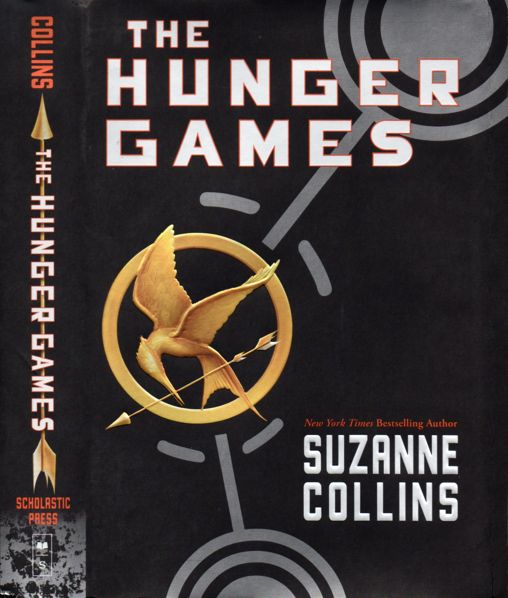
Panem, they call it now — a nation raised on the drowned bones of North America, a glittering Capitol ringed by twelve districts it once starved into obedience. Every year the Capitol collects its debt in children: two tributes from each district, drawn by lottery, dropped into an engineered arena, and made to kill one another on live television while the whole country is required to watch. This is the Hunger Games — entertainment, punishment, and government at once. Suzanne Collins tells it in a compact, unified body of work. The founding trilogy — The Hunger Games, Catching Fire, and Mockingjay — follows Katniss Everdeen, a girl from the coal-mining District 12 who volunteers in her sister's place and becomes something the Capitol never scripted. Two prequels reach back into the same machinery: The Ballad of Songbirds and Snakes traces a young Coriolanus Snow long before he is President, and Sunrise on the Reaping returns to District 12 a generation ahead of Katniss. Begin with the trilogy, in order — it is Katniss's voice, close and present-tense, that makes Panem breathe, and the prequels land hardest once you know how her story ends. Beneath the spectacle sits one steady, uncomfortable question: who profits when we agree to look away.
- The Hunger Games
series3 books2008
part of The Hunger Games Universe
similar byscience fictiontensefar futuredark
The Hunger Games is a series of young adult dystopian novels written by American author Suzanne Collins. The series consists of a trilogy that follows teenage protagonist Katniss Everdeen, as well as two prequels. The Hunger Games universe is a dystopia set in Panem, a post-apocalyptic North American country consisting of the wealthy Capitol and 12 districts in varying states of poverty. As punishment for rebellion, the Capitol hosts an annual battle royale competition called The Hunger Games. Each of the 12 districts must send two children between the ages of 12 and 18 to participate, and the last surviving child is dubbed the victor.
- Alliance-Union Universe
universe173 books1976
Start hereCompany Wars · The central sequence
similar byscience fictionfar future+1 more
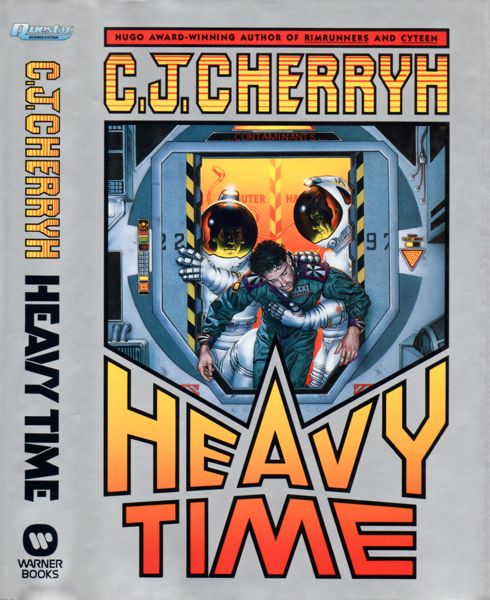
The dark between the stars belongs to no one, and everyone who lives out here knows it: the merchanter Families hauling cargo between stations that cannot feed themselves, the Earth Company clutching at colonies it can no longer supply, the Union breeding its cloned azi to settle worlds faster than birth allows. C. J. Cherryh's Alliance-Union is a future history of humankind's spread across the third and fourth millennia, told from inside the pressure — no clean empires, only stations, ships, treaties, and the people caught in the machinery of who holds the jump-points. The sequence runs from the first laborious pre-FTL stations through the Company Wars, the independence struggle that breaks over Pell in Downbelow Station (Hugo, 1981), to the genetics and cold politics of Union's homeworld in Cyteen (Hugo, 1988) and its sequel Regenesis. Around that spine cluster the merchanter novels of trader Families, the Faded Sun trilogy of human envoys among the martial alien Mri, and the Chanur books, narrated from the hierarchical, whiskered viewpoint of the hani. On the isolated world of Merovin, the Merovingen Nights anthologies open the setting to other hands — Mercedes Lackey, Janet and Chris Morris, Nancy Asire — a shared world braided into the whole. What sets it apart is intimacy at scale. Cherryh drops you without a map into a single skull and lets you assemble the politics from what that person fears and bargains for; the aliens are genuinely alien, loyalty is always provisional, and the real antagonist is usually logistics. Most books stand alone, in her words, "like real history." The surest way in is Downbelow Station — the war seen from one besieged station — then Cyteen, for the mind that shaped the other side.
- Tripods
series4 books1967
completed
similar byscience fictiontense+1 more
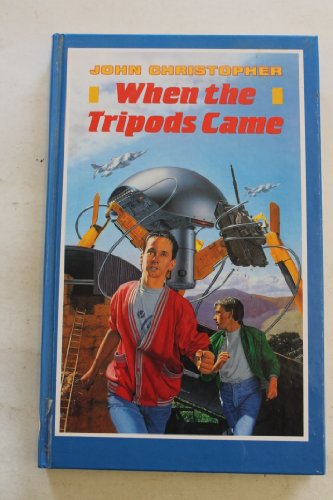
The Tripods is a series of young adult science fiction novels by John Christopher. The series takes place in a post-apocalyptic world where humanity is enslaved by "Tripods"—gigantic three-legged walking machines piloted by an alien race later identified as the "Masters". The first two books were the basis of a science fiction TV series, produced in the United Kingdom in the 1980s.
- Pandora
series4 books1966
similar byscience fictionfar future+2 more
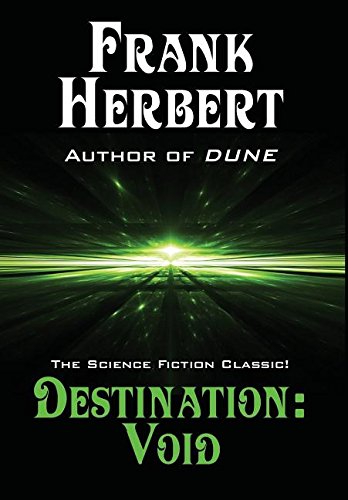
The Pandora Sequence opens with Frank Herbert's solo novel Destination: Void, in which a starship crew must jury-rig a working artificial consciousness after their vessel's control systems fail. Bill Ransom co-writes the three novels that follow, carrying the survivors to the world Pandora, where they must contend with both a manipulative machine intelligence and the planet's own hostile ecology. Across its four books the series moves from a claustrophobic ship-bound crisis to a generations-long struggle over faith, control, and survival on a dangerous new world.
- Company Wars
series7 books1981
part of Alliance-Union Universe
similar byscience fictiontensefar future
Company Wars gathers the novels C. J. Cherryh set during the breakaway conflict between Earth's colonial Company and the newly independent Union, within her wider Alliance-Union future history. Anchored by the Hugo Award-winning Downbelow Station, the books follow different ships, stations, and crews caught on either side, from merchanter traders to military spacers, rather than a single continuing cast. Read in any order, they build up a picture of the political and economic pressure that reshapes Cherryh's larger Alliance-Union universe.
- Ender Wiggin
series14 books1977
part of Ender's Game Universe
similar byscience fictionfar future+1 more
Orson Scott Card's Ender's Game (1985, expanded from his 1977 novella) follows child prodigy Andrew "Ender" Wiggin as he is recruited into a military training program built to prepare Earth's defenses for an anticipated third war against an insectoid alien species known as the Formics. The saga continues years later through Speaker for the Dead and Xenocide, following an older Ender as he confronts the moral weight of his role in that earlier conflict, and concludes the core arc in Children of the Mind, with Ender in Exile filling in the years between the first two books. Set within the wider Ender's Game universe, the series shifts from military coming-of-age story to slower, more philosophical science fiction as it progresses.
- The Eyes of Heisenberg
Frank Herbertstandalone novel1966
similar byscience fictiontensefar futuredark
Tens of thousands of years in the future, Earth is ruled by the Optimen, a genetically engineered aristocracy that has made itself functionally immortal, while ordinary people, the Folk, live under strict reproductive control. When Harvey and Lizbeth Durant arrive to have their embryo genetically screened, the examining doctor finds something in the child no one has seen in a very long time: real potential for both fertility and life span, traits the Optimen have arrogated to themselves. Rather than destroy the embryo as policy demands, the doctor hesitates, setting off a chain of surveillance, suspicion and resistance. A tightly wound Frank Herbert thriller about genetic caste and rebellion.
- Forge of God
series2 books1987
completed
similar byscience fictiontensedark+1 more
The Forge of God (1987) is Greg Bear's science fiction novel about Earth's discovery that it is the target of an incomprehensible, overwhelming alien attack, following scientists and ordinary people as they try to understand what is destroying the planet. Its 1992 sequel, Anvil of Stars, follows a group of young survivors sent on a mission of interstellar retaliation, continuing directly from the first book's ending.
- The Moon Is a Harsh Mistress
Robert A. Heinleinstandalone novel1966
similar byscience fictionfar future+1 more
A technician discovers that the massive computer that operates everything on Luna (a prison colony) has become self-aware. He befriends it, but when he accompanied a beautiful girl to a dissident meeting, he encounters people who want to throw off the yoke of their Earth rulers.
- Maze Runner
series11 books2009
similar byscience fictiontense+2 more
The Maze Runner is a series of young adult dystopian science fiction novels written by American author James Dashner. The series consists of the trilogy The Maze Runner (2009), The Scorch Trials (2010) and The Death Cure (2011), as well as two prequel novels, The Kill Order (2012) and The Fever Code (2016). A novella titled Crank Palace (2020) and a companion book titled The Maze Runner Files (2013) have also been released. A sequel trilogy in the series titled The Maze Cutter takes place 73 years following the events of The Death Cure and consists of the novels The Maze Cutter (2022), The Godhead Complex (2023), and The Infinite Glade (2025).
- The Dosadi Experiment
Frank Herbertstandalone novel1977
similar byscience fictiontensefar future+1 more
From the flaps of the Berkley Putnam first edition: "In his first new work of science fiction since the best-selling Children of Dune, Frank Herbert returns to his world of Whipping Star, and involves Jorj X. McKie, Saboteur Extraordinary, in a new intrigue. In Whipping Star, McKie discovered that some of the stars in the universe are actually intelligent, super-powerful beings, and was able to befriend one of them, the star Alcyone - affectionately known as Fannie Mae. As The Dosadi Experiment opens, McKie is assigned to investigate the planet Dosadi, which is isolated from the rest of the galaxy by a "god-wall," a barrier set up by one of the intelligent stars. Dosadi is rumored to be an experimental planet, and the experimenters are the froglike Gowachin, whose culture is founded upon a strange legal system in which McKie is the only human ever trained. He learns that humans and Gowachin have been placed on Dosadi, without their consent, for an experiment that could last centuries: an experiment in extreme overcrowding. But this monstrous plot is apparently out of control, and it seems the Gowachin may be prepared to destroy Dosadi rather than expose its secret, thus breaking the peace among the races, and starting the first interstellar war. But this is just the beginning. When McKie finally reaches Dosadi he discovers that the Dosadis have taken control of their own evolution and produced a competitive, highly evolved elite, of both humans and Gowachin, who have been able to extrapolate the existence of a universe beyond the god-wall and hate whoever has imprisoned them like this. They plan to break out and avenge themselves on the galaxy."
- Forever War
series10 books1972
similar byscience fictionfar future+2 more
Joe Haldeman's The Forever War (1974) follows a soldier conscripted into a centuries-long interstellar war against the alien Taurans, using relativistic space travel so that months spent in transit correspond to years or decades passing back on Earth. Haldeman later returned to the same conflict in Forever Peace (1997), a thematically connected but separate story, and Forever Free (1999), a direct sequel set years after the original war's end. The first novel won the Hugo, Nebula, and Locus awards and is considered a foundational work of military science fiction.
- Moties
series4 books1974
part of CoDominium
similar byscience fictionfar future+1 more
Larry Niven and Jerry Pournelle's The Mote in God's Eye (1974) depicts humanity's first contact with an alien species, the Moties, set within the far-future interstellar setting of Pournelle's codominium future history. The Gripping Hand continues that first-contact crisis years later, and Outies, written by J. R. Pournelle, carries the story forward into a new generation. Together the three books trace an escalating encounter between human and Motie civilizations within the codominium universe.
- Patternist
series6 books1976
completed
similar byscience fictiondark+2 more
The Patternist series is a group of science fiction novels by Octavia E. Butler that detail a secret history continuing from the Ancient Egyptian period to the far future that involves telepathic mind control and an extraterrestrial plague. A profile of Butler in Black Women in America notes that the themes of the series include "racial and gender-based animosity, the ethical implications of biological engineering, the question of what it means to be human, ethical and unethical uses of power, and how the assumption of power changes people."
- The Chrysalids
John Wyndhamstandalone novel1955
similar byscience fictiontensefar future
The Chrysalids is a science fiction novel by British writer John Wyndham, first published in 1955 by Michael Joseph. It is the least typical of Wyndham's major novels, but regarded by some as his best. An early manuscript version was entitled Time for a Change.
- Double Star
Robert A. Heinleinstandalone novel1956
similar byscience fictionfar future+1 more
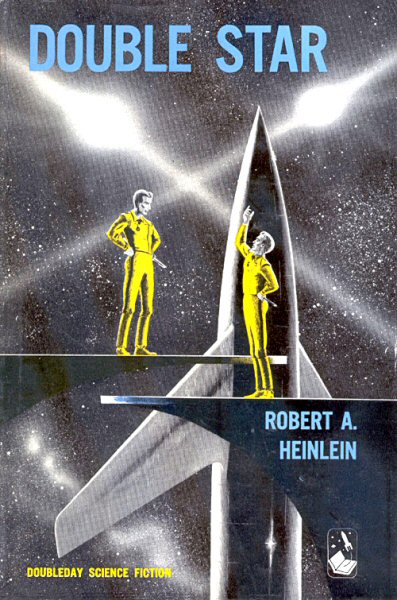
Lorenzo Smythe, the excellent yet unemployed actor, meets Dak Broadbent in a bar. Broadbent hires Lorenzo for an unspecified role, and hustles him onto a rocket ship. Broadbent turns out to be an assistant to the famous interplanetary politician and leader of the Expansionist party: John J. Bonforte. Bonforte, however, has been kidnapped by the political opposition on Mars, and due to Lorenzo's physical similarity to Bonforte, his staff wants Lorenzo to impersonate the politician for an important Martian ceremony.
- When the Sleeper Wakes
H. G. Wellsstandalone novel1899
similar byscience fictiontensefar futuredark
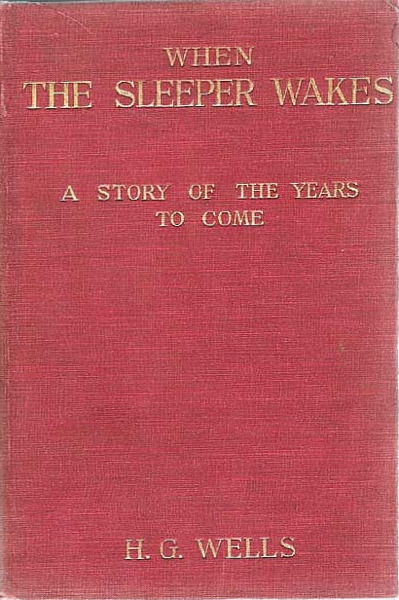
Graham, an insomniac Englishman in 1890s London, takes a course of sleep-inducing drugs and falls into a coma that lasts two centuries. He wakes in the year 2100 to find his investments have compounded, through a ruling body called the White Council, into effective ownership of most of the world's wealth and power, making him, on paper, humanity's master, and in practice, its prisoner, held under guard while the Council governs in his name. A rebel faction led by a man named Ostrog frees him, hoping to use his symbolic authority to spark an uprising against the Council. An early H. G. Wells dystopia about inherited power and manufactured consent.
- Heorot
series4 books1987
similar byscience fictionfar future+1 more
Larry Niven, Jerry Pournelle and Steven Barnes's The Legacy of Heorot strands human colonists on an idyllic-seeming alien world where they discover apex predators -- grendels -- hidden beneath the surface, forcing them to fight for survival. Beowulf's Children continues the colony a generation later as the children born on the planet clash with their parents over how to live alongside the grendels, and a fourth book, Starborn and Godsons, returns to the settlement decades further on. It's hard-SF creature-horror crossed with generational colony drama.