More like Fractured Echo
anchored on:science fiction
but
- Library of America P. K. Dick Collection
series9 books1962
completed
similar byscience fictionnear future+1 more
- Bridge Trilogy
series4 books1990
similar byscience fictionnear future+2 more
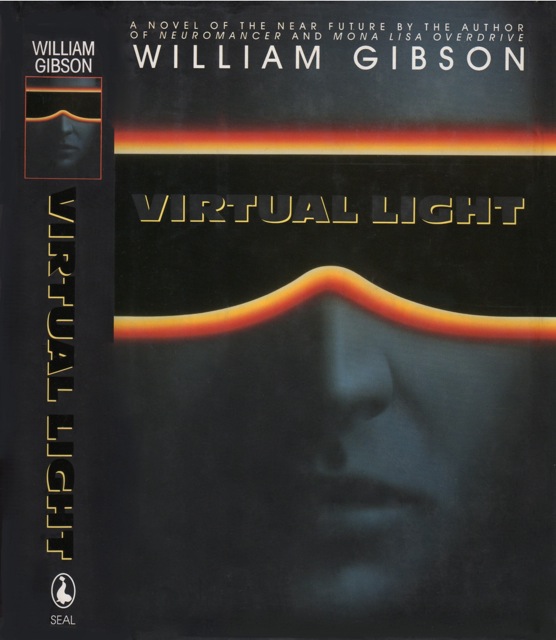
The Bridge trilogy is a series of novels by William Gibson, his second after the successful Sprawl trilogy. The trilogy comprises the novels Virtual Light (1993), Idoru (1996) and All Tomorrow's Parties (1999). A short story, "Skinner's Room", was originally composed for Visionary San Francisco, a 1990 museum exhibition exploring the future of San Francisco.
- Otherland
series6 books1996
similar byscience fictionvirtual realitynear future+1 more
Otherland is a science fiction tetralogy by American writer Tad Williams, published between 1996 and 2001. The story is set on Earth near the end of the 21st century, probably between 2082 and 2089, in a world where technology has advanced somewhat beyond the present. The most notable advancement is the widespread availability of full-immersion virtual reality installations, which allow people from all walks of life to access an online world, called simply the Net. Tad Williams weaves an intricate plot spanning four thick volumes, and creates a picture of a future society where virtual worlds are fully integrated into everyday life.
- Lock In
series3 books2014
similar byscience fictionmysteriousnear future+2 more
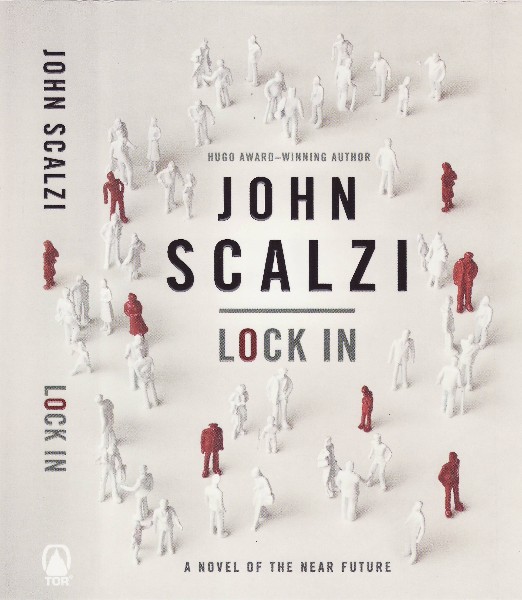
Lock In imagines a near-future pandemic that leaves a fraction of survivors fully conscious but completely paralyzed, able to interact with the world only through robotic surrogates or by borrowing the bodies of rare people whose brains can host another person's consciousness. John Scalzi's series follows a rookie FBI agent investigating crimes that exploit this new class of disability and technology, across the novels Lock In and Head On plus the interstitial oral history Unlocked. It's science-fiction police procedural more than space opera.
- Halting State
series2 books2007
similar byscience fictionnear future+2 more
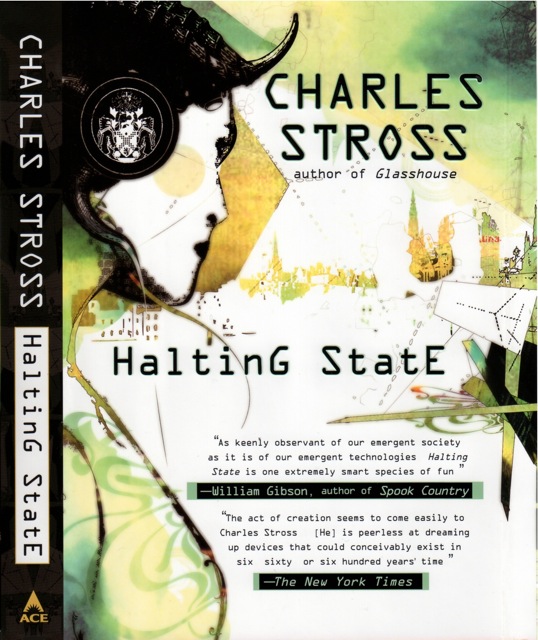
Charles Stross's Halting State opens as a near-future police procedural: a bank robbery inside a massively multiplayer online game turns out to mask a much larger cybercrime, investigated through shifting narrators using augmented-reality glasses and always-on networks. Its loose sequel, Rule 34, follows an Edinburgh police officer investigating a string of deaths linked by nothing but an obscure internet meme, in the same near-future Scotland. Both are standalone technothrillers connected by setting and tone rather than a continuing plot.
- The Idlewild Trilogy
series3 books2003
similar byscience fictionnear futureidentity+2 more
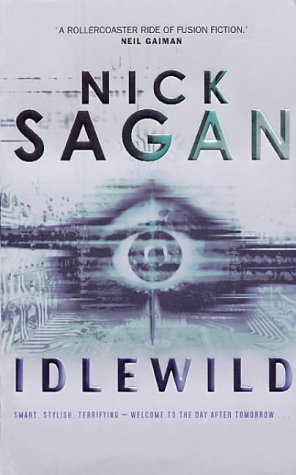
Nick Sagan's Idlewild trilogy opens with Idlewild (2003), a science-fiction novel that alternates between mid-21st-century interludes and events a generation later, following humanity's ten last survivors, cast in a modern mythological framework as god-like figures. It continues across Edenborn and Everfree.
- Gnomon
Nick Harkawaystandalone novel2017
similar byscience fictionmysteriousnear futureidentity+1 more
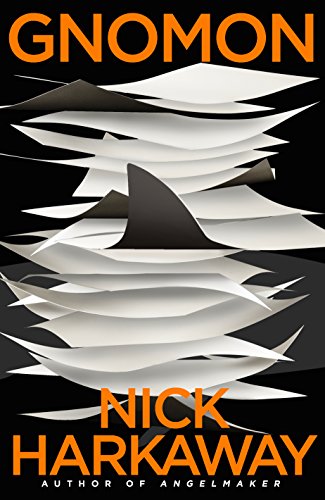
Gnomon is a 2017 science fiction novel by British author Nick Harkaway. The book deals with a state that exerts ubiquitous surveillance on its population. A detective investigates a murder through unconventional methods that leads to questions about her society's very nature.
- Time Out of Joint
Philip K. Dickstandalone novel1959
similar byscience fictionmysteriousvirtual realityidentity
Time Out of Joint is a science fiction novel by American writer Philip K. Dick, first published in novel form in the United States in 1959. An abridged version was also serialised in the British science fiction magazine New Worlds Science Fiction in several installments from December 1959 to February 1960.
- Total Recall
Piers Anthonystandalone novel1989
similar byscience fictionmysteriousvirtual realitynear futureidentity
Douglas Quail is haunted by nightmares of Mars, covert missions and a life more glamorous than his earthbound 2089 AD reality. So he turns to "Recall", manufacturers of synthetic memories. They implant a memory into him but he soon finds that his nightmares are true memories.
- Foundation Universe
universe123 books1940
Start hereFoundation · Start here
similar byscience fiction+1 more
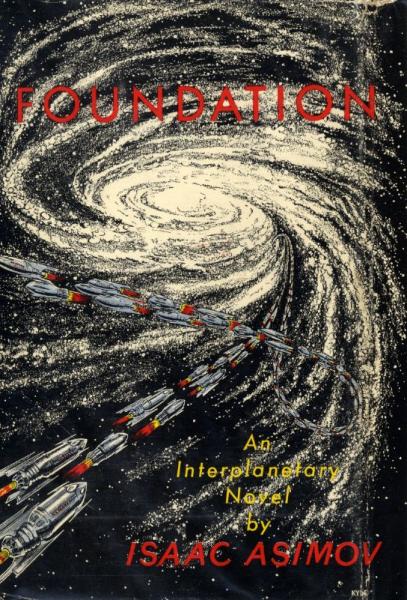
There is a science that reads the future of quadrillions the way an astronomer reads the orbits of stars. It is called psychohistory, and its equations foresee something the ruling Galactic Empire cannot admit: the throne is rotting, and thirty thousand years of barbarism are coming. One man, Hari Seldon, cannot stop the fall. He can only shorten it — by seeding a Foundation of scholars at the rim of the galaxy, a fragile institution built to carry knowledge across the dark and cut the interregnum to a single millennium. This is a universe told in the register of history itself: the long view, the calm of deep time, empires measured in centuries and men measured against them. The spine is Asimov's original trilogy — Foundation, Foundation and Empire, Second Foundation — followed decades later by the sequels Foundation's Edge and Foundation and Earth and the prequels Prelude to Foundation and Forward the Foundation. Late in life Asimov braided this in with his other future histories: the Robot novels of detective Elijah Baley and his humaniform partner R. Daneel Olivaw (The Caves of Steel, The Naked Sun, The Robots of Dawn, Robots and Empire) and the early Galactic Empire novels (Pebble in the Sky and its kin), until one continuous chronicle ran from the first thinking robots to the Second Empire. Other hands extend it — the Second Foundation Trilogy by Gregory Benford, Greg Bear, and David Brin, and shared-world spinoffs such as Robot City — so the corpus sprawls beyond a single author's tidy shelf. What distinguishes it is that the drama is intellectual: crises resolved by insight, nerve, and dialogue rather than fleets and blades, each turn hinging on the hidden logic of the Seldon Plan. Begin where readers have always begun — with Foundation, and the original trilogy in publication order. The rest opens outward from there.
- More Than This
Patrick Nessstandalone novel2013
similar byscience fictionmysteriousnear futureidentity+1 more
More Than This is a young adult novel by Patrick Ness, published by Candlewick Press in 2013. It follows a teenage boy named Seth who, after drowning in the ocean, wakes up alone on a desolate suburban English street in what he believes to be hell.
- Pastworld
Ian Beckstandalone novel2009
similar byscience fictionmysteriousvirtual realitynear futureidentity
What if all of London were really an amusement park—a whole city returned to Victorian times to entertain visitors from the twenty-first century? That's the wildly original premise of Ian Beck's Pastworld, a high-stakes mystery set in a simulated past. Eve is a lifelong resident of Pastworld who doesn’t know she’s living in a theme park until a mysterious threat forces her to leave home. Caleb is a visiting tourist who finds the lawlessness of the past thrilling—until he suddenly becomes a fugitive from an antiquated justice system. And in the midst of it all, in the thick London fog a dark and deadly figure prowls, claiming victim after victim. He’s the Fantom, a creature both of the past and of the present, in whose dark purpose Caleb and Eve will find their destinies combined. Page-turning, complex, and haunting, Pastworld masterfully exposes the human experience of the past, of violence, of technology, and of entertainment.
- Sprawl Trilogy
series10 books1981
similar byscience fictionvirtual realitynear future
The Sprawl Trilogy is William Gibson's foundational cyberpunk sequence: Neuromancer (1984), in which hacker Case is drawn into a high-stakes heist alongside an artificial intelligence and a damaged ex-soldier, followed by Count Zero (1986) and Mona Lisa Overdrive (1988), which widen the same near-future world of corporate power and networked cyberspace to new characters. Johnny Mnemonic, an early short story set in the same fictional milieu, predates the novels and introduces the courier Molly Millions before her role in the trilogy. Together these works established much of cyberpunk's visual and thematic vocabulary.
- The Jackpot Trilogy
series2 books2014
similar byscience fictionmysteriousnear future+1 more
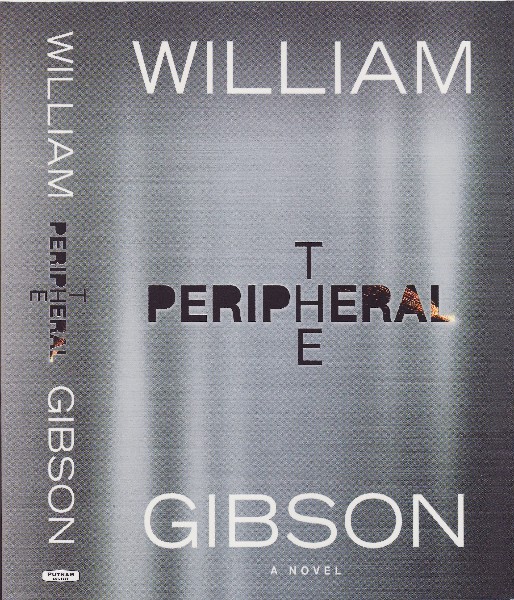
William Gibson's Jackpot sequence begins with The Peripheral (2014), a science-fiction thriller cross-cutting between a near-future American town and a devastated London seventy years on. Gibson continued the same world in Agency (2020), set slightly later in the near-future timeline.
- Simulacron-3
Daniel F. Galouyestandalone novel1964
similar byscience fictionmysteriousvirtual realitynear futureidentity
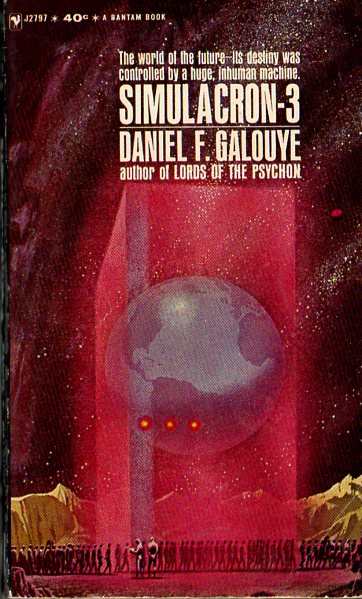
Simulacron-3 is a 1964 science fiction novel by American author Daniel F. Galouye featuring an early literary description of a simulated reality.
- WWW Trilogy
series3 books2009
similar byscience fiction+2 more
The WWW Trilogy is a trilogy of science-fiction novels by Canadian science fiction author Robert J. Sawyer. The first book, Wake, was originally serialized in four parts in Analog Science Fiction and Fact from November 2008 to March 2009, published in book form through Ace on April 7, 2009, and was followed by the second book, Watch, on April 6, 2010. Wonder was published in 2011.
- Stamping Butterflies
Jon Courtenay Grimwoodstandalone novel2004
similar byscience fictionmysteriousnear futureidentity+1 more
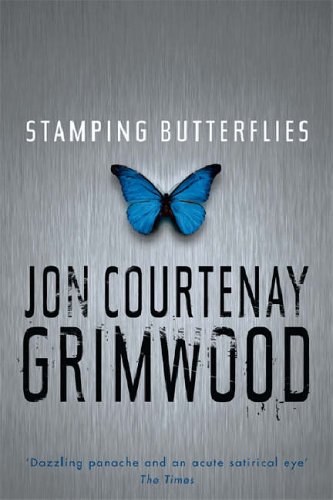
From acclaimed author Jon Courtenay Grimwood comes an exotic new novel that defies expectation at every turn. A mystery, a thriller, and a cutting-edge sci-fi adventure all in one, Stamping Butterflies bends time, genre, and consciousness itself to tell the spellbinding story of two worlds, three lives, one future--and the question upon which everything depends: who is dreaming whom....From Marrakech to China's Forbidden City, from a doomed starship carrying a cryogenically preserved crew to an island prison camp, the fate of the world is being played out in the minds of two dreamers. One, a would-be assassin obsessed with enigmatic equations, has set out to kill the U.S. President. The other is a young Chinese emperor ruling thousands of years in the future. Each believes he is dreaming the other. One must change the future; one must change the past. And time is running out for both.Caught in the maelstrom is a motley cast of characters, each an unwitting key to the ultimate fate of both worlds: Moz, a resourceful young Marrakech street punk, and his half-German girlfriend, Malika; Jake Razor, a self-exiled rock star; and psychiatrist Katie Petrov, who finds herself racing against a looming death sentence to pry free the secret of her condemned patient--a secret with the power to restore hope to the future...or stamp it out forever.From the Trade Paperback edition.
- Jean le Flambeur
series3 books2010
similar byscience fictionvirtual reality+1 more
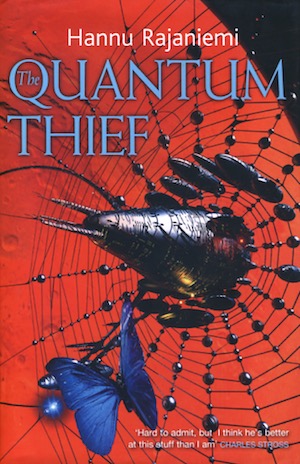
Jean le Flambeur is a master thief broken out of a virtual prison to pull off one more impossible heist, in a solar system reshaped by uploaded minds, post-human factions, and economies built on memory and privacy themselves. Hannu Rajaniemi's trilogy - The Quantum Thief, The Fractal Prince, The Causal Angel - is dense, idea-heavy hard SF that trusts readers to piece its future together from context rather than exposition.
- Ubik: The Screenplay
Philip K. Dickstandalone novel1985
similar byscience fictionnear future+1 more
Named one of Time's 100 Best Books, Ubik is a mind-bending, classic novel about the perception of reality from Philip K. Dick, the Hugo Award-winning author of The Man in the High Castle. “From the stuff of space opera, Dick spins a deeply unsettling existential horror story, a nightmare you’ll never be sure you’ve woken up from.”—Lev Grossman, Time Glen Runciter runs a lucrative business — deploying his teams of anti-psychics to corporate clients who want privacy and security from psychic spies. But when he and his top team are ambushed by a rival, he is gravely injured and placed in “half-life,” a dreamlike state of suspended animation. Soon, though, the surviving members of the team begin experiencing some strange phenomena, such as Runciter’s face appearing on coins and the world seeming to move backward in time. As consumables deteriorate and technology gets ever more primitive, the group needs to find out what is causing the shifts and what a mysterious product called Ubik has to do with it all. “More brilliant than similar experiments conducted by Pynchon or DeLillo.”—Roberto Bolaño
- Childhood's End
Arthur C. Clarkestandalone novel1953
similar byscience fictionnear futureidentity+1 more
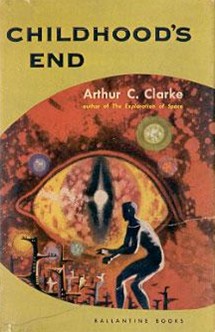
Childhood's End is a 1953 science fiction novel by the British author Arthur C. Clarke. The story follows a peaceful alien invasion of Earth by mysterious Overlords, whose arrival begins decades of apparent utopia under indirect alien rule, at the cost of human identity and culture.