More like Lightning Wolves
anchored on:steampunkscience fiction
but
- H. G. Wells' War of the Worlds
universe65 books1898
Start hereThe War of the Worlds · Start here
similar byscience fiction+2 more
No one would have believed, in the closing years of the nineteenth century, that human affairs were being watched keenly and closely from the timeless worlds of space. And then the cylinders fell. H. G. Wells' War of the Worlds opens in the quiet of the Surrey commons, where a falling star proves to be the first Martian craft — and from the pit rise the towering tripods, the Heat-Ray, the choking Black Smoke and the creeping red weed, wielded by minds that regard mankind much as we regard the creatures we boil for supper. This is invasion rendered as natural disaster: cold, methodical, and vast beyond argument. Wells' 1898 novel is the seed; everything else grows from that Martian soil. The catalogue gathers direct sequels and continuations alongside a wide field of other hands. In War of the Worlds: Global Dispatches the invasion is retold across the whole planet through the eyes of Twain, Verne, Tolstoy, Lowell and Kipling; in the Manly Wade and Wade Wellman crossover, Sherlock Holmes, Watson and Professor Challenger take the field against the machines; and Scott Washburn's Great Martian War stretches the fighting into a decades-long alternate history of steam, artillery and grinding attrition. It is a loose shared world — no single decreed sequence, many voices answering one calamity. What sets this world apart is its refusal of heroics: the invaders fall not to generals but to the smallest things of Earth, humbling and indifferent. Begin, always, with Wells' original novel — it is short, and it is the ground every later book stands upon. From there follow your appetite: Global Dispatches for the panorama, the Holmes campaign for adventure, Washburn for the long war.
- The Collected Science Fiction and Fantasy of Jack London
series6 books1906
completed
similar byscience fictionour world+1 more
- Bring the Jubilee
Ward Moorestandalone novel1953
similar by19th centuryscience fictionnorth america+1 more
From the flaps of the Farrar, Straus and Young first edition: ""Although I am writing this in the year 1877, I was not born until 1921." So Hodge Backmaker begins his story of the harsh and curious world he lived in, a world in which the South won the Civil War and the all-powerful Confederacy dominated the poor and backward North; a North that had neither a transcontinental railroad, and where television was undreamed of. Like most Northerners, Hodge was poor - but he had ambition. A printer's handyman in 1938, he had since become an eminent historian. Hodge's special interest was the American past, when the States had been united and had seemed to be on the brink of prosperity and technical progress. And then he was offered an opportunity no historian could resist - he could go back in time. Hodge chsoe to return to a certain field near Gettysburg on a day in July, 1863... Bring the Jubilee is a novel of curious events, of adventures and reflection, of passions and comment. It at time Hodge's world, its horse-carriages and gas-lights, minibles and tinugraphs and the Great Emperors' War of 1914 faintly resembles our own, it is perhaps, because that world might well become a reality: on the battlefield of Gettysburg there is a small hill called Little Round Top. One July morning in 1863 the Confederate Army made the tactical error of not occupying this hill. It was a mistake that cost them victory in a battle which - in the view of many historians - was the turning point of the Civil War."
- Clockwork Century Universe
series8 books2008
similar byadventurous19th centurysteampunknorth america+1 more
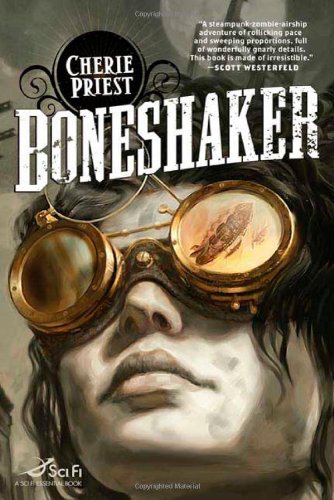
Boneshaker opens Cherie Priest's Clockwork Century, a steampunk alternate history that reimagines Seattle after a mining disaster releases a toxic gas that turns people into the walking dead, forcing survivors behind a massive wall around the poisoned city. The series expands out from that starting point across the American Civil War era, following different characters and cities in each book (Clementine, Dreadnought, Ganymede, The Inexplicables, Fiddlehead, Jacaranda) rather than one continuous plot. Boneshaker was nominated for the Nebula Award and won the 2010 Locus Award for Best Science Fiction Novel.
- Mormon Steampunk Anthologies
series4 books2018
similar by19th centurysteampunkscience fictionnorth america+2 more
- George Dower / Infernal Devices
series3 books1987
similar by19th centurysteampunk+2 more
K. W. Jeter's trilogy, whose 1987 original helped coin the term 'steampunk,' follows clockmaker George Dower as he's dragged into escalating Victorian conspiracies involving mechanical devices, secret societies, and inventions that shouldn't work but do. Infernal Devices, Fiendish Schemes, and Grim Expectations mix dark comedy with the gears-and-brass aesthetic the series helped establish before it had a name.
- Newbury & Hobbes Investigations
series23 books2008
similar by19th centurysteampunk
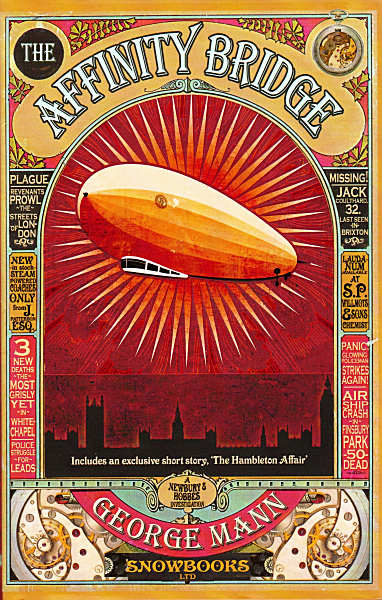
George Mann's steampunk series follows Sir Maurice Newbury, an occult investigator working for the crown in an alternate, more mechanized Victorian Britain, and his assistant Veronica Hobbes, as they take on cases blending supernatural threats with the era's mechanical marvels. The Affinity Bridge, the opening novel, entangles them with a crashed automaton airship and a spreading plague of the reanimated; later books deepen Newbury's struggle with addiction and Veronica's search for her institutionalized sister. It combines detective procedural with alternate-history steampunk London.
- Timewars
series12 books1984
similar byscience fiction+3 more
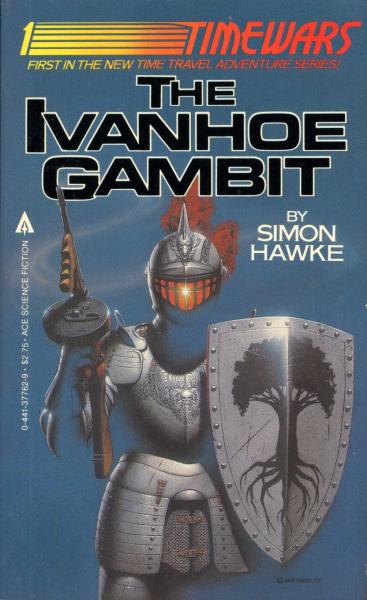
Simon Hawke's TimeWars series follows an organization of agents assigned to protect history from rogue time travelers who would rewrite it, while treating famous adventure novels as real historical events they must safeguard from the inside. The Ivanhoe Gambit opens the series by dropping its agents into the era of Richard I alongside the events of Walter Scott's Ivanhoe, a template repeated across the following eleven books, each pairing the agents with a different classic tale, from Ivanhoe to Dracula and Gulliver's Travels.
- Kairos
series11 books1962
completed
similar byscience fiction+2 more
The Time Quintet is a science fantasy series of five young adult novels written by American author Madeleine L'Engle and made up of A Wrinkle in Time (1962), A Wind in the Door (1973), A Swiftly Tilting Planet (1978), Many Waters (1986), and An Acceptable Time (1989).
- H. G. Wells' Time Machine
universe51 books1888
Start hereThe Time Machine · Start here
similar byscience fiction+1 more
The Time Traveller throws his lever, and the laboratory dissolves into grey — day and night beating like a pulse, the sun streaking into a band of fire, the years falling away by the thousand. When the machine stops he stands in the year 802,701, among the gentle, idle Eloi who dance in the ruins of paradise, and the pale Morlocks who tend the machines below and climb, in the dark, to feed. This is the seed from which every tale of time travel grew: one Victorian evening's fireside account of a fourth dimension a man might walk down. At its centre stands H. G. Wells's slim 1895 romance, complete in itself. Around it has grown a long canopy of retellings — abridged and illustrated editions that carry the Eloi and Morlocks to younger readers, shaped by hands such as Betty Ren Wright and Chris Sasaki — and a strand of homage that treats Wells's invention as fact: Karl Alexander's Time After Time, in which Wells himself pursues Jack the Ripper through his own machine into a startled modern age, and David J. Lake's return to the Morlock world. It is honestly one work and its echoes, not a saga of equals. What lingers is the cool, reasoning voice of a gentleman-scientist watching wonder curdle into dread — for the machine does not stop at 802,701, but runs on to a still shore beneath a swollen, dying sun. Begin where all of it begins: with Wells's original. It is short, it is whole, and nothing after it is required.
- Temporal Regulatory Authority / Jason Thanou
series6 books2006
similar byadventurousscience fiction+1 more
- Wolves Chronicles
series12 books1962
completed
similar byadventurous19th century
The Wolves Chronicles is Joan Aiken's long-running alternate-history series for young readers, set in a nineteenth-century England ruled by the Stuart dynasty and beset by wolves that have migrated across a Channel land-bridge. It opens with The Wolves of Willoughby Chase, in which two girls outwit a scheming governess sent to ruin them, and expands over twelve books into a sprawling saga of orphans, conspiracies, and journeys through a Britain quite unlike the real one. Aiken kept adding to the same timeline across more than four decades, including later prequels set before the first book.
- Future History
series42 books1939
completed
similar byscience fiction+1 more
The Future History is a series of science fiction stories written by American author Robert A. Heinlein (1907–1988). It describes a projected future of the human race from the middle of the 20th century through the early 23rd century. The term Future History was coined by John W. Campbell Jr. in the February 1941 issue of Astounding Science Fiction. Campbell published an early draft of Heinlein's chart of the series in the May 1941 issue.
- Ready Player One
series3 books2011
similar byadventurousscience fiction+2 more
Ernest Cline's Ready Player One (2011) is set in a near-future dystopia where much of humanity escapes into the OASIS, a vast virtual-reality universe, and follows teenager Wade Watts as he chases an Easter egg hidden by the OASIS's late creator in a puzzle-based hunt worth a fortune. The 2020 sequel, Ready Player Two, picks up after Wade has gained control of the OASIS and follows him and his friends into a new quest built around a brain-computer interface the creator left behind.
- Larklight Trilogy
series3 books2006
similar byadventurous19th centuryscience fictionsteampunk
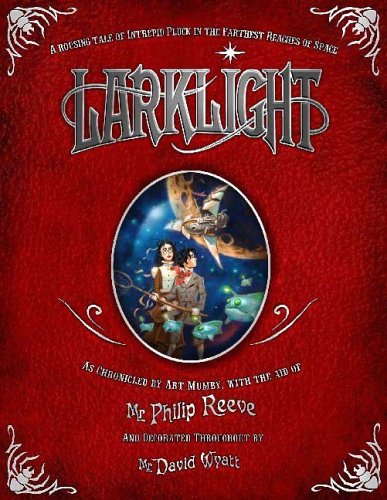
The Larklight trilogy is a trilogy of middle grade novels by Philip Reeve, entitled Larklight, Starcross, and Mothstorm. These books are all illustrated by David Wyatt.
- The Anubis Gates
series3 books1983
similar byadventurous19th century+2 more
The Anubis Gates is a single time-travel fantasy novel by Tim Powers, following a present-day academic who takes part in a time-travel experiment and ends up stranded in early nineteenth-century London. It won the Philip K. Dick Award in 1983 and the Science Fiction Chronicle Award the following year.