More like Pellucidar
anchored on:fantasyadventurelost worldadventuroussurvivalunderground & caves
but
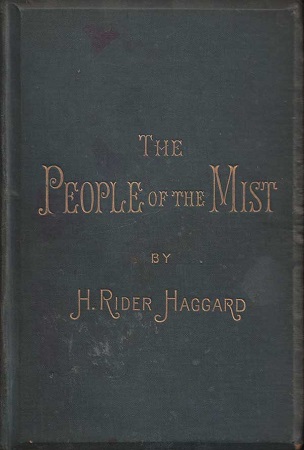
- The People of the Mist
H. Rider Haggardstandalone novel1894
similar bysurvivaladventurousfantasylost worldadventure
The People of the Mist is a classic lost world fantasy novel written by H. Rider Haggard. It was first published serially in the weekly magazine Tit-Bits, between December 1893 and August 1894; the first edition in book form was published in London by Longman in October, 1894. It was reprinted in December, 1973 by Ballantine Books as the sixty-third paperback volume of the Ballantine Adult Fantasy series.
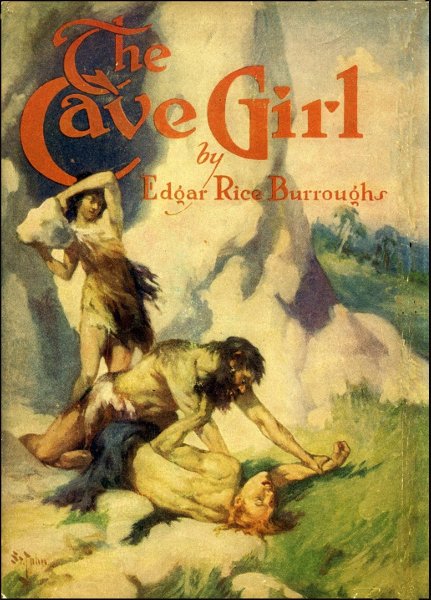
- The Cave Girl
Edgar Rice Burroughsstandalone novel1925
similar bysurvivaladventurousadventurelost world+1 more
The Cave Girl is a lost world novel by American writer Edgar Rice Burroughs. Originally published in two separate stories, The Cave Girl begun in February 1913 and published by "All-Story" in July, August, and September 1913; and The Cave Man begun in 1914 and published by "All-Story Weekly" throughout March and April 1917. The book version was first published by A. C. McClurg on 1925-03-21. In August 1949, Dell Paperback published a version with a map captioned "Wild Island Home of Nadara the Cave Girl Where Violence and Bloodshed Rule."
- Watership Down
series21 books1972
completed
similar bysurvivaladventurousfantasy+1 more
Watership Down is Richard Adams's 1972 novel following a group of rabbits who flee the destruction of their warren and cross the English countryside of Hampshire in search of a new home, developing over the journey a full rabbit culture of language, proverbs, and mythology. Adams returned to the same world in 1996 with Tales from Watership Down, a collection of nineteen short stories mixing rabbit folklore with further adventures of characters from the novel.
- Edgar Rice Burroughs' Pellucidar universe
series24 books1922
similar byadventurouslost worldunderground & caves+4 more
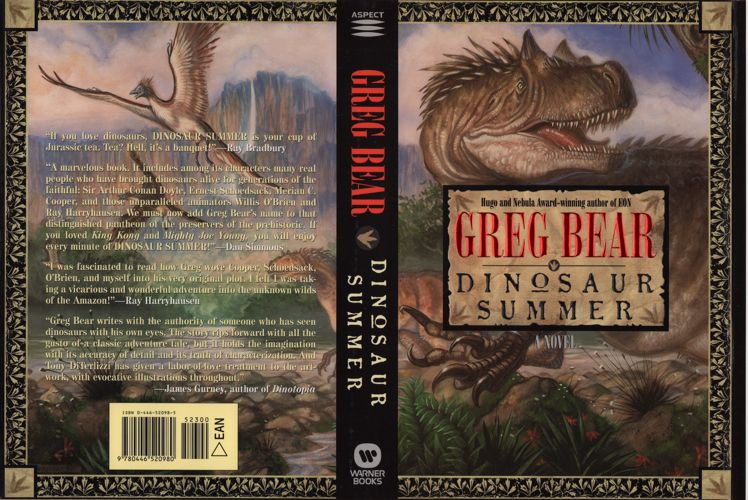
- Dinosaur Summer
Greg Bearstandalone novel1998
similar bysurvivaladventurousadventurelost worldscience fiction+1 more
From the flaps of the Warner first edition: "It's the year 1947, and nobody's interested in dinosaurs anymore. Less than fifty years after Professor Challenger's famed journey to the Lost World, America's last dinosaur circus is closing down... but the adventure of a lifetime is about to begin. In a dramatic change of pace, multiple Hugo and Nebula award-winning science fiction master Greg Bear, ... presents a lavishly illustrated thriller that is certain to become a new classic adventure beyond time... Peter Belzoni is dreading summer in Manhattan. Then his father, photojournalist Anthony Belzoni, offers the youth a job, a byline in National Geographic... and a trip to South America. For the Lothar Gluck Circus, once the world's foremost dinosaur attraction, had gone bankrupt. Left behind is a menagerie of avisaurs, centrosaurs, and ankylosaurs, as well as one large predatory raptor named Dagger. And now two filmmakers and the circus trainer plan to return the giants to the wild - with Peter and his dad chronicling the odyssey for Geographic. The task seems impossible. Many have died trying to bring beasts our of the Lost World, the plateau of El Grande in Venezuela, but nobody has ever attempted to transport nearly a dozen full-grown, multiton prehistoric creatures across continents, down rivers, through jungles, and up mountains that has been isolated for 70,000,000 years... The trek will strain the technologies of trains, cargo ships, barges, trucks... en route lurk robbers and hostile, trigger-happy soldiers... and each mile toward freedom excites Dagger toward an unstoppable primal killing frenzy. When the unthinkable threatens to strand Peter and the rest of the crew in an uncharted realm, four modern Americans will face all the unknown dangers, mysteries, and terrors of El Grande..."
- Caspak Universe
series4 books1918
similar bysurvivaladventurouslost worldadventurefantasy+1 more
The Caspak trilogy — The Land That Time Forgot, The People That Time Forgot, and Out of Time's Abyss — is Edgar Rice Burroughs's 1918 adventure sequence set on a hidden Pacific island called Caprona, where a World War I-era U-boat crew discovers an isolated world of dinosaurs and successive stages of human evolution living side by side. The story was later adapted into comics by Mike Wolfer, credited alongside Burroughs.
- Tarzan
series50 books1912
part of Tarzan Universe
similar byadventurousadventure+2 more
Tarzan is a series of 24 adventure novels written by Edgar Rice Burroughs (1875–1950) and published between 1912 and 1966, followed by several novels either co-written by Burroughs, or officially authorized by his estate. There are also two works written by Burroughs especially for children that are not related to the main series.
- Dian of the Lost Land
Edison Marshallstandalone novel1935
similar bysurvivaladventurousadventurelost worldscience fiction
Adam knew that the creatures who surrounded him had vanished from the earth five million years ago. Their beautiful art, their terrible weaponry, their religion, customs and language, even the animals they hunted and the alien dark tribe against whom they waged eternal war, all belonged to a time before the great glaciers had retreated and man had assumed control of the globe. But Adam was in no position to deny their reality. For now he and his companion, the renowned Professor Karl Belgrade, were being led to their ruler-the young and beautiful Queen who would decide whether the intruders would live or die. The last ravings of a man dying from a mysterious fever and the haunting hypothesis of a brilliant and obsessed scientist were all that the two explorers had to go on as their tiny plane winged high over the menacing Antarctic ice. They find a secret valley that only one human being had ever visited and lived to tell about it, a lost world ruled by creatures from the darkest depths of time, who even now might be playing out a gigantic contest between good and evil to its strange and terrible conclusion. (adapted from the texts published with the 1972 edition)
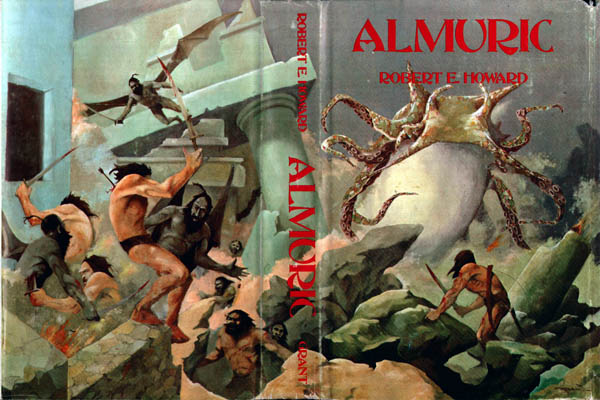
- Almuric
series1 book1964
similar bysurvivaladventurousfantasy+1 more
Published posthumously in 1964, Robert E. Howard's Almuric is a single planetary-romance novel rather than an ongoing series: Earthman Esau Cairn is transported to the savage world of Almuric, where he fights beast-men and wins the love of Altha, in a story indebted to Edgar Rice Burroughs' Barsoom books.
- Airman
Eoin Colferstandalone novel2008
similar bysurvivaladventurousadventure+1 more
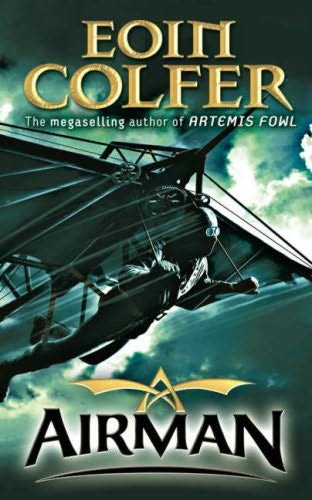
Airman, by Eoin Colfer, is a best-selling historical adventure novel set in the 19th century. It was released in the UK, Ireland and US in January 2008. The novel was shortlisted for the 2009 Carnegie Medal.
- Tunnel in the Sky
Robert A. Heinleinstandalone novel1955
similar bysurvivaladventurousscience fiction+1 more
As the final test of a survivalist/explorer class, teenagers are dumped on an alien planet to use their skills while awaiting pickup. But something has gone wrong, and they find they are on their own.
- The Blue World
Jack Vancestandalone novel1966
similar bysurvivaladventurousadventurescience fiction
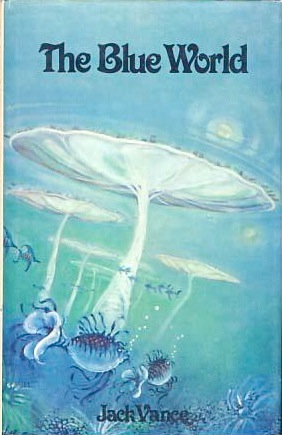
The Blue World is a science fiction adventure novel by American writer Jack Vance. The novel is based on Vance's earlier novella The Kragen, which appeared in the July 1964 edition of Fantastic.
- Congo
Michael Crichtonstandalone novel1980
similar bysurvivaladventurousadventure+1 more
WorldCat: On an expedition to return Amy, his talking gorilla, to her home in the Congo, Professor Peter Elliot is joined by others who hope to find a legendary diamond mine guarded by mutant gorillas.
- A Strange Discovery
Charles Romyn Dakestandalone novel1899
similar bysurvivaladventurousadventurelost world
A "completion" of Edgar Allan Poe's Narrative of Arthur Gordon Pym (1838). Pym and his companion Dirk Peters are swept into a strange uncharted region in the Antarctic Sea where they find an island utopia inhabited by descendants of fourth-century Romans. The story "combines the further adventures of. Pym with a love story in the manner of Rider Haggard."- Anatomy of Wonder (1981) 1-54. "After Pym and Peters penetrate the veil, they find the city of Hili-li, inhabited by citizens of the Roman empire who fled the barbarian invasions of the fourth century. One ship reached the Antarctic. They represent the height of Greco-Roman culture; though mentally advanced, they have made no practical application of their knowledge. Pym falls in love with Lilama; so great is their devotion that 'the episode of Romeo and Juliet sinks into insignificance' when compared to it. After parental objection, kidnapping by a rival suitor, Ahpilus, and an attack by barbarians, they marry. Within months occurs 'the strange thermal phenomenon' which occasionally devastates the city: the winds shift so that a combination of a hurricane and a blizzard strikes Hili-li. The city is unprepared. Pym goes in search of food and fuel, while Lilama is among those who freeze to death. After her death the Hili-lites permit Pym, highly depressed, and Peters, a troublemaker in Utopia, to depart in a small boat; they are picked up by a ship which takes them to Montevideo, where they separate and never see one another again.
- King of the Cloud Forests
Michael Morpurgostandalone novel1987
similar bysurvivaladventurousfantasyadventure
King of the Cloud Forests is a children's fantasy and adventure novel written by Michael Morpurgo. It was first published in the United Kingdom by Heinemann in 1987. It was released on audiobook in 2007, with Morpurgo providing the narration. It was shortlisted for a Carnegie Medal in 1987, and the novel was also adapted into a thirty-minute animated short in 2002.
- Bromeliad
series3 books1989
completed
similar bysurvivaladventurousfantasy+1 more
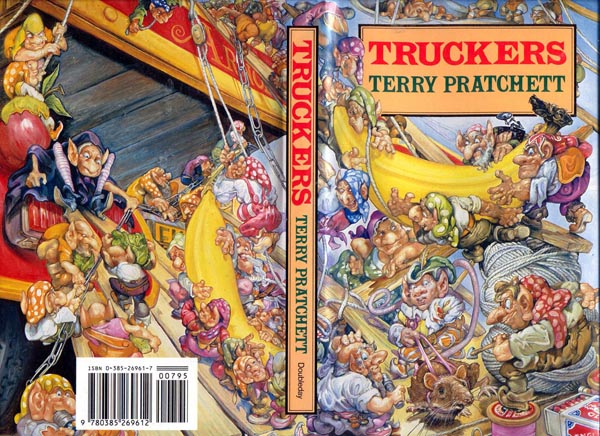
The Nome Trilogy, also known as The Bromeliad, is a trilogy of children's books by British writer Terry Pratchett, consisting of the books Truckers (1989), Diggers (1990) and Wings (1990). The trilogy tells the story of the Nomes, a race of tiny people from another world who now live hidden among humans. Through the books they struggle to survive in the human world and, once they learn of their history from an artefact known as "The Thing", make plans to return home.
- Northwood
Brian Falknerstandalone novel2011
similar bysurvivaladventurousfantasyadventure
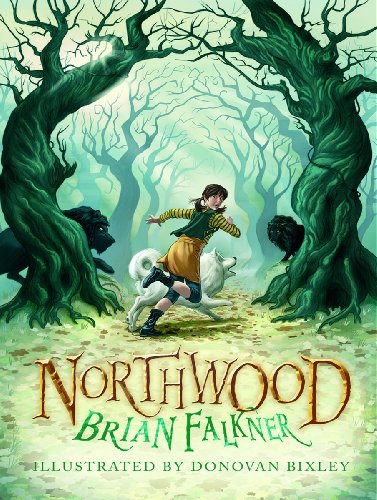
"Cecilia Undergarment likes a challenge. So when she discovers a sad and neglected dog, she is determined to rescue him. But here daring dog rescue lands her lost and alone in the dark forest of Northwood. A forest where ferocious black lions roam. A forest where those who enter never return. But then, Northwood has never seen the likes of Cecilia Undergarment before ..."--Page 4 of cover. Suggested level: primary, intermediate.
- The Kaiju Preservation Society
John Scalzistandalone novel2022
similar bysurvivaladventurousadventurescience fiction
Covid lands Jamie with no job, no money and a lot of obligations. She'll take pretty much any job. After a detour through pizza deliveries, she says yes to a job handling large animals, that need protection. But when it comes to further details, everybody's very secretive. First stop: Greenland.
- The Lad and the Lion
Edgar Rice Burroughsstandalone novel1938
similar bysurvivaladventurousadventure
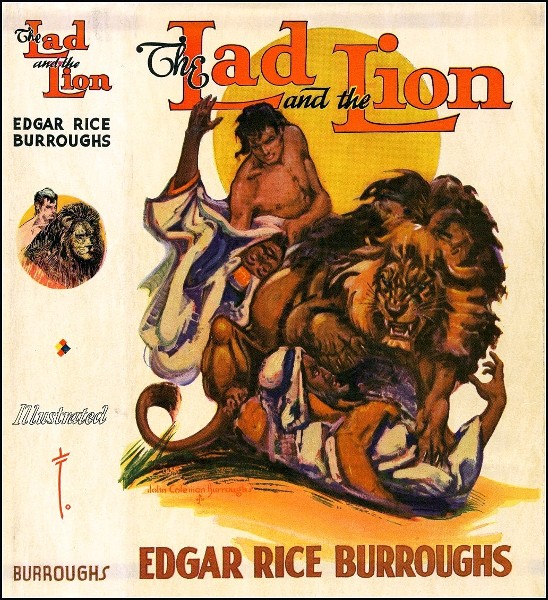
The Lad and the Lion is an adventure novel by American writer Edgar Rice Burroughs, written in February 1914. His working title for the piece was "Men and Beasts." It was first published as a three-part serial in All-Story Weekly in the issues for June 30, July 7, and July 14, 1917. The story was the first by Burroughs adapted to film, the movie appearing about the same time as the print serial. Despite this distinction, the story did not appear in book form for over twenty years; only after a remake of the film appeared was the first book edition published, by Burroughs's own publishing firm, Edgar Rice Burroughs, Inc., in February 1938. The text was apparently expanded for book publication, as certain incidentals of the story reflect the political situation of Europe in the late 1930s rather than the mid-1910s. The book was reprinted by Grosset & Dunlap in 1939 and Canaveral Press in 1964. The first paperback edition was issued by Ballantine Books in September 1964, with a second appearing from Ace Books in May 1974, reprinted in June 1982.
- Watchers
Dean R. Koontzstandalone novel1987
similar bysurvivaladventurousadventurescience fiction
This probably qualifies as a science-based adventure rather than a science fiction novel. The premise, and only speculative fiction element, is that a U.S. government funded laboratory creates a golden retriever that's as intelligent as a human for use in intelligence gathering and also creates a monkey hybrid that's intended for a military police dog role and as a killing machine on battlefields. The animals escape and the story plays out as a straight adventure novel with a good chunk of romance thrown in.
- Have Space Suit - Will Travel
Robert A. Heinleinstandalone novel1958
similar bysurvivaladventurousscience fiction
From the back cover of the Del Rey 9th printing: "Skyjacked - Everything happened at once. One minute Kip Russell was walking about in his own backyard, testing out an old space suit and dreaming about going to the moon - and the next he was out cold and the captive of an insidious space pirate. The whole thing seemed like a very bad dream until he discovered he wasn't the only prisoner on board. Then the reality of the situation became inescapable. He - along with the daughter of a world-renowned scientist and a beautiful creature from an alien planet - had been skyjacked by a monstrous extraterrestrial and they were on their way to the Moon... a journey toward a fate worse than death!"
- The Stars My Destination
Alfred Besterstandalone novel1956
similar bysurvivaladventurousscience fiction+1 more
When a passing spaceship refuses to rescue the lone survivor from the drifting wreck of another ship, he dedicates his life to discovering who made that decision and exacting his revenge, in the process altering human history and his own character.
- Rats of NIMH
series3 books1971
similar bysurvivaladventurousfantasy+1 more
Robert C. O'Brien's Mrs. Frisby and the Rats of NIMH follows a widowed mouse seeking help to save her sick son and her home from a farmer's plow, turning to a colony of rats who escaped laboratory experiments at the National Institute of Mental Health with enhanced intelligence and a literate, technological society of their own. After O'Brien's death, his daughter Jane Leslie Conly continued the story in Racso and the Rats of NIMH, in which a city rat joins the colony ahead of a flood, and R-T, Margaret, and the Rats of NIMH, in which the rats rescue and are helped by lost human children. All three carry forward the original's interest in community, responsibility, and the costs of intelligence.
- WondLa
series3 books2010
similar bysurvivaladventurousfantasyscience fiction+1 more
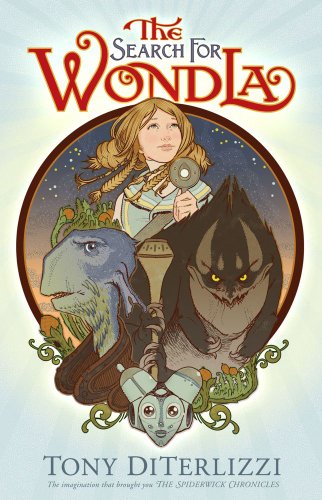
Tony DiTerlizzi's WondLa trilogy follows Eva Nine, a twelve-year-old girl raised in isolation underground by a robot guardian, who emerges onto a surface world populated by strange alien life and sets out to find others like herself. The Search for WondLa launches her journey, continuing through A Hero for WondLa and The Battle for WondLa.