More like The Amplifier Protocol
anchored on:north americanear futureshort story cycleurban fantasyscience fictiongenetic engineering+4 more
but
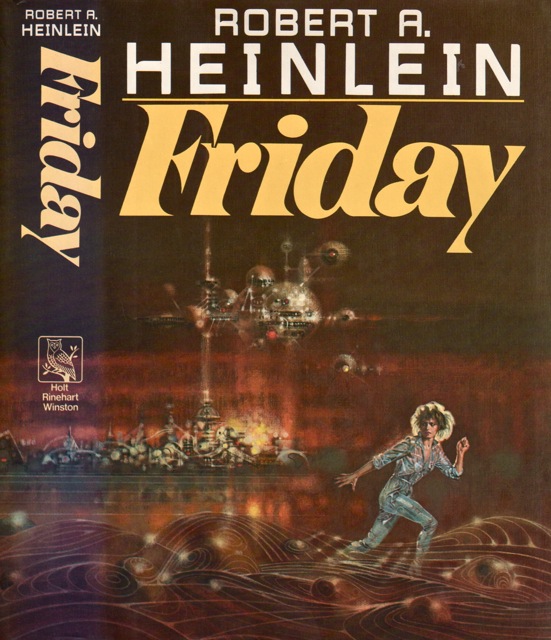
- Friday
Robert A. Heinleinstandalone novel1982
similar bygenetic engineeringnear futurescience fictionadventuroustensenorth america
Friday is a 1982 science fiction novel by American writer Robert A. Heinlein. It is the story of a female "artificial person", the eponymous Friday, genetically engineered to be stronger, faster, smarter, and generally better than normal humans. Artificial humans are widely resented, and much of the story deals with Friday's struggle both against prejudice and to conceal her enhanced attributes from other humans. The story is set in a Balkanized 21st century, in which the nations of the North American continent have been split up into a number of smaller states.
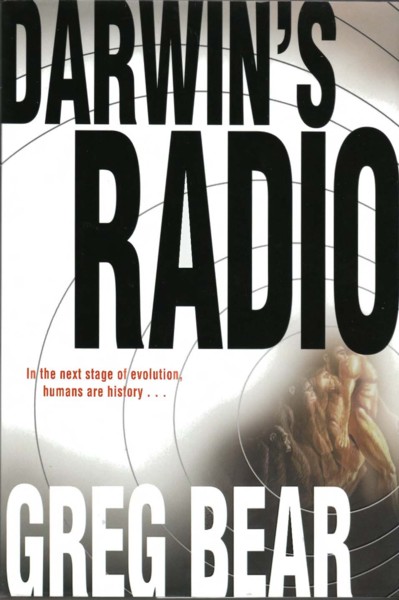
- Darwin
series2 books1999
completed
similar bygenetic engineeringnear futurescience fictiontensenorth america
Greg Bear's Darwin's Radio imagines a dormant retrovirus in human DNA activating worldwide, triggering an accelerated leap in human evolution that governments respond to as a plague. The 1999 novel won the Nebula Award; its sequel Darwin's Children follows the first generation of changed children as society decides what to do with them. Together they're speculative near-future science fiction grounded in genetics rather than space opera.
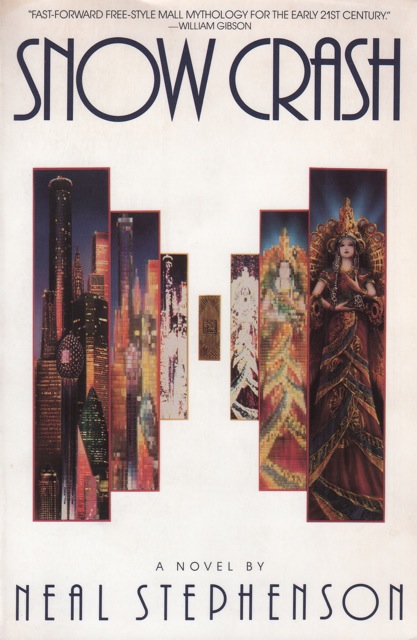
- Snow Crash
Neal Stephensonstandalone novel1992
similar bynear futurescience fictionadventuroustensebig city
Snow Crash is a 1992 science fiction novel by Neal Stephenson. Like many of Stephenson's novels, its themes include history, linguistics, anthropology, archaeology, religion, computer science, politics, cryptography, memetics, and philosophy.
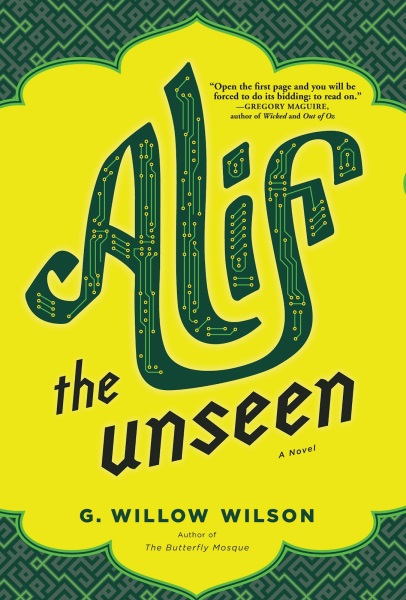
- Alif the Unseen
G. Willow Wilsonstandalone novel2012
similar bydemonsscience fictionadventuroustenseurban fantasybig city
Alif the Unseen is a 2012 cyberpunk fantasy novel by American writer G. Willow Wilson. In the novel, a Middle Eastern hacker named Alif discovers a book of djinn tales which may lead to a new age of quantum computing. The novel won the 2013 World Fantasy Award for Best Novel.
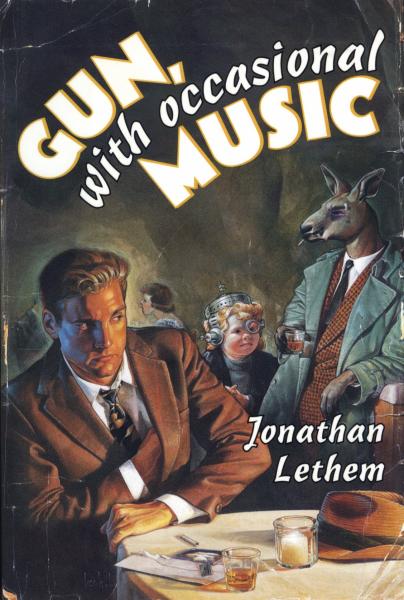
- Gun, with Occasional Music
Jonathan Lethemstandalone novel1994
similar bygenetic engineeringnear futurescience fictiontensenorth americabig city
Conrad Metcalf has problems. He has a monkey on his back, a rabbit in his waiting room and a trigger-happy kangaroo on his tail. (Maybe evolution therapy is not such a good idea.) He's been shadowing Celeste, the wife of an affluent Oakland urologist. Maybe falling in love a little with her at the same time. When the doctor turns up dead, Metcalf finds himself caught in a crossfire between the boys from the Inquisitor's Office and gangsters who operate out of the back room of the Fickle Muse. (adapted from the blurb accompanying the first edition)
- Have Space Suit - Will Travel
Robert A. Heinleinstandalone novel1958
similar bynear futurescience fictionadventuroustensenorth america
From the back cover of the Del Rey 9th printing: "Skyjacked - Everything happened at once. One minute Kip Russell was walking about in his own backyard, testing out an old space suit and dreaming about going to the moon - and the next he was out cold and the captive of an insidious space pirate. The whole thing seemed like a very bad dream until he discovered he wasn't the only prisoner on board. Then the reality of the situation became inescapable. He - along with the daughter of a world-renowned scientist and a beautiful creature from an alien planet - had been skyjacked by a monstrous extraterrestrial and they were on their way to the Moon... a journey toward a fate worse than death!"
- When She Woke
Hillary Jordanstandalone novel2011
similar bygenetic engineeringnear futurescience fictiontensenorth america
When She Woke is a science fiction novel by American author Hillary Jordan, published in October 2011. It has been translated into French, Spanish, Turkish, German, Portuguese and Chinese. The novel is a dystopian reimagining of Nathaniel Hawthorne's The Scarlet Letter, set in a future theocratic America where rather than being imprisoned and rehabilitated, criminals are punished by being "chromed" – having their skin color genetically altered to fit their crime – and released into the general population to survive as best they can.
- A Fall of Moondust
Arthur C. Clarkestandalone novel1961
similar bynear futurescience fictionadventuroustense
From the back cover of the Harbrace paperback: "The action of A Fall of Moondust takes place almost a century from now when tours on the moon are a common occurrence. One of the high points of each tour is a cruise around the Sea of Thirst, a body of volcanic dust, in a specially designed vessel called the Selene On a perfectly routine voyage one day the Selene suddenly disappears. How do you locate a small tourist "cruiser" buried beneath fifty feet of dust? If you find it, how do you rescue the passengers and crew? If you are on board, how do you feel and what do you do while brave men and expert technicians join forces in a race against time? Sustained excitement, lively humor, and an engaging cast of characters make this one of Arthur C. Clarke's most intriguing novels."
- Heavy Weather
Bruce Sterlingstandalone novel1994
similar bynear futurescience fictionadventuroustensenorth america
Set in 2031 when global climatology has significantly changed the world's weather patterns, Jane Unger "rescues" her brother Alex from a Mexican clinic and takes him to the Storm Troupe. The troupe, under the leadership of Dr. Jerry Mulcahey, chases tornadoes primarily across northern Texas, gathering data in preparation for tracking the mythical F-6 tornado.
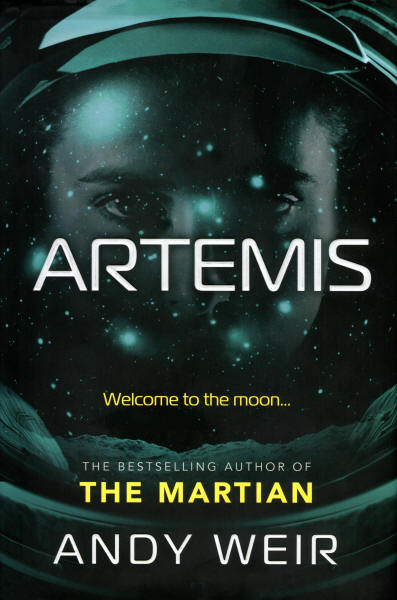
- Artemis
Andy Weirstandalone novel2017
similar bynear futurescience fictionadventuroustensebig city
Artemis is a 2017 science fiction novel by American writer Andy Weir. It takes place in the late 2080s in Artemis, the first and only city on the Moon. It follows the life of porter and smuggler Jasmine "Jazz" Bashara as she gets caught up in a conspiracy for control of the city. The book received mixed reviews from critics.
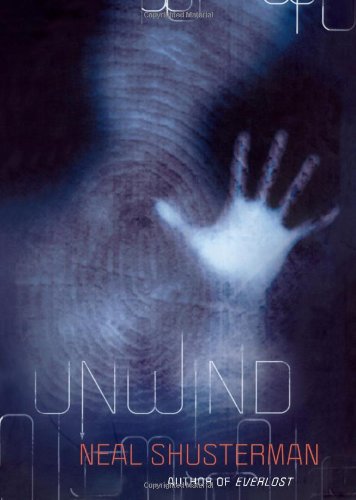
- Unwind Dystology
series5 books2007
similar bynear futuregenetic engineeringscience fictiontensenorth america
Neal Shusterman's Unwind Dystology opens in a United States reshaped by the resolution to a war over reproductive rights: parents can retroactively have a teenager "unwound," their body disassembled for transplant on the premise that nothing technically dies since every part lives on in someone else. The first novel follows three teens fleeing that fate, and the sequels widen the same dystopia's cast and consequences across a four-book arc plus companion material. It is grim speculative fiction built to ask hard bioethical questions rather than offer comfort.
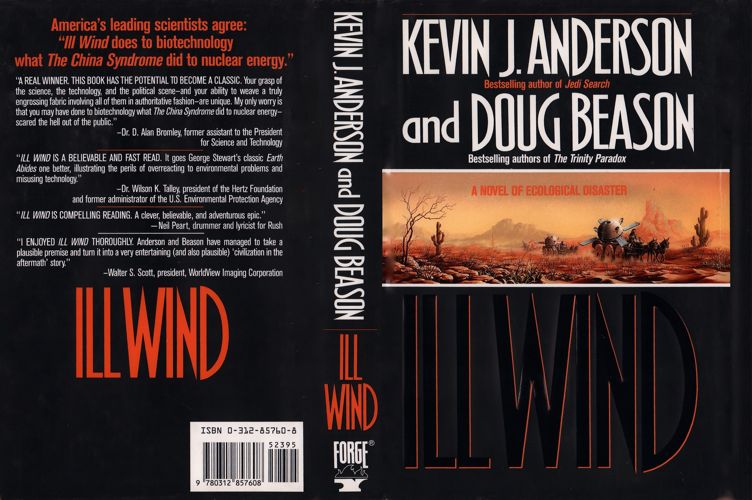
- Ill Wind
Kevin J. Anderson & Doug Beasonstandalone novel1995
similar bygenetic engineeringnear futurescience fictiontensenorth america
From the flaps of the Forge first printing: "A supertanker has crashed off the shores of San Francisco, producing the largest oil spill in history. Desperate to avert an ecological - and public relations - disaster, a multinational oil company releases an untested virus designed to break up the spill. A virus that spreads like wildfire on the wind, destroying anything made of petroleum - destroying gasoline in automobile tanks, plastics, nylon, the very fabric of modern civilization itself. Dr. Spencer Lockwood, one of the few scientists to recognize the danger, tries to alert government and industry to the impending danger. But his warnings go unheeded and the devastation mounts. As America descends into savagery, Lockwood forges a courageous band of scientists to carry out a daring plan to restore order. But humanity's last hope my be snuffed out by a ruthless general driven by an insatiable desire for power. A riveting and inspiring saga of ecological catastrophe and human survival, Ill Wind is all the more frightening because it could actually happen. Kevin Anderson, a technical consultant for the Air Force, and Doug Beason, a former science advisor o the Reagan administration, have drawn upon the latest breakthroughs in biotechnology to create a disaster scenario that is terrifying in its plausibility."
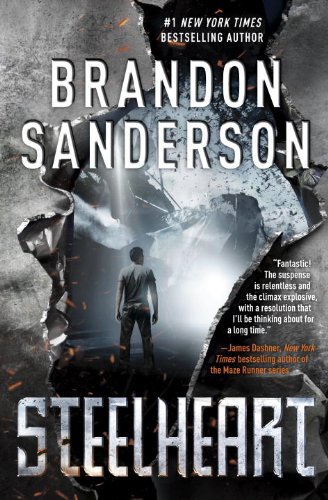
- Reckoners
series6 books2013
similar byscience fictionnear futureadventuroustensenorth america+1 more
The Reckoners is a series of young adult superhero novels written by American author Brandon Sanderson. The series consists of Steelheart (2013), Firefight (2015), Calamity (2016) and Lux (2021). The series depicts a post-apocalyptic world in which the appearance of an orbiting cosmic phenomenon known as Calamity has given random people superhuman powers in apparent defiance of known physical laws, turning them into "Epics". These Epics prey upon or enslave the rest of humanity, causing the collapse of traditional governments. One young man orphaned by a High Epic joins a group that is killing Epics.
- Oath of Fealty
Larry Niven & Jerry Pournellestandalone novel1981
similar bynear futurescience fictiontensenorth americabig city
Oath of Fealty is a 1981 novel by American writers Larry Niven and Jerry Pournelle, published originally by Phantasia Press, then by Timescape Books, with numerous reprints. Set in the near future, it involves an arcology, a large inhabited structure, called Todos Santos, which rises above a crime-ridden Los Angeles, California, but has little beyond casual contact with the city. The novel popularized the phrase "think of it as evolution in action", which occurs elsewhere in Niven's books. The novel anticipated the building of the Los Angeles subway. It was included in David Pringle's book Science Fiction: The 100 Best Novels.
- The Shockwave Rider
John Brunnerstandalone novel1975
similar bynear futurescience fictiontensenorth americabig city
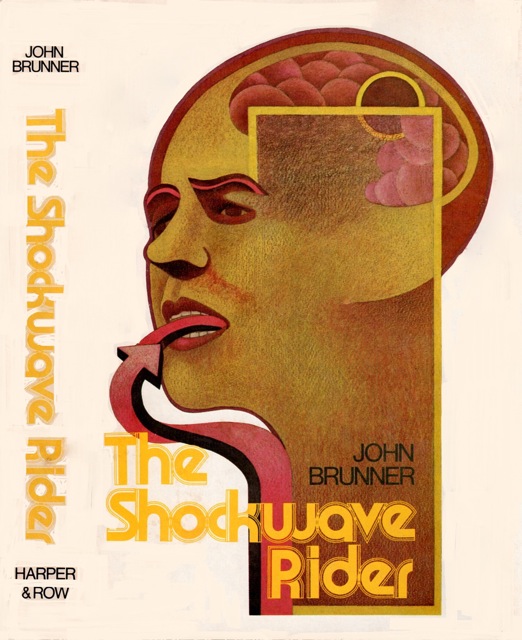
The Shockwave Rider is a science fiction novel by John Brunner, originally published in 1975. It is notable for its hero's use of computer hacking skills to escape pursuit in a dystopian future, and for the coining of the word "worm" to describe a program that propagates itself through a computer network. It also introduces the concept of a Delphi pool, perhaps derived from the RAND Corporation's Delphi method – a prediction market on world events which bears close resemblance to DARPA's controversial and cancelled Policy Analysis Market.
- The Thousandth Floor
series3 books2016
similar bynear futurescience fictiontensenorth americabig city+1 more
Katharine McGee's trilogy imagines Manhattan in 2118 as a single thousand-story tower housing every stratum of society, following five teenagers whose ambitions collide as they climb toward, or fall from, its highest floors. Across The Thousandth Floor, The Dazzling Heights, and The Towering Sky, addiction, surveillance, genetic privilege, and family betrayal play out as soap-opera drama in a meticulously built near-future setting.
- Watchers
Dean R. Koontzstandalone novel1987
similar bygenetic engineeringscience fictionadventuroustensenorth america
This probably qualifies as a science-based adventure rather than a science fiction novel. The premise, and only speculative fiction element, is that a U.S. government funded laboratory creates a golden retriever that's as intelligent as a human for use in intelligence gathering and also creates a monkey hybrid that's intended for a military police dog role and as a killing machine on battlefields. The animals escape and the story plays out as a straight adventure novel with a good chunk of romance thrown in.
- Sprawl Trilogy
series10 books1981
similar bynear futurescience fictiontensebig city
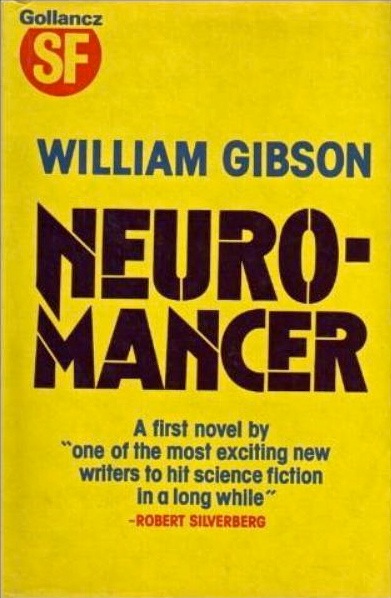
The Sprawl Trilogy is William Gibson's foundational cyberpunk sequence: Neuromancer (1984), in which hacker Case is drawn into a high-stakes heist alongside an artificial intelligence and a damaged ex-soldier, followed by Count Zero (1986) and Mona Lisa Overdrive (1988), which widen the same near-future world of corporate power and networked cyberspace to new characters. Johnny Mnemonic, an early short story set in the same fictional milieu, predates the novels and introduces the courier Molly Millions before her role in the trilogy. Together these works established much of cyberpunk's visual and thematic vocabulary.
- Upgrade
Blake Crouchstandalone novel2022
similar bygenetic engineeringnear futurescience fictiontensenorth america
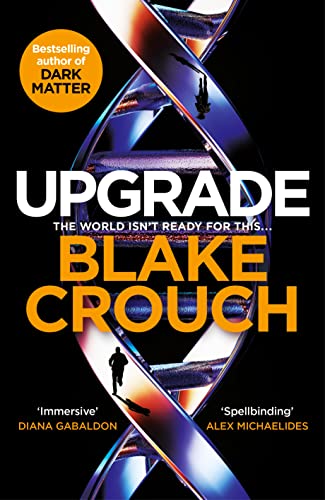
Upgrade is a 2022 novel by Blake Crouch. It is his tenth stand-alone novel, published three years after Summer Frost (2019). The novel explores the ethical and existential ramifications of genetic engineering, set in a near-future world where humanity grapples with the consequences of advanced human genetic enhancement.
- The Handmaid's Tale
series3 books1985
similar bynear futurescience fictiontensenorth america
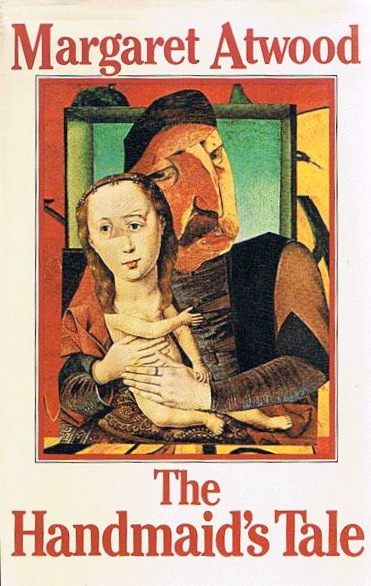
The Handmaid's Tale is Margaret Atwood's 1985 novel set in Gilead, a totalitarian theocracy that has overthrown the United States and forces fertile women into reproductive servitude as Handmaids; it is narrated by one such woman, Offred. Atwood returned to the world in her 2019 sequel The Testaments, set fifteen years later and narrated by three women, including the regime's Aunt Lydia. Together the two novels move from Gilead's grip on power toward the first cracks in it.
- The Door Into Summer
Robert A. Heinleinstandalone novel1957
similar bynear futurescience fictionadventurousnorth america
From the first page of the Signet 6th printing: "An electronics engineer invents a wizard robot... only to find himself shanghaied by his ruthless partner and his gold-digging fiancee. The crafty pair forces him to submit to the "long sleep" - suspended animation for thirty years. But when he wakes up in the year 2000 A.D. the inventor makes a startling discovery. He learns that it is possible now to twist time forwards or backwards. And so he returns to the past bent on a mission... of revenge."
- Demons
John Shirleystandalone novel2002
similar bydemonsnear futurescience fictiontensenorth americabig city
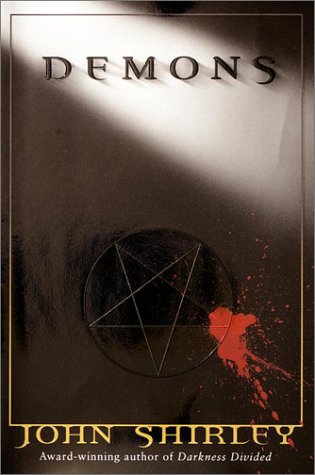
Writers from Clive Barker to Bruce Sterling and Roger Zelazny have praised John Shirley's searing, apocalyptic visions of postmodern hell on earth. Now this perversely brilliant author, one of the seminal representatives on the cyberpunk movement, unleashes his newest masterpiece.DEMONSIn a future uncomfortably close to the present day, the apocalypse has surpassed all expectations. Hideous demons roam the streets in an orgy of terror, drawing pleasure from torturing humans as sadistically as possible. Divided into seven clans, these grisly invaders--gnashing, writhing, bloodthirsty monsters--seem horrifically to belong in our world.Ira, a young San Francisco artist, becomes involved with a strange group of scientists and philosophers desperately trying to end the bloody siege. Yet through it all, Ira continues to paint--for in his canvasses lie crucial clues to the demons' origins.Yet the demons draw their strength from an all-too-familiar evil--a deadly malevolence supported by some of the greatest powers on earth, concealed beneath the trappings of status, success, and abused power. Ira and his allies-- including a compelling young seeress--come to believe these demons didn't just appear. They were summoned. But the most shocking revelation is yet to come . . .EXCLUSIVE TO THIS EDITION: The original novella Demons was published as an acclaimed, limited edition hardcover which Publishers Weekly called a "mini-masterpiece." Now the terror continues, as the sequel story, "Undercurrents," takes the reader on a macabre journey into the center of the conspiracy that may lay waste to the Earth. From the Hardcover edition.
- Ready Player One
series3 books2011
similar bynear futurescience fictionadventurous+2 more
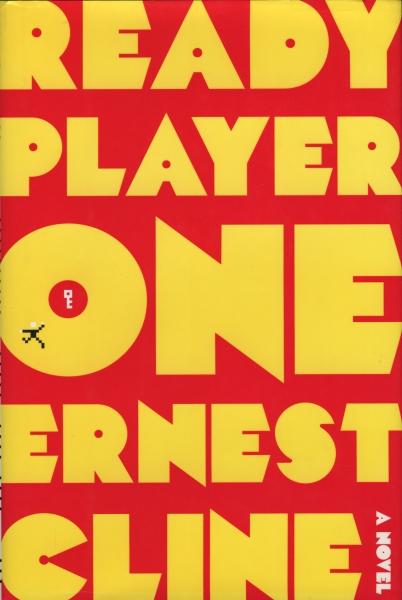
Ernest Cline's Ready Player One (2011) is set in a near-future dystopia where much of humanity escapes into the OASIS, a vast virtual-reality universe, and follows teenager Wade Watts as he chases an Easter egg hidden by the OASIS's late creator in a puzzle-based hunt worth a fortune. The 2020 sequel, Ready Player Two, picks up after Wade has gained control of the OASIS and follows him and his friends into a new quest built around a brain-computer interface the creator left behind.