Loreful
HomeDiscover
Search series, authors…⌘K
Loreful

Reading orders for SF/F series and shared universes — with your place kept in every one.

Explore

UniversesSeriesWorksAuthorsAtlas

Help

FAQAboutSite map

Account & legal

Sign inCreate accountPrivacyTerms

Data

Built on ISFDB, Wikipedia, Wikidata and Open Library. Curated reading orders carry their reasoning on the page; the rest follow publication order. Data sources & licenses

© Loreful · data: ISFDB · CC BY

More like The Clockwork Man

but

Mood

The mood the book leaves you in.

  • The reading experience is propelled by journeys, exploration, and physical risk; excitement and forward momentum dominate over dread or introspection.
  • Joy and loss are deliberately mixed; the resolution grants characters something real while taking something else away, leaving warmth and sorrow together.
  • The book demands work from the reader — dense prose, difficult structure, unfamiliar ideas, or morally uncomfortable material — as part of its intended effect.
  • Grim events, cruelty, or despair dominate the atmosphere, and the book does not soften them with comfort or comic relief.
  • The atmosphere is quietly unsettling — wrongness, unease, and the uncanny pervade the book without necessarily escalating into overt horror.
  • The book is built to move the reader; character feeling is foregrounded and major scenes aim at a strong emotional response.
  • Humor is a primary aim and the prose plays for laughs — comic situations, wit, or dialogue produce sustained comedy, not occasional levity.
  • The book insists that things can improve; effort and decency are shown to matter, and the arc bends toward better outcomes even through hardship.
  • The book teaches as it goes — real facts, history, science, or craft are conveyed in enough depth that learning is part of the reading experience.
  • The book is designed to uplift and motivate, presenting perseverance or achievement in a way that invites the reader to aspire or act.
  • The overall register is cheerful and easygoing; stakes are kept gentle and the book avoids dwelling on pain or dread.
  • Withheld information drives the experience; the book sustains enigmas and secrets the reader wants resolved, whatever its genre.
  • The book is contemplative and inward-looking, giving more weight to thought, memory, and meaning than to external events.
  • The book works as comfort reading — low tension, a soothing pace, and an atmosphere the reader can unwind in.
  • Grief, loss, or melancholy set the dominant register, and the book lets sorrow stand rather than resolving it into comfort.
  • Sustained suspense is the point; the book keeps the reader braced for what happens next through danger, pressure, or impending revelation.
  • Playful invention and charm define the register — fanciful conceits, light absurdity, and a narration that delights in its own oddity.

About

What the story runs on.

  • Stories in which extraterrestrial beings are central — as characters, cultures, or the object of the plot.
  • Stories about venturing into space to explore — survey missions, astronauts, and the frontier of the unknown beyond Earth.
  • Stories structured as a quest — a journey undertaken to find, deliver, or destroy something of great import.
  • Stories in which staying alive against nature, catastrophe, or scarcity is the central problem.
  • Stories of lovers kept apart by law, family, faith, or station, where the obstacle to love is the plot.
  • Stories in which a friendship — its making, testing, or loss — is the emotional center.
  • Stories of growing up — a young protagonist crossing from childhood into adult knowledge and responsibility.
  • Stories about who a character truly is — self-discovery, doubled lives, and the search for a self.
  • Stories in which a buried family truth — hidden parentage, crimes, or shames — surfaces and reorders the present.
  • Stories driven by maneuvering for power — factions, conspiracies, and statecraft conducted in shadow.
  • Stories in which war itself is the subject — combat, occupation, and what warfare does to soldiers and civilians.
  • Stories organized around investigating a killing — the case, the clues, and the pursuit of the killer, in any genre's clothing.

Shelf

Where it sits in the library.

    • Fiction built on magic or other supernatural elements that have no scientific explanation.
    • Secondary-world fantasy at large scale, where the fate of nations or the world turns on the protagonists' struggle.
    • Fantasy set in a recognizably modern city or contemporary world where the supernatural intrudes on everyday life.
    • Fantasy that blends in horror's atmosphere and imagery, keeping a fantastical frame around grim or frightening material.
    • Action-driven fantasy following warriors or rogues with personal stakes against sorcerous threats, rather than world-spanning conflicts.
    • Fantasy set in a real historical period or a close analogue of one, with magic woven into the era.
    • Fantasy in which protagonists cross from the ordinary world into another world through a portal or similar passage.
    • Fiction that retells or reworks a traditional fairy tale in a new form or setting.
    • Fantasy drawing directly on myths, legends, and folklore, retelling them or building on their figures and logic.
    • Fantasy of ghosts, vampires, shapeshifters, psychics, and similar phenomena, usually set in an otherwise ordinary world.
    • Fiction mixing science-fictional trappings with overtly magical or impossible elements in one setting.
    • Low-stakes fantasy emphasizing comfort, community, and everyday pleasures over conflict and peril.
    • Speculative fiction of pervasive moral ambiguity, violence, and cynicism that rejects heroic conventions — fantasy and SF alike.
      • Fiction that extrapolates from science and technology — future societies, space travel, or speculative inventions — within at least nominally natural laws.
      • Science fiction of interstellar scope — starships, galactic polities, and adventure across star systems.
      • Science fiction committed to scientific rigor, where technical plausibility constrains the story.
      • Science fiction centered on armed forces and warfare, told largely from a military point of view.
      • Science fiction of networked, corporate-dominated near futures, pairing high technology with social decay.
      • Science fiction styled on nineteenth-century steam-powered technology, often in a Victorian or pseudo-Victorian setting.
      • Fiction depicting an oppressive or catastrophic society, presented as a warning.
      • Fiction set after civilization's collapse, following survivors in the ruins of the old world.
      • Fiction in which characters move between past and future, and the mechanics or consequences of that travel drive the plot.
      • Fiction exploring a world where a historical event went differently and history diverged from ours.
      • Science fiction about humanity's first encounter and communication with an alien intelligence.
      • Science fiction in which extraterrestrial forces attack or occupy Earth and humanity resists.
      • Fiction whose primary aim is to frighten or unsettle the reader through dread, menace, or the monstrous.
      • Horror of vast, indifferent, incomprehensible entities before which humanity is insignificant, in the Lovecraft tradition.
      • Horror of decaying houses, buried family secrets, and oppressive atmosphere in the Gothic literary tradition.
      • Horror centered on hauntings and the returning dead.
      • Horror located in the mind — paranoia, obsession, and unreliable perception rather than external monsters.
      • Horror built around the reanimated dead and survival amid their outbreaks.
      • Horror defined by explicit, transgressive gore that refuses to cut away from violence.
      • Speculative fiction of the strange and uncanny that resists both natural explanation and standard genre categories.
      • Fiction organized around solving a crime or puzzle, typically following an investigator toward the identification of a culprit.
      • A puzzle-first mystery that lays out clues so the culprit's identity can be deduced before the reveal.
      • Crime fiction of moral ambiguity, fatalism, and hard-edged style, set among the corrupt and the doomed.
      • A mystery following the realistic routines of police work — forensics, interviews, and case-building.
      • A gentle mystery with an amateur sleuth, a small community, and violence kept off the page.
      • A mystery set in a past era, where the investigation works within that period's methods and society.
      • Fast-paced fiction driven by imminent danger, pursuit, or high-stakes conspiracy, built to sustain tension.
      • A thriller of espionage — agents, tradecraft, and intelligence services in conflict.
      • A thriller centered on lawyers and the courtroom, where litigation carries the suspense.
      • A thriller driven by detailed contemporary or near-future technology, often military or scientific.
      • A thriller whose tension comes from mental states and manipulation between characters rather than external action.
      • Fiction whose central plot is a romantic relationship and its development toward an emotionally satisfying resolution.
      • Romance in which one or both partners are supernatural beings, blending fantasy elements into the love story.
      • A fantasy-romance hybrid in which the romantic arc and the fantasy plot carry equal weight.
      • Romance set in a past era, with courtship shaped by the period's society and manners.
      • Romance set in the present day, without supernatural or historical elements.
      • Fiction set in a real past period, where the historical setting materially shapes characters and events.
        • General and literary fiction emphasizing prose style, character interiority, or formal ambition over genre plot conventions.
        • Fiction in a realistic world where magical events occur and are treated as ordinary, in the tradition of Latin American literature.
        • Fiction that ridicules people, institutions, or society in order to criticize them.
        • Fiction of dreamlike, irrational imagery and logic that breaks from realistic representation.
        • Fiction that plays with narrative convention through metafiction, fragmentation, and self-reference.
        • Fiction propelled by journeys, exploration, and physical peril, where action and survival carry the plot.
        • Adventure fiction of ships and seafaring — naval engagements, voyages, and life at sea.
        • Fiction of the American frontier West — gunmen, ranchers, and lawmen, typically in the late nineteenth century.
        • Fiction centered on soldiers, campaigns, and the experience of warfare, historical or imagined.
          • Fiction written primarily to amuse, using comedic situations, wit, or parody as its organizing principle.
            • Multi-generational fiction following a family or dynasty across decades, with inheritance and kinship as the through-line.
              • Fiction whose world runs on explicit game mechanics — levels, stats, and skills that characters can see and exploit.
                • Fiction about costumed or superpowered heroes and their conflicts with comparable villains.

                Practical

                How long a commitment, whether it stands alone, and whether it has finished.

                Tap a chip to ask for it · tap again to rule it out · once more to clear. Numbers show what would be left.

                • Cover of Nineteen Eighty-Four
                  Nineteen Eighty-Four

                  series · 4 books · 1949

                  similar by+2 more

                  Nineteen Eighty-Four (1949) is George Orwell's novel of a totalitarian future Britain kept under constant surveillance and thought control, following Winston Smith's doomed attempt at a private rebellion against the ruling Party. Sandra Newman's Julia (2023), written with the Orwell estate's authorization, retells the same events from the point of view of Winston's lover Julia, filling in a life and set of motives the original largely left offstage.

                • Cover of Trouble with Lichen
                  Trouble with Lichen

                  John Wyndham · standalone novel · 1960

                  similar bygender and societybritish islesscience fiction

                  Biochemists Diana Brackley and Francis Saxover, working independently, both isolate a compound from a rare lichen that appears to dramatically slow the aging process. Francis quietly doses himself and his family and says nothing; Diana takes the opposite approach, opening exclusive beauty spas as cover to give the drug to well-connected women across Britain, reasoning that if longevity becomes known before women have a foothold, men will simply monopolize it as they have everything else. The secret can only hold so long, and the novel's tension builds toward the moment it gets out. A quietly subversive social science-fiction novel from John Wyndham.

                • Cover of Dirk Gently
                  Dirk Gently

                  series · 3 books · 1987

                  completed

                  part of The Hitchhiker's Guide to the Galaxy Universe

                  similar bybritish islesscience fiction+2 more

                  Dirk Gently's Holistic Detective Agency (1987) introduces Douglas Adams's eccentric investigator, whose approach treats all events and objects as ultimately connected however implausibly, as a case involving time travel, a ghost, and a Cambridge murder tangles into one plot. Adams completed one further full novel, The Long Dark Tea-Time of the Soul (1988), before his death; The Salmon of Doubt (2002) later collected his unfinished notes toward a third book alongside essays and other writing, rather than completing the story.

                • Cover of The Stepford Wives
                  The Stepford Wives

                  Ira Levin · standalone novel · 1972

                  similar byrobotsgender and society+1 more

                  The Stepford Wives is a 1972 satirical "feminist horror" novel by Ira Levin. The story concerns Joanna Eberhart, a talented photographer, wife, and young mother who suspects that something in the town of Stepford is changing the wives from free-thinking, intelligent women into compliant wives dedicated solely to homemaking. As her friends slowly transform, Joanna realizes the horrific truth.

                • Cover of Roadmarks
                  Roadmarks

                  Roger Zelazny · standalone novel · 1979

                  similar byscience fictiontime travel+2 more

                  Roadmarks is a science fantasy novel by American author Roger Zelazny, written during the late 1970s and published in 1979.

                • Cover of The White Plague
                  The White Plague

                  Frank Herbert · standalone novel · 1982

                  similar bygender and societyscience fiction+1 more

                  The White Plague is a 1982 science fiction novel by American author Frank Herbert about an engineered disease which kills only women. It was nominated for a best science fiction novel Locus Award in 1983.

                • Cover of The Goblin Reservation
                  The Goblin Reservation

                  Clifford D. Simak · standalone novel · 1968

                  similar byscience fictionfantasytime travel+1 more

                  The Goblin Reservation is a 1968 science fiction novel by American writer Clifford D. Simak, featuring an educated Neanderthal, a biomechanical sabertooth tiger, aliens that move about on wheels, a man who time-travels using an unreliable device implanted in his brain, meeting a ghost, trolls, banshees, goblins, a dragon and even Shakespeare himself. The Goblin Reservation was a Hugo Award nominee in 1969 and was originally serialized in Galaxy Science Fiction magazine.

                • Cover of Triptych
                  Triptych

                  J. M. Frey · standalone novel · 2011

                  similar byscience fiction+3 more

                  Triptych is a 2011 debut novel by Canadian author J.M. Frey. The novel follows three narrators as they recount the events surrounding major turning points in the life of Gwen Pierson, a languages specialist: Evvie Pierson, Gwen's mother a housewife in rural southern Ontario; Kalp, an alien refugee from a dead planet living in England and Gwen's lover; and Basil Grey, a Welsh computer engineer.

                • Cover of The Prey of Gods
                  The Prey of Gods

                  Nicky Drayden · standalone novel · 2017

                  similar byscience fictionfantasy+2 more

                  The Prey of Gods is a 2017 young adult science fiction novel by Nicky Drayden. The audiobook was narrated by Prentice Anoyemi. It features characters who were queer, lesbian and gay.

                • Cover of The Wanting Seed
                  The Wanting Seed

                  Anthony Burgess · standalone novel · 1962

                  similar bygender and societyscience fiction+1 more

                  The Wanting Seed is a dystopian novel by the English author Anthony Burgess, written in 1962.

                • Cover of Mother of Storms
                  Mother of Storms

                  John Barnes · standalone novel · 1994

                  similar byscience fiction+2 more

                  From the flaps of the Tor first edition: "It is 2028. A strike to destroy an illegal Arctic weapons cache has a catastrophic side effect. Massive amounts of energy are liberated from the polar ice, suddenly warming the Earth's climate. In the middle of the Pacific, a gigantic hurricane thousands of miles across is forming, larger than any in human history. A storm with winds of supersonic speed. A storm that changes direction at whim. A storm that refuses to die. A storm so vast it spawns dozens more in its wake... Blinded by intrigue, expedience, and greed, the world's politicians and power brokers have ignored the killer storms threat until it is too late. Already the death toll is in the tens of millions, as it savages the Pacific coast, while its devil's brood of smaller storms are wreaking havoc across the face of the planet. While the survivors scramble for advantage, a handful of courageous men and women undertake a daring, desperate plan to save humanity from total destruction - a plan so visionary it may alter forever the future of the human race."

                • Cover of The Anubis Gates
                  The Anubis Gates

                  series · 3 books · 1983

                  similar bybritish islesfantasytime travel+1 more

                  The Anubis Gates is a single time-travel fantasy novel by Tim Powers, following a present-day academic who takes part in a time-travel experiment and ends up stranded in early nineteenth-century London. It won the Philip K. Dick Award in 1983 and the Science Fiction Chronicle Award the following year.

                • Cover of Frankissstein
                  Frankissstein

                  Jeanette Winterson · standalone novel · 2019

                  similar bygender and societybritish islesscience fiction+1 more

                  Frankissstein: A Love Story is a 2019 novel by Jeanette Winterson. It was published on 28 May 2019 by Jonathan Cape. The novel employs speculative fiction and historical fiction to reimagine Mary Shelley's classic novel Frankenstein (1818). The story switches between Mary Shelley writing Frankenstein in Geneva, Switzerland in 1816 and the story of Ry Shelley, a transgender doctor and Victor Stein, a transhumanist, who become involved in the world of artificial intelligence and cryonics in present-day Brexit-era Britain.

                • Cover of A Tale of Time City
                  A Tale of Time City

                  Diana Wynne Jones · standalone novel · 1987

                  similar byscience fictiontime travel+2 more

                  In 1939 an eleven-year-old London girl is kidnapped to Time City, a place existing outside the stream of time and manipulating the history of humanity, where she finds the inhabitants facing their worst hour of crisis.

                • Cover of The One
                  The One

                  series · 2 books · 2017

                  similar byscience fiction+2 more

                • Cover of George Dower / Infernal Devices
                  George Dower / Infernal Devices

                  series · 3 books · 1987

                  similar by+2 more

                  K. W. Jeter's trilogy, whose 1987 original helped coin the term 'steampunk,' follows clockmaker George Dower as he's dragged into escalating Victorian conspiracies involving mechanical devices, secret societies, and inventions that shouldn't work but do. Infernal Devices, Fiendish Schemes, and Grim Expectations mix dark comedy with the gears-and-brass aesthetic the series helped establish before it had a name.

                • Cover of The Door Into Summer
                  The Door Into Summer

                  Robert A. Heinlein · standalone novel · 1957

                  similar byrobotsscience fictiontime travel

                  From the first page of the Signet 6th printing: "An electronics engineer invents a wizard robot... only to find himself shanghaied by his ruthless partner and his gold-digging fiancee. The crafty pair forces him to submit to the "long sleep" - suspended animation for thirty years. But when he wakes up in the year 2000 A.D. the inventor makes a startling discovery. He learns that it is possible now to twist time forwards or backwards. And so he returns to the past bent on a mission... of revenge."

                • Cover of He, She and It
                  He, She and It

                  Marge Piercy · standalone novel · 1991

                  similar byrobotsgender and societyscience fiction

                  He, She, and It is a 1991 cyberpunk novel by American writer Marge Piercy. It won the Arthur C. Clarke Award for Best Science Fiction Novel in 1993. The novel, set in a post-apocalyptic America, follows a romance between a human woman and a cyborg created to protect her community from corporate raiders. The novel also interweaves a secondary narrative of the creation of a golem in 17th century Prague. Like Piercy's earlier novel Woman on the Edge of Time (1976), He, She, and It also examines themes such as gender roles, political economy, and environmentalism. In the mid-twenty-first century, Norika is a toxic wasteland. Dominated by powerful corporations known as "multis", the region includes environmental domes, independent "free towns", and the chaotic "Glop", where most Norikans live in violent, polluted conditions ruled by gangs and warlords.

                • Cover of Autonomous
                  Autonomous

                  Annalee Newitz · standalone novel · 2017

                  similar byrobotsscience fiction+1 more

                  Autonomous is a 2017 science fiction novel by Annalee Newitz. It is Newitz's debut novel and was published by Tor Books on September 19, 2017. Set in a near future Earth, the book describes a world where both humans and intelligent robots can be owned as property. The events of the novel follow Jack, a "drug pirate" who manufactures illegal versions of patented drugs, and Paladin, a combat robot who is owned by the law enforcement agency searching for Jack after one of the drugs she reverse-engineered turns out to have dangerous side effects.

                • Cover of Great Apes
                  Great Apes

                  Will Self · standalone novel · 1997

                  similar bygender and societybritish isles+1 more

                  Great Apes is a 1997 novel by Will Self.

                • Cover of The Cloning of Joanna May
                  The Cloning of Joanna May

                  Fay Weldon · standalone novel · 1989

                  similar bygender and societybritish islesscience fiction

                  The Cloning of Joanna May is a 1989 science fiction novel by British writer Fay Weldon.

                • Cover of Traces
                  Traces

                  series · 7 books · 2005

                  similar by+3 more

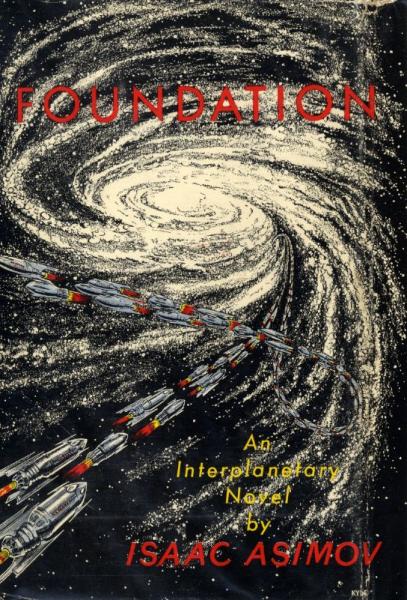
                • Cover of Foundation Universe
                  Foundation Universe

                  universe · 123 books · 1940

                  Start hereFoundation · Start here

                  similar byrobotsscience fiction

                  There is a science that reads the future of quadrillions the way an astronomer reads the orbits of stars. It is called psychohistory, and its equations foresee something the ruling Galactic Empire cannot admit: the throne is rotting, and thirty thousand years of barbarism are coming. One man, Hari Seldon, cannot stop the fall. He can only shorten it — by seeding a Foundation of scholars at the rim of the galaxy, a fragile institution built to carry knowledge across the dark and cut the interregnum to a single millennium. This is a universe told in the register of history itself: the long view, the calm of deep time, empires measured in centuries and men measured against them. The spine is Asimov's original trilogy — Foundation, Foundation and Empire, Second Foundation — followed decades later by the sequels Foundation's Edge and Foundation and Earth and the prequels Prelude to Foundation and Forward the Foundation. Late in life Asimov braided this in with his other future histories: the Robot novels of detective Elijah Baley and his humaniform partner R. Daneel Olivaw (The Caves of Steel, The Naked Sun, The Robots of Dawn, Robots and Empire) and the early Galactic Empire novels (Pebble in the Sky and its kin), until one continuous chronicle ran from the first thinking robots to the Second Empire. Other hands extend it — the Second Foundation Trilogy by Gregory Benford, Greg Bear, and David Brin, and shared-world spinoffs such as Robot City — so the corpus sprawls beyond a single author's tidy shelf. What distinguishes it is that the drama is intellectual: crises resolved by insight, nerve, and dialogue rather than fleets and blades, each turn hinging on the hidden logic of the Seldon Plan. Begin where readers have always begun — with Foundation, and the original trilogy in publication order. The rest opens outward from there.

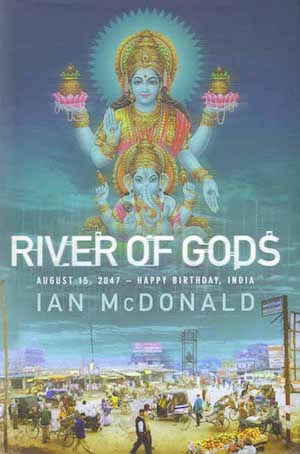
                • Cover of India 2047
                  India 2047

                  series · 9 books · 2004

                  similar byscience fiction+1 more

                  Set in an India a century after independence, this sequence follows the political and personal fallout of banned, illegally evolved artificial intelligences amid an India-Pakistan water war. River of Gods (2004) is the core novel; The Little Goddess and the linked stories collected in Cyberabad Days (2009) revisit the same Cyberabad setting from smaller, more intimate angles. Ian McDonald built it around near-future biotech, nanotech, and AI rather than a continuing cast of characters.