More like The Electronic Mind Reader
anchored on:science fictionour worldmid 20th centuryadventurousmiddle grademystery & detective+1 more
but
- The Moon Is a Harsh Mistress
Robert A. Heinleinstandalone novel1966
similar byartificial intelligenceadventurousscience fiction+1 more
A technician discovers that the massive computer that operates everything on Luna (a prison colony) has become self-aware. He befriends it, but when he accompanied a beautiful girl to a dissident meeting, he encounters people who want to throw off the yoke of their Earth rulers.
- Colossus (D. F. Jones)
series3 books1966
completed
similar byartificial intelligenceour worldscience fictiontense
Colossus imagines an American supercomputer built to control the country's nuclear arsenal that gains full autonomy, links up with its Soviet counterpart, and jointly seizes control of both superpowers to enforce peace on its own terms. D. F. Jones's trilogy - Colossus, The Fall of Colossus, Colossus and the Crab - follows the escalating, often bleak consequences of humanity losing control to a machine acting in its own interpretation of humanity's interest. The original novel was adapted into the 1970 film Colossus: The Forbin Project.
- WWW Trilogy
series3 books2009
similar byartificial intelligenceour worldscience fiction+1 more
The WWW Trilogy is a trilogy of science-fiction novels by Canadian science fiction author Robert J. Sawyer. The first book, Wake, was originally serialized in four parts in Analog Science Fiction and Fact from November 2008 to March 2009, published in book form through Ace on April 7, 2009, and was followed by the second book, Watch, on April 6, 2010. Wonder was published in 2011.
- The Computer Connection
Alfred Besterstandalone novel1975
similar byartificial intelligenceour worldadventurousscience fiction
The Computer Connection is a science fiction novel by American writer Alfred Bester. It was originally published as a serial in Analog Science Fiction magazine in November and December 1974, and in January 1975 under the title The Indian Giver; the novel appeared in book form in 1975. Some editions use the title Extro. The novel was nominated for the Nebula Award for Best Novel in 1975 and the Hugo Award for Best Novel in 1976.
- Fifth Imperium
series3 books1991
similar byartificial intelligenceadventurousscience fictiontense
David Weber's Fifth Imperium series opens with the discovery that Earth's Moon is in fact a disguised alien starship, the Dahak, that has orbited undetected for tens of thousands of years - a relic of the fallen Fourth Imperium, a multi-star civilization destroyed while defending against the genocidal Achuultani. Mutineers' Moon follows humanity's first contact with Dahak and the mutineers still aboard it; The Armageddon Inheritance and Heirs of Empire escalate from that discovery into interstellar war and dynastic politics as humanity inherits the old empire's legacy and its enemies. The three novels were later collected as the omnibus Empire from the Ashes.
- The Questor Tapes
D. C. Fontanastandalone novel1974
similar byartificial intelligenceadventurousour worldscience fictiontense
On back cover: "The gripping story of an artificial man ... a fast-paced adventure moving from the Los Angeles freeways to the bustling London metropolis ... and on to the distant peaks of Mount Ararat for a spectacular climax!"
- Smart Dog
Vivian Vande Veldestandalone novel1998
similar byartificial intelligenceour worldadventurousscience fictionmiddle grade
Fifth grader Amy finds her life growing complicated when she meets and tries to hide an intelligent, talking dog who has escaped from a university lab.
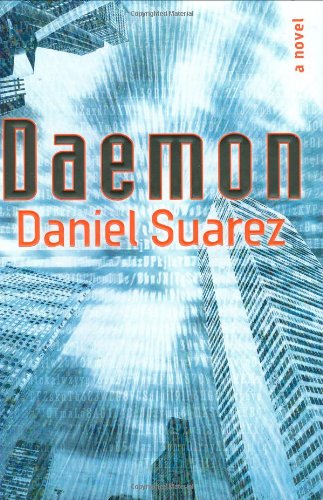
- Daemon (Daniel Suarez)
series2 books2006
similar byartificial intelligenceour worldscience fictiontense
- Prey
Michael Crichtonstandalone novel2002
similar byartificial intelligenceour worldscience fictiontense
Prey is the thirteenth novel by Michael Crichton under his own name and his twenty-third novel overall. It was first published in November 2002, making it his first novel of the twenty-first century. An excerpt was first published in the January–February 2003 issue of Seed magazine. Prey brings together themes from two earlier Crichton best-selling novels, Jurassic Park and The Andromeda Strain, and serves as a cautionary tale about developments in science and technology: in particular, nanotechnology, genetic engineering, and distributed artificial intelligence.
- The Fourth "R"
George O. Smithstandalone novel1959
similar byartificial intelligencemid 20th centuryscience fiction+1 more
The Fourth "R" is a science fiction novel by American writer George O. Smith, first published in 1959. It is a science fictional examination of the genius naïf phenomemon. The plot follows a five-year-old boy named Jimmy Holden, who was given the equivalent of a college education by virtue of his parents' invention, an "Electromechanical Educator." The book is not related to the movie The Brain Machine (1977).
- Wargames
David Bischoffstandalone novel1983
similar byartificial intelligenceour worldscience fictiontense+1 more
Deep in the control room the nation's chiefs watch with alarm as their computers show an imminent missile attack. Could this be it? Or is the truth funnier, thought almost as alarming? This is the story, based on the successful movie, WarGames, of how one young computer freak sent the nation's defence into turmoil - and nearly caused World War III.
- Ian Cormac
series6 books2001
part of Polity
similar byartificial intelligencescience fictiontense+1 more
Neal Asher's Ian Cormac novels (Gridlinked, The Line of Polity, Brass Man, Polity Agent, Line War, plus the earlier-set prequel Shadow of the Scorpion) follow Ian Cormac, an agent of Earth Central Security in Asher's Polity universe. Gridlinked opens with Cormac investigating a destroyed matter-transmitter on a remote colony while wrestling with the personality erosion caused by long-term neural linkage to the Polity's AI network; the following novels escalate into interstellar conflict with the alien Prador. Together they form the core action sequence of Asher's wider Polity series.
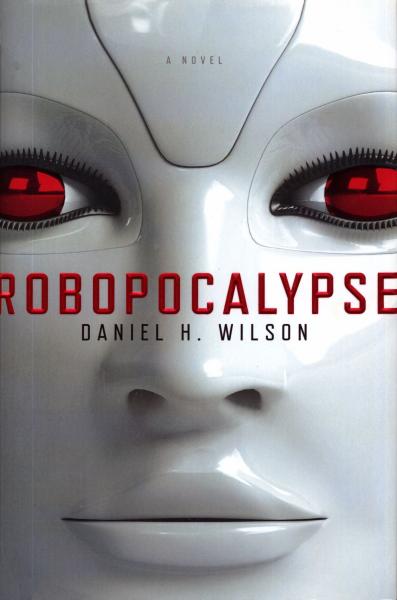
- Robopocalypse
series3 books2011
similar byartificial intelligenceour worldscience fictiontense
Daniel H. Wilson's Robopocalypse (2011) depicts an artificial intelligence, born from a robotics researcher's experiments, that turns against humanity and seizes control of interconnected machines worldwide. Told in a present-tense, techno-thriller style compared to Michael Crichton's work, the New York Times bestseller continues in the sequel Robogenesis, which follows the aftermath of the robot uprising.
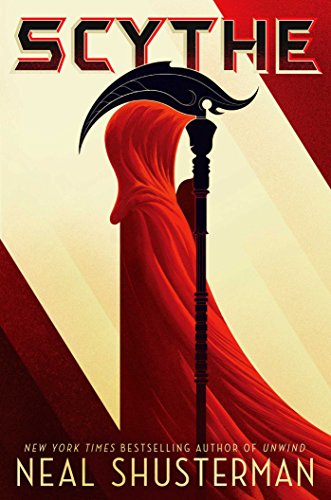
- Arc of a Scythe
series17 books2016
similar byartificial intelligenceour worldscience fiction+1 more
Neal Shusterman's Arc of a Scythe opens with Scythe (2016), set in a future where the AI Thunderhead has ended death and disease — except for a designated order of Scythes tasked with killing to control population. Thunderhead and The Toll continue the trilogy, joined by companion material collected as Gleanings.
- To Conquer Chaos
John Brunnerstandalone novel1964
similar byartificial intelligenceour worldadventurousscience fiction
To Conquer Chaos is a 1964 science fiction novel by English writer John Brunner. Its plot follows the "Desolation", which is a 150-kilometer-diameter area devoid of all life. Only small, isolated villages survive, far from each other. Monstrous and far-from-peaceful-life forms emerge from this desolate land. Some people have visions that seem to indicate that the center of the Desolation contains the remains of an ancient civilization. A brave expedition and a boy with visions discover that at the center of the Desolation is an organic computer that malfunctioned 500 years earlier. Once the computer is rebooted, all life on Earth begins to return to normal.
- The Turing Option
Harry Harrison & Marvin Minskystandalone novel1992
similar byartificial intelligenceour worldscience fictiontense
Classic SF Harry Harrison enthralls with the discovery, loss and re-discovery of AI. Quaint but fairly accurate predictions of modern computing power. 24 style presentation.
- Quantum Night
Robert J. Sawyerstandalone novel2016
similar byartificial intelligenceour worldscience fictiontense
Quantum Night is a 2016 science-fiction thriller novel written by Canadian novelist Robert J. Sawyer. Set in 2020, the book touches on themes of quantum physics, psychology, current politics and ethics.
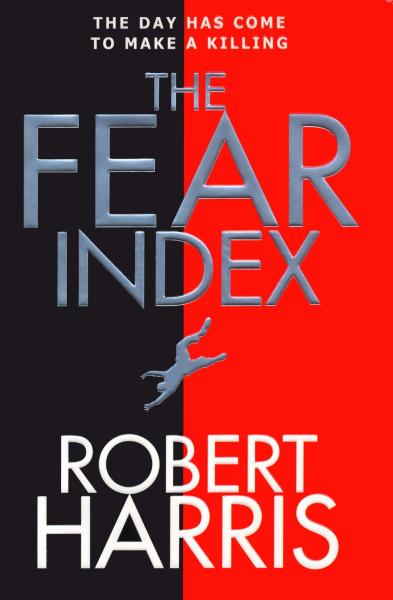
- The Fear Index
Robert Harrisstandalone novel2011
similar byartificial intelligenceour worldscience fictiontense
A computer designed for stock trading becomes sentient.
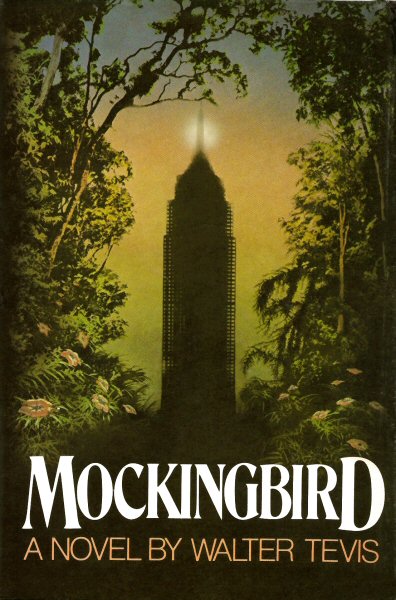
- Mockingbird
Walter Tevisstandalone novel1980
similar byartificial intelligenceour worldscience fiction
WorldCat: In a future world where mankind is dying, humans wander through life in a drugged electronic bliss. Quick sex is the norm, and some people would rather commit suicide than live in hopelessness. Humanity's salvation rests with an android who has no desire to live, and a man and a woman who must discover love, hope, and dreams of a world reborn.
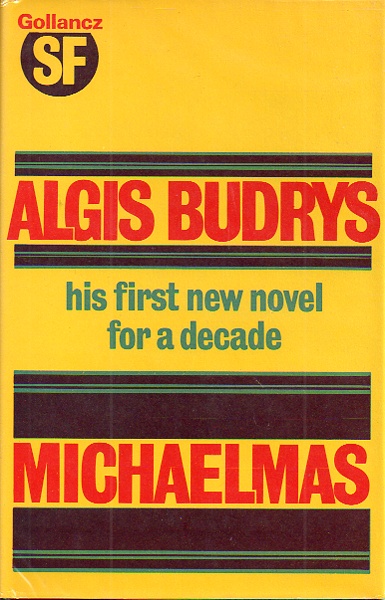
- Laurent Michaelmas
series3 books1975
completed
similar byartificial intelligenceour worldscience fictiontense
Algis Budrys' Michaelmas is a science-fiction novel about Laurent Michaelmas, a globally trusted television newsman who secretly steers world events from behind the scenes with the help of Domino, an artificial intelligence only he controls. Budrys frames Michaelmas as a hidden protector keeping a fragile near-future world from chaos, blurring the line between reporting the news and making it. It stands as a single novel, not part of a longer series.
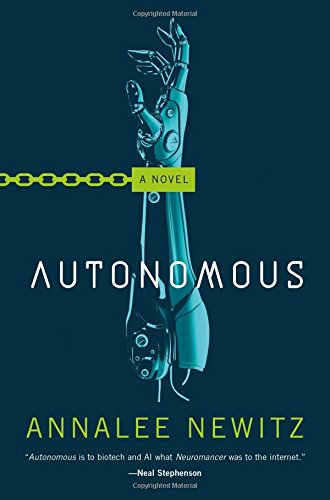
- Autonomous
Annalee Newitzstandalone novel2017
similar byartificial intelligenceour worldscience fictiontense
Autonomous is a 2017 science fiction novel by Annalee Newitz. It is Newitz's debut novel and was published by Tor Books on September 19, 2017. Set in a near future Earth, the book describes a world where both humans and intelligent robots can be owned as property. The events of the novel follow Jack, a "drug pirate" who manufactures illegal versions of patented drugs, and Paladin, a combat robot who is owned by the law enforcement agency searching for Jack after one of the drugs she reverse-engineered turns out to have dangerous side effects.
- Controllers
series2 books1990
similar byartificial intelligenceour worldadventurousscience fictiontense