More like Touching Ice
anchored on:science fiction
but
- Renegades (Marissa Meyer)
series3 books2017
similar byscience fictiontense+2 more
Renegades is set in Gatlon City after a civil war between the superheroic Renegades and the villainous Anarchists, and follows Nova, a young woman with the power to put people to sleep by touch, as she infiltrates the Renegades as a spy for her uncle's Anarchists and falls for Adrian, the adopted son of the Renegades' leaders. Marissa Meyer's trilogy, continuing through Archenemies and Supernova, plays the two factions' history against the leads' divided loyalties; Meyer has said she doesn't plan to extend the series further.
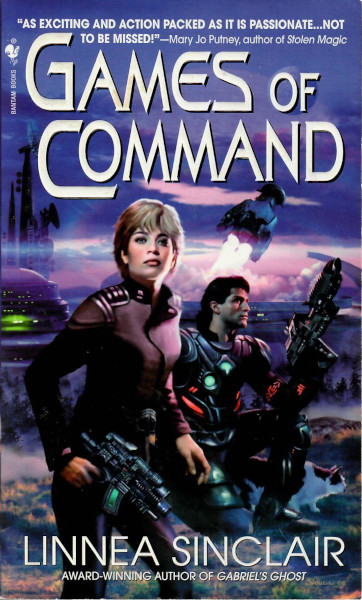
- Temporal Enforcement Universe
series8 books2004
similar bytensescience fictionparanormal romance+1 more
- Psy-Changelings
series38 books2006
similar byparanormal romance+4 more
Nalini Singh's long-running paranormal romance series imagines a future where the emotion-suppressing Psy, animal-shifting Changelings, and ordinary humans share an uneasy world. It opens with Slave to Sensation, pairing a Psy telepath and a Changeling leopard alpha as a string of murders pushes their two peoples toward war, while a slower arc across the books tracks the Psy's emotional-control system fraying. The series has grown across two decades into more than twenty novels plus spin-off novellas.
- The League
series15 books1994
similar byscience fiction+2 more
Sherrilyn Kenyon's The League opens with Born of Night, a science-fiction romance centered on an assassin protagonist, continuing across more than a dozen further 'Born of...' novels.
- The Ophelia Prophecy
Sharon Lynn Fisherstandalone novel2014
similar byenemies to loversscience fictiontense+1 more
Asha and Pax -- strangers and enemies -- find themselves stranded together on the border of the last human city, neither with a memory of how they got there. Asha is an archivist working to preserve humanity's most valuable resource -- information -- viewed as the only means of resurrecting their society. Pax is Manti, his Scarab ship a menacing presence in the skies over Sanctuary, keeping the last dregs of humanity in check. Neither of them is really what they seem, and what humanity believes about the Manti is a lie. With their hearts and fates on a collision course, they must unlock each other's secrets and forge a bond of trust before a rekindled conflict pushes their two races into repeating the mistakes of the past.
- Blade Runner Universe
series6 books1968
similar byscience fictionrobots+1 more
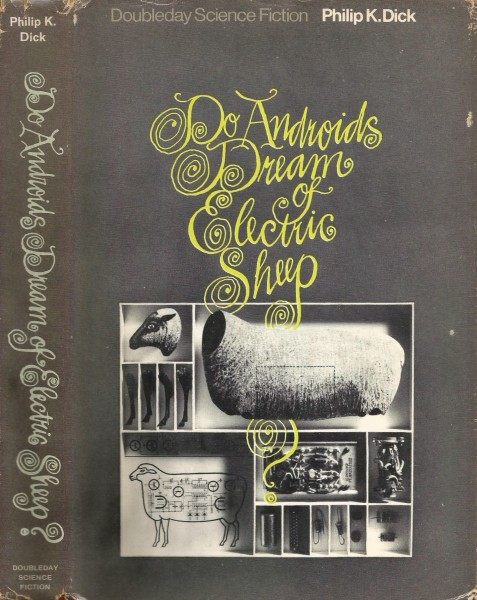
Philip K. Dick's 1968 novel Do Androids Dream of Electric Sheep? follows bounty hunter Rick Deckard as he tracks escaped androids through an irradiated, near-abandoned San Francisco, using the hunt to probe questions of empathy and what separates human from machine. The novel became the basis for Ridley Scott's 1982 film Blade Runner, and Marvel Comics later published an illustrated adaptation of that film. Together the two trace the story's path from prose original to screen and comic-page adaptation.
- Heavenbreaker
Sara Wolfstandalone novel2024
similar byscience fictiontense+1 more
The duke of the powerful House Hauteclare is the first to die. With my dagger in his back. He didn't see it coming. Didn't anticipate the bastard daughter who was supposed to die with her mother—on his order. He should have left us with the rest of the Station's starving, commoner rubbish. Now there's nothing left. Just icy-white rage and a need to make House Hauteclare pay. Every damn one of them. Even if it means riding Heavenbreaker—one of the few enormous machines left over from the War—and jousting against the fiercest nobles in the system. Each win means another one of my enemies dies. And here, in the cold terror of space, the machine and I move as one, intent on destroying each adversary—even if it's someone I care about. Even if it's someone I'm falling for. Only I'm not alone. Not anymore. Because there's something in the machine with me. Something horrifying. Something...more. And it won't be stopped.
- They Call Me Death
Missy Janestandalone novel2009
similar byscience fictiontense+2 more
"Humans are no longer at the top of the food chain... My name is Alexia Williams, and I'm nothing more than a human soldier trying to live one day at a time. After losing my family to shape-shifters, I joined the Combined Human States Army. Now I find myself on the front lines, defending the wall between my species and theirs. My mission is simple: keep the animals on their side by whatever means necessary, don't talk to them, don't sympathize with them, don't let them in. But then one of them saves my life. Andor isn't like any shifter I've ever met. He's a three-hundred-year-old golden eagle asking for help finding missing shifters who may be on my side of the wall. Now I'm helping the animals and seeing signs that my fellow humans aren't what I thought they were. Nothing is what it seems, but one fact remains...in the land of the shifters, they call me Death." — from this book's product page on Samhain's website as of 2016-11-08.
- Moties
series4 books1974
part of CoDominium
similar byscience fiction+1 more
Larry Niven and Jerry Pournelle's The Mote in God's Eye (1974) depicts humanity's first contact with an alien species, the Moties, set within the far-future interstellar setting of Pournelle's codominium future history. The Gripping Hand continues that first-contact crisis years later, and Outies, written by J. R. Pournelle, carries the story forward into a new generation. Together the three books trace an escalating encounter between human and Motie civilizations within the codominium universe.
- Dune Universe
universe78 books1963
Start hereDune · Start here
similar byscience fiction+1 more
Arrakis. Dune. The desert planet, where empire runs on a single substance: the spice melange, which folds space, prolongs life, and unlocks prescience, and which exists nowhere else in the known universe. Frank Herbert's saga is a meditation dressed as an adventure — feudal houses and a secret sisterhood, engineered messiahs and the patient ecology of a world without water, all turning on the terrible gravity of who commands the spice. It reads like scripture and schemes like a war room, ten thousand years hence, among people who have outlawed the thinking machine and made instruments of themselves instead. At its heart stand Herbert's original six — Dune, Dune Messiah, Children of Dune, God Emperor of Dune, Heretics of Dune, Chapterhouse: Dune — a single deepening arc across millennia, arguing the whole way between prophecy and free will. Around that spine his son Brian Herbert and Kevin J. Anderson have raised a vast prequel architecture: Prelude to Dune, tracing the great houses a generation before Paul; Legends of Dune, reaching back to the crusade that broke the machines; the Schools of Dune cycle on the founding of Bene Gesserit, Mentat, and Navigator; the Caladan Trilogy and Heroes of Dune filling years the originals left in shadow. Many hands, dozens of volumes, one desert. What sets Dune apart is its refusal of the simple: religion is manufactured, heroes are hazards, and the sand itself — worm, water, ecology — acts as a political power. Begin where the universe did, with Frank Herbert's Dune (1965), and read the original six in order; you need nothing else to feel the full weight. The prequels are a country to explore afterward, taken by era. Beginnings are delicate times.
- Dune
series20 books1963
part of Dune Universe
similar byscience fiction+1 more
Frank Herbert's Dune Chronicles opens with 1965's Dune, set on the desert planet Arrakis where House Atreides takes control of the only source of the vital spice melange and young Paul Atreides is pulled into a struggle over its politics and religion. Herbert carried the story forward across five further novels — Dune Messiah, Children of Dune, God Emperor of Dune, Heretics of Dune, and Chapterhouse: Dune — following Paul's line over the following millennia, before Brian Herbert and Kevin J. Anderson later extended the saga. Many other editions of these six novels are omnibus and box-set repackagings rather than separate stories.
- The Invisible Man
series6 books1897
similar byscience fiction+1 more
The Invisible Man is H. G. Wells's 1897 science fiction novel about Griffin, a scientist who works out how to make living tissue invisible and tests the process on himself, only to discover he has no way to reverse it. Unseen and increasingly cut off from other people, he turns to theft and violence while trying to survive and find a cure, making the book as much about his moral collapse as about the invisibility premise itself. It's a single self-contained novel; the two listed titles here are duplicate editions rather than separate books.
- The Eyes of Heisenberg
Frank Herbertstandalone novel1966
similar byscience fictiontense+1 more
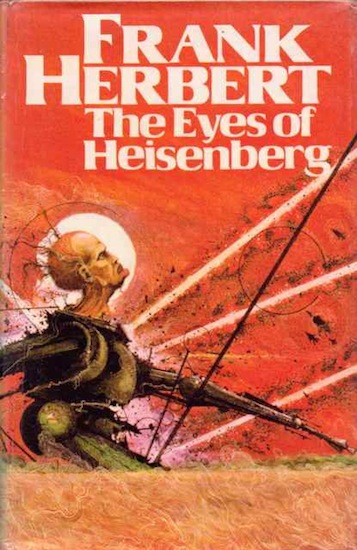
Tens of thousands of years in the future, Earth is ruled by the Optimen, a genetically engineered aristocracy that has made itself functionally immortal, while ordinary people, the Folk, live under strict reproductive control. When Harvey and Lizbeth Durant arrive to have their embryo genetically screened, the examining doctor finds something in the child no one has seen in a very long time: real potential for both fertility and life span, traits the Optimen have arrogated to themselves. Rather than destroy the embryo as policy demands, the doctor hesitates, setting off a chain of surveillance, suspicion and resistance. A tightly wound Frank Herbert thriller about genetic caste and rebellion.
- Forge of God
series2 books1987
completed
similar byscience fictiontense+1 more
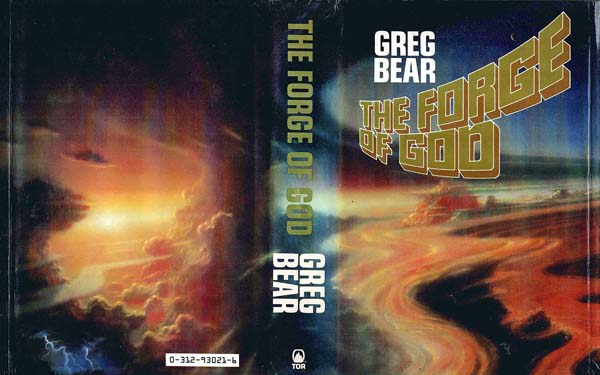
The Forge of God (1987) is Greg Bear's science fiction novel about Earth's discovery that it is the target of an incomprehensible, overwhelming alien attack, following scientists and ordinary people as they try to understand what is destroying the planet. Its 1992 sequel, Anvil of Stars, follows a group of young survivors sent on a mission of interstellar retaliation, continuing directly from the first book's ending.
- H. G. Wells' War of the Worlds
universe65 books1898
Start hereThe War of the Worlds · Start here
similar byscience fiction+1 more
No one would have believed, in the closing years of the nineteenth century, that human affairs were being watched keenly and closely from the timeless worlds of space. And then the cylinders fell. H. G. Wells' War of the Worlds opens in the quiet of the Surrey commons, where a falling star proves to be the first Martian craft — and from the pit rise the towering tripods, the Heat-Ray, the choking Black Smoke and the creeping red weed, wielded by minds that regard mankind much as we regard the creatures we boil for supper. This is invasion rendered as natural disaster: cold, methodical, and vast beyond argument. Wells' 1898 novel is the seed; everything else grows from that Martian soil. The catalogue gathers direct sequels and continuations alongside a wide field of other hands. In War of the Worlds: Global Dispatches the invasion is retold across the whole planet through the eyes of Twain, Verne, Tolstoy, Lowell and Kipling; in the Manly Wade and Wade Wellman crossover, Sherlock Holmes, Watson and Professor Challenger take the field against the machines; and Scott Washburn's Great Martian War stretches the fighting into a decades-long alternate history of steam, artillery and grinding attrition. It is a loose shared world — no single decreed sequence, many voices answering one calamity. What sets this world apart is its refusal of heroics: the invaders fall not to generals but to the smallest things of Earth, humbling and indifferent. Begin, always, with Wells' original novel — it is short, and it is the ground every later book stands upon. From there follow your appetite: Global Dispatches for the panorama, the Holmes campaign for adventure, Washburn for the long war.