More like Zero
anchored on:science fiction
but
- Riverworld
series37 books1965
similar byscience fiction
The Riverworld series consists of five science fiction novels (1971–1983) by American author Philip José Farmer (1918–2009). The Riverworld is an artificial, or heavily terraformed, planet where all humans who ever lived throughout history have been resurrected. The novels explore interactions of resurrected individuals from many different cultures and time periods. The underlying theme is quasi-religious. The motivations and ethics of the unknown intelligences that created the Riverworld and its inhabitants are explored.
- Barsoom
series53 books1917
similar byscience fiction
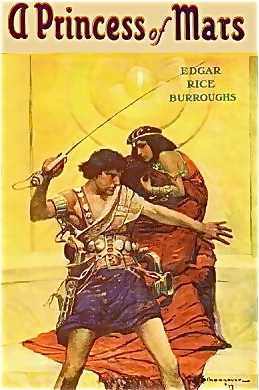
Barsoom is a fictional representation of the planet Mars created by American pulp fiction author Edgar Rice Burroughs. The first Barsoom tale was serialized as Under the Moons of Mars in pulp magazine The All-Story from February to July 1912 and published compiled as a novel as A Princess of Mars in 1917. It features John Carter, a late-19th-century American Confederate veteran who is mysteriously transported from Earth to the dying world of Mars where he meets and romances the beautiful Martian princess Dejah Thoris. Ten sequels followed over the next three decades, further extending his vision of Barsoom and adding other characters.
- Flatland
series2 books1884
similar byscience fiction
Edwin A. Abbott's 1884 novella Flatland: A Romance of Many Dimensions imagines a two-dimensional world of geometric beings, using its narrator's brush with higher dimensions as both a mathematical thought experiment and a satire of Victorian social rank. Ian Stewart's 2001 Flatterland follows a descendant of that narrator on a tour of stranger geometries, from curved and multidimensional space to relativity, as a knowing homage to Abbott's original. Together they pair a Victorian mathematical classic with its modern sequel.
- Alliance-Union Universe
universe173 books1976
Start hereCompany Wars · The central sequence
similar byscience fiction
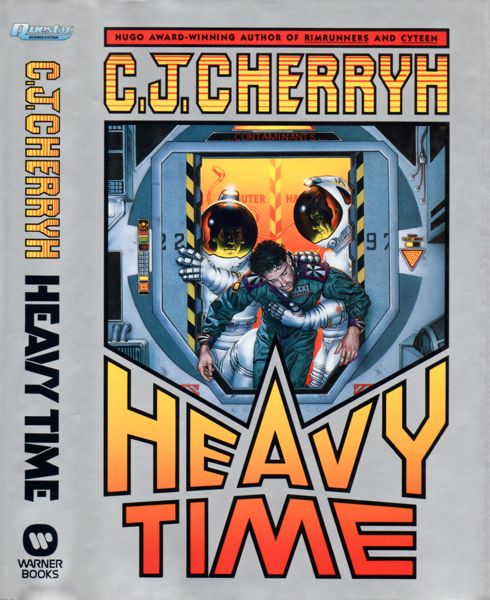
The dark between the stars belongs to no one, and everyone who lives out here knows it: the merchanter Families hauling cargo between stations that cannot feed themselves, the Earth Company clutching at colonies it can no longer supply, the Union breeding its cloned azi to settle worlds faster than birth allows. C. J. Cherryh's Alliance-Union is a future history of humankind's spread across the third and fourth millennia, told from inside the pressure — no clean empires, only stations, ships, treaties, and the people caught in the machinery of who holds the jump-points. The sequence runs from the first laborious pre-FTL stations through the Company Wars, the independence struggle that breaks over Pell in Downbelow Station (Hugo, 1981), to the genetics and cold politics of Union's homeworld in Cyteen (Hugo, 1988) and its sequel Regenesis. Around that spine cluster the merchanter novels of trader Families, the Faded Sun trilogy of human envoys among the martial alien Mri, and the Chanur books, narrated from the hierarchical, whiskered viewpoint of the hani. On the isolated world of Merovin, the Merovingen Nights anthologies open the setting to other hands — Mercedes Lackey, Janet and Chris Morris, Nancy Asire — a shared world braided into the whole. What sets it apart is intimacy at scale. Cherryh drops you without a map into a single skull and lets you assemble the politics from what that person fears and bargains for; the aliens are genuinely alien, loyalty is always provisional, and the real antagonist is usually logistics. Most books stand alone, in her words, "like real history." The surest way in is Downbelow Station — the war seen from one besieged station — then Cyteen, for the mind that shaped the other side.
- Change War
series16 books1958
completed
similar byscience fiction
The Big Time is Fritz Leiber's Hugo Award-winning novel set in his Change War future history, where two rival powers called the Spiders and the Snakes recruit soldiers out of history to fight by altering past events, with the novel itself confined to a neutral recovery station suspended outside normal time. Leiber followed it with a string of shorter Change War stories, later gathered into collections such as Changewar, exploring other soldiers and other flashpoints in the same endless, mutable conflict.
- Restoree
Anne McCaffreystandalone novel1967
similar byscience fiction
Torn from Earth by a bizarre and nameless black force, Sara has no idea where she is or why she inhabits a beautiful new body. Controlled by brutal guards and tamed by terror, she can not comprehend her role as a nurse for a man who appears to be an idiot. She discovers that the planet she had been brought to was Lothar and that the man she was caring for was its Regent, Sara knows the restorees had to escape. When they do, they become fugitives on a world of multiple evils. (adapted from the back cover of the Baen edition)
- Kairos
series11 books1962
completed
similar byscience fiction
The Time Quintet is a science fantasy series of five young adult novels written by American author Madeleine L'Engle and made up of A Wrinkle in Time (1962), A Wind in the Door (1973), A Swiftly Tilting Planet (1978), Many Waters (1986), and An Acceptable Time (1989).
- Culture
series15 books1987
completed
part of The Culture
similar byscience fiction
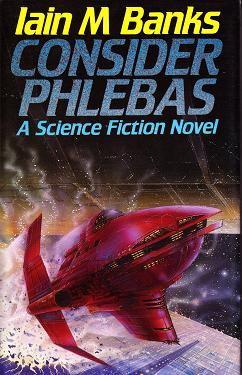
The Culture series is a science fiction series written by Scottish author Iain M. Banks and released from 1987 until 2012. The stories centre on The Culture, a utopian, post-scarcity space society of humanoid aliens and advanced superintelligent artificial intelligences living in artificial habitats spread across the Milky Way galaxy. The main themes of the series are the dilemmas that an idealistic, more-advanced civilization faces in dealing with smaller, less-advanced civilizations that do not share its ideals, and whose behaviour it sometimes finds barbaric. In some of the stories, action takes place mainly in non-Culture environments, and the leading characters are often on the fringes of the Culture, sometimes acting as agents of the Culture in its plans to civilize the galaxy. Each novel is a self-contained story with new characters, although reference is occasionally made to the events of previous novels.
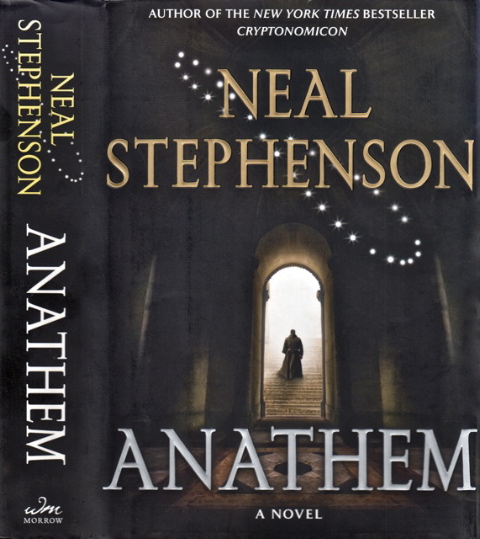
- Anathem
Neal Stephensonstandalone novel2008
similar byscience fiction
On a planet where quasi-monastic academic institutions have existed alongside the secular world for thousands of years, a young scholar from one such institution becomes part of a planetwide effort to muster an appropriate reaction to a shocking discovery.
- The World of Tiers
series9 books1965
similar byscience fiction
The World of Tiers is a series of science fiction novels by American writer Philip José Farmer. They are set within a series of artificially constructed universes, created and ruled by decadent beings who are genetically identical to humans, but regard themselves as superior, and are the inheritors of an advanced technology they no longer understand. This technology enables the "Lords" to create novel lifeforms, and also to prevent aging or disease, making them effectively immortal. Their technology also allows them to create small artificial universes, and the planets and stars within them, and modify the physical laws to create unusual or interesting phenomena within these universes. Instantaneous travel within and between these universes is achieved by the use of "gates" which seem to function as teleportation devices, or as a means of creating wormholes between different regions of spacetime.
- Kesh / Always Coming Home
series10 books1984
similar byscience fiction
Ursula K. Le Guin's Always Coming Home imagines the Kesh, a society living in California's Napa Valley long after an unspecified societal collapse, presented not as a conventional novel but as a found archive of Kesh stories, poems, glossaries and 'anthropological' material assembled by a fictional visiting scholar-narrator. The book was originally released with a companion cassette, Music and Poetry of the Kesh, featuring original compositions by Todd Barton for instruments and songs described in the text. It's one of Le Guin's most formally experimental works, closer to an invented ethnography than a traditional science-fiction narrative.
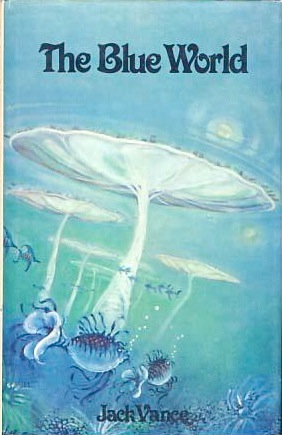
- The Blue World
Jack Vancestandalone novel1966
similar byscience fiction
The Blue World is a science fiction adventure novel by American writer Jack Vance. The novel is based on Vance's earlier novella The Kragen, which appeared in the July 1964 edition of Fantastic.
- Inverted World
Christopher Prieststandalone novel1974
similar byscience fiction
A city travels slowly along tracks laid by the residents ahead of the city and pulled up from behind the city, through territory where other people live.
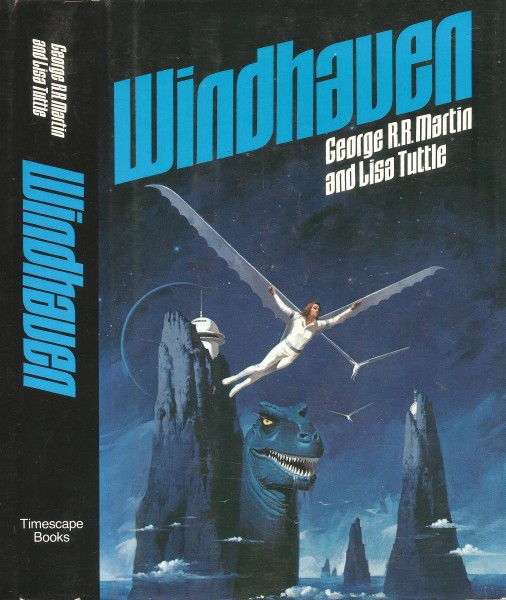
- Windhaven
series4 books1975
similar byscience fiction
George R.R. Martin and Lisa Tuttle's Windhaven is set on a storm-wracked ocean world settled by shipwrecked colonists, whose descendants have adapted lightweight metal wings salvaged from their crashed ship into gliders used by a hereditary caste of flyers who carry messages and news between isolated island communities. The novel follows a commoner who fights to win a set of wings for herself against a tradition that says they should only pass down through flyer bloodlines. It was assembled as a fix-up from three novellas the authors wrote together across the 1970s.
- Dream Archipelago
series16 books1976
completed
similar byscience fiction
Christopher Priest's Dream Archipelago stories return again and again to a vast chain of islands stretched across a world locked in permanent, distant war between two continental powers, without ever quite settling whether the archipelago is a real place or something closer to collective dream or fiction within the fiction. Novels like The Affirmation and The Islanders, along with numerous short stories, revisit the setting from different, often contradictory angles rather than building one continuous narrative. The ambiguity between what's real and what's invented is treated as the point, not a gap to be resolved.
- The Lost Regiment
series9 books1990
similar byscience fiction
William R. Forstchen's Lost Regiment series begins with Rally Cry, in which a Civil War Union regiment is swept onto a distant world where humans transplanted from many eras and cultures are farmed as food by an alien race. Arriving with nineteenth-century gunpowder weapons and organized tactics, the regiment's survivors fight to build a defensible nation and turn the war back on their captors, a conflict that escalates across nine novels of technology, politics, and generations.
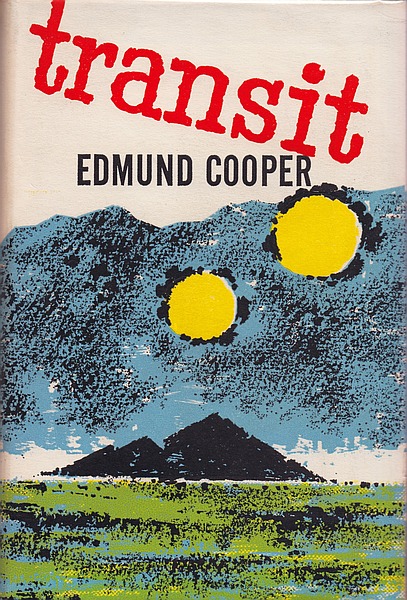
- Transit
Edmund Cooperstandalone novel1964
similar byscience fiction
Transit... to another world. As a human being - an Earthman - Richard Avery was not particularly successful. He was mediocre as a teacher, and a failure as an artist. The rewards of Earth had passed him by. Still... Earth was home. It was where he belonged, where he could at least go his way unnoticed. Until that afternoon in Kensington Gardens, and that gleaming, hypnotic crystal that transported him - instantaneously - to a new and alien world. He was not alone, at least. There were three other Earth people marooned with him, all without a hint of the location or reason. And four more oddly assorted individuals would have been hard to imagine... Together, they faced sudden, savage onslaughts from an unknown foe. Together, they faced a fantastic implacable environment. And alone, they faced themselves - for to win, or even to survive, they had to re-discover what it meant to be human... (from the back cover of the Lancer first American edition)
- Paratime Police
series33 books1948
similar byscience fiction
The Paratime series written by H. Beam Piper and subsequently by John F. Carr consists of several short stories, one novella, and one novel, all but one of which were originally published in Astounding Science Fiction under the editorship of John W. Campbell. The series deals with an advanced civilization that is able to travel between parallel universes with alternate histories, and uses that ability to trade for goods and services that its own, exhausted Earth cannot provide. The protagonists of the stories are the Paratime Police, the organization that protects the secret of paratime travel.
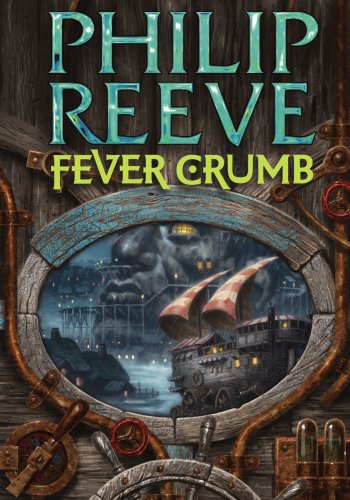
- Mortal Engines Prequels
series3 books2009
part of Mortal Engines Universe
similar byscience fiction
The Fever Crumb series is the title of a series of novels written by British author, Philip Reeve, and is the prequel series to his Mortal Engines Quartet. The series consists of three books: Fever Crumb (2009), A Web of Air (2010), and Scrivener's Moon (2011). The books follow a young woman known as Fever Crumb, and her adventures set around the time of the creation of the first traction cities that become prevalent in the Mortal Engines series. While Reeve stated in 2011 that he had always envisaged a quartet for the series, assuring readers of a fourth installment, by 2020 he said that "too much time has passed", making it difficult to revisit the series, and that he did not intend to finish and publish a fourth book.
- Sime/Gen
series40 books1969
similar byscience fiction
House of Zeor opens the Sime~Gen series, a universe split between Sime, who must periodically drain life-energy from others or die in agony, and Gen, who produce and can safely give that energy. The founding novels follow a Sime channel working to build peaceful exchange between the two populations instead of the raids and killing that mark their shared history. Jacqueline Lichtenberg wrote the founding books, later joined by co-authors including Jean Lorrah across a long-running, multi-decade series.