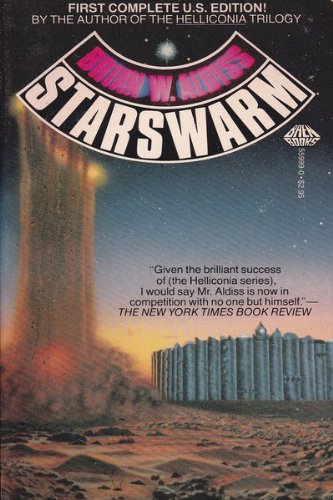
Adapted from Joseph Milicia's Introduction to the Gregg Press edition: As everyone knows, it is customary for writers to gather previously published stories into books, in pursuit of larger artistic schemes or simply of larger sales... The most memorable volumes as volumes are usually novel-like in some way, as when the stories have a continuing cast of characters in a more or less chronological sequence... or at least a common setting (in science fiction, Ray Bradbury's The Martian Chronicles, 1950...). Somewhat more unusual are volumes with connecting passages: new material to give a framework to the original tales, at best creating an organic whole, at worst gluing the tales together like an album of photographs with captions... In SF, probably the best known volume is Clifford D. Simak's City (1952), in which the links purport to be scholarly analyses of a collection of "ancient tales... Brian Aldiss early in his career produced two volumes of stories with frameworks — they were called "chronicle-novels" by his publisher, Signet. Aldiss comments on the first: "I was ambitious early in my career, and soon began to compose stories which would fit roughly into a millennia-long plan for the future, to create a giant perspective. The result ran to about 110,000 words, which my British and American publishers (Faber and Signet) then regarded as far too long for an SF book. It contained about fourteen stories embodied in connecting narrative. Signet loved the connecting narrative and asked to drop some stories; Faber preferred the stories. So the two hooks [The Canopy of Time, Faber, 1959, and Galaxies Like Grains of Sand, Signet, 1960; Gregg Press, 1977] resulted. I always liked Galaxies Like Grains of Sand the better, believing that the narrative strengthened the stories." Starswarm, on the other hand, originally "was just a collection of tales," and published as such by Faber as The Airs of Earth: "Signet, however, thought the title unadventurous and wanted me to try what they called another "chronicle-novel", to follow up the success of Galaxies Like Grains of Sand. Well, I saw the attractions and was modestly pleased with the results; but here was the case of commercial considerations dictating the shape of the volume.... I altered bits of the stories to fit their procrustian bed." All the same, despite its commercial origin, the Starswarm framework, like that of Galaxies Like Grains of Sand, is of some interest in itself; and while the volume as a whole may be less organically conceived than Galaxies Like Grains of Sand, it is a much finer collection of stories."
Source · ISFDB CC BY 4.0
Contents
- 1Sector Vermilionshort story
- 2A Kind of Artistrynovelette
- 3Sector Grayshort story
- 4Hearts and Enginesshort story
- 5Sector Violetshort story
- 6The Underprivilegedshort story
- 7Sector Diamondshort story
- 8Segregationnovelette
- 9Sector Greenshort story
- 10Shardsshort story
- 11Sector Yellowshort story
- 12Legends of Smith's Burstnovelette
- 13Sector Azureshort story
- 14O Moon of My Delight!novelette
- 15Sector Mauveshort story
- 16Intangibles, Inc.novelette
- 17The Riftshort story
- 18Old Hundredthshort story