More like Calintane Explains
anchored on:science fantasyother star systemsfar futurepolitical intriguereflective
but
- Dune
series20 books1963
part of Dune Universe
similar bypolitical intriguefar futureother star systems+1 more
Frank Herbert's Dune Chronicles opens with 1965's Dune, set on the desert planet Arrakis where House Atreides takes control of the only source of the vital spice melange and young Paul Atreides is pulled into a struggle over its politics and religion. Herbert carried the story forward across five further novels — Dune Messiah, Children of Dune, God Emperor of Dune, Heretics of Dune, and Chapterhouse: Dune — following Paul's line over the following millennia, before Brian Herbert and Kevin J. Anderson later extended the saga. Many other editions of these six novels are omnibus and box-set repackagings rather than separate stories.
- Triton
Samuel R. Delanystandalone novel1976
similar bypolitical intriguereflectiveother star systemsfar future
Trouble on Triton: An Ambiguous Heterotopia (1976) is a science fiction novel by American writer Samuel R. Delany. It was nominated for the 1976 Nebula Award for Best Novel, and was shortlisted for a retrospective James Tiptree, Jr. Award in 1995. It was originally published under the shorter title Triton.
- The Languages of Pao
Jack Vancestandalone novel1958
similar bypolitical intriguereflectiveother star systemsfar future
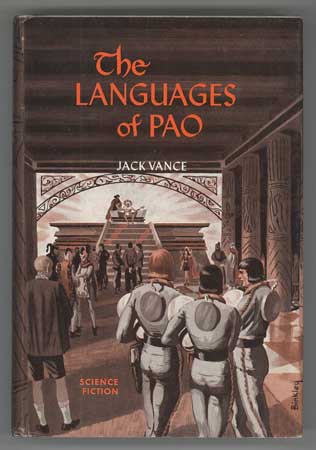
The Languages of Pao is a science fiction novel by American writer Jack Vance, first published in 1958, based on the Sapir–Whorf hypothesis, which asserts that a language's structure and grammar construct the perception and consciousness of its speakers. In the novel, the placid people from the planet Pao rely on other planets for technological innovations and manufactured goods and they do not resist when an invading force occupies the land and levies heavy taxes. To expel the aggressors and make the planet more independent, three new languages are introduced. A scientific language induces its speakers to innovate more; a well-ordered language encourages its speakers to be industrious; and a warlike language induces competitiveness and aggression. The new languages change the culture and Pao ousts their overlords and develops a sophisticated modern economy.
- Teixcalaan
series2 books2019
similar bypolitical intriguereflectiveother star systemsfar future
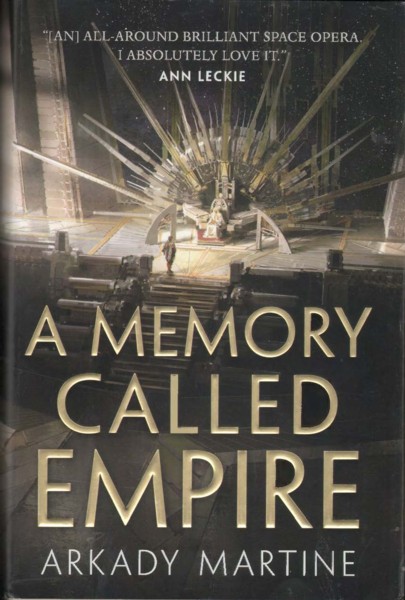
Arkady Martine's space opera duology follows Mahit Dzmare, ambassador from the small, independent Lsel Station, as she arrives in the vast Teixcalaanli Empire to investigate her predecessor's death and finds herself caught up in the empire's own succession crisis. A Memory Called Empire and A Desolation Called Peace pair court intrigue with Mahit's conflicted, outsider fascination with an empire she can't help admiring.
- Dune Universe
universe78 books1963
Start hereDune · Start here
similar bypolitical intriguefar futureother star systems
Arrakis. Dune. The desert planet, where empire runs on a single substance: the spice melange, which folds space, prolongs life, and unlocks prescience, and which exists nowhere else in the known universe. Frank Herbert's saga is a meditation dressed as an adventure — feudal houses and a secret sisterhood, engineered messiahs and the patient ecology of a world without water, all turning on the terrible gravity of who commands the spice. It reads like scripture and schemes like a war room, ten thousand years hence, among people who have outlawed the thinking machine and made instruments of themselves instead. At its heart stand Herbert's original six — Dune, Dune Messiah, Children of Dune, God Emperor of Dune, Heretics of Dune, Chapterhouse: Dune — a single deepening arc across millennia, arguing the whole way between prophecy and free will. Around that spine his son Brian Herbert and Kevin J. Anderson have raised a vast prequel architecture: Prelude to Dune, tracing the great houses a generation before Paul; Legends of Dune, reaching back to the crusade that broke the machines; the Schools of Dune cycle on the founding of Bene Gesserit, Mentat, and Navigator; the Caladan Trilogy and Heroes of Dune filling years the originals left in shadow. Many hands, dozens of volumes, one desert. What sets Dune apart is its refusal of the simple: religion is manufactured, heroes are hazards, and the sand itself — worm, water, ecology — acts as a political power. Begin where the universe did, with Frank Herbert's Dune (1965), and read the original six in order; you need nothing else to feel the full weight. The prequels are a country to explore afterward, taken by era. Beginnings are delicate times.
- 2312
Kim Stanley Robinsonstandalone novel2012
similar byreflectivefar futureother star systems+1 more
In the eponymous year, when Earth's ecology is degraded and humanity has settled throughout the solar system by terraforming and genetic engineering, mysterious disasters strike some human communities and an assortment of human types from throughout the system seek to find and eliminate the cause.
- Hainish
series33 books1964
completed
similar byreflectivefar futureother star systems+1 more
The Hainish Cycle consists of a number of science fiction novels and stories by Ursula K. Le Guin. The cycle is set in a future history that features civilizations of human beings on planets orbiting a number of nearby stars, including Terra ("Earth"); these humans are contacting each other for the first time and establishing diplomatic relations, as well as setting up a confederacy under the guidance of the oldest of the human worlds, the peaceful planet Hain. In this history, human beings did not evolve on Earth, but they were instead the result of interstellar colonies planted by Hain in the distant past, after which interstellar travel ceased for an extended period. Some of the human races have new genetic traits, a result of ancient Hainish experiments in genetic engineering; this includes people who can dream while awake, and a world of hermaphroditic people who only enter active sexuality once per month, not knowing which sex will manifest in them. In keeping with Le Guin's narrative approach, she uses varied social and environmental settings to explore the anthropological and sociological outcomes of human evolution in those environments. The author often discounted the characterization of a so-called "Hainish Cycle".
- The Locked Tomb
series6 books2019
similar byscience fantasyother star systemsfar future+1 more
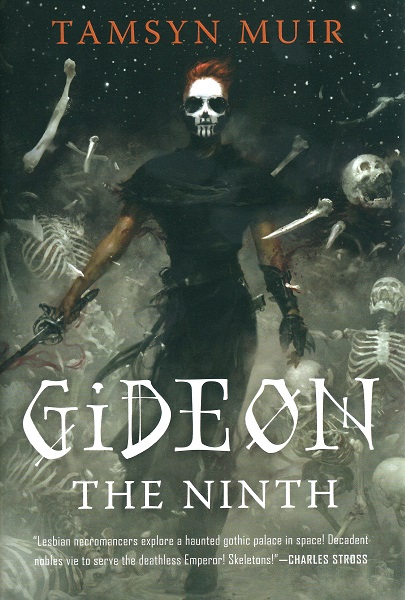
Tamsyn Muir's Gideon the Ninth follows Gideon Nav, an indentured swordswoman raised among nuns and skeletons in the Ninth House, who is drafted into a deadly imperial trial by Harrowhark, the necromancer she can't stand. Competing against heirs from the Emperor's other necromantic Houses, the two must survive a decaying, secret-filled fortress where old powers are best left undisturbed. Harrow the Ninth and Nona the Ninth continue the Locked Tomb series.
- The Dosadi Experiment
Frank Herbertstandalone novel1977
similar bypolitical intrigueother star systemsfar future
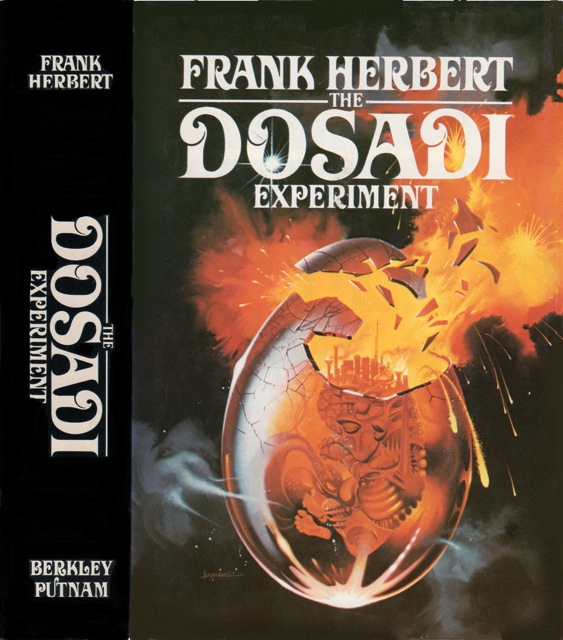
From the flaps of the Berkley Putnam first edition: "In his first new work of science fiction since the best-selling Children of Dune, Frank Herbert returns to his world of Whipping Star, and involves Jorj X. McKie, Saboteur Extraordinary, in a new intrigue. In Whipping Star, McKie discovered that some of the stars in the universe are actually intelligent, super-powerful beings, and was able to befriend one of them, the star Alcyone - affectionately known as Fannie Mae. As The Dosadi Experiment opens, McKie is assigned to investigate the planet Dosadi, which is isolated from the rest of the galaxy by a "god-wall," a barrier set up by one of the intelligent stars. Dosadi is rumored to be an experimental planet, and the experimenters are the froglike Gowachin, whose culture is founded upon a strange legal system in which McKie is the only human ever trained. He learns that humans and Gowachin have been placed on Dosadi, without their consent, for an experiment that could last centuries: an experiment in extreme overcrowding. But this monstrous plot is apparently out of control, and it seems the Gowachin may be prepared to destroy Dosadi rather than expose its secret, thus breaking the peace among the races, and starting the first interstellar war. But this is just the beginning. When McKie finally reaches Dosadi he discovers that the Dosadis have taken control of their own evolution and produced a competitive, highly evolved elite, of both humans and Gowachin, who have been able to extrapolate the existence of a universe beyond the god-wall and hate whoever has imprisoned them like this. They plan to break out and avenge themselves on the galaxy."
- Imperial Radch
series7 books2012
part of Radchaai Universe
similar byfar futureother star systems+2 more
Ann Leckie's Imperial Radch trilogy (Ancillary Justice, Ancillary Sword, Ancillary Mercy, 2013-2015) follows Breq, the sole surviving fragment of an AI that once inhabited both a troop-transport starship and dozens of soldier bodies, now alone and hunting for revenge inside the vast, expansionist Radch empire. Breq's quest widens across the trilogy into a conflict with the empire's own fractured ruler, and the books use her alien difficulty perceiving gender to unsettle the space-opera conventions around her.
- The City and the Stars
Arthur C. Clarkestandalone novel1956
similar byreflectiveother star systemsfar future
The City and the Stars is a science fiction novel by British writer Arthur C. Clarke, published in 1956. This novel is a complete rewrite of Clarke's earlier Against the Fall of Night, his first novel, which had been published in Startling Stories magazine in 1948 after being rejected by the editor of Astounding Science-Fiction, according to the author.
- Beyond This Horizon
Robert A. Heinleinstandalone novel1948
similar byreflectivefar future+1 more
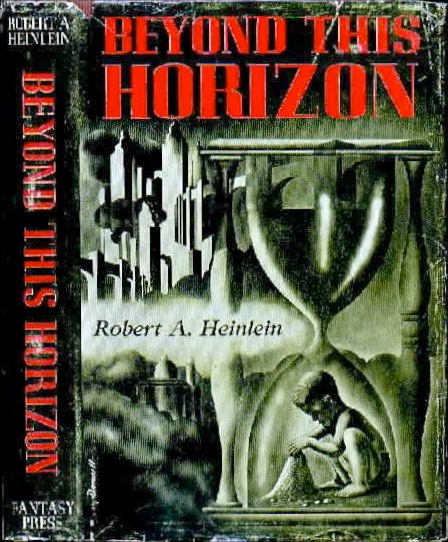
From the front flap of a 2001 Baen reprint: "Utopia has been achieved. For centuries, disease, hunger, poverty, and war have been things found only in the history tapes. And applied genetics has given men and women the bodies of athletes and a lifespan of over a century. They should all have been very happy... But Hamilton Felix is bored. And he is the culmination of a star line, each of his last thirty ancestors chosen for superior genes. Hamilton is, as far as genetics can produce one, the ultimate man. And this ultimate man can see no reason why the human race should survive, and has no intention of continuing the pointless comedy. However, Hamilton's life is about to become less boring. A secret cabal of revolutionaries who find utopia not just boring, but desperately in need of leaders who know just What Needs to be Done, are planning to revolt and put themselves in charge. Knowing of Hamilton's disenchantment with the modern world, they have recruited him to join their Glorious Revolution. Big mistake! The revolutionaries are about to find out that recruiting a superman was definitely not a good idea..."
- Janissaries
series4 books1979
similar bypolitical intrigueother star systemsfar future
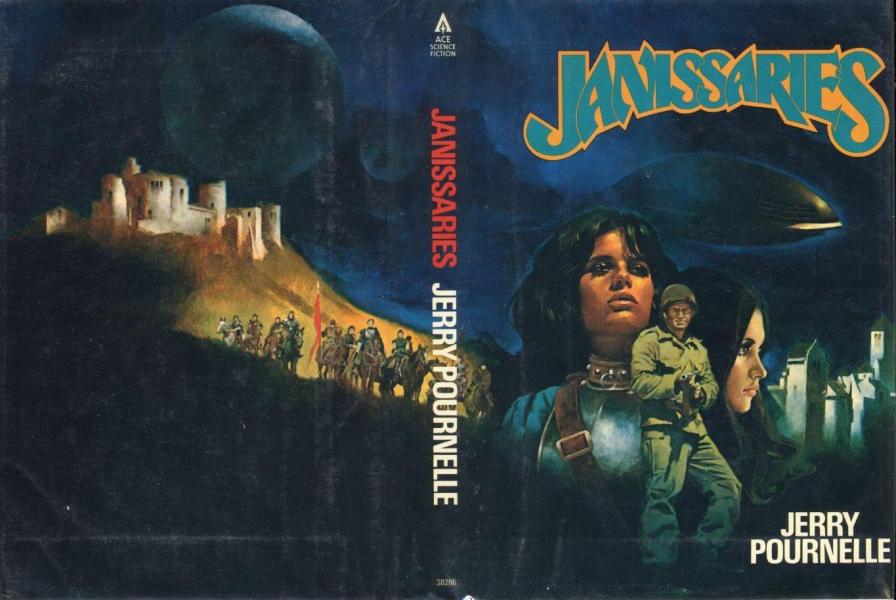
Janissaries are an American series of military and political-based science fiction novels are set in an interstellar confederation of races, in which humans are a slave race entrusted with military affairs and law enforcement. They were written by Jerry Pournelle, with Roland J. Green co-authoring the second two books.
- Imperial Earth
Arthur C. Clarkestandalone novel1975
similar byreflectivefar future+1 more
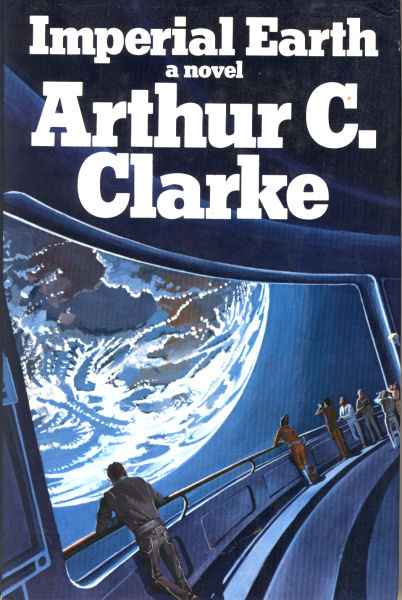
Imperial Earth is a science fiction novel by British writer Sir Arthur C. Clarke, published in 1975 by Gollancz Books. The plot follows the protagonist, Duncan Makenzie, on a trip to Earth from his home on Titan, in large part as a diplomatic visit to the U.S. for its quincentennial in 2276, but also to have a clone of himself produced. The book was published in time for the U.S. bicentennial in 1976.
- Silistra
series4 books1977
completed
similar bypolitical intriguescience fantasyother star systemsfar future
- Chanur
series7 books1982
part of Alliance-Union Universe
similar bypolitical intriguefar futureother star systems
The Chanur novels are a series of five science fiction novels, forming three separate stories, written by American author C. J. Cherryh and published by DAW Books between 1982 and 1992. The first novel in the series is The Pride of Chanur (1982), which was nominated for both the Hugo and Locus Awards in 1983. The Pride of Chanur, originally a stand-alone story, was followed by the Chanur's Venture trilogy, Chanur's Venture (1984), which was shortlisted for a Locus Award in 1985; The Kif Strike Back (1985) and Chanur's Homecoming (1986). These were followed by a later sequel, Chanur's Legacy (1992). The five novels were also published in two omnibus editions: the first three in The Chanur Saga in 2000 and the next two in Chanur's Endgame in 2007.
- Moties
series4 books1974
part of CoDominium
similar bypolitical intriguefar futureother star systems
Larry Niven and Jerry Pournelle's The Mote in God's Eye (1974) depicts humanity's first contact with an alien species, the Moties, set within the far-future interstellar setting of Pournelle's codominium future history. The Gripping Hand continues that first-contact crisis years later, and Outies, written by J. R. Pournelle, carries the story forward into a new generation. Together the three books trace an escalating encounter between human and Motie civilizations within the codominium universe.
- The Algebraist
Iain M. Banksstandalone novel2004
similar bypolitical intrigueother star systemsfar future
The Algebraist is a science fiction novel by Scottish writer Iain M. Banks, published in print in 2004. It was nominated for a Hugo Award for Best Novel in 2005.
- Julian Comstock: A Story of 22nd-Century America
Robert Charles Wilsonstandalone novel2009
similar bypolitical intriguereflectivefar future
Julian Comstock: A Story of 22nd-Century America is a dystopian speculative fiction novel written by Robert Charles Wilson, and an expansion of Wilson's 2006 novella Julian: A Christmas Story.
- The Fall of the Towers
series3 books1963
similar bypolitical intriguescience fantasyother star systemsfar future
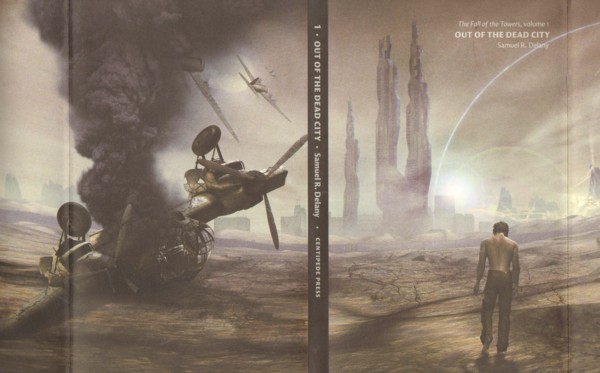
Samuel R. Delany's early trilogy - originally published as Captives of the Flame, The Towers of Toron, and City of a Thousand Suns, with Delany later revising the first volume as Out of the Dead City - is set on a post-nuclear-war Earth where the isolated city-state of Toromon fights a war its rulers can no longer clearly explain, while dissidents and outsiders start to see through the propaganda holding the city together. It's early, ambitious New Wave SF blending psychological and political themes with the interest in language and perception that would define Delany's later work. The trilogy was subsequently collected as the omnibus The Fall of the Towers.
- Wolfling
Gordon R. Dicksonstandalone novel1969
similar bypolitical intrigueother star systemsfar future
From the flaps of the Baen/SFBC edition: "Is Earth merely the lost colony of a superior race? - She was well over six feet tall, and beautiful in a sculpted, abstract way. She had skin the color of white onyx, and her eyes... her eyes were large and feline - a startling lemon yellow in color. She was the Princess Afuan, one of the High-born, and she had chosen the Earthman Kim Keil to return to the Throne World with her - for she had decided that his performance in the bull-ring might amuse the Emperor. She didn't know that Jim was a bull-fighter only by virtue of six months' intensive training, nor that the bull was programmed - his behavior following and impressively fierce but unswerving pattern. Jim was just another wolfling to Afuan - a lesser being from a backward colony world. Jim, however, was keenly aware that he was playing a role, one which might prove to be extremely dangerous. Up until 10 years earlier, when their first ship had reached Alpha Centauri, the people of Earth hadn't even known that the vast Empire of human-occupied worlds existed. The discovery had been a profound shock. Had we evolved independently? Or were we merely descendants of the Empire's first space pioneers - a lost colony found at last, perhaps with devastating consequences? That's what Jim Keil had to find out. Chosen from among numerous highly qualified candidates - an anthropologist trained, mentally and physically, beyond the limits of his profession - it was his mission to observe the Throne World and the High-born... to determine whether or not they posed a threat to Earth. One thing was apparent from the start. The High-born were superior beings - physically taller and stronger than other humans, endowed with faster reflexes, superior mental capacity... and extraordinary technological resources. Their contempt for the new wolfling in their midst was open, their intrigues complex. An enormous gulf separated the people of the Throne World from Earthlings. But that gulf was not so wide that Jim couldn't recognize an enemy when he met one. Clearly, if he remained merely a passive observer of the High-born, he'd never survive among them."
- Safehold
series11 books2006
similar bypolitical intrigueother star systemsfar future
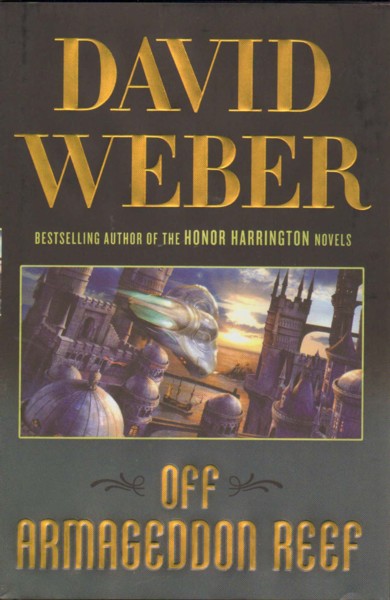
Safehold is a science fiction book series by David Weber, currently consisting of ten titles, the latest released in January 2019. The series is mostly set around the 31st century, on a distant world dubbed "Safehold" where a group of humans are in hiding from the Gbaba, an alien enemy responsible for the end of all other human civilization.
- Return to Earth
H. M. Hooverstandalone novel1980
similar bypolitical intriguereflectivefar future
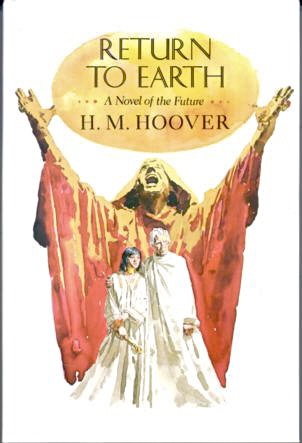
WorldCat: In a future world a diplomat returns to Earth to retire and finds himself involved in political intrigue and a disquieting friendship with a young girl.