More like Conquist
but
- H. G. Wells' War of the Worlds
universe65 books1898
Start hereThe War of the Worlds · Start here
similar byscience fiction+1 more
No one would have believed, in the closing years of the nineteenth century, that human affairs were being watched keenly and closely from the timeless worlds of space. And then the cylinders fell. H. G. Wells' War of the Worlds opens in the quiet of the Surrey commons, where a falling star proves to be the first Martian craft — and from the pit rise the towering tripods, the Heat-Ray, the choking Black Smoke and the creeping red weed, wielded by minds that regard mankind much as we regard the creatures we boil for supper. This is invasion rendered as natural disaster: cold, methodical, and vast beyond argument. Wells' 1898 novel is the seed; everything else grows from that Martian soil. The catalogue gathers direct sequels and continuations alongside a wide field of other hands. In War of the Worlds: Global Dispatches the invasion is retold across the whole planet through the eyes of Twain, Verne, Tolstoy, Lowell and Kipling; in the Manly Wade and Wade Wellman crossover, Sherlock Holmes, Watson and Professor Challenger take the field against the machines; and Scott Washburn's Great Martian War stretches the fighting into a decades-long alternate history of steam, artillery and grinding attrition. It is a loose shared world — no single decreed sequence, many voices answering one calamity. What sets this world apart is its refusal of heroics: the invaders fall not to generals but to the smallest things of Earth, humbling and indifferent. Begin, always, with Wells' original novel — it is short, and it is the ground every later book stands upon. From there follow your appetite: Global Dispatches for the panorama, the Holmes campaign for adventure, Washburn for the long war.
- Dune
series20 books1963
part of Dune Universe
similar byscience fiction+1 more
Frank Herbert's Dune Chronicles opens with 1965's Dune, set on the desert planet Arrakis where House Atreides takes control of the only source of the vital spice melange and young Paul Atreides is pulled into a struggle over its politics and religion. Herbert carried the story forward across five further novels — Dune Messiah, Children of Dune, God Emperor of Dune, Heretics of Dune, and Chapterhouse: Dune — following Paul's line over the following millennia, before Brian Herbert and Kevin J. Anderson later extended the saga. Many other editions of these six novels are omnibus and box-set repackagings rather than separate stories.
- Dune Universe
universe78 books1963
Start hereDune · Start here
similar byscience fiction+1 more
Arrakis. Dune. The desert planet, where empire runs on a single substance: the spice melange, which folds space, prolongs life, and unlocks prescience, and which exists nowhere else in the known universe. Frank Herbert's saga is a meditation dressed as an adventure — feudal houses and a secret sisterhood, engineered messiahs and the patient ecology of a world without water, all turning on the terrible gravity of who commands the spice. It reads like scripture and schemes like a war room, ten thousand years hence, among people who have outlawed the thinking machine and made instruments of themselves instead. At its heart stand Herbert's original six — Dune, Dune Messiah, Children of Dune, God Emperor of Dune, Heretics of Dune, Chapterhouse: Dune — a single deepening arc across millennia, arguing the whole way between prophecy and free will. Around that spine his son Brian Herbert and Kevin J. Anderson have raised a vast prequel architecture: Prelude to Dune, tracing the great houses a generation before Paul; Legends of Dune, reaching back to the crusade that broke the machines; the Schools of Dune cycle on the founding of Bene Gesserit, Mentat, and Navigator; the Caladan Trilogy and Heroes of Dune filling years the originals left in shadow. Many hands, dozens of volumes, one desert. What sets Dune apart is its refusal of the simple: religion is manufactured, heroes are hazards, and the sand itself — worm, water, ecology — acts as a political power. Begin where the universe did, with Frank Herbert's Dune (1965), and read the original six in order; you need nothing else to feel the full weight. The prequels are a country to explore afterward, taken by era. Beginnings are delicate times.
- The Change / The Event
series41 books1998
similar byscience fictionadventurous+2 more
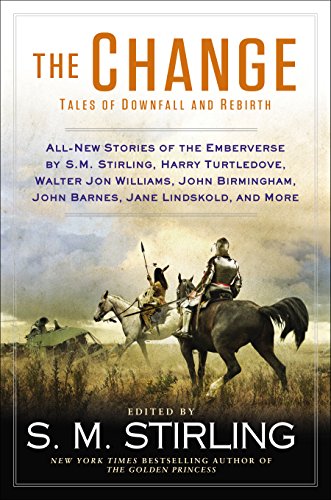
The Change: Tales of Downfall and Rebirth is a shared-world anthology of stories set in the years right after a mysterious global event instantly disables gunpowder, electricity, and combustion engines, the founding premise of S. M. Stirling's Emberverse. Sixteen different authors, coordinated by Stirling, each contribute stories set in various corners of the suddenly de-industrialized world as survivors scramble to rebuild. It's a companion volume to the Change/Emberverse novels rather than a novel itself.
- Falkenberg's Legion
series11 books1971
part of CoDominium
similar byscience fiction+2 more
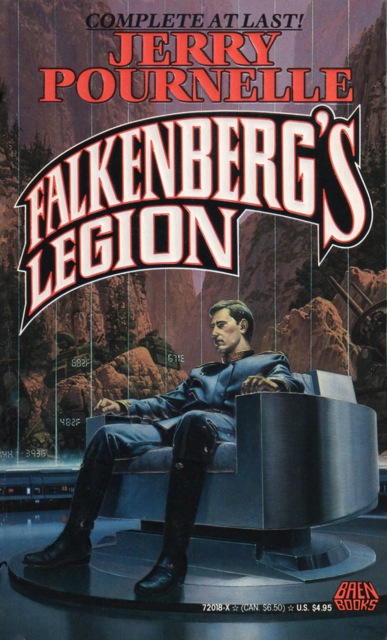
Falkenberg's Legion collects Jerry Pournelle's military science-fiction novels — later joined by co-author S. M. Stirling — following mercenary commander Falkenberg across Pournelle's CoDominium future history. The books, including Falkenberg's Legion, Prince of Mercenaries, Go Tell the Spartans, and Prince of Sparta, were themselves later combined into the omnibus The Prince.
- Terro-Human Future History
universe48 books1952
Start hereFuzzy Sequence · Start here
similar byscience fiction+1 more
History does not repeat, Piper's chroniclers are fond of saying — it rhymes, and it rhymes in iron. Reckon the years from the first atomic pile, 1942, Year One of the Atomic Era, and follow the ledger forward some six thousand years: out of a nuclear war that nearly ended everything, up through the Terran Federation and its reach into the stars, down again through collapse and a long neobarbaric dark, and back up into the enlightened empires that rise from the ruins. It is one continuous future history — not a plot but a chronicle, worlds and centuries sharing a single unbroken timeline. H. Beam Piper assembled it in pieces through the 1950s and 60s, novels and novellas bound by chronology rather than by recurring heroes. The anchors are Little Fuzzy, a courtroom argument over whether a small golden native of Zarathustra is a person; Space Viking, raid and revenge amid the wreckage of the interregnum; and the Federation-era Four-Day Planet, The Cosmic Computer, and Uller Uprising. The eras sort cleanly — Federation, the System States War, the Space Vikings of the long dark, the Empire. After Piper's death in 1964 other hands took up the ledger: John F. Carr, who arranged the short fiction into the chronological Federation and Empire collections and carried on the Tanith and Space Viking line, plus Wolfgang Diehr's Fuzzy sequels and Dietmar Arthur Wehr's additions. The register is sober and engineer-eyed — competent men solving hard problems, empires ruled by benign despots, the cool conviction that civilizations rise and fall to the same recurring script. It ranges from the sunlit warmth of the Fuzzy books to the cold steel of a Viking raid. Newcomers start with Little Fuzzy, the warmest and most self-contained, or with Space Viking.
- Culture
series15 books1987
completed
part of The Culture
similar byscience fiction+2 more
The Culture series is a science fiction series written by Scottish author Iain M. Banks and released from 1987 until 2012. The stories centre on The Culture, a utopian, post-scarcity space society of humanoid aliens and advanced superintelligent artificial intelligences living in artificial habitats spread across the Milky Way galaxy. The main themes of the series are the dilemmas that an idealistic, more-advanced civilization faces in dealing with smaller, less-advanced civilizations that do not share its ideals, and whose behaviour it sometimes finds barbaric. In some of the stories, action takes place mainly in non-Culture environments, and the leading characters are often on the fringes of the Culture, sometimes acting as agents of the Culture in its plans to civilize the galaxy. Each novel is a self-contained story with new characters, although reference is occasionally made to the events of previous novels.
- Fifth Imperium
series3 books1991
similar byscience fictiontensewaradventurous
David Weber's Fifth Imperium series opens with the discovery that Earth's Moon is in fact a disguised alien starship, the Dahak, that has orbited undetected for tens of thousands of years - a relic of the fallen Fourth Imperium, a multi-star civilization destroyed while defending against the genocidal Achuultani. Mutineers' Moon follows humanity's first contact with Dahak and the mutineers still aboard it; The Armageddon Inheritance and Heirs of Empire escalate from that discovery into interstellar war and dynastic politics as humanity inherits the old empire's legacy and its enemies. The three novels were later collected as the omnibus Empire from the Ashes.
- Moties
series4 books1974
part of CoDominium
similar byscience fiction+3 more
Larry Niven and Jerry Pournelle's The Mote in God's Eye (1974) depicts humanity's first contact with an alien species, the Moties, set within the far-future interstellar setting of Pournelle's codominium future history. The Gripping Hand continues that first-contact crisis years later, and Outies, written by J. R. Pournelle, carries the story forward into a new generation. Together the three books trace an escalating encounter between human and Motie civilizations within the codominium universe.
- Eden (Harry Harrison)
series5 books1984
completed
similar byscience fictionwar+3 more
Harry Harrison's Eden trilogy imagines an Earth where the dinosaurs never died out, evolving instead into the Yilane, a technologically advanced reptilian civilization that shares the planet uneasily with early humans. West of Eden (1984) introduces the clash between the two species; Winter in Eden and Return to Eden carry it forward as a shifting climate forces both sides to adapt or die. It's an alternate-evolution saga more than a conventional dinosaur adventure.
- Teixcalaan
series2 books2019
similar byscience fictiontense+1 more
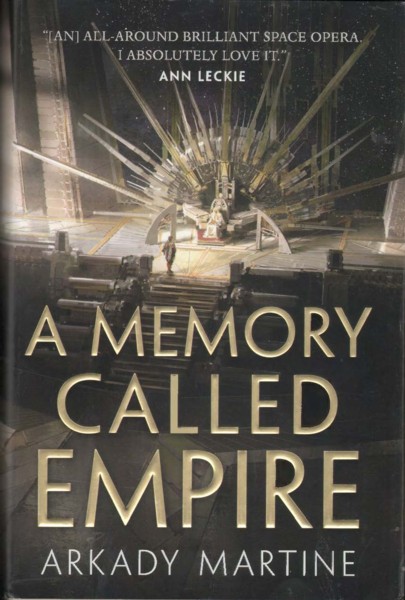
Arkady Martine's space opera duology follows Mahit Dzmare, ambassador from the small, independent Lsel Station, as she arrives in the vast Teixcalaanli Empire to investigate her predecessor's death and finds herself caught up in the empire's own succession crisis. A Memory Called Empire and A Desolation Called Peace pair court intrigue with Mahit's conflicted, outsider fascination with an empire she can't help admiring.
- Alliance-Union Universe
universe173 books1976
Start hereCompany Wars · The central sequence
similar byscience fiction+2 more
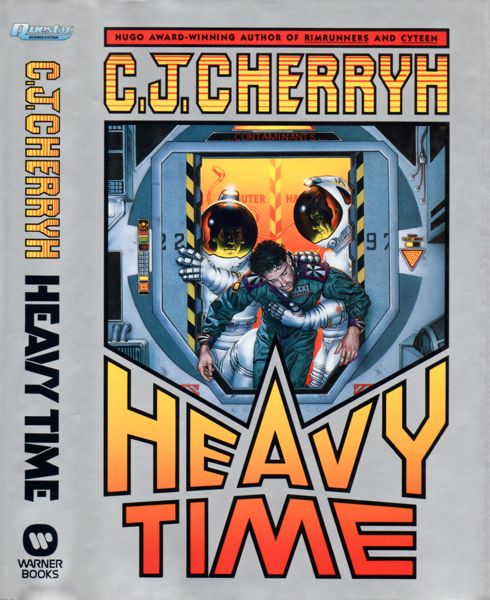
The dark between the stars belongs to no one, and everyone who lives out here knows it: the merchanter Families hauling cargo between stations that cannot feed themselves, the Earth Company clutching at colonies it can no longer supply, the Union breeding its cloned azi to settle worlds faster than birth allows. C. J. Cherryh's Alliance-Union is a future history of humankind's spread across the third and fourth millennia, told from inside the pressure — no clean empires, only stations, ships, treaties, and the people caught in the machinery of who holds the jump-points. The sequence runs from the first laborious pre-FTL stations through the Company Wars, the independence struggle that breaks over Pell in Downbelow Station (Hugo, 1981), to the genetics and cold politics of Union's homeworld in Cyteen (Hugo, 1988) and its sequel Regenesis. Around that spine cluster the merchanter novels of trader Families, the Faded Sun trilogy of human envoys among the martial alien Mri, and the Chanur books, narrated from the hierarchical, whiskered viewpoint of the hani. On the isolated world of Merovin, the Merovingen Nights anthologies open the setting to other hands — Mercedes Lackey, Janet and Chris Morris, Nancy Asire — a shared world braided into the whole. What sets it apart is intimacy at scale. Cherryh drops you without a map into a single skull and lets you assemble the politics from what that person fears and bargains for; the aliens are genuinely alien, loyalty is always provisional, and the real antagonist is usually logistics. Most books stand alone, in her words, "like real history." The surest way in is Downbelow Station — the war seen from one besieged station — then Cyteen, for the mind that shaped the other side.
- Old Man's War
series16 books2005
similar byscience fictionwaradventurous+1 more
The Old Man's War series is a series of science fiction novels by John Scalzi. The first book in the series, Old Man's War, was first published in 2005 by Tor Books, and was nominated for the Hugo Award for Best Novel in 2006. In 2026 it was a finalist for the Hugo Award for Best Series.
- Azean Empire
series2 books1987
similar byscience fictiontensewar
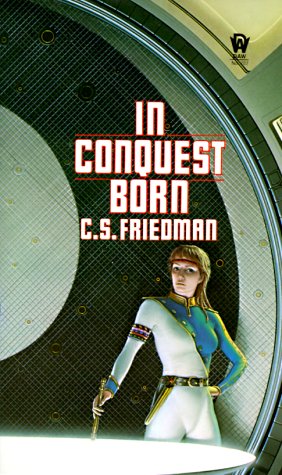
C. S. Friedman's Azean Empire novels are set in a distant-future conflict between two competing human societies, the Azeans and the Braxins, contesting interstellar dominance. In Conquest Born, her debut, works as space opera and military SF with an anthropological bent, using the two societies' opposed cultures and reproductive philosophies as the real engine of the conflict rather than just the battles themselves. The Wilding continues the same interstellar rivalry.
- Black Star Rising
Frederik Pohlstandalone novel1985
similar byscience fictiontensecolonialism+1 more
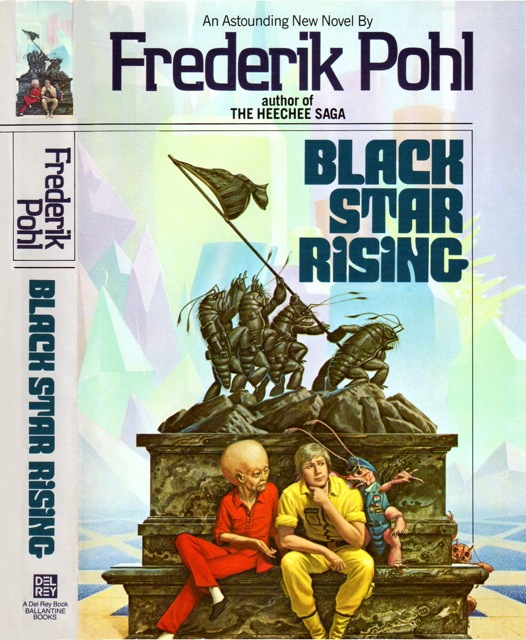
Black Star Rising, published in 1986, is a dystopian science fiction novel by American author Frederik Pohl. It is about a post-nuclear war future in which a conquered United States becomes a Chinese farming colony. The main character is an American who the Chinese send to meet a race of warlike aliens who come to Earth.
- Company Wars
series7 books1981
part of Alliance-Union Universe
similar byscience fictiontense
Company Wars gathers the novels C. J. Cherryh set during the breakaway conflict between Earth's colonial Company and the newly independent Union, within her wider Alliance-Union future history. Anchored by the Hugo Award-winning Downbelow Station, the books follow different ships, stations, and crews caught on either side, from merchanter traders to military spacers, rather than a single continuing cast. Read in any order, they build up a picture of the political and economic pressure that reshapes Cherryh's larger Alliance-Union universe.