More like Distant Planes
anchored on:fantasysecondary worldwizardsadventurousshort story cycle
but
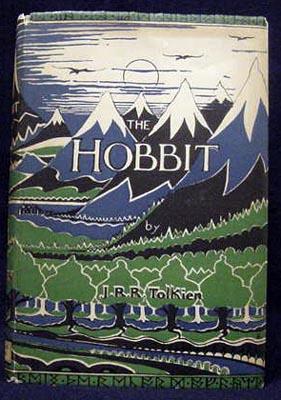
- The Hobbit
series2 books1937
completed
part of Tolkien's legendarium
similar byfantasyadventuroussecondary world+1 more
The Hobbit (1937) is J. R. R. Tolkien's children's fantasy novel following the reluctant burglar Bilbo Baggins, who joins a company of dwarves and the wizard Gandalf on a journey to reclaim treasure guarded by the dragon Smaug. It stands as a complete adventure on its own, but shares its setting with the rest of Tolkien's legendarium and leads into the events of The Lord of the Rings.
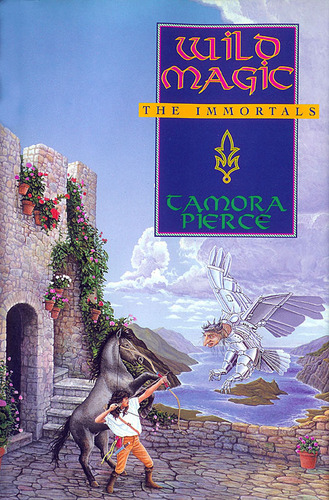
- The Immortals
series6 books1992
part of Tortall
similar byfantasyadventuroussecondary worldwizards+1 more
Tamora Pierce's Immortals quartet follows Daine, a young woman whose 'wild magic' lets her communicate with and shapeshift among animals, as she's drawn into the kingdom of Tortall's defense against immortal creatures -- griffins, dragons and darker things -- released back into the world after centuries sealed away. Beginning with Wild Magic, the four books pair Daine's personal coming-of-age with an escalating magical threat, and connect to Pierce's earlier Song of the Lioness quartet through several shared characters.
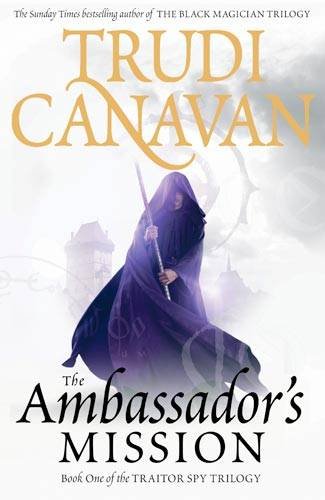
- The Traitor Spy Trilogy
series3 books2010
part of Kyralia series
similar byfantasyadventuroussecondary worldwizardspolitical intrigue
Trudi Canavan is an Australian writer of fantasy novels, best known for her best-selling fantasy trilogies The Black Magician and Age of the Five. While establishing her writing career she worked as a graphic designer. She completed her third trilogy, The Traitor Spy trilogy, in August 2012 with The Traitor Queen. Subsequently, Canavan has written a series called Millennium's Rule, with a completely new setting consisting of multiple worlds which characters can cross between. Though originally planned as a trilogy, a fourth and final book in the Millennium's Rule series was published.
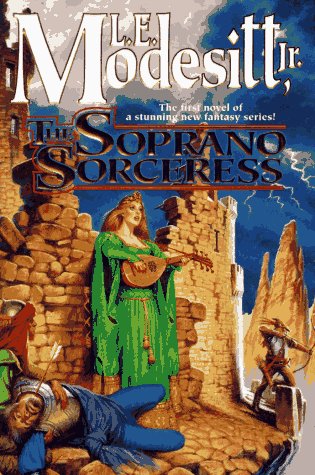
- Spellsong Cycle
series6 books1997
similar byadventurousfantasysecondary worldwizards+2 more
The Spellsong Cycle is a fantasy series written by L. E. Modesitt Jr. Set in the fictional world of Erde, it is notable for its system of magic, based on music and song.
- Narnia
series26 books1950
part of Narnia Universe
similar byadventurousfantasysecondary world+1 more
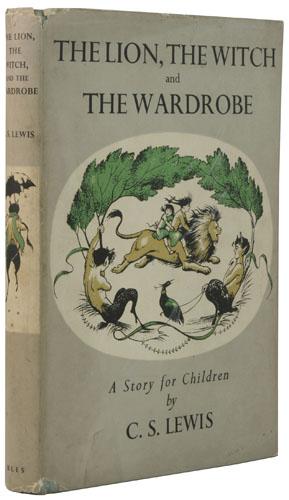
The Chronicles of Narnia is a series of seven portal fantasy novels by British author C. S. Lewis. Illustrated by Pauline Baynes and originally published between 1950 and 1956, the series is set in the fictional realm of Narnia, a fantasy world of magic, mythical beasts, and talking animals. It narrates the adventures of various children who play central roles in the unfolding history of the Narnian world. Except in The Horse and His Boy, the protagonists are all children from the real world who are magically transported to Narnia, where they are sometimes called upon by the lion Aslan to protect Narnia from evil. The books span the entire history of Narnia, from its creation in The Magician's Nephew to its eventual destruction in The Last Battle.
- Redwall
series22 books1986
completed
part of Redwall Universe
similar byfantasyadventuroussecondary world+1 more
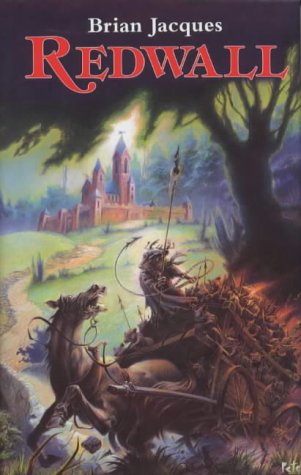
Redwall is Brian Jacques's long-running series of fantasy novels for young readers, set within the redwall-universe of Redwall Abbey and its community of anthropomorphic animals. It opened in 1986 with the mouse Matthias searching for the lost sword of the legendary Martin the Warrior to defend the abbey from the invading rat Cluny the Scourge, and grew across 22 largely stand-alone novels published through 2011, each set in a different generation of the abbey's history and following its mice, otters, badgers, and vermin adversaries.
- The Saga of Recluce
series48 books1991
similar byfantasysecondary worldwizardspolitical intrigue+2 more
The Saga of Recluce is a series of fantasy novels written by L. E. Modesitt Jr. The initial novel in the series, The Magic of Recluce, was published in 1991. The series is still in publication with the latest novel published in June 2026. In 2015 Modesitt stated that the (then) 20 novels in the Recluce series had sold nearly three million copies.
- Riftwar Saga
series7 books1982
part of The Riftwar Universe
similar byadventurousfantasysecondary worldwar+1 more
The Riftwar Saga is Raymond E. Feist's debut fantasy trilogy, opening with Magician, in which an orphaned apprentice named Pug is swept up when otherworldly invaders emerge through a dimensional rift into the frontier kingdom of Midkemia. Silverthorn and A Darkness at Sethanon carry the resulting war to its close, and the trilogy became the founding entry of Feist's much larger Riftwar Cycle.
- Sparhawk
universe6 books1989
Start hereElenium · Start here
similar byadventurousfantasysecondary world+2 more
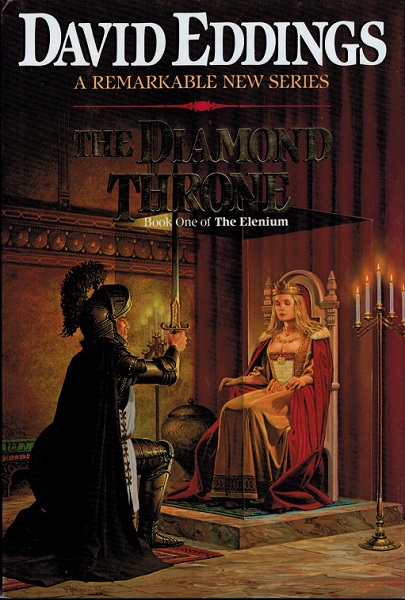
Sir Sparhawk is not a young man, and he has little patience for the pageantry his order pretends to. A Pandion Knight of the militant Elene Church, he rides home from a long exile to find his kingdom rotten with intrigue and his young queen, Ehlana, poisoned — kept alive only inside a shell of living crystal. To wake her he must find Bhelliom, a jewel with the power to remake the world or unmake it. So begins a long ride across the continent of Eosia. This is warm, character-first epic fantasy from David Eddings, told across two trilogies. The Elenium — The Diamond Throne, The Ruby Knight, The Sapphire Rose — pits Sparhawk against a corrupt church and a hungry elder god. The Tamuli — Domes of Fire, The Shining Ones, The Hidden City — carries him east into the vast Tamul Empire, where older enemies stir. Around him gathers a quarrelsome company: the Styric sorceress Sephrenia, the thief-boy Talen, the plain-spoken squire Kurik, and a small, imperious goddess who plays a set of pipes and always, somehow, gets her way. The pleasure here is the talk — grizzled knights trading dry insults between miracles and murders, a hero who solves as many problems with patience as with a sword. It never reaches for grimness or grand obscurity; it wants your good company for a long journey. Newcomers begin with The Diamond Throne and read the six in order: the Elenium stands whole on its own before the Tamuli widens the map.
- The Seven Towers
Patricia C. Wredestandalone novel1984
similar byfantasyadventuroussecondary worldwizardspolitical intriguewar
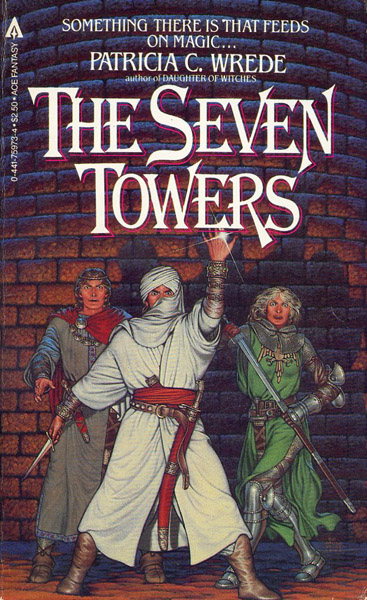
They are seven players in a game of deadly magic- Eltiron, Prince of Sevarin; Crystalorn, Princess of Barinash; Ranlyn, the desert rider; Jermain, the outlaw; Vandaris, the soldier; Carachel, the Wizard-King; and Amberglas, the sorceress. Each of them has a secret, and each fights his or her part in the thrilling battle that has put seven kingdoms on the very edge of destruction. Filled with wit, swordplay, humor, and intrigue, this early novel is one of Patricia C. Wrede's best.
- The Riftwar Universe
universe44 books1982
Start hereRiftwar Saga · Start here
similar byfantasysecondary world+3 more
On the world of Midkemia a tear opens in the air itself, a rift hung between stars, and through it march the armies of an empire from another world entirely. So begins the chronicle Raymond E. Feist has kept for three decades: the tale of Pug, a castle kitchen boy apprenticed to a magician on the very day the invasion lands, and of Tomas, his friend, who inherits the armor and the ancient fury of a dead dragon-lord. Around these two the Riftwar Cycle turns, widening book by book from one besieged frontier keep into the whole history of a world of kingdoms, guilds, thieves' dens and mage-towers. The cycle runs to roughly thirty novels, gathered into arcs a newcomer can enter and finish on their own. The founding Riftwar Saga (Magician, Silverthorn, A Darkness at Sethanon) sets the board; the Serpentwar Saga, Krondor's Sons and the Conclave of Shadows carry the story down the generations; the Darkwar, Demonwar and Chaoswar sagas bring it toward its close. Crossing the rift to the rival world of Kelewan, Feist and Janny Wurts wrote the Empire trilogy, opening with Daughter of the Empire, a court intrigue told wholly from the invaders' side and for many the finest thing here. Shorter Legends of the Riftwar and the game-born Riftwar Legacy fill the corners; later still, Feist opens an altogether new world in the Firemane books. Feist writes fantasy in its most companionable key: apprentices who grow into archmages, tavern boys who become spies and dukes, a world you return to the way you return to an old inn. The mood is adventure before dread, friendship and rank and hard-won craft, wars that cost something, all of it rendered plainly and at a gallop. Begin where it began, with Magician, then follow the arcs in the order they were written, and the rift will carry you the rest of the way.
- Fortress (C. J. Cherryh)
series5 books1995
similar byadventurousfantasysecondary worldwizardspolitical intrigue+1 more
Fortress is a series of fantasy novels by American writer C. J. Cherryh, published by HarperCollins. They are set in a medieval fantasy world with a 15th-century feel and feature magic, sorcery, medieval warfare, politics and other elements common to the high fantasy subgenre. The first book in the series, Fortress in the Eye of Time, was published in 1995 and followed by Fortress of Eagles in 1998, Fortress of Owls in 1999, Fortress of Dragons in 2000 and Fortress of Ice in 2006. The books are all sub-titled "A Galasien novel".
- Circle of Magic / The Wizard Apprentice
series8 books1990
similar byfantasyadventurouswizardssecondary world
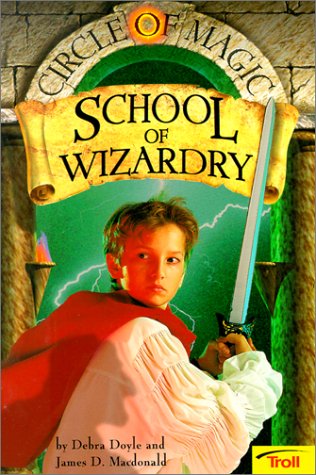
This eight-book series by Debra Doyle and James D. Macdonald follows a young apprentice training in the practice of wizardry alongside knights and nobles in an invented medieval world, moving from a fixed school setting into wider adventures as the books progress. It is a lighter, adventure-driven take on magical apprenticeship aimed at younger readers, distinct from other series sharing the same "Circle of Magic" name. The later volumes carry the apprentice further from the classroom into court intrigue and open conflict.
- Earthsea Cycle
series18 books1964
completed
part of Earthsea
similar byfantasysecondary worldwizards
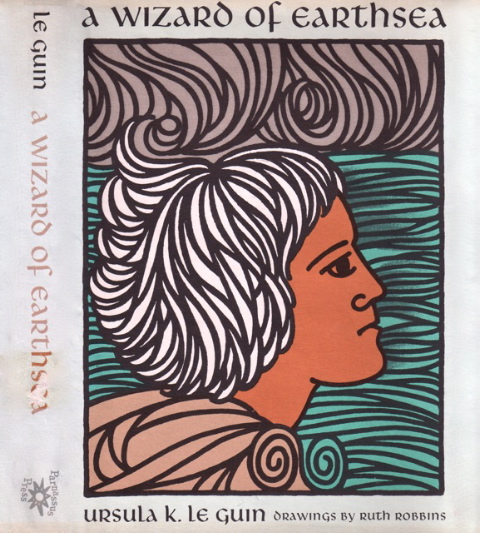
The Earthsea Cycle, also known as Earthsea, is a series of high fantasy books written by American author Ursula K. Le Guin. Beginning with A Wizard of Earthsea (1968), The Tombs of Atuan (1970), and The Farthest Shore (1972), the series was continued in Tehanu (1990), and Tales from Earthsea and The Other Wind. In 2018, all the novels and short stories were published in a single volume, The Books of Earthsea: The Complete Illustrated Edition, with artwork by Charles Vess.
- The Fire's Stone
Tanya Huffstandalone novel1990
similar byfantasyadventuroussecondary worldwizards+1 more
From the back cover of the DAW Books first edition: Thief, Swordsman, and Wizardess... Aaron - Clan Heir, he had fled his people when his beloved was slain by his own father's command, abandoning his training, duty, and beliefs to become a thief. A master of his trade, he now dared the odds in Ischia, city of the volcano, where the price of being caught was death. Darvish - prince of Ischia, third son of a king who had no intention of giving up his throne. The prince was a drunkard, a lover, and a wastrel, yet was gifted with sword skills and with the ability to charm all around him. But not even his charm could free him from the political marriage now being planned. Chandra - born a princess, she had chosen to become a Wizard of the Nine, that rarest of beings, able to master all the forms that sorcery could take. Now, promised as Darvish's bride, she undertook a desperate journey to Ischia to convince him they must not wed. Aaron, Darvish, Chandra - three strangers whose fates were about to become intertwined. For someone had stolen The Stone, the magical talisman which stood between Ischia and the volcano's wrath. And unless the three could learn to work together on a quest to the The Stone, Ischia would drown in a sea of lava...
- The Grisha
series9 books2012
part of Grishaverse
similar byadventurousfantasysecondary world+2 more
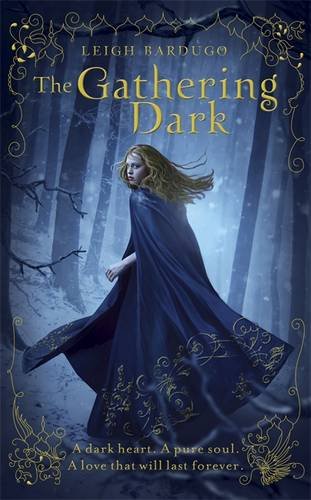
Leigh Bardugo is an American fantasy author. She is best known for her young adult Grishaverse novels, which include the Shadow and Bone trilogy and the Six of Crows and King of Scars duologies. She also received acclaim for her paranormal fantasy adult debut, Ninth House. The Shadow and Bone and Six of Crows series have been adapted into Shadow and Bone by Netflix, and Ninth House will be adapted by Amazon Studios; Bardugo is an executive producer on both works.
- The Lord of the Rings
series13 books1954
part of Tolkien's legendarium
similar bysecondary world+4 more
The Lord of the Rings is an epic high fantasy novel written by the English author and scholar J. R. R. Tolkien. Set in Middle-earth, the story began as a sequel to Tolkien's 1937 children's book The Hobbit but eventually developed into a much larger work. Written in stages between 1937 and 1949, The Lord of the Rings is one of the best-selling books ever written, with over 150 million copies sold.
- Howl's Castle
series3 books1986
completed
similar byfantasyadventuroussecondary world+1 more
Howl's Moving Castle (1986) follows Sophie Hatter, cursed by the Witch of the Waste into an old woman's body, who takes refuge in the wandering castle of the wizard Howl and strikes an uneasy bargain with his fire demon Calcifer while trying to break the spell. Diana Wynne Jones returned to the same magical kingdom in Castle in the Air (1990), following a new lead character, Abdullah, with Sophie and Howl appearing in supporting roles, and again in House of Many Ways (2008).
- Halfblood Chronicles
series3 books1991
similar byadventurousfantasysecondary worldwizards
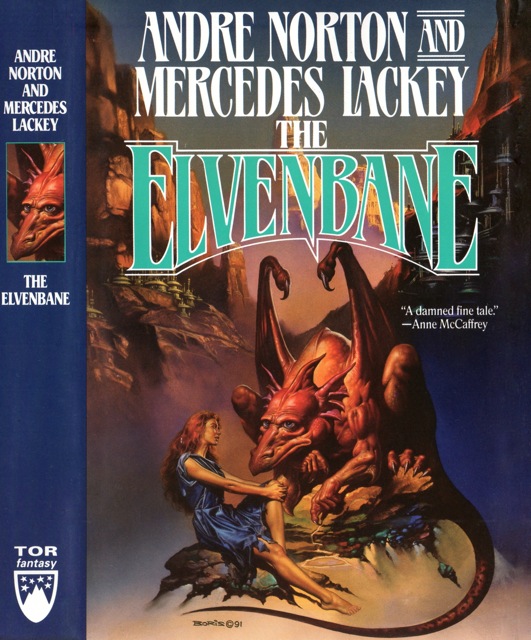
The Halfblood Chronicles is a series of fantasy books originally written by Andre Norton and Mercedes Lackey. The series is set in a mystical world of elves, wizards and dragons. The series was originally released by Tor Books, and comprised three books: Elvenbane (1991), Elvenblood (1995), Elvenborn (2002). Elvenbred, the fourth book in the series, remained unfinished due to the death of Andre Norton.
- Spellsinger
series9 books1983
similar byfantasyadventuroussecondary world+1 more
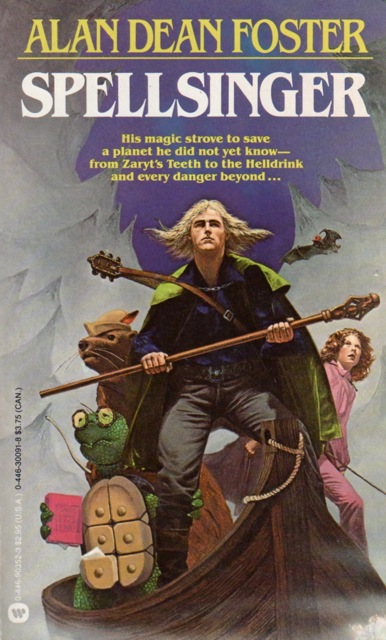
Alan Dean Foster's Spellsinger series follows Jon-Tom, a UCLA law student pulled into a fantasy world by the wizard Clothahump, where he discovers he can cast spells by singing along with his guitar. That world is populated almost entirely by anthropomorphic animals -- otters, rabbits, turtles -- with humans a rare minority, and across eight books published between 1983 and 2004, Jon-Tom and his companions repeatedly clash with the insectoid Plated Folk raiding the western territories.
- A Wizard in Rhyme
series8 books1986
completed
similar byfantasyadventurouswizardssecondary world+1 more
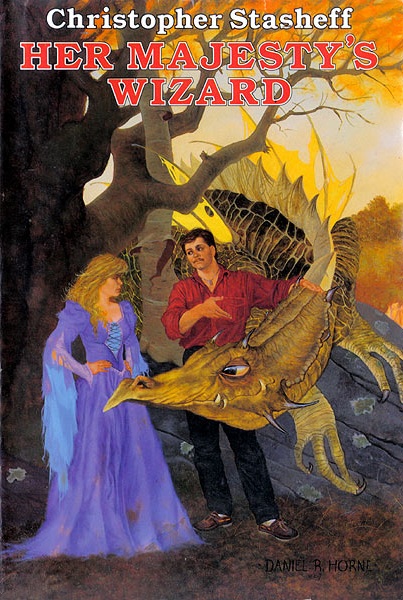
A Wizard in Rhyme is a series of fantasy novels by American writer Christopher Stasheff. The series follows the character of Matthew Mantrell, an English literature Ph.D. student, who is transported to a magical world where poetry is used to cast spells. There his knowledge of poetry, gained through his literature studies, establishes him as a powerful wizard and positions him as "lord wizard of the realm". The series consists of eight novels, and is said to have hints of L. Sprague de Camp and Fletcher Pratt.